Posts Tagged ‘uncertainty’
“The unpredictable and the predetermined unfold together to make everything the way it is.”*…
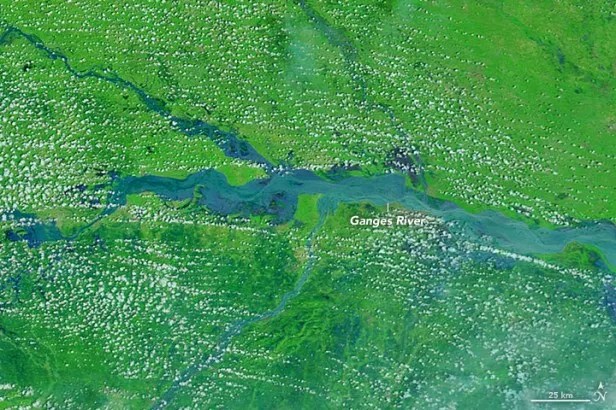
Thinking– worrying– about the future occupies more and more of our mindshare. How do we ready ourselves for the impacts of the playing out of the myriad uncertainties we face? Your correspondent’s approach-of-choice has been scenario planning (see, e.g., here and here), a method of thinking through and making sense of those unknowns. But as we do that, we have to think against the backdrop of “pre-determined elements”– forces that are going to accrue no matter how the uncertainties resolve, no matter which scenario unfolds.
Old friend and colleague Art Kleiner has dropped a thoughtful– and provocative– reminder of just how important understanding pre-determined elements is…
Pierre Wack, the scenario pioneer who built Royal Dutch Shell’s celebrated foresight practice, sometimes explained his methods by talking about the Ganges river in northern India. If there are heavy monsoon rains over the Himalayan headwaters, you can tell with certainty that there will be a flood five days later at Allahabad, which is 650 miles downstream. Five days after that, he said, the floods would reach Benares.
“Now the people down here in Benares don’t know that this flood is on its way,” he said, “but I do. Because I’ve seen it! This is not fortune telling. This is not crystal-ball gazing. This is merely describing future implications of something that has already happened.”…
… Most of us, peering ahead, fix on anxieties and uncertainties that may or may not happen: elections, technologies, and potential crises. We imagine what might happen, and get into the habit of thinking that our fate depends on this contingency. For instance, we pin our hopes on a particular candidate getting into office.
An alternative [your correspondent would suggest: “a critical complement”] is to look at the predetermined elements in our world as the playing field. When we recognize the true certainties, we can leap ahead to framing our choices and modulating our expectations. For example: We know it will take a long time to mitigate the effects of the climate crisis, so we invest accordingly in renewable energy. We also know our efforts to manage artificial intelligence need to happen practically overnight, so we work to rapidly build the necessary skills.
There are two kinds of predetermined elements. The first-order trends are basic and happening now. They follow directly from events that already took place — children already born, tons of carbon already in the air, debts already incurred. The second-order ones arise from the combination of first-order forces. Their effects are less predictable, but we can’t avoid the pressures they will place on us.
Taken together, they tell us the world of the 2030s will be markedly different from today and from most predictions being made today. For system leaders, a good list of predetermined elements gives you a start on developing scenarios that help you move to a creative orientation: creating the future you want.
I do a lot of work with scenarios, particularly at New York University’s Interactive Telecommunications Program, where I teach a graduate-level course on the future of media and technology. Here is my list of predetermined elements facing us today…
[Art shares a meaty– and bracing– list of both first- and second-order “pre-determineds.” He concludes…]
… The persistence of the ordinary. Against all the above sits the most underrated predetermined element of all: most people, most days, will live recognizable lives. The school, the clinic, the shop, and the family table endure because institutions change far more slowly than the forces acting on them. This is not complacency; it is the buffer that keeps the surprises survivable — and the reason that system leadership is generally local.
It’s as if we’re all driving down a treacherous highway. We notice the accidents and cars being towed off the shoulder, and the road rage as cars cut each other off. We don’t pay attention to all the drivers who stay in lane, leaving enough space between themselves and the car in front of them. Many of those drivers have experienced past accidents; they don’t want any more. If there were more of them, the road wouldn’t be nearly so scary. Uncertain: the prevailing attitudes and what it takes to bring people to a more system-oriented perspective...
[He then turns to the implications of his insight…]
… The discipline of scenario thinking is a discipline of attention. It tells us where to pay attention. Which predetermined elements affect us most? Which opportunities should we focus on? And which changes do we care about most urgently?
It is humbling and steadying at once: humbling because so much of the future is already decided, steadying because so much of it depends on what we do together.
The predetermined elements provide a working map. The first-order forces — the aging, the warming, the sun, the grid, the genome, the debt — are the ground on which the next decade must be built. The second-order combinations — cities, pressures, robots, possible relief — are where our work takes place…
Art’s conclusion is worth underling: first-order predetermineds are the terrain on which we will have to build our future; second order-pre-determineds are (a large part of) the agenda of issues we’ll have to address as we do; uncertainties are the unpredictable “weather” in which we’ll have to do that– guided throughout by our values and the hope that powers them. As Dennis Gabor said: “The future cannot be predicted, but futures can be invented.”
We already know much of what’s coming in the 2030s: “The Futures We Can’t Avoid.” Eminently worth reading in full.
* Tom Stoppard
###
As we buckle up, we might recall that it was on this date in 1927 that “The Cyclone,” a wooden roller coaster in Luna Park at Coney Island, opened to the public. It wasn’t the first roller coaster at Coney Island; but with total track length of 2,640 feet, a maximum height of 75 feet, and cars that reached 60 miles per hour on a ride, The Cyclone became a signature attraction. Operating still, it was declared a New York City designated landmark in 1988 and was placed on the National Register of Historic Places in 1991.

“I think it’s much more interesting to live not knowing than to have answers which might be wrong… when we know that we actually do live in uncertainty, then we ought to admit it; it is of great value to realize that we do not know the answers to different questions.”*…

The immense complexity of the climate makes it impossible to model accurately. Instead, David Stainforth argues, we must use uncertainty to our advantage…
Today’s complex climate models aren’t equivalent to reality. In fact, computer models of Earth are very different to reality – particularly on regional, national and local scales. They don’t represent many aspects of the physical processes that we know are important for climate change, which means we can’t rely on them to provide detailed local predictions. This is a concern because human-induced climate change is all about our understanding of the future. This understanding empowers us. It enables us to make informed decisions by telling us about the consequences of our actions. It helps us consider what the future will be like if we act strongly to reduce greenhouse gas emissions, if we act only half-heartedly, or if we take no action at all. Such information enables us to assess the level of investment that we believe is worthwhile as individuals, communities and nations. It enables us to balance action on climate change against other demands on our finances such as health, education, security and culture.
For many of us, these issues are approached through the lens of personal experience and personal cares: we want to know what changes to expect where we live, in the places we know, and in the regions where we have our roots. We want local climate predictions – predictions conditioned on the choices that our societies make.
So, where do we get them? Well, nowadays most of these predictions originate from complicated computer models of the climate system – so-called Earth System Models (ESMs). These models are ubiquitous in climate change science. And for good reason. The increasing greenhouse gases in the atmosphere are driving the climate system into a never-before-seen state. That means the past cannot be a good guide to the future, and predictions based simply on historic observations can’t be reliable: the information isn’t in the observational data, so no amount of processing can extract it. Climate prediction is therefore about our understanding of the physical processes of climate, not about data-processing. And since there are so many physical processes involved – everything from the movement of heat and moisture around the atmosphere to the interaction of oceans with ice-sheets – this naturally leads to the use of computer models.
But there’s a problem: models aren’t equivalent to reality.
So, what can we do? One option is to make the models better. Make them more detailed and more complicated. That, though, raises an important question: when is a model sufficiently realistic to predict something as complex as climate change? When will the models be good enough? We don’t have an answer to this question. Indeed, scientists have hardly begun to study this problem, and some argue that these models might never be sufficiently accurate to make multi-decadal, local climate predictions.
Nevertheless, changing the way we use ESMs could provide a different and better way to generate the local climate information we seek. Doing so involves embracing uncertainty as a key part of our knowledge about climate change. It involves stepping back and accepting that what we want is not precise predictions but robust predictions, even if robustness involves accepting large uncertainties in what we can know about the future…
[Stainforth explains the current state of modeling, efforts to make them better, and the problems those efforts encounter…]
… focusing on high-resolution modelling is dangerous not only because we have no answer to the question of when a model is sufficiently realistic. Investing in this approach also means we don’t have the capacity to explore the uncertainties, which inevitably encourages overconfidence in the predictions that models make. This is a particular concern because Earth System Models are increasingly being used to guide decisions and investments across our societies. Overconfidence in model-based predictions therefore risks encouraging bad decisions: decisions that are optimised for the futures in our models rather than what we understand about the range of possible futures for reality.
By contrast, perturbed physics ensembles and storyline approaches focus on exploring and describing our uncertainties. Placing uncertainty front and centre is important. When we make an investment or a gamble, we don’t just base it on what we think is the most likely result. We consider the range of outcomes that we think are possible – ideally these are characterised by probabilities, although this isn’t always achievable. It’s the same with climate change. We should not only make plans based solely on our best estimate of what might happen. We should also consider the range of plausible outcomes we foresee. Our knowledge of uncertainty is also part of what we know about climate change. We should embrace this knowledge, expand it and use it.
If we understand the uncertainties well, we can bring our values to bear on the risks we are willing to take. Uncertainty therefore needs to be at the core of adaptation planning while also being the lens through which we judge the value of climate policy and the energy transition. In my view, climate researchers and modellers wanting to support society should focus on understanding, characterising and quantifying uncertainty, and avoid the trap of seeking climate models that make reliable predictions. They may well never exist…
A more practical approach to preparing for climate change: “The model of catastrophe,” from @aeon.co
* Richard Feynman
###
As we preference plausibility (over predictability), we might send never-ending birthday greetings to August Möbius; he was born on this date in 1790. An astronomer and mathematician, he studied under mathematician Carl Friedrich Gauss while Gauss was the director of the Göttingen Observatory. From there, he went on to study with Carl Gauss’s instructor, Johann Pfaff, at the University of Halle, where he completed his doctoral thesis The occultation of fixed stars in 1815. In 1816, he became Extraordinary Professor in the “chair of astronomy and higher mechanics” at the University of Leipzig, where he remained for the rest of his career. Möbius made many contributions to both astronomy and the math that underlay it: he was among the first to conceive the possibility of geometry in more than three dimensions; he introduced homogeneous coordinates into projective geometry; and he pioneered the barycentric coordinate system… all parts of the intellectual foundation of the complex system modeling described above.
But while he was an influential scholar and professor, he is best remembered for his creation of the “Möbius strip.”

“Nothing is lost. . . Everything is transformed.”*…

In yesterday’s post, Álvaro García Linera wrote of the liminal time in which we live. Today, Parag Khanna starts from a similar place, but equally provocatively concentrates on what he sees coming next…
… the grander the vision, the further it likely lies from reality. Theories that inaccurately observe the present will inevitably fall short in predicting the future. This goes both for proponents of American hegemony as well as those aping the “return of great power rivalry” meme. Even as mainstream Western scholars belatedly accept the emergence of a multipolar world, it would be a mistake to allow their parsimonious frameworks such as neorealism to guide our thinking.
These top-down approaches neither capture the shifting global and regional dynamics among more than a dozen primary and secondary powers, nor the deeper systemic change by which a wide range of actors contest authority and shape global society in an irrevocably decentralized direction.
Indeed, the most accurate description of today’s world is high entropy, in which energy is dissipating rapidly and even chaotically through the global system. In physics, entropy is embodied in the Second Law of Thermodynamics (pithily summed up in a Woody Allen film as: “Sooner or later, everything turns to shit”). Entropy denotes disorder and a lack of coherence.
Robert Kaplan’s famous thesis of “The Coming Anarchy” three decades ago strongly aligns with the entropy mega-trend. Indeed, Kaplan memorably captured the decay underway, particularly in the “global south,” and the failed attempts by the post-Cold War West to sustain order in those regions.
Covid, supply chain shocks, inflation, corruption and climate volatility have all conspired to uphold his thesis alarmingly well: Swathes of Latin America, Africa and the Near East exhibit neither functional domestic authority nor regional coherence. The current faddish term “poly-crisis” applies in spades to this large post-colonial domain.
But entropy is not anarchy. It is a systemic property that manifests itself as a growing number of states and other actors seize the tools of power, whether military, financial or technological, and exercise agency within the system. There is still no consensus as to what to name the post-Cold War era, but its defining characteristic is clear: radical entropy at every level and in every domain of global life. How do we reconcile an increasingly fractured order with an increasingly planetary reality?…
[Khanna characterizes the decline of U.S. exceptionalism (centrality/hegemony), the rapid diffusion of systemic power, …
… the structure of power is no longer a pyramid but a web with multiple spiders forging networks of varying strength. Today we live in a truly multipolar, multicivilizational and multiregional system in which no power can dominate over others — while all can freely associate with others according to their own interests.
This structural entropy is embodied in what I call the geopolitical marketplace, a distributed landscape far more complex than the conventional wisdom of a bipolar U.S.-China “new Cold War.” Many countries in the world are post-colonial nations innately suspicious of overtures that would render them subservient pawns of either the U.S. or China.
This is why the notion of alliances is a hollow one for much of the world. Alliances are more like multi-alignments in which swing states, regional anchors and almost every other country actively play all sides in pursuit of their own best deal. This is not about deference to hierarchy but active positionalism: each country, large or small, places itself at the center of its own calculations…
This is the reality of regional systems, overlapping spheres of influence, and ascending powers willing to say yes or no as it suits them. Exploring dynamics within this geopolitical marketplace are far more revealing than today’s anodyne tropes such as the “return of great power rivalry” that posit a neat division of the world into red and blue. And yet the rapidly changing structure of global order is only half the story of the entropy engulfing our world…
[Kahnna describes the “Global Middles Ages,” in which the world has moved from a presumed monopoly to an active marketplace in which anyone with the capacity can offer their supply to meet another’s demand, and the world devolves into a networked archipelago of functional hubs…..
… Every geography in the world thus features a complex milieu of overlapping and contested authority among some combination of the five Cs: countries, cities, commonwealths, companies, and communities. The answer to the question “who’s in charge?” is far from uniform. In contrast to an era where the government was the sole sovereign, authority in today’s polities is an ever more unique combination that depends on the locale.
A similar devolution is underway in the financial domain. The Eurozone is moving toward a capital markets union to deepen its own liquidity, while countries within regional trade blocs such as Asia’s Regional Comprehensive Economic Partnership (RCEP) are harmonizing interest rate policies to minimize exchange rate fluctuations. The BRICS nations also want tighter exchange rate bands and trade denominated in their own currencies.
The U.S. dollar still comprises the largest share of global reserves, but nations have amassed dollar savings not to underwrite America’s low borrowing costs but to invest in their own economic security — including offloading U.S. Treasuries to hoard gold. Trillions of dollars of accumulated savings have been channeled into Western corporate war chests and Asian and Arab sovereign wealth funds whose capital flows and recirculates in all directions.
Most global trade is also still denominated in dollars, but new agreements are undercutting Washington’s blocking power. China is the largest trading partner of most countries in the world, and incrementally converting its trade with them into RMB currency, meaning they will increase their RMB share of reserves in order to finance imports. Russia is not only accumulating RMB reserves but has started lending RMB to its own banks. Expect a petro-yuan soon — but also a petro-euro and petro-rupee as well. But remember, countries don’t want to unshackle themselves from the dollar only to become subservient to another self-interested superpower.
Indeed, the more the U.S. weaponizes the dollar through sanctions, the more countries flock to alternatives such as central bank digital currencies (CBDCs) that enable instantaneous and secure transactions while circumventing the U.S. financial system…
The diffusion of power in the technological domain accelerates all this simply by way of states enabling other states — whether by launching their satellites, installing their 5G networks, selling them surveillance technology, training their scientists or engaging in other modes of technology transfer. Now thanks to Starlink, there is WiFi almost everywhere.
And anywhere there is WiFi there can be DeFi — decentralized finance — a peer-to-peer marketplace of exchanges and crypto-currencies. We have entered a supply-demand world in which any two nodes in the global network can transact with a third by whichever means they choose…
The dollar, the internet and the modern-era primacy of the English language are symbols of American strength but also default utilities now slipping out of their master’s control. Americans have the loudest English language megaphones on global social media platforms such as X (formerly known as Twitter) and Facebook, but that hasn’t stopped Chinese and Russian state-affiliated groups from bombarding Americans with mind-warping propaganda on TikTok. Regardless of whoever professes to own the global town square, the truth is that nobody controls it.
America is clearly not immune from social and political entropy. In theory, political devolution is a hedge against federal dysfunction. More than a dozen American states have a GDP size that would earn them membership in the global G20; each could be self-governed politically and serve as a laboratory of policy innovation while making America much more than the sum of its parts economically and demographically. But in practice, the federal system all but encourages the Balkanization visible today: An antiquated electoral process has convinced each side that the other is illegitimate, the Second Amendment has become so contorted as to justify red state militias, and a 2024 election may hinge on a heartbeat (or courtroom conviction).
Indeed, of the thousand cuts lacerating America today, most are self-inflicted. Gun violence is escalating, hordes of undocumented migrants are flooding in and being weaponized by red states against blue while drug abuse and fentanyl overdoses surge to record levels. Meanwhile, corporate America has been gorging on inflation while small businesses are forced to swallow rising interest rates and over-regulation. Make no mistake that a restoration of national unity in the model of Johnson’s Great Society is not the most likely scenario for America’s future…
[Khanna contrasts the U.S. condition with that in China, India, and others…]
… Planetary thinking embraces the liminal phenomena and complex butterfly effects that tie us together, but it must also contend with the diffuse patterns of terrestrial agency that will shape our response to the planetary condition. Nowhere is this more apparent than in our efforts to adapt to climate change, which will further create the future’s winners and losers.
Some geographies will suffer such intense drought that they may be fully vacated, while others such as Canada and Kazakhstan will gain millions of grateful climate migrants and be able to harness their human capital to become new power centers. The world will no longer be bureaucratically divided into investment grade categories set by ratings agencies that label them as a “developed market” (DM) or “emerging market” (EM), but between climate resilient and non-climate resilient zones.
If institutionalized orders such as the late 20th-century multilateral system tended to be established only after major wars, would an entropic drift into regional spheres of influence be preferable to a World War III among dueling hegemons? In this scenario, conflicts may flare from Ukraine to Taiwan, but they would be ring-fenced within their respective regions rather than becoming tripwires for global conflict. Regions that strive for greater self-sufficiency, such as North America and Europe today, could reduce the carbon intensity of their economies and trade, but potentially at the cost of undermining their interdependence with and leverage over other regions. Such is the double-edged nature of an entropic world.
With no major power able to impose itself on the global system or able to reign in those transnational actors domiciled abroad or in the cloud, the future looks less like a collective of sovereign nations than a scattered tableau of regional fortresses, city-states and an archipelago of islands of stability connected through networks of mobile capital, technology and talent. To argue that there is some bedrock Western-led order underpinning the global system rather than crumbling inertia is tantamount to infinite regress.
Global entropy doesn’t solely imply fragmentation. To the contrary, the system exhibits characteristics of self-organization, even aggregation, into new patterns and formations. Highways, railways, electricity grids and airlines link cities in ways that form neo-Hanseatic networks and alliances, and the internet transcends borders to link self-governing social communities. The universal reach and penetration of connectivity enables authorities of all kinds to forge bonds effectively more real than the many states that exist more on maps than in their peoples’ reality. The world comes together — even as it falls apart…
Reconciling an increasingly fractured order with planetary reality: “The Coming Entropy of Our World Order,” from @paragkhanna in @NoemaMag. Eminently worth reading in full.
(Image above: source)
* Michael Ende, The Neverending Story
###
As we reconsider reorganization, we might recall that it was on this date in 2011, per Harold Camping, that the world would end. A Christian radio broadcaster and evangelist, Camping first predicted that the Judgment Day would occur on or about September 6, 1994. When it failed to occur, he revised the date to September 29 and then to October 2. In 2005, Camping predicted the Second Coming of Christ on May 21, 2011, whereupon the saved would be taken up to heaven in the rapture, and that “there would follow five months of fire, brimstone and plagues on Earth, with millions of people dying each day, culminating on October 21, 2011, with the final destruction of the world.”
For several years after Camping’s death in 2013, Family Radio, the netwok of Christian stations that he co-founded and fronted, continued to air some of his past broadcasts and distribute his literature. But in October 2018, it discontinued using any of Camping’s commentary and content; Tom Evans, president and general manager of Family Radio, explained that “Family Radio has come out of self-imposed isolation and we’ve repented from many of our former positions, date-setting the end of the world and all that.”

“The old world is dying, and the new world struggles to be born: now is the time of monsters”*…

From Álvaro García Linera, a provocative essay on the times in which we live, which he begins with a quote from the World Bank (March, 2023):
“Nearly all the economic forces that powered progress and prosperity over the last three decades are fading.”
Linera continues…
For 35 years, from 1980 to 2005, the moral and labour order of much of the world was governed by a set of basic principles. These principles encouraged an imagined and inevitable destiny for the course of societies. They underpinned the personal and family efforts with which individuals justified their daily activities, their sacrifices and their everyday strategies.
The free market was perceived as a “natural” mechanism for allocating resources, offering individuals a “niche of opportunity” for entrepreneurial ventures. Globalisation was seen as the path to a universalised humanity, where the prosperity and welfare of the world’s affluent would eventually percolate down to everyone, commensurate with their efforts. The minimalist state would liberate social energy and reduce taxation. The goal of zero fiscal deficit would shape the nation into a homestead austere in collective rights but auspicious in rewarding the competitive and successful. These guiding emblems served as perceived imperative destinies. Most governments, businesses, journalists, opinion “leaders”, social leaders, renowned academics, and families aligned their expectations of a bright future and their feasible possibilities for development and modernity with these principles.
It was the prevailing spirit of a world with a sense of direction. Societies anticipated an inevitable future. Families, a certainty of epochal proportions. Individuals saw an outlook, a predictive horizon under which they would shape their daily strategies. The distance to these goals did not matter, nor was it demoralising to face numerous failures or disruptions along the way or to consider the uneven odds of success. These were powerful ideas, part of a shared imagination, equipped with the tacit certainty of common sense, which made it possible to organise the fragmented patchwork of daily life towards a destiny of success and greatness.
“That’s just the way the world is, and that’s how one must be in the world”, nearly everyone said. The arrow of time was hurtling towards this optimistic future, and no one, unless utterly out of step with the times or the world, could claim otherwise.
The first early signs of the decay of this global order emerged from the peripheries of the capitalist world at the start of the 21st century. Latin America began experimenting with alternatives to the prevailing economic and political systems, implementing hybrid policies that combined sovereignty, expanded rights and free trade, followed by the global financial crisis of 2008. Then, there was a shift towards a semi-protectionist form of neoliberalism, exemplified by Donald Trump in the United States and Brexit in the United Kingdom. This shift led to the “geoeconomic fragmentation” of the global order into regional blocs that traded based on political alliances and geographical closeness. [1] Overall, we are witnessing the slow and melancholic disintegration of the old free market order and the nascent rise of various alternative models, none of which has secured a definitive foothold yet. This scenario gives rise to a chaotic world, characterised by fleeting trajectories, still unable to discern a new order that, if established, could endure for another 40 to 50 years…
[Linera review the last 150 years, and the economic and political phases that have characterized them…]
We are witnessing the decline of the global accumulation model that has dominated for the past 40 years. The world will not revert to its former state, where globalism was the shared and enthusiastic language across societies. However, this shift does not mean the disappearance of neoliberalism, nor does it indicate that a new model is ready to take its place. Instead, we observe a landscape of global confusion characterised by contradictory economic directions. While globalism is still advocated in certain areas, fervent protectionism prevails in others.
We are witnessing the decline of the global accumulation model that has dominated for the past 40 years. The world will not revert to its former state, where globalism was the shared and enthusiastic language across societies. However, this shift does not mean the disappearance of neoliberalism, nor does it indicate that a new model is ready to take its place. Instead, we observe a landscape of global confusion characterised by contradictory economic directions. While globalism is still advocated in certain areas, fervent protectionism prevails in others.
It is as though the meaning of history has dissipated, overtaken by the immediacy of a world that appears devoid of destiny or promise. We have been left with only the burden of an endless and aimless present.
It is a peculiar foyer of historical times where everyone knows their origins, yet no one has the slightest collective vision of the future. We are in a liminal epoch, a threshold separating an exhausted neoliberal era—with no active people’s consensus, persisting solely by inertia, kind of like a zombie—from an anticipated historical period that paradoxically fails to materialise and remains unannounced, undefined and unexpected. This enigmatic historical moment seems non-existent, plunging the world into the solitude of an unfathomable abyss without name or boundary…
[Linera characterizes this liminal moment…]
In the coming decade, social stupor and unease must swiftly give way to a period of cognitive readiness—an imperative shift to discard old beliefs and embrace new ones where solutions to prevailing anxieties and needs are viable. This will mark the moment for the crystallisation of a new belief system, one that will restore direction to historical time and rejuvenate the passage of social time with clear objectives. A century ago, Durkheim discussed such periods as “moments of creative effervescence”—times when new ideals emerge to guide humanity. This transition basically involves the formation of a new model of legitimisation and domination. This model must either be based on or adapted to a new paradigm of economic accumulation.
The cognitive opening of society follows no predetermined path and has no set timeline. It is not merely a rhetorical flourish or a simple result of top-down negotiations. Instead, it represents a volatile moment in which new modes of future sociality are forged. This opening can veer in conservative directions, such as post-fascist variants, or it may take reformist or revolutionary paths. The political struggle inherent to this moment—determined by how political forces respond to society’s cognitive openness—will define the nature of the new cycle of legitimation and accumulation.
In fact, we are witnessing the early symptoms of this impending battle across various parts of the world, albeit in local, peripheral, partial and ephemeral forms. Economically, this is seen in the experimentation with hybrid models that blend free trade and protectionism, especially in critical areas such as energy transition, telecommunications, microprocessors and modern industrialism. We also see the regional contraction of strategic product value chains through friend-shoring, aimed at reducing dependency on countries like China, or a revival of archaic neoliberal practices, now draped in authoritarianism.
Despite time-related limitations and their current inability to establish enduring and influential hegemonies, these initiatives serve as laboratories for exploring potential future actions. Alongside other emerging options that may overcome these initial constraints, these possible lines of action will contend on a global scale for the monopoly of new, powerful ideas. They aim to foster a new global common sense, one that captivates societal hopes and imaginations for the decades ahead, thereby initiating a new cycle of global accumulation and domination…
Eminently worth reading in full: “The age of uncertainty- liminal time,” in Metapolis. (TotH to Dewayne Hendricks)
* Antonio Gramsci
###
As we fumble with the future, we might send thoughtful birthday greetings to a man whose thinking both contributed to our current fix and may offer help in finding a way out: John Stuart Mill; he was born on this date in 1806. A philosopher, political economist, politician, and civil servant, Mill was the most influential thinkers in the history of liberalism, he contributed widely to social theory, political theory, and thinking about political economy.
Mill reputedly learned Greek at the age of three, Latin and arithmetic at eight, and logic at twelve. He studied with Jeremy Bentham, and followed Bentham’s Utilitarian lead, though Mill both extended and deviated from his mentor’s thinking. He was a member of the Liberal Party and author of the early feminist work The Subjection of Women (and was the second member of Parliament to call for women’s suffrage after Henry Hunt in 1832).
The Stanford Encyclopedia of Philosophy has called him “the most influential English-speaking philosopher of the nineteenth century.”
Conservatives are not necessarily stupid, but most stupid people are conservatives.
– John Stuart Mill

“We use the term risk all too casually, and the term uncertainty all too rarely”*…

How private-equity giants are overhauling the financial system, and its potential impact on pensions…
A decade or so ago private equity was a niche corner of finance; today it is a vast enterprise in its own right. Having grabbed business and prestige from banks, private-equity firms manage $12trn of assets globally, are worth more than $500bn on America’s stockmarket and have their pick of Wall Street’s top talent. Whereas America’s listed banks are worth little more than they were before the pandemic, its listed private-equity firms are worth about twice as much. The biggest, Blackstone, is more valuable than either Goldman Sachs or Morgan Stanley—and has the confidence of a winner. “It’s the alternatives era,” proclaimed the company’s ebullient Taylor Swift-themed festive video in December. “We buy assets then we make ’em better.”
This is not, though, the business that has recently boomed for them. Traditional private equity—using lots of debt to buy companies, improving them, and selling or listing them—has been lifeless. High interest rates have cast doubt on the value of privately held companies and reduced investors’ willingness to provide new funds. It does not seem to matter. Core private-equity activity is now just one part of the industry’s terrain, which includes infrastructure, property and loans made directly to companies, all under the broad label of “private assets”. Here the empire-building continues. Most recently, as we report this week, the industry is swallowing up life insurers.
All of the three kings of private equity—Apollo, Blackstone and KKR—have bought insurers or taken minority stakes in them in exchange for managing their assets. Smaller firms are following suit. The insurers are not portfolio investments, destined to be sold for a profit. Instead they are prized for their vast balance-sheets, which are a new source of funding.
Judged by the fundamentals, the strategy makes sense. Insurance firms invest over long periods to fund payouts, including annuities sold to pensioners. They have traditionally bought lots of government and corporate bonds that are traded on public markets. Firms like Apollo can instead knowledgeably move their portfolios into the higher-yielding private investments in which they specialise. A higher rate of return should mean a better deal for customers. And because insurers’ liabilities stretch years into the future, the finance they provide is patient. In banking, long-term loans are funded with lots of instantly accessible deposits; with private assets and insurance, the duration of the assets matches the duration of the liabilities.
Yet the strategy brings risks—and not just to the firms. Pension promises matter to society. Implicitly or explicitly, the taxpayer backstops insurance to some degree, and regulators enforce minimum capital requirements so that insurers can withstand losses. Yet judging the safety-buffers of a firm stuffed with illiquid private assets is hard, because its losses are not apparent from movements in financial markets. And in a crisis insurance policyholders may sometimes flee as they seek to get out some of their money even if that entails a financial penalty. Last year an Italian insurer suffered just such a bank-run-like meltdown…
Funding pension providers with private equity: “The risks to global finance from private equity’s insurance binge” (gift article) from @TheEconomist.
And lest we think that publicly-funded defined benefit pensions are less risky, see “Akin to Fraud” by Mary Willliams Walsh, an account of the sorry state of the public pension fund in New Hampshire (the state with the second-oldest population in the nation).
###
As we rethink retirement, we might recall that it was on this date in 1728 that John Gay‘s The Beggar’s Opera premiered. A “ballad opera” (a satirical work with lyrics set to vernacular music), it was a huge hit– it has been called “the most popular play of the eighteenth century“– a watershed in Augustan drama.
The original idea of the opera came from Jonathan Swift, who wrote to Alexander Pope in 1716 asking “…what think you, of a Newgate pastoral among the thieves and whores there?” Their friend, Gay, decided that it would be a satire rather than a pastoral opera.
In 1928, Bertolt Brecht (working from a translation into German by Elisabeth Hauptmann) adapted the work into Die Dreigroschenoper (The Threepenny Opera) in 1928, sticking closely to the original plot and characters but with a new libretto, and mostly new music by Kurt Weill.

You must be logged in to post a comment.