Posts Tagged ‘Franklin D. Roosevelt’
“See, all our people are businessmen. Their loyalty’s based on that.”*…

In his nifty newsletter, Benedict Evans observes…
In ‘Godfather II,’ the Cuban representative of ITT gave President Batista a solid gold telephone. In 2025, Apple’s Tim Cook gave President Trump a piece of Corning Glass on a gold plinth…
See this University of Florida piece for more background on the 1959 “gift” to Bautita and the corruption it came to symbolize. (But note that the U of F note incorretly attributes the gesture to AT&T; it was in fact from ITT.) And see Tim Cook pay Apple’s “tribute” here.
Apposite: “A UFC fight at the White House.”
Oh, and (from The Onion): “Frito-Lay CEO Gifts Trump Gold Funyun.”
* “Michael Corleone” (Al Pacino), The Godfather Part II
###
As we ponder payola, we might remind ourselves that things have been– and can again be– different: on this date in 1935 President Franklin D. Roosevelt signed the Social Security Act, part of his New Deal program that created a government pension system for the retired.
By 1930, the United States was, along with Switzerland, the only modern industrial country without any national social security system. Amid the Great Depression, the physician Francis Townsend galvanized support behind a proposal to issue direct payments to older people. Responding to that movement, Roosevelt organized a committee led by Secretary of Labor Frances Perkins to develop a major social welfare program proposal. Roosevelt presented the plan in early 1935 and signed the Social Security Act into law on August 14, 1935. The Supreme Court upheld the act in two major cases decided in 1937.
The law established the Social Security program. The old-age program is funded by payroll taxes, and over the ensuing decades, it contributed to a dramatic decline in poverty among older people, and spending on Social Security became a significant part of the federal budget. The Social Security Act also established an unemployment insurance program [only a few states had poorly-funded programs at the time] administered by the states and the Aid to Dependent Children program, which provided aid to families headed by single mothers. The law was later amended by acts such as the Social Security Amendments of 1965, which established two major healthcare programs: Medicare and Medicaid.

“Public opinion polls are rather like children in a garden, digging things up all the time to see how they’re growing”*…

As the press continues to treat this year’s all–too–consequential election as a horse race, your correspondent is re-visiting a topic touched a few weeks ago: the prevalence of polling data in election coverage. Rick Perlstein weighs in with a (fascinating) history of presidential election polling, then turns to it implications…
… That polls do not predict Presidential election outcomes any better now than they did a century ago is but one conclusion of this remarkable history. A second conclusion lurks more in the background—but I think it is the most important one to absorb.
For most of this century, the work was the subject of extraordinary ambivalence, even among pollsters. In 1948, George Gallup called presidential polling (as distinguished from issue polling, which has its own problems) “this Frankenstein.” In 1980, Elmo Roper admitted that “our polling techniques have gotten more and more sophisticated, yet we seem to be missing more and more elections.” All along, conventional journalists made a remarkably consistent case that they were empty calories that actively crowded out genuine civic engagement: “Instead of feeling the pulse of democracy,” as a 1949 critic put it, “Dr. Gallup listens to its baby talk.”
Critics rooted for polls to fail. Eric Sevareid, in 1964, recorded his “secret glee and relief when the polls go wrong,” which might restore “the mystery and suspense of human behavior eliminated by clinical dissection.” If they were always right, as James Reston picked up the plaint in 1970, “Who would vote?” Edward R. Murrow argued in 1952 that polling “contributed something to the dehumanization of society,” and was delighted, that year, when “the people surprised the pollsters … It restored to the individual, I suspect, some sense of his own sovereignty” over the “petty tyranny of those who assert that they can tell us what we think.”
Still and all, the practice grew like Topsy. There was an “extraordinary expansion” in polls for the 1980 election, including the first partnerships between polling and media organizations. The increase was accompanied by a measurable failure of quality, which gave birth to a new critique: news organizations “making their own news and flacking it as if it were an event over which they had no control.”
And so, after the 1980 debacle, high-minded observers began wondering whether presidential polls had “outlived their usefulness,” whether the priesthood would end up “defrocked.” In 1992, the popular columnist Mike Royko went further, proposing sabotage: Maybe if people just lied, pollsters would have to give up. In 2000, Alison Mitchell of The New York Times proposed a polling moratorium in the four weeks leading up to elections, noting the “numbing length … to which polling is consuming both politics and journalism.”
Instead, polling proliferated: a “relentless barrage,” the American Journalism Review complained, the media obsessing over each statistically insignificant blip. Then, something truly disturbing started happening: People stopped complaining.
A last gasp was 2008, when Arianna Huffington revived Royko’s call for sabotage, until, two years later, she acquired the aggregator Polling.com and renamed it HuffPost Pollster. “Polling, whether we like it or not,” the former skeptic proclaimed, “is a big part of how we communicate about politics.”
And so it is.
Even as the resources devoted to every other kind of journalism atrophied, poll-based political culture has overwhelmed us, crowding out all other ways of thinking about public life. Joshua Cohen tells the story of the time Silver, looking for a way to earn eyeballs between elections, considered making a model to predict congressional votes. But voters, he snidely remarked, “don’t care about bills being passed.”
Pollsters might not be able to tell us what we think about politics. But increasingly, they tell us how to think about politics—like them. Following polls has become our vision of what political participation is. Our therapy—headlines like the one on AlterNet last week, “Data Scientist Who Correctly Predicted 2020 Election Now Betting on ‘Landslide’ Harris Win.” Our political masochism: “Holy cow, did you hear about that Times poll.” “Don’t worry, I heard it’s an outlier …”
The Washington Post’s polling director once said, “There’s something addictive about polls and poll numbers.” He’s right. When we refer to “political junkies,” polls are pretty much the junk.
For some reason, I’ve been able to pretty much swear off the stuff, beyond mild indulgence. Maybe it’s my dime-store Buddhism. I try to stay in the present—and when it comes to the future, try to stick with things I can do. Maybe, I hereby offer myself as a role model?
As a “political expert,” friends, relatives, and even strangers are always asking me, “Who’s going to win?” I say I really have no idea. People are always a little shocked: Prediction has become what people think political expertise is for.
Afterward, the novelty of the response gets shrugged off, and we can talk. Beyond polling’s baby talk. About our common life together, about what we want to happen, and how we might make it so. But no predictions about whether this sort of thing might ever prevail. No predictions at all…
Presidential polls are no more reliable than they were a century ago. So why do they consume our political lives?
Eminently worth reading in full. Presidential polls are no more reliable than they were a century ago. So why do they consume our political lives? “The Polling Imperilment,” from @rickperlstein in @TheProspect.
Pair with: “The Problems with Polls.”
For more on why today’s polls are so flawed, see “A public-opinion poll is no substitute for thought.”
Apposite: from the estimable James Fallows: “Election Countdown, 38 Days to Go: What Is Wrong With Our Leading Paper?“
* J. B. Priestley
###
As we pray for more consequential coverage, we might recall that it was on this date in 1936 that the (then-venerable) Literary Digest mailed out return postcard to 2,000,000 Americans, asking them to return the card with an indication for whether they would be voting in the upcoming presidential election for incumbent, Franklin D. Roosevelt or challenger Alf Landon. They published the results of their anxiously-anticipated poll in their October 31 issue: a massive victory for Landon. In the event, of course, Roosevelt defeated Landon in an unprecedented landslide.

“The real alchemy consists in being able to turn gold back again into something else; and that’s the secret that most of your friends have lost.”*…
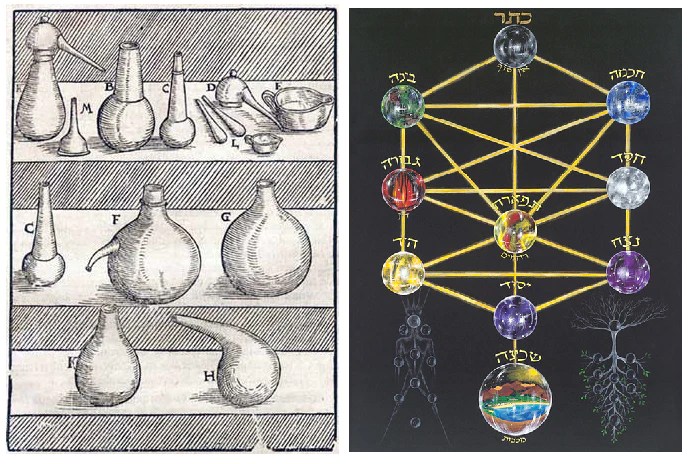
About a decade ago, the formidable Lawrence Weschler was a visiting scholar at the Getty Research Institute in Los Angeles, where he conceived a concept for an exhibit that, sadly, never materialized. Happily, he has shared the design in his wonderful newsletter, Wondercabinet…
Lead into Gold:
Proposal for a little jewel-box exhibit
surveying the Age-Old Quest
To Wrest Something from Nothing,
from the Philosopher’s Stone
through Subprime Loans
The boutique-sized (four-room) show would be called “Lead into Gold” and would track the alchemical passion—from its prehistory in the memory palaces of late antiquity through the Middle Ages

(those elaborate mnemonic techniques whereby monks and clerks stored astonishing amounts of details in their minds by placing them in ever-expanding imaginary structures, forebears, as it were, to the physical wondercabinets of the later medieval period—a sampling of manuscripts depicting the technique would grace a sort of foyer to the exhibition),

into its high classic phase (the show’s first long room) with alchemy as pre-chemistry (with maguses actually trying, that is, to turn physical lead into physical gold, all the beakers and flasks and retorts, etc.) to one side, and astrology as pre-astronomy (the whole deliriously marvelous sixteenth-into-seventeenth centuries) to the other, and Isaac Newton serving as a key leitmotif figure through the entire show (though starting out here), recast no longer in his role as the first of the moderns so much as “the Last of the Sumerians” (as an astonished John Maynard Keynes dubbed him, upon stumbling on a cache of thousands of pages of his Cambridge forebear’s detailed alchemical notes, not just from his early years before the Principia, but from throughout his entire life!).
The show would then branch off in two directions, in a sort of Y configuration. To one side:
1) The Golden Path, which is to say the growing conviction among maguses and their progeny during the later early-modern period that the point was allegorical, an inducement to soul-work, in which one was called upon to try to refine the leaden parts of oneself into ever more perfect golden forms, hence Faustus and Prospero through Jung, with those magi Leibniz and Newton riffing off Kabbalistic meditations on Infinity and stumbling instead onto the infinitesimal as they invent the Calculus, in turn eventually opening out (by way of Blake) onto all those Sixties versions, the dawning of the Age of Aquarius, etc., which set the stage for the Whole Earth Catalog and all those kid-maguses working in their garages (developing both hardware and software: fashioning the Calculus into material reality) and presently the Web itself (latter day version of those original memory palaces from back in the show’s foyer, writ large);
while, branching off to the other side, we would have:
2) The Leaden Path, in which moneychangers and presently bankers decided to cut to the chase, for, after all, who needed lead and who needed gold and for god’s sake who needed a more perfect soul when you could simply turn any old crap into money (!)—thus, for example, the South Sea Bubble, in which Newton lost the equivalent of a million dollars (whereupon he declared that he could understand the transit of stars but not the madness of men), tulipomania, etc., and thence onward to Freud (rather than Jung) and his conception of “filthy lucre” and George Soros (with his book, The Alchemy of Finance), with the Calculus showing up again across ever more elaborate permutations, leading on through Ponzi and Gecko (by way of Ayn Rand and Alan “The Wizard” Greenspan) to the whole derivatives bubble/tumor, as adumbrated in part by my own main man, the money artist JSG Boggs, and then on past that to the purest mechanism ever conceived for generating fast money out of crap: meth labs (which deploy exactly but exactly the same equipment as the original alchemists, beakers and flasks and retorts, to accomplish the literal-leaden version of what they were after, the turning of filth into lucre).
And I appended a xerox of that napkin sketch:

Eminently worth reading– and enjoying–in full. “The age-old human quest to turn nothing into something.”
* Edith Wharton
###
As we appreciate the abiding attraction of alchemy, we might recall that it was on this date in 1933 that President Franklin D. Roosevelt signed the act creating the Tennessee Valley Authority. A feature of the New Deal, the TVA was created to provide navigation, flood control, electricity generation, fertilizer manufacturing, regional planning, and economic development to the Tennessee Valley, a region (all of Tennessee, portions of Alabama, Mississippi, and Kentucky, and small areas of Georgia, North Carolina, and Virginia) which was particularly hard hit by the Great Depression relative to the rest of the nation. While owned by the federal government, TVA receives no taxpayer funding and operates similar to a private for-profit company.
The TVA has been criticized for its use of eminent domain, which resulted in the displacement of over 125,000 Tennessee Valley residents for the agency’s infrastructure projects. But on balance the TVA has been documented as a success in its efforts to modernize the Tennessee Valley and helping to recruit new employment opportunities to the region.

“Now, you can continue to protect your home and family even after you are gone”…

The craftsmen at Holy Smoke will take the cremated remains of a loved one and pack them into firearm ammunition: one pound of human ash yields 250 shotgun shells, 100 rifle cartridges, or 250 pistol cartridges. The company’s website avers…
The services provided by Holy Smoke are a fraction of the cost of what most funeral burial services cost – oftentimes saving families as much as 75% of traditional costs.
The ecological footprint caused by our service, as opposed to most of the current funeral interment methods, is virtually non-existent.
Now, you can continue to protect your home and family even after you are gone.
Or, as one of the company’s founders suggests in recounting how he conceived the service, one can use the remains to “share the death”:
My friend smiled and said “You know I’ve thought about this for some time and I want to be cremated. Then I want my ashes put into some turkey load shotgun shells and have someone that knows how to turkey hunt use the shotgun shells with my ashes to shoot a turkey. That way I will rest in peace knowing that the last thing that one turkey will see is me, screaming at him at about 900 feet per second.”

[TotH to Gizmodo]
As we aim for the afterlife, we might recall that it was on this date in 1939 that physicists Albert Einstein and Leó Szilárd wrote President Franklin D. Roosevelt, urging him to begin develop a nuclear weapon. Their letter was delivered a couple of months later, and led to the formation of the Advisory Committee on Uranium (the “Briggs Uranium Committee”) and ultimately the Manhattan Project.
 Einstein and Szilárd (source)
They giveth; they taketh away…
The Economist reports that participation in the U.S. Food Stamps program– designed to insure that poor Americans have enough to eat– had, by this past April, reached almost 45 million, or one in seven Americans.

At the same time, Reuters reports that In 11 states, lotteries provided more revenue than the state corporate income tax in 2009… The Rhode Island lottery netted the state more than $3 for each dollar of state corporate income tax in fiscal 2009.
 click image above, or here, for larger version
As we strain to think of even more regressive ways to raise revenue, we might recall that it was on this date in 1932 that General Douglas MacArthur, on the order of President Herbert Hoover, led two regiments and six tanks against the Bonus Marchers in Washington, D.C. The Bonus Army was a group of 43,000 marchers– 17,000 World War I veterans, their families, and affiliated groups– who gathered to demand cash-payment of the certificates they’d been issued by the government at the end of World War Two as a bonus for their service. MacArthur’s cavalry charged the protestors’ camp, and his infantry entered with fixed bayonets and adamsite gas, an arsenical vomiting agent, evicting veterans, families, and camp followers.
The Bonus Army incident proved disastrous for Hoover’s chances at re-election; he lost the 1932 election in a landslide to Franklin D. Roosevelt.
 Shacks that members of the Bonus Army erected on the Anacostia Flats burning after the confrontation with the military (source)
You must be logged in to post a comment.