… and in some cultures, Nathan Gardels observes, that that phenomenon is picking up pace, as the ruling parties of the world’s two largest nations are fusing high-tech tools with old-fashioned patronage and local wardens…
The more we know or learn through connected networks, the more is known and learned about us.
The same apparatus that enables unprecedented connectivity enables unprecedented surveillance.
Such systems are invasive by design, recording and storing every digital transaction from an online purchase to chatbot queries to uploaded photos in giant databases that are searchable, not least by snooping governments, aggressive marketers and the large language models of Big Tech.
The other side of the coin of connectivity is sousveillance, the capacity of citizens and consumers to monitor authorities, professions and businesses from below to expose abuse, corruption, complacency, incompetence, dissembling or outright lies. (One recent example that springs to mind is the fracas over pro-Palestinian encampments on the U.C.L.A. campus where journalists and students correlated online personal data with facial recognition tools to identify violent counter-demonstrators while law enforcement dawdled.)
Information gathered through connective surveillance is also a means for tracking the pressing concerns, discontent or shifting attitudes of publics that out-of-touch private companies disregard at the risk of their consumer appeal and unresponsive governments or ruling parties ignore at the peril of losing popular legitimacy.
Inundated by junk emails and pop-up ads, most of us are all too familiar with how surveillance capitalism works. But something more is going on in China and India, where the state and ruling parties are wiring a new kind of body politic for the digital age by combining connective capacity with the old stalwarts of allegiance and control — local wardens and the spoils system of patronage…
[Gardels explains the all-too-effective efforts of the Chinese and Indian governments and comes to an alarming (at least to your correspondent) conclusion…]
… To the extent that what we may call “autocratic connectivity” remains an adaptive two-way street where feedback from below is heard and heeded, such a system appears politically sustainable without the liberal freedoms so cherished in the West.
If it works in the two largest nations on the planet, others may see it as their future as well…
As we muse on manipulation, we might send persuasive birthday greetings to Carl Hovland; he was born on this date in 1912. A psychologist, he was a pioneer in the study of pioneered in the study of social communication and the modification of attitudes and beliefs. Hovland was the first to record the “sleeper effect,” the observation that individuals exposed repeatedly to what they know is propaganda– e.g., a political smear ad, paid for by an opponent), forget over time that the message is propaganda. (Note that, while the effect has been widely acknowledged and studied, it has been notoriously difficult to reproduce, leading to some doubt over its existence.)
Hovland also developed the social judgment theory of attitude change. He thought that the ability of someone to resist persuasion by a certain group depended on his/her degree of belonging to the group. And he collaborated closely with Irving Janis who would later become famous for his theory of groupthink.
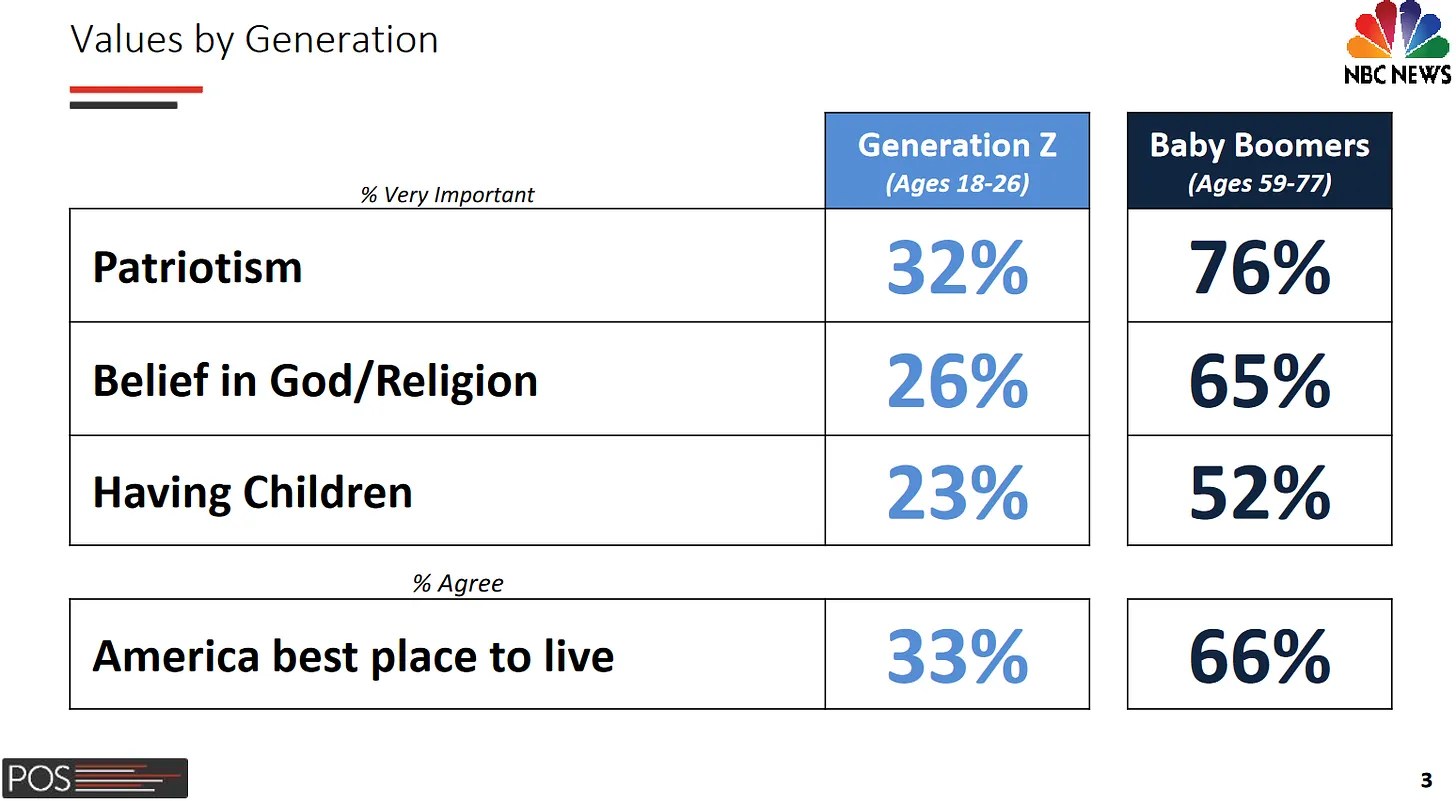
Every Sunday Bruce Mehlman, a Washington insider (a “government relations consultant”) publishes “Six Chart Sunday” in his newsletter, Age of Disruption. They’re always fascinating and informative; this week’s was especially striking.
The chart above and five others, each with brief explanatory summaries, tell the tale of wide “Generation Gaps.”
As Victor Klemperer observed, “A generation has more in common, after all, than a nation, than a profession.”
* Bertrand Russell, Mortals and Others: American Essays 1931-35
###
As we mind the gap, we might recall that it was on this date in 1971 that the Rolling Stones’ Sticky Fingers hit #1 on the U.S. album chart (their second chart-topping album). A critical and popular success, it is also remembered for its cover (conceived by Andy Warhol and photographed and designed by members of his art collective, the Factory, featuring a zippable image of a man’s jeans) and for its introduction of the now ubiquitous tongue and lips logo.
… and that could be an issue for the global order. People’s principles were expected to align as countries got richer; research suggests that instead they’re diverging. What happened?…
In 1981 over 40% of the world’s population lived in extreme poverty. But economic growth was starting to accelerate in developing countries. And Ron Inglehart, a professor at the University of Michigan, was organising a worldwide survey team to test the theory that, as peasant farmers escape poverty, they begin to think and behave differently, as people in the past had done when they joined the middle classes.
They might give a higher priority to education, to widening their children’s knowledge, than their own parents had done. They might give greater weight to their own experience and reasoning, and less to religious books or the authority of kings. And perhaps these new ways, these basic values, would begin to converge around the world. Such matters, Inglehart thought, could be tested by asking questions which revealed underlying values such as “How important is religion in your life?”, “Would you be happy living next to a foreigner?” and “Can you trust most people?”
Forty years later, only 8% of the world’s population is still in extreme poverty; more than half, on some measures, count as middle class. The World Values Survey (WVS), Inglehart’s baby, has become the world’s biggest social-research network. Every five years or so its researchers sally out into the field interviewing, at last count, almost 130,000 people in 90 countries. Yet its latest wave of results, which covers 2017-22, provides only partial endorsement of the idea that basic values tend to converge as people get richer. In significant ways, the differences between how people think in different parts of the world seem to be widening.
As we contemplate culture, we might send carefully-observed birthday greetings to John Scott CBEFRSAFBAFAcSS; he was born on this date in 1949. A sociologist, he is best known for his work on economic and social networks, perhaps especially The Sage Handbook of Social Network Analysis and Conceptualising the Social World.
The Chimp-Pig Hypothesis is, to put it mildly, a revolutionary proposition. Uri Bram suggests that we use it– whether we believe it or not– to stretch ourselves…
In this post I’m going to explain, as best I can, an idea about evolution that many of my friends find (to say the least) outlandish.
I’m not very knowledgeable about genetics, and I can’t really vouch for how plausible the hypothesis is. (But note: on the same grounds, I can’t really vouch for how plausible Darwinian evolution is).
My interest is actually in something else: what does it feel like to have your beliefs overturned? You know the story: as was true for every previous generation, some of the things we believe today must be entirely wrong, and yet very few of us ever make a 180 on anything. It’s easier to accept we must be wrong about something than to actually admit we are wrong about anything. Which ought to worry us.
I’m frankly more interested in moral wrongs than scientific one. But the tricky thing is that successful moral revolutions are so complete that once they’re over we struggle to imagine how anyone ever believed X. (Kazuo Ishiguro is the only person I know to have actually captured what this probably feels like, but my co-blogger and I also made an attempt in this piece for WIRED).
Fear not: I’m coming back to the chimps and pigs. To me, the Chimp-Pig hypothesis is a rare theory that is 1) internally consistent and coherent enough not to be ridiculous, 2) overturns everything we think we know about a major area of knowledge, and 3) doesn’t have any meaningful implications for our current lives, so it won’t really hurt anyone if you give it some credence and it turns out to be false.
Which is all to say: to me, the most interesting interaction you can have with the Chimp-Pig hypothesis is to let yourself believe it, at least briefly, and then observe what it feels like to have your world overturned. The Chimp-Pig hypothesis may not be one of the great revolutions of your lifetime, but I think it’s one of the best practice cases I’ve ever seen. And when your real moment of truth comes, it’d be good to have some practice…
As we rehearse, we might spare a thought for Rube Goldberg; he died on this date in 1970. A cartoonist, sculptor, author, engineer, and inventor, he is best remembered as a satirist of the American obsession with technology; his series of “Invention” cartoons used a string of outlandish tools, people, plants, and steps to accomplish simple, everyday tasks in the most complicated possible way. (His work has inspired a number of “Rube Goldberg competitions,” the best-known of which, readers may recall, has been profiled here.)
Goldberg was a founder and the first president of the National Cartoonists Society, and he is the namesake of the Reuben Award, which the organization awards to the Cartoonist of the Year.
“The competition between paradigms is not the sort of battle that can be resolved by proofs” – Thomas S. Kuhn, The Structure of Scientific Revolutions
As recently as the late 1980s, most Americans thought gay sex was not only immoral but also something that ought to be illegal. Yet by 2015, when the Supreme Court legalised same-sex marriage, there were only faint murmurs of protest. Today two-thirds of Americans support it, and even those who frown on it make no serious effort to criminalise it.
This surge in tolerance illustrates how fast public opinion can shift. The change occurred because two trends reinforced each other. First, many socially conservative old people have died, and their places in the polling samples have been taken by liberal millennials. In addition, people have changed their minds. Support for gay marriage has risen by some 30 percentage points within each generation since 2004, from 20% to 49% among those born in 1928-45 and from 45% to 78% among those born after 1980.
However, this shift in opinion makes gay marriage an exception among political issues. Since 1972 the University of Chicago has run a General Social Survey every year or two, which asks Americans their views on a wide range of topics. Over time, public opinion has grown more liberal. But this is mostly the result of generational replacement, not of changes of heart.
For example, in 1972, 42% of Americans said communist books should be banned from public libraries. Views varied widely by age: 55% of people born before 1928 (who were 45 or older at the time) supported a ban, compared with 37% of people aged 27-44 and just 25% of those 26 or younger. Today, only a quarter of Americans favour this policy. However, within each of these birth cohorts, views today are almost identical to those from 47 years ago. The change was caused entirely by the share of respondents born before 1928 falling from 49% to nil, and that of millennials—who were not born until at least 1981, and staunchly oppose such a ban—rising from zero to 36%.
Not every issue is as extreme as these two. But on six of the eight questions we examined—all save gay marriage and marijuana legalisation—demographic shifts accounted for a bigger share of overall movement in public opinion than changes in beliefs within cohorts. On average, their impact was about twice as large.
Social activists devote themselves to changing people’s views, and sometimes succeed. In general, however, battles for hearts and minds are won by grinding attrition more often than by rapid conquest.
“The proliferation of competing articulations, the willingness to try anything, the expression of explicit discontent, the recourse to philosophy and to debate over fundamentals, all these are symptoms of a transition from normal to extraordinary research. It is upon their existence more than upon that of revolutions that the notion of normal science depends… though the world does not change with a change of paradigm, the scientist afterward works in a different world.”
– Thomas S. Kuhn, The Structure of Scientific Revolutions
* The Who
###
As we go with the flow, we might send responsive birthday greetings to John Broadus Watson; he was born on this date in 1878. A psychologist inspired by the (then recent) work of Ivan Pavlov, Watson established the psychological school of behaviorism, most dramatically through his address Psychology as the Behaviorist Views it, at Columbia University in 1913. Watson studied the biology, physiology, and behavior of animals, viewing them as extremely complex machines that responded to situations according to their “wiring,” or nerve pathways, which were conditioned by experience. When he continued with studies of the behavior of children, his conclusion was that humans, while more complicated than animals, operated on the same principles; he was particularly interested in the conditioning of emotions. Watson’s behaviorism dominated psychology in the U.S. in the 1920s and ’30s (and got a second wind with the ascendence of B.F. Skinner).
Ironically, it is also the birthday (1886) of one of Watson’s contemporaries and antagonists, Edwin Ray Guthrie. Guthrie was also a behaviorist, but argued against of Watson’s theory of classical conditioning and Skinner’s related theory of operant conditioning. Guthie’s focus was the psychology of learning and the role that association plays. In his Law of Contiguity, he held that “a combination of stimuli which has accompanied a movement, will on its recurrence tend to be followed by that movement.” He held that all learning is based on a stimulus- response association; movements are small stimulus- response combinations. These movements make up an act. A learned behavior is a series of movements, and it takes time for the movements to develop into an act. Which is to say that he believed that learning is incremental, and that many acquired behaviors involve repetition of movements– because what is learned are movements, not behaviors.




You must be logged in to post a comment.