Archive for October 2024
“In mathematics, the art of proposing a question must be held of higher value than solving it”*…

Matteo Wong talks with mathematician Terence Tao about the advent of AI in mathematical research and finds that Tao has some very big questions indeed…
Terence Tao, a mathematics professor at UCLA, is a real-life superintelligence. The “Mozart of Math,” as he is sometimes called, is widely considered the world’s greatest living mathematician. He has won numerous awards, including the equivalent of a Nobel Prize for mathematics, for his advances and proofs. Right now, AI is nowhere close to his level.
But technology companies are trying to get it there. Recent, attention-grabbing generations of AI—even the almighty ChatGPT—were not built to handle mathematical reasoning. They were instead focused on language: When you asked such a program to answer a basic question, it did not understand and execute an equation or formulate a proof, but instead presented an answer based on which words were likely to appear in sequence. For instance, the original ChatGPT can’t add or multiply, but has seen enough examples of algebra to solve x + 2 = 4: “To solve the equation x + 2 = 4, subtract 2 from both sides …” Now, however, OpenAI is explicitly marketing a new line of “reasoning models,” known collectively as the o1 series, for their ability to problem-solve “much like a person” and work through complex mathematical and scientific tasks and queries. If these models are successful, they could represent a sea change for the slow, lonely work that Tao and his peers do.
After I saw Tao post his impressions of o1 online—he compared it to a “mediocre, but not completely incompetent” graduate student—I wanted to understand more about his views on the technology’s potential. In a Zoom call last week, he described a kind of AI-enabled, “industrial-scale mathematics” that has never been possible before: one in which AI, at least in the near future, is not a creative collaborator in its own right so much as a lubricant for mathematicians’ hypotheses and approaches. This new sort of math, which could unlock terra incognitae of knowledge, will remain human at its core, embracing how people and machines have very different strengths that should be thought of as complementary rather than competing…
A sample of what follows…
The classic idea of math is that you pick some really hard problem, and then you have one or two people locked away in the attic for seven years just banging away at it. The types of problems you want to attack with AI are the opposite. The naive way you would use AI is to feed it the most difficult problem that we have in mathematics. I don’t think that’s going to be super successful, and also, we already have humans that are working on those problems.
… Tao: The type of math that I’m most interested in is math that doesn’t really exist. The project that I launched just a few days ago is about an area of math called universal algebra, which is about whether certain mathematical statements or equations imply that other statements are true. The way people have studied this in the past is that they pick one or two equations and they study them to death, like how a craftsperson used to make one toy at a time, then work on the next one. Now we have factories; we can produce thousands of toys at a time. In my project, there’s a collection of about 4,000 equations, and the task is to find connections between them. Each is relatively easy, but there’s a million implications. There’s like 10 points of light, 10 equations among these thousands that have been studied reasonably well, and then there’s this whole terra incognita.
There are other fields where this transition has happened, like in genetics. It used to be that if you wanted to sequence a genome of an organism, this was an entire Ph.D. thesis. Now we have these gene-sequencing machines, and so geneticists are sequencing entire populations. You can do different types of genetics that way. Instead of narrow, deep mathematics, where an expert human works very hard on a narrow scope of problems, you could have broad, crowdsourced problems with lots of AI assistance that are maybe shallower, but at a much larger scale. And it could be a very complementary way of gaining mathematical insight.
Wong: It reminds me of how an AI program made by Google Deepmind, called AlphaFold, figured out how to predict the three-dimensional structure of proteins, which was for a long time something that had to be done one protein at a time.
Tao: Right, but that doesn’t mean protein science is obsolete. You have to change the problems you study. A hundred and fifty years ago, mathematicians’ primary usefulness was in solving partial differential equations. There are computer packages that do this automatically now. Six hundred years ago, mathematicians were building tables of sines and cosines, which were needed for navigation, but these can now be generated by computers in seconds.
I’m not super interested in duplicating the things that humans are already good at. It seems inefficient. I think at the frontier, we will always need humans and AI. They have complementary strengths. AI is very good at converting billions of pieces of data into one good answer. Humans are good at taking 10 observations and making really inspired guesses…
Terence Tao, the world’s greatest living mathematician, has a vision for AI: “We’re Entering Uncharted Territory for Math,” from @matteo_wong in @TheAtlantic.
###
As we go figure, we might think recursively about Benoit Mandelbrot; he died on this date in 2010. A mathematician (and polymath), his interest in “the art of roughness” of physical phenomena and “the uncontrolled element in life” led to work (which included coining the word “fractal”, as well as developing a theory of “self-similarity” in nature) for which he is known as “the father of fractal geometry.”

“We live, in fact, in a world starved for solitude, silence, and private: and therefore starved for meditation and true friendship”*…

… if then, even more so now. Ben Tarnoff takes off from Lowry Pressly‘s new book to ponder why privacy matters and why we have such trouble even thinking about how to protect it…
… Today, it is harder to keep one’s mind in place. Our thoughts leak through the sieve of our smartphones, where they join the great river of everyone else’s. The consequences, for both our personal and collective lives, are much discussed: How can we safeguard our privacy against state and corporate surveillance? Is Instagram making teen-agers depressed? Is our attention span shrinking?
There is no doubt that an omnipresent Internet connection, and the attendant computerization of everything, is inducing profound changes. Yet the conversation that has sprung up around these changes can sometimes feel a little predictable. The same themes and phrases tend to reappear. As the Internet and the companies that control it have become an object of permanent public concern, the concerns themselves have calcified into clichés. There is an algorithmic quality to our grievances with algorithmic life.
Lowry Pressly’s new book, “The Right to Oblivion: Privacy and the Good Life,” defies this pattern. It is a radiantly original contribution to a conversation gravely in need of new thinking. Pressly, who teaches political science at Stanford, takes up familiar fixations of tech discourse—privacy, mental health, civic strife—but puts them into such a new and surprising arrangement that they are nearly unrecognizable. The effect is like walking through your home town after a tornado: you recognize the buildings, but after some vigorous jumbling they have acquired a very different shape.
Pressly trained as a philosopher, and he has a philosopher’s fondness for sniffing out unspoken assumptions. He finds one that he considers fundamental to our networked era: “the idea that information has a natural existence in human affairs, and that there are no aspects of human life which cannot be translated somehow into data.” This belief, which he calls the “ideology of information,” has an obvious instrumental value to companies whose business models depend on the mass production of data, and to government agencies whose machinery of monitoring and repression rely on the same.
But Pressly also sees the ideology of information lurking in a less likely place—among privacy advocates trying to defend us from digital intrusions. This is because the standard view of privacy assumes there is “some information that already exists,” and what matters is keeping it out of the wrong hands. Such an assumption, for Pressly, is fatal. It “misses privacy’s true value and unwittingly aids the forces it takes itself to be resisting,” he writes. To be clear, Pressly is not opposed to reforms that would give us more power over our data—but it is a mistake “to think that this is what privacy is for.” “Privacy is valuable not because it empowers us to exercise control over our information,” he argues, “but because it protects against the creation of such information in the first place.”
If this idea sounds intriguing but exotic, you may be surprised to learn how common it once was. “A sense that privacy is fundamentally opposed to information has animated public moral discourse on the subject since the very beginning,” Pressly writes…
[Tarnoff recaps Pressly’s a brief history of the technologies that changed our relationship to information, from Kodak through CCTV, to AI…]
… The reason that Pressly feels so strongly about imposing limits on datafication is not only because of the many ways that data can be used to damage us. It is also because, in his view, we lose something precious when we become information, regardless of how it is used. In the very moment when data are made, Pressly believes, a line is crossed. “Oblivion” is his word for what lies on the other side.
Oblivion is a realm of ambiguity and potential. It is fluid, formless, and opaque. A secret is an unknown that can become known. Oblivion, by contrast, is unknowable: it holds those varieties of human experience which are “essentially resistant to articulation and discovery.” It is also a place beyond “deliberate, rational control,” where we lose ourselves or, as Pressly puts it, “come apart.” Sex and sleep are two of the examples he provides. Both bring us into the “unaccountable regions of the self,” those depths at which our ego dissolves and about which it is difficult to speak in definite terms. Physical intimacy is hard to render in words—“The experience is deflated by description,” Pressly observes—and the same is notoriously true of the dreams we have while sleeping, which we struggle to narrate, or even to remember, on waking.
Oblivion is fragile, however. When it comes into contact with information, it disappears. This is why we need privacy: it is the protective barrier that keeps oblivion safe from information. Such protection insures that “one can actually enter into oblivion from time to time, and that it will form a reliably available part of the structure of one’s society.”
But why do we need to enter into oblivion from time to time, and what good does it do us? Pressly gives a long list of answers, drawn not only from the Victorians but also from the work of Michel Foucault, Roland Barthes, Gay Talese, Jorge Luis Borges, and Hannah Arendt. One is that oblivion is restorative: we come apart in order to come back together. (Sleep is a case in point; without a nightly suspension of our rational faculties, we go nuts.) Another is the notion that oblivion is integral to the possibility of personal evolution. “The main interest in life and work is to become someone else that you were not in the beginning,” Foucault writes. To do so, however, you must believe that the future can be different from the past—a belief that becomes harder to sustain when one is besieged by information, as the obsessive documentation of life makes it “more fixed, more factual, with less ambiguity and life-giving potentiality.” Oblivion, by setting aside a space for forgetting, offers a refuge from this “excess of memory,” and thus a standpoint from which to imagine alternative futures.
Oblivion is also essential for human dignity. Because we cannot be fully known, we cannot be fully instrumentalized. Immanuel Kant urged us to treat others as ends in themselves, not merely as means. For Pressly, our obscurities are precisely what endow us with a sense of value that exceeds our usefulness. This, in turn, helps assure us that life is worth living, and that our fellow human beings are worthy of our trust. “There can be no trust of any sort without some limits to knowledge,” Pressly writes…
… Psychoanalysis first emerged in the late nineteenth century, in parallel with the idea of privacy. This was a period when the boundary between public and private was being redrawn, not only with the onslaught of handheld cameras but also, more broadly, because of the dislocating forces of what historians call the Second Industrial Revolution. Urbanization pulled workers from the countryside and packed them into cities, while mass production meant they could buy (rather than make) most of what they needed. These developments weakened the institution of the family, which lost its primacy as people fled rural kin networks and the production of life’s necessities moved from the household to the factory.
In response, a new freedom appeared. For the first time, the historian Eli Zaretsky observes, “personal identity became a problem and a project for individuals.” If you didn’t have your family to tell you who you were, you had to figure it out yourself. Psychoanalysis helped the moderns to make sense of this question, and to try to arrive at an answer.
More than a century later, the situation looks different. If an earlier stage of capitalism laid the material foundations for a new experience of individuality, the present stage seems to be producing the opposite. In their taverns, theatres, and dance halls, the city dwellers of the Second Industrial Revolution created a culture of social and sexual experimentation. Today’s young people are lonely and sexless. At least part of the reason is the permanent connectivity that, as Pressly argues, conveys the feeling that “one’s time and attention—that is to say, one’s life—are not entirely one’s own.”
The modernist city promised anonymity, reinvention. The Internet is devoid of such pleasures. It is more like a village: a place where your identity is fixed. Online, we are the sum of what we have searched, clicked, liked, and bought. But there are futures beyond those predicted through statistical extrapolations from the present. In fact, the past is filled with the arrival of such futures: those blind corners when no amount of information could tell you what was coming. History has a habit of humbling its participants. Somewhere in its strange rhythms sits the lifelong work of making a life of one’s own…
We often want to keep some information to ourselves. But information itself may be the problem: “What Is Privacy For?” from @bentarnoff in @NewYorker. (Possible paywall; archived link here.)
Pair with the two (marvelous, provocative) documentary series from Adam Curtis and the BBC: The Century of Self and Hypernormalization, both of which are available on You Tube.)
* C. S. Lewis
###
As we make room, we might send painfully-observant birthday greetings to Lenny Bruce; he was born on this date in 1925. A comedian, social critic, and satirist, he was ranked (in a 2017 Roling Stone poll) the third best stand-up comic of all time– behind Richard Pryor and George Carlin, both of whom credit Bruce as an influence.

“The poets have been mysteriously silent on the subject of cheese”*…

… not so, Americans, who have been, as Millie Giles reports, speaking loudly with their wallets…
Topping off a pizza. Eyeballing a slice for cracker-stacking. Perfecting your own combination for a grilled sandwich. Many of us have spent time ruminating on one of life’s great questions: what’s the right amount of cheese?
The answer turns out to be exactly the same reply you’d give to a Parmesan-doling server: just a little more…
A great report from Bloomberg’s Ilena Peng last week outlined how America’s dairy processors are planning to build new facilities across the US to meet surging demand, which is a headline that could have been from just about any decade in the last 50 years. Indeed, data from the US Department of Agriculture shows that American consumption of cheese amounted to a record-breaking ~42 pounds per year for the average person in 2022, the latest figure available — more than double the amount reported in 1975.
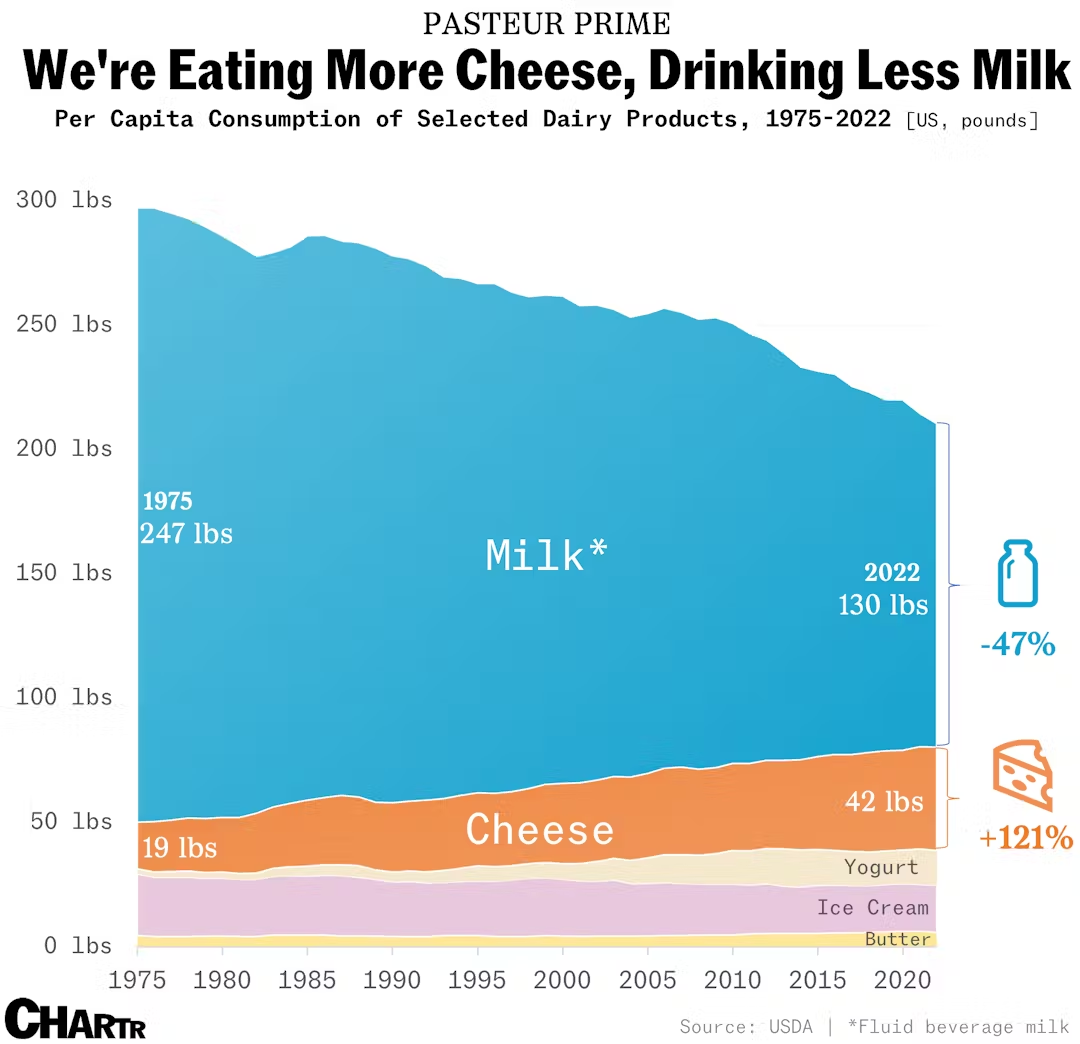
Interestingly, cheese is something of an exception in the world of dairy. As America has sprinkled, grated, and sliced its way through more and more cheese, there’s also been a concurrent 47% decline in fluid milk consumption observed over the same period. In the 20th century, drinking milk was a mainstay of daily life, with its nutritional completeness cementing its place in the American ideal of “growing big and strong” (as well as giving us arguably the best ad campaign of the ‘90s).
Today, a considerable number of people have ditched dairy in favor of plant-based milks like almond, soy, and oat for ethical and dietary reasons (parallel with a counterculture of anti-milk drinking, which some people think is simply “gross”). The boom in alt-milks created a lucrative landscape for fledgling brands like Oatly, which at one point was worth an eye-watering $13 billion (although it is now worth just a tiny fraction of that, some $530 million).
Meanwhile, non-dairy cheeses haven’t taken off in quite the same way. Iterations have struggled to recreate the flavor and texture, with some people, frankly, scarred by sampling a few of these pseudo-cheese attempts, as even VeganCheese.co itself admits.
The discrepancy between these dairy dupes might boil down to one of the unique selling points of regular dairy cheese. As outlined by Bloomberg, the process of making a complex, artisan-derived product from a few simple ingredients, which is hard to do at home, carries weight with an increasingly organic-oriented public.
As well as this, the high protein content of dairy cheese is resonating with a growing number of “gains-conscious” consumers. For example, typically divisive but protein-dense cottage cheese has recently blown up on social media. The longer list of generally viral TikTok recipes also has a very high hit rate for having cheese as a main ingredient.
As Americans dine out more, they may also err on the side of their favorite foods — many of which involve at least some degree of cheese (think: pizza, burgers, pasta)…
Americans eat mozzarella more than any other cheese, with the average citizen getting through 12.55 pounds in 2022, per the USDA.
Consumption of the semi-soft Italian cheese has been sharply on the rise since it knocked cheddar off the top spot back in 2010; though, cheddar has hardly fallen out of favor, with the average person eating over 11 pounds of it each year. Interestingly, processed cheese (think: melty slices) has been mounting a comeback since 2020, after consumption dropped at the turn of the millennium.
What do crude oil and cheese have in common? Not a lot, except that America can’t seem to function without either… and, in recent years, they’ve both become an important American export.
Indeed, while most of America’s favorite cheeses originally derive from elsewhere in the world, the US still makes much of its own supply, accounting for some 29% of the world’s cheese production, second only to the European Union, per the USDA. And, in recent years, it’s started selling more of it abroad.
The US has been a net exporter of cheese since 2010, sending over 450,000 metric tons at its 2022 peak to large international markets like Mexico, where America accounts for 87% of all imported cheese… sales of American cheese abroad are only expected to grow, with the USDA forecasting cheese exports to rise 17% from 2023-24…
… While authentic varieties from places like France and Italy must still be shipped into the country, the US has gone all-in on its own overseas sales. Part of this can be chalked up to the continued drive in global demand for cheese, but the US also has a history of having too much of it lying around.
In 1981, when faced with a milk surplus, the federal government under Ronald Reagan began storing the product as cheese in huge quantities. In fact, the ~560 million pounds of cheese mostly kept in subterranean facilities was at one point costing the government ~$1 million a day in storage and interest costs, according to the Washington Post.
While many countries follow the same food stockpiling rulebook to stabilize prices, a recent surge in milk production, alongside the decline in milk consumption, has meant that America’s cheese pile hasn’t gone anywhere. New, tariff-subsidized deals and a greater national appetite for the yellow stuff have helped… but not by enough. As of August 2024, the total cheese cold in storage holdings in the US was reported to be ~1.4 billion pounds…
More on “Making America Grate Again”: “America is eating, and exporting, more cheese than ever before,” from @chartrdaily.
* G. K. Chesterton
###
As we stuff the crust, we might note that today is National Farmers Day in the U.S.

“The blues are the roots and the other musics are the fruits”*…

We recently lost an audio pioneer: Ben Manilla, an award-winning radio and podcast producer, audio entrepreneur, pioneering disc jockey, and broadcast journalism educator, passed away at the end of last month. In his long and storied career, he won awards (the Peabody, Columbia University’s Edward Howard Armstrong Award, RTNDA Edward R. Murrow Award, and the Scripps Howard Award among others) for everything from Philosophy Talk (from Stanford University) to The Loose Leaf Book Company (with Tom Bodett).
But Ben had a long suit in programming about the Blues. His work with Martin Scorcese and the Experience Music Project helped lead the year-long, nation-wide multimedia event, “The Blues.” It included Ben’s thirteen-hour radio documentary, The Blues with Keb’ Mo’, the most widely distributed special in the history of Public Radio International (PRI). His long running Elwood’s BluesMobile with Dan Aykroyd (nee, House of Blues) was recently inducted into the Library of Congress.

Here in tribute both to Ben and to the Blues, the series’ induction ceremony at the Library of Congress:
(Image at the top: source)
* “The blues are the roots and the other musics are the fruits. It’s better keeping the roots alive, because it means better fruits from now on. The blues are the roots of all American music. As long as American music survives, so will the blues.” – Willie Dixon
###
As we feel it, we might recall that it was on this date in 1997 that Bo Diddley, Keb’ Mo’, Buddy Guy, and a host of others performed at a tribute at the Kennedy Center to the “father of Chicago Blues,” Muddy Waters.
“The only thing that will redeem mankind is cooperation”*…

Industrial policy is on the rise around the world, as nations (and sometimes regions) create laws and policies that prioritize domestic competitiveness and economic benefit over free trade, using tools like investment, regulation, and tariffs. Increasingly these policies are being animated not only by economic, but also security concerns. (See, e.g., here and here.)
The traditional worry about policies like these is that they create barriers (thus tensions) between countries… which, at a time when the world desperately needs collaborative responses to global challenges like climate change, could be deeply problematic. But Nathan Gardels argues that industrial policy might be precisely what we need to set the stage for meaningful cooperation…
The remarkable story future historians will tell about the late 20th and early 21st century is how inviting a Communist Party-state to enter a global economy built on the capitalist principles of free trade and markets ended up transforming the neoliberal West into a bastion of protectionism and state-directed industrial policy of the same kind now condemned as unfairly advantaging China’s rise.
They will also note the further irony that the logic of opening to China in the 1970s — and of China’s opening to the West — had a national security premise of checkmating the Soviet Union. Half a century on, the Middle Kingdom is more closely aligned with Russia than in the later stages of the Cold War, primarily as a way to do the opposite: checkmate America’s continuing dominance of the very world order that enabled its rapid ascent.
Adding more complexity to this reversal of history are the related global challenges that have arisen in both East and West: decarbonization of fossil-fuel dependency to mitigate climate change while coping with the disruptions of the digital revolution and the advent of artificial intelligence.
These threads of deglobalization, climate and technological revolution have all converged in the competitive assertion of “industrial strategies” in which nation-building is integrally bound up with international security concerns. China is driven by the fear of not catching up, the United States by alarm at losing the upper hand and Europe by the angst of falling behind both and losing its strategic autonomy.
China’s industrial strategy is called “dual circulation,” essentially a policy of self-reliance and resilience in the face of newfound Western hostility. It is aimed at bolstering domestic consumption and production, including conquering the latest AI technologies with its own resources, while off-loading manufacturing overproduction abroad and expanding trading ties in the global South.
The U.S. strategy, as crafted by President Joe Biden, encompasses a broad array of protective tariffs and subsidies. The CHIPs Act and related policies seek to foster homegrown microchip production while denying frontier technologies to China and restructuring supply chains to friendly nations. The Inflation Reduction Act promotes extensive new investment in the green energy transition. Incongruously, at the same time, a tariff of 100% has been imposed on the import of Chinese electric vehicles. Further tariffs on component inputs, such as batteries sourced in China, are already on track.
Following the U.S, the European Union is also set to raise its own stiff tariff hikes on Chinese EVs as it pursues a European Green Deal to transition to renewables on its own terms. Europe also seeks to blunt the impact of the “buy American” restrictions of the IRA so that fleeing capital looking to exploit the subsidized U.S. market does not hollow out its own green industries before they can be firmly established.
Earlier this month, the former European central banker and one-time Italian prime minister, Mario Draghi, has gone the next step and plotted out a detailed, long-term “industrial strategy” to close the gap with the U.S. and China, which he calls “an existential challenge” to the European way of life.
“If Europe cannot become more productive,” Draghi writes in his report, “we will be forced to choose. We will not be able to become, at once, a leader in new technologies, a beacon of climate responsibility and an independent player on the world stage. We will not be able to finance our social model. We will have to scale back some, if not all, of our ambitions.”…
[Gardels unpacks both European and Australian industrial policy..]
… For all these divergent industrial strategies to succeed in the end depends largely on whether sustained nation-building investment outstrips the duration of protective measures that ought to be only a temporary respite from asymmetrical conditions while they are rebalanced.
To the extent these decoupled initiatives do succeed, they will, paradoxically, come to be regarded not as the antithesis of global cooperation, but as the precondition for it. Only when the power centers of China, the U.S. and Europe are assuredly in control of their own destiny will they be secure enough to open up and cooperate on the global issues that impact them all equally…
The case that divergent “industrial strategies” in the U.S., China, and Europe can create the security to open up: “The Precondition for Global Cooperation,” from @NoemaMag.
* Bertrand Russell
###
As we reconfigure, we might spare a thought for a man who provided an important part the foundation on which opponents of industrial policy base their arguments: Pierre Le Pesant, sieur de Boisguilbert (or as he is more commonly known, simply Boisguilbert); he died on this date in 1714. A French Enlightenment law-maker and economist, he was the first of the great continental liberals– a proponent of laissez-faire and minimalist government and an early opponent of mercantilist “Colbertisme.” He is considered one of the fathers of the notion of an economic market.

You must be logged in to post a comment.