Archive for November 2015
“There Are Two Typos Of People In This World: Those Who Can Edit And Those Who Can’t”*…

Typos can be embarrassing. They can also be costly. And not just for those individuals whose jobs depend on knowing the difference between “it’s” and “its” or where a comma is most appropriate. In 2013, bauble-loving Texans got the deal of a lifetime when a misprint in a Macy’s mailer advertised a $1500 necklace for just $47. (It should have read $497.) It didn’t take long for the entire inventory to be zapped, at a loss of $450 a pop to the retail giant. (Not to mention plenty of faces as red as the star in the company’s logo.)
Google, on the other hand, loves a good typing transposition: Harvard University researchers claim that the company earns about $497 million each year from people mistyping the names of popular websites and landing on “typosquatter” sites … which just happen to be littered with Google ads…
From a NSFW travel agency ad to “the most expensive hyphen in history”– “10 very costly typos.”
* Jarod Kintz
###
As we check our work, we might send carefully-edited birthday greetings to Samuel Langhorne Clemens, AKA Mark Twain; he was born on this date in 1835 in Florida, Missouri. One of the best-known writers and aphorists of his time and ours, his The Adventures of Huckleberry Finn is consistently cited as a (if not indeed the) Great American Novel, at the same time that it is equally consistently the target of censors who would ban it from school and public libraries… but not for sloppy editing or typos: Clemens began his career as a newspaper man– first as a typesetter, then as a reporter, where he honed his copy editing skills. And he carried those skills with him into the use of new technologies: he was the first author to submit a typewritten manuscript to his publisher.
 Matthew Brady’s photo of Mark Twain
“Oh how Shakespeare would have loved cinema!”*…

Indiewire‘s list of “The 50 Best Opening Credit Sequences Of All Time“– each with a video of the sequence, and followed by a bonus “starter list” of other candidates that might have made the cut… because after all, the point of lists like these is the arguments they provoke.
* Derek Jarman, Dancing Ledge
###
As we settle into our seats, we might spare a thought for Archibald Alexander Leach; he died on this date in 1986. Known by his stage name, Cary Grant, he became one of the greatest stars in Hollywood history, the epitome of the “leading man,” famous for roles both comedic (e.g., Holiday, Bringing Up Baby, The Philadelphia Story) and dramatic (Grant was Hitchcock’s favorite actor, for reasons obvious in Suspicion, North By Northwest, To Catch a Thief, and Notorious).
Living for much of his career “above the title,” Grant was the first actor of note to “go independent”– to refuse to sign a studio contract– which gave him control over roles and collaborators and a bigger piece of the action; he was one of the first actors to earn a percentage of his pictures’ gross revenues.

“If it was so, it might be; and if it were so, it would be; but as it isn’t, it ain’t. That’s logic.”*…
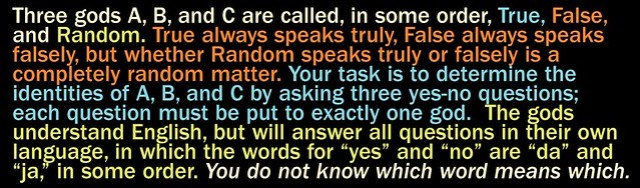
Your correspondent is headed into the chilly wilds for the Thanksgiving holiday, so this will be the last post until after the passing of the tryptophan haze. By way of keeping readers amused in the meantime, the puzzle above…
Find a step-by-step guide to its answer at “How to Solve the Hardest Logic Puzzle Ever.”
* Tweedledee, in Lewis Caroll’s Through the Looking-Glass, and What Alice Found There
###
As we muddle in the excluded middle, we might recall that it was on this date in 1915 that Albert Einstein presented the Einstein Field Equations to the Prussian Academy of Sciences. Einstein developed what was elaborated into a set of 10 equations to account for gravitation in the curved spacetime described in his General Theory of Relativity; they are used to determine spacetime geometry.
(German mathematician David Hilbert reached the same conclusion, and actually published the equation before Einstein– though Hilbert, who was a correspondent of Einstein’s, never suggested that Einstein’s credit was inappropriate.)

On the right side of the equal sign, the distribution of matter and energy in space; on the left, the geometry of the space, the so-called metric, a prescription for how to compute the distance between two points.
“There’s never enough time to do all the nothing you want”*…

How do you spend your days? Since 2003, the Bureau of Labor Statistics and the American Time Use Survey have asked thousands of people this question. See the answers– and use interactive charts to see where you fit– at “Counting the Hours.”
* Calvin (Bill Watterson)
###
As we consider a nap, we might send thoughtful birthday greetings to Baruch (or Benedict) de Spinoza, the Dutch philosopher whose rationalism and determinism put him in opposition to Descartes and helped lay the foundation for The Enlightenment, and whose pantheistic views led to his excommunication from the Jewish community in Amsterdam; he was born on this date in 1632.
As men’s habits of mind differ, so that some more readily embrace one form of faith, some another, for what moves one to pray may move another to scoff, I conclude … that everyone should be free to choose for himself the foundations of his creed, and that faith should be judged only by its fruits; each would then obey God freely with his whole heart, while nothing would be publicly honored save justice and charity.
– Tractatus Theologico-Politicus, 1670

“I was supposed to say, ‘In a pig’s eye you are,’ what came out was, ‘In a pig’s ass you are.’ Old habits die awfully hard.”*…

Explore expletives at “Strong Language.” (Though it probably goes without saying: NSFW.)
Special word-lover’s bonus:

* Ava Gardner, Ava: My Story
###
As we flirt with forswearing swearing, we might recall that it was on this date in 1644, at the height of the English Civil War, that Milton’s Areopagitica (or Areopagitica; A speech of Mr. John Milton for the Liberty of Unlicenc’d Printing, to the Parlament of England) was published. An impassioned philosophical attack on censorship and defense of the principle of a right to freedom of speech and expression, it is regarded as one of the most eloquent arguments for press freedom ever written; indeed, many of its principles form the basis for modern justifications of that right.

You must be logged in to post a comment.