Posts Tagged ‘weather’
“Criticism may not be agreeable, but it is necessary. It fulfills the same function as pain in the human body. It calls attention to an unhealthy state of things.”*…

The estimable Henry Farrell on why, on average, we’re better at criticizing others than thinking originally ourselves…
… our individual reasoning processes are biased in ways that are really hard for us (individually) to correct. We have a strong tendency to believe our own bullshit. The upside is that if we are far better at detecting bullshit in others than in ourselves, and if we have some minimal good faith commitment to making good criticisms, and entertaining good criticisms when we get them, we can harness our individual cognitive biases through appropriate group processes to produce socially beneficial ends. Our ability to see the motes in others’ eyes while ignoring the beams in our own can be put to good work, when we criticize others and force them to improve their arguments. There are strong benefits to collective institutions that underpin a cognitive division of labor.
This superficially looks to resemble the ‘overcoming bias’/’not wrong’ approaches to self-improvement that are popular on the Internet. But it ends up going in a very different direction: collective processes of improvement rather than individual efforts to remedy the irremediable. The ideal of the individual seeking to eliminate all sources of bias so that he (it is, usually, a he) can calmly consider everything from a neutral and dispassionate perspective is replaced by a Humean recognition that reason cannot readily be separated from the desires of the reasoner. We need negative criticisms from others, since they lead us to understand weaknesses in our arguments that we are incapable of coming at ourselves, unless they are pointed out to us…
…
… It’s not about a radical individual virtuosity, but a radical individual humility. Your most truthful contributions to collective reasoning are unlikely to be your own individual arguments, but your useful criticisms of others’ rationales. Even more pungently, you are on average best able to contribute to collective understanding through your criticisms of those whose perspectives are most different to your own, and hence very likely those you most strongly disagree with. The very best thing that you may do in your life is create a speck of intense irritation for someone whose views you vigorously dispute, around which a pearl of new intelligence may then accrete…
…
… One of my favourite passages from anywhere is the closing of Middlemarch, where Eliot says of Dorothea:
“Her full nature, like that river of which Cyrus broke the strength, spent itself in channels which had no great name on the earth. But the effect of her being on those around her was incalculably diffusive: for the growing good of the world is partly dependent on unhistoric acts; and that things are not so ill with you and me as they might have been, is half owing to the number who lived faithfully a hidden life, and rest in unvisited tombs.”
Striving to be a Dorothea is a noble vocation, and likely the best we can hope for in any event; sooner or later, we will all be forgotten. In the long course of time, all of our arguments and ideas will be broken down and decomposed. At best we may hope, if we are very lucky, that they will contribute in some minute way to a rich humus, from which plants that we will never see or understand might spring.
Eminently worth reading in full: “In praise of negativity,” from @henryfarrell.
* Winston Churchill
###
As we contemplate the constructive, we might recall that it was on this date in 1871 that a discipline wholly dependent on incorporating corrective critique into its methods was founded: Cleveland Abbe became the founding chief scientist– effectively the head– of the newly formed U.S. Weather Service (later named the Weather Bureau; later still, the National Weather Service).
Abbe had started the first private weather reporting and warning service (in Cincinnati) and had been issuing weather reports or bulletins since 1869 and was the only person in the country at the time who was experienced in drawing weather maps from telegraphic reports and forecasting from them. The first U.S. meteorologist, he is known as the “father of the U.S. Weather Bureau,” where he systemized observation, trained personnel, and established scientific methods. He went on to become one of the 33 founders of the National Geographic Society.

“If lightning is the anger of the gods, then the gods are concerned mostly about trees”*…

Mostly, but not entirely. Chloe Aridjis on survivors of lightning strikes…
There are three types of lightning: cloud to cloud, or intercloud, which leaps across gaps of clear air; intracloud, which doesn’t leave the cloud at all; and cloud to ground, the most threatening: a stream, or rather a meeting of two streams, of ionised particles, each following its own determined course, one towards the heavens, the other towards earth, and where they meet the air crackles with heat, creating a sky of forking paths.
To the attendees of the International Lightning Strike Survivor Conference, who have all had encounters with the third kind, the oft-mentioned statistic (nine out of ten survive) offers little consolation. Many of them, given the consequences, would prefer to have been struck dead. Survival provides small solace when your entire existence has been electrically altered.
Just as lightning isn’t a single event but rather a sequence of strokes, so the memory of a lightning strike returns in fierce, dramatic bolts rather than as one clear picture.
…
Distinguished ornithologist ALEX COSTA from Tampa, Florida, the lightning state (three times more strikes than any other in the US), was observing a rare migratory bird when struck, and when he returned to his senses the bird had vanished along with his shoes, binoculars and long-term memory. Indoor landscape painting (he rarely leaves home) has replaced ornithology and, with his good hand, he now paints imaginary woods and meadows. He doesn’t sleep much at night but reads and takes long naps in his armchair by the window….
What is it like to be touched by a lightning bolt? More current-charged recollections: “Notes on the International Lightning Strike Survivor Conference,” at @thedialmag.
* Lao Tzu
###
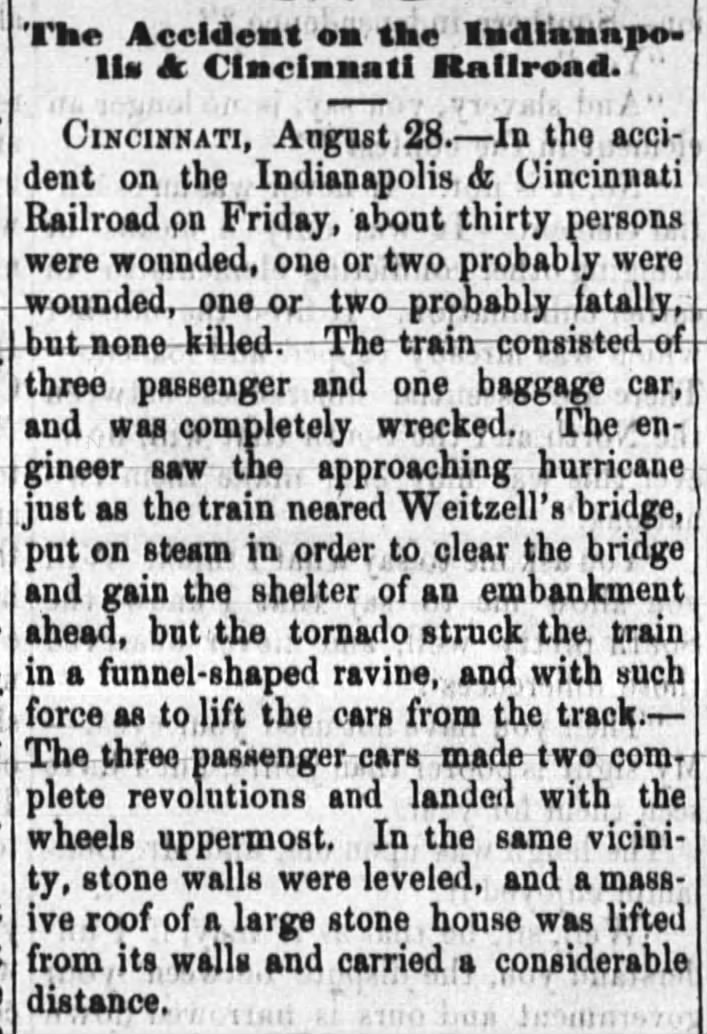
As we take cover, we might remember that it was on this date in 1864 that a train running from Cincinnati to Chicago was derailed by a tornado in Dearborn County, Indiana (about 75 miles southeast of Indianapolis). Three passenger cars were lifted from the tracks and dropped in a ravine, injuring 30 people.
“There is a limit to thinking about even a small piece of something monumental”*…
Still, we can try…

Via Jason Kottke, who is reminded…
of Ben Terrett’s calculation of how many helveticas from here to the Moon and my subsequent calculations about the point size of the Earth and the Moon (50.2 billion and 13.7 billion, respectively).
* Jeff VanderMeer, Annihilation
As we size up scale, we might recall that it was on this date (the feast day of St. Mary Magdalene) in 1342, that Central Europe’s worst flood ever occurred. Following the passage of a Genoa low, the rivers Rhine, Moselle, Main, Danube, Weser, Werra, Unstrut, Elbe, Vltava, and their tributaries inundated large areas. Many towns such as Cologne, Mainz, Frankfurt am Main, Würzburg, Regensburg, Passau, and Vienna were seriously damaged, with water levels exceeding those of the 2002 European floods. Even the river Eider north of Hamburg flooded the surrounding land; indeed, the affected area extended to Carinthia and northern Italy.

“I’m playing both sides, so that I always come out on top”*…

A new database shows 1,500 US lobbyists working for fossil-fuel firms while representing green groups and other with similarly contradictory concerns…
More than 1,500 lobbyists in the US are working on behalf of fossil-fuel companies while at the same time representing hundreds of liberal-run cities, universities, technology companies and environmental groups that say they are tackling the climate crisis, the Guardian can reveal.
Lobbyists for oil, gas and coal interests are also employed by a vast sweep of institutions, ranging from the city governments of Los Angeles, Chicago and Philadelphia; tech giants such as Apple and Google; more than 150 universities; some of the country’s leading environmental groups – and even ski resorts seeing their snow melted by global heating.
The breadth of fossil fuel lobbyists’ work for other clients is captured in a new database of their lobbying interests which was published online on Wednesday.
It shows the reach of state-level fossil fuel lobbyists into almost every aspect of American life, spanning local governments, large corporations, cultural institutions such as museums and film festivals, and advocacy groups, grouping together clients with starkly contradictory aims…
Read on for chilling examples: “‘Double agents’: fossil-fuel lobbyists work for US groups trying to fight climate crisis,” from @olliemilman in @GuardianUS.
* “Mac,” It’s Always Sunny in Philadelphia
###
As we contemplate conflicts (and note that last Monday’s, then Tuesday’s “hottest day ever” records are sure to continue to be broken), we might spare a thought for Jacob Bjerknes; he died on this date in 1975. Son of Vilhelm Bjerknes, one of the pioneers of modern weather forecasting, Jacob is remembered for his seminal paper on the dynamics of the polar front, the mechanism for north-south heat transport, and for his contributions to the understanding of the weather phenomenon El Niño.

“Hurricane season brings a humbling reminder that, despite our technologies, most of nature remains unpredictable”*…

Still, as Katarina Zimmer explains, an emerging science can help us improve our forecasts…
… contemporary simulations suggest the Great Colonial Hurricane was a Category 3.5 storm, probably the strongest in recorded eastern New England history. (For reference, Sandy, which killed nearly 150 people and caused some $65 billion in damage in the United States, was technically no longer even a hurricane when it made landfall in the New York metro area in 2012.)
Scientists know about the Great Colonial Hurricane’s impact not only from written reports but curiously, also from hidden, physical impressions the long-ago storm left on the landscape.
At the bottom of a pond, Jeffrey Donnelly, a hurricane scientist at the Woods Hole Oceanographic Institution, and his colleagues found subtle, buried evidence of the storm that almost felled the Mather line. The researchers were collecting sediment cores from a lakebed on Cape Cod. The spot, known as Salt Pond, lies about a third of a mile from the ocean and has long been a place of mud. But in their core samples, they found a pinky finger-thick layer of pure ocean sand in layers that dated back to roughly 1635. The only thing that could have pulled that much beach material over the sand barrier and that far inland was a truly massive storm.
The cores revealed other clues, too. Although written accounts suggest the 1635 tempest was the strongest of its time, the exhumed samples showed it wasn’t the only intense storm in the area. Donnelly found evidence for 10 major storms in the area between 1400 and 1675—a surprising toll, given that major hurricanes are virtually unheard of this far north today. The fact that hurricanes were much more frequent in the past begs the question of why, and whether these levels of storm activity could someday return.
Which is why researchers like Donnelly are traipsing along coastlines and digging in the muck. They hope their relatively new branch of science, paleotempestology (the study of old storms), can use these buried traces of long-gone winds to augur ancient patterns. Patterns that might also help us predict the weather that lies ahead…
Paleotempestology promises to uncover patterns of historical hurricanes—to better predict destructive weather of the future. More at: “The Secret Messages in Ancient Storms,” (or here) from @katarinazimmer in @NautilusMag.
* Diane Ackerman
###
As we muse on the meteorological, we might send exploratory birthday greetings to Bernard Brunhes; he was born on this date in 1867. A geophysicist, he is known for his pioneering work in paleomagnetism, in particular, his 1906 discovery of geomagnetic reversal [see here]. The current period of normal polarity, Brunhes Chron, and the Brunhes–Matuyama reversal are named for him.
Brunes made his discovery in a way that presaged the work of paleotempestologists: he found volcanic lava and clay samples that recorded the Earth’s inversion of its magnetic field.

You must be logged in to post a comment.