Posts Tagged ‘Trump’
“America I’ve given you all and now I’m nothing”*…

I don’t normally deal with current politics, and certainly not two days on a row. But these are tumultuous times. As we look forward, we’d be wise to heed Marilynne Robinson…
… I have devoted a good part of my life to studying American history and literature. And I have regretted the habit of self-disparagement that has caused things of great worth to be undervalued, including the habits of respect that make debate possible. I mention this because there is a baffled cynicism abroad in the country, a sense that we will and must fail at everything except adding wealth to wealth and influencing other countries to their harm. We have the war in Gaza to remind us how suddenly horror can descend on a region, how a provocation can unleash utter disaster, and how the contending pathologies of a few men can destroy lives by the scores of thousands. A profound alienation has set in, regularly expressed on both sides in contempt—contempt for Trumpists and those who vote with them on one side, and on the other side Trump and his allies’ contemptuous rejection of the entire project we have called America. In contemporary parlance this rejection is called conservatism…
… my subject is the rage and rejection that have emerged in America, threatening to displace politics, therefore democracy, and to supplant them with a figure whose rage and resentment excite an extreme loyalty, and disloyalty, a sort of black mass of patriotism, a business of inverted words and symbols where the idea of the sacred is turned against itself. I will suggest that one great reason for this rage is a gross maldistribution of the burdens and consequences of our wars. If I am right that this inequity has some part in the anger that has inflamed our public life, in order to vindicate democracy we must acknowledge it and try to put it right.
It is taken to be true that the Trump phenomenon reflects the feeling in a large part of the population that they are “left behind.” This view is obviously too smug to deserve the acceptance it enjoys. Why does this movement have no vision of a future, beyond the incarceration of whomever Trump chooses to vilify? Why have its members proposed no reforms to narrow the economic divide? Why is there no response to the ambitious investments President Biden has made, designed to stimulate the economies of struggling areas? A “populism” whose lieutenants have an impressive number of Yale Law degrees and whose idol is a Manhattan moneyman is not to be understood as a flaring up of aggrieved self-interest. Nothing we normally think of as profit will accrue to these foot soldiers.
An anger that is too intense and immediate to pause over possible consequences, whether desirable or not, seems to make a better account of this movement. Having no vision, it would certainly have a future. Trump is an old man, and he will soon go the way of his ancestors. But the very arbitrariness of his being chosen as the hero of the disaffected means that when he goes he is likely to be replaced in their angry adoration by someone equally improbable, perhaps Robert F. Kennedy Jr. This is truer because Trump has proved that law can be scorned without consequence. He has shown us that there is a kind of loyalty that neuters outrage, and he has established a breadth of latitude for scurrilous and threatening speech that can only be of profound use to every scoundrel who succeeds him.
This anger is entangled with resentments and revanchism and varieties of opportunism, including Trump’s, that are readily seen as discrediting the entire phenomenon of unrest. But this is the kind of mistake that comes with the idea that the old symmetry of opposed parties is in play here. The MAGA side really has no politics. Its broad appeal lies in its galvanizing resentment, which is what anger becomes when its legitimacy is not acknowledged. Trump can reverse himself on any point, and his followers will simply realign themselves as necessary. If he were dealing with his followers in good faith, Trump would be offering them policies addressed to the relief of their grievances. Instead, he recites his own.
I will suggest that, in the very fact of making no sense, the movement has enormous meaning. Something has enraged a great many Americans, and a democracy worthy of the name should make a serious effort to understand what it is. The pocketbook metric we apply to everything is not sufficiently respectful to be of use…
…
… All the flags and chants give the Trump rallies the look of traditional nationalism. Trumpism is in fact very singular, however, in its insistence that America is a failed country, a scene of hideous crime, invaded by depraved aliens and betrayed by depraved liberals, all of whom should be jailed or worse. Trump’s America is a thing of sham institutions and fake information—this should be a joke, considering, for example, Trump University and the fakery of the National Enquirer—and is altogether so fallen that it must defer to the wisdom of Vladimir Putin and autocrats in general. All this seems less like love than loathing. By every measure I know of, the country is doing well. Comparisons are always difficult. We know from the reportage of Tucker Carlson that Moscow has one highly polished grocery store. How appropriate it is to generalize from this fact we cannot tell. And, of course, what should it matter to anyone who prefers a little democratic clutter to an (apparently) immaculate authoritarianism? This choice has presented itself before.
In any case, this “nationalism” departs from tradition in that its foreign enemies are the desperate immigrants trying to cross the southern border—for all the excitement, an appropriate adversary for a bully only. Trump’s militaristic fantasies involve calling up the army to crush resistance on the part of Americans. I cannot account for these passions he seems to channel for his crowds except as a fusion of disillusionments, a sort of plasma not accessible to conventional political or economic analysis. I am far from dismissing it on these grounds. With the proviso that the part of the population that might show up at Trump rallies is small, and that many might be attracted by the febrile showmanship, even by the certainty that their own primal screams would startle no one in all that noise, opinion makers assume that these people do tell us what our future might be, beginning as soon as November.
If my analysis has any merit, one side in this opposition has a far richer and more nuanced geopolitical insight. A population more likely to provide troops for the military would have a livelier awareness of the fact that they are deployed all over the world, in places that are or at any time might become very dangerous. This might yield a different definition of globalism. On the other side, that regrettable gift for forgetting is a factor, forgetfulness of the weight of this burden. Trump’s utter lack of foreign policy beyond a resentment of Europe, his hinted readiness to capitulate in the face of what he constantly represents as superior strength and “genius,” seems never to thin his crowds. His antagonism toward NATO is expressed in mercenary terms, though the economic consequences of the fraying of the West would be unimaginably great. An era of smash-and-grab would benefit those inclined that way and well positioned for it. Trump never describes a future, which is sensible, since no policy he suggests would be less than disastrous.
All this is beside the point in the minds of his followers. Perhaps their zeal is driven by the thought of shaking the foundations of the existing order, which they passionately insist is not the legitimate order that would be restored by institutions and elections they accepted as having integrity. The problem is that they will never be satisfied as long as their resentments are channeled without definition, and without hope or purpose, into a political system that was designed and has functioned to produce a government. If their grievances could be made political, could be spoken of in terms of policy, in terms of justice and reform, of democracy, then Trump could concentrate on selling sneakers and Bibles. And the press and public should stop seeing his hectic road show performances as proof of health and vigor.
I have done the thing I deplore. I sat down to write about Joseph Biden and ended up writing about Donald Trump. President Biden is looking back on a long life, imagining a future that will return the country to its true work, of achieving fairness and mutual respect as norms of American life. The personal tragedies he has suffered are well known. It should be noted here that he lost a son to illness apparently related to military service.
Why does President Biden not receive credit for his remarkable legislative achievements? Whenever he announces a policy that is designed to benefit a particular region, this is interpreted in the press as a lure meant to attract swing state voters, which if true would only mean that the policy is welcome and likely to produce good results. Cynicism is an excuse for the failure to actually look at the substance of a presidency, and can only be a major contributor to the general sense that the country is adrift. Add to this the erasure of differences between parties and candidates that comes with cynicism, and the idea that voting is an empty exercise is reinforced. All this tends to delegitimize government, making it a thing of ploys and impositions no matter how wise and well-intentioned it may in fact be.
There is a tone of implied dissatisfaction among the commentators, in the absence of specifics, that functions in the public discourse as if it were weighty and considered objection. It is an attitude, not a reaction to actual circumstance, so there is no possibility of rebuttal. Jimmy Carter, now revered, his brilliance acknowledged, fell victim to this same hectoring. It is fair to wonder what the state of the environment might be if the press then were not so distracted by his cardigans and his southernisms. President Biden is old, and there is concern that his health might decline, leading to some disruption. But this consideration should be weighed against the fact that Trump promises only disruption. That he might pursue bad policies with enormous vigor should reassure no one.
The twentieth century left the world in a parlous state. Our foreign entanglements have passed through permutations that have made them truly baffling. We have always supported Israel. Now our strength is shackled to its weakness. The consequences of our even seeming to be about to abandon Israel could be cataclysmic, for it and for that region, at very least. So Netanyahu has a free hand, to the world’s grief and, it must be feared, ultimately to Israel’s. This state of things has been developing over many years. There is no simple, obvious solution available to an American president.
Americans have special obligations to reality. It is true and manifest that we will have an outsize part in determining the fate of the planet. If it should be that big problems cannot be solved and that we are left with the tedious business of managing them, we should discipline ourselves to patience and deliberation, the old courtesies that have made democracy possible. We have at hand the best resources that can be had to deal with our situation, if we can agree to respect them…
Eminently worth reading in full. We ignore at our peril the rage that animates Trump voters: “Agreeing to Our Harm,” in @nybooks. (With apologies to The New York Review of Books, to which I subscribe, I have broken my usual habit of sharing direct links, even when the source is behind a pay wall. Because I hope that everyone will click through and read the entire essay, I have linked to an archived copy, freely available to all.)
See also: Richard Slotkin‘s “The conflict between Red and Blue America is a clash of national mythologies” from @yalereview.
* Allen Ginsberg, “America”
###
As we take stock, we might recall that it was on this date in 1972 that the Supreme Court– a very different Supreme Court than today’s– unanimously ruled that President Richard Nixon did not have the authority to withhold subpoenaed White House tapes and ordered him to surrender the tapes to the Watergate special prosecutor.

“When the gods want to punish us, they answer our prayers”*…

… So, the estimable Rana Foroohar suggests, American business leaders should be careful what they wish for…
For months now, I’ve been watching with alarm how many top business leaders in the US are buying the line that Donald Trump II would somehow be just like the last time around — loud, but laissez-faire. It was so depressing to see some of America’s top CEOs giggling as the former president joked at his recent Business Roundtable event in Washington. Trump said that he’d polled waitresses and caddies (presumably at Mar-a-Lago) about removing taxes on tips and they were in favour. Sure, there were reports of some grumbling about hardline tariff talk, Trump’s inability to stay on point and his general blow-hardness. But for the most part, tax cuts, deregulation and an utter lack of imagination about political risk seems to be driving business sentiment around him.
It’s not just American business that has the blinders on. I did a Lunch with the FT [gift link] with Lloyd’s of London chief executive John Neal, and I was amazed that when I asked him to think about his top US political risks, he spoke first about Joe Biden’s money printing — rather than the risk to, say, the rule of law under Trump. When I pressed him on the Trump risk, his biggest worry seemed to be the differing policies of the two candidates around things like electric vehicle production, and the decision risk that this might introduce for companies.
Really folks? Let’s have a refresher course on Trumpian economics.
In 2016, Trump talked tough about Made in America and helping working people, but most of his economic policies (aside from tariffs on China) were basically business as usual. He rolled back regulation and lowered taxes on big corporations. Much of the money went to stock buybacks, not Main Street investment. That buoyed short-term stock prices, which were also helped along by low interest rates.
But, it’s VERY unlikely we would see the same phenomenon in a second Trump administration. His tenure marked the apex of financialised growth, which is now largely tapped out. As the Federal Reserve’s End of an Era paper from June 2023 laid out, more than 40 per cent of real corporate profit growth between 1989 and 2019 came from the secular fall in interest rates, and corporate tax rates being cut. That’s what has propelled so much growth in equities in recent years.
Today, the S&P is by some measures more overvalued than it was when the housing bubble burst. In this environment, it’s difficult to see equities rising even if the Fed were to begin cutting rates in the face of a recession. It’s much more likely they’d fall, despite any new Trump tax cuts. And that is the more benign scenario. A more likely possibility is that we’d get a harder-edged, even more insular, xenophobic and paranoid version of Trump this time around.
For starters, few of the more moderate business types that served with him the first time would be willing to come into a second administration given the January 6 2021 Capitol riots and Trump’s ongoing election-loss denial. Some smart people in the business community have concerns about his propensity for fiscal profligacy at a time when rising US deficit levels are worrying investors. It’s fascinating to me that people think about Biden when they think about debt, rather than Trump. Biden’s White House has made record fiscal investment, sure, but it is investing in the real economy, while Trump’s legacy was a classic Republican formula of boosting asset markets with financialisation.
Add to that the prospects of a 10 per cent tariff on imports across the board, and 60 per cent levy on China. This goes to what has been one of the biggest problems with Trump’s trade and economic strategies from the beginning — a tendency to blame China and employ tariffs as a standalone solution to the big, complex problem of slower secular growth and growing inequality in the US. Not that Trump seems to think in such nuanced terms. The fact is that America’s economic and political problems are only partly about the failings of globalisation and the neoliberal trading system in particular. They are also about a lack of investment at home, in basic infrastructure, skills and education, as well as core research and development.
I haven’t seen anything yet that makes me think that Trump or anyone in his orbit has a plan for a multipolar world, or any sense of how to manage complex supply chain de-risking or the politics of friendshoring. And yet, 10 or 60 per cent tariffs depending on the locale would require some kind of reshoring approach. None of that will square with an asset boom, but rather quite the opposite…
A warning to business leaders supporting Trump, from @RanaForoohar @FT.
(Image above: source)
* Oscar Wilde
###
As we study self-interest, we might recall that it was on this date in 1972 that an 18-1/2-minute gap appears in the tape recording of the conversations between U.S. President Richard Nixon and his advisers regarding the recent arrests of his operatives while breaking into the Watergate complex.
Still, the tapes were damming. The White House released the subpoenaed tapes on August 5. One tape, later known as the “Smoking Gun” tape, documented the initial stages of the Watergate coverup. On it, Nixon and Haldeman are heard formulating a plan to block investigations by having the CIA falsely claim to the FBI that national security was involved.
It’s a measure of how different those times were from ours that, once the “Smoking Gun” transcript was made public, Nixon’s political support practically vanished: the ten Republicans on the House Judiciary Committee who had voted against impeachment in committee announced that they would now vote for impeachment once the matter reached the House floor.

“Despite the constant negative press covfefe”*…

(Roughly) Daily rarely addresses the topically-political, but today– Inauguration Day in the U.S.– is a special occasion. So, even as we witness the not-as-peaceful-as-it-should-have-been transfer of power, we might spare a thought for the legacy of our out-going President…
We are still grappling with what it means to have endured Donald J. Trump’s presidency while still repairing the historic carnage of this tumultuous period in American history. This Presidential Library is an attempt to provide the American and International communities a place to reflect on what the rise of White Nationalism has meant to our country and try to eradicate it from our political discourse…

Tax evasion or the world’s worst businessman… why choose just one when you could have both? You’ve read The Art of the Deal – now take in volume II: the art of being smarter than all of you idiots. This mural showcases the staggering amounts of money one man declares to have lost, all in an effort to prove to the world that he’s actually a… winner…

A troubled history of failure– putting the 45th President’s life and work into historical context, while documenting the damage done to American institutions and spirit: “The Donald J. Trump Library.”
* President Donald J. Trump, Twitter, 31/5/17
###
As we face history, we might (or might not) send birthday greetings to Kellyanne Conway; she was born on this date in 1967. A pollster and political consultant, she served as campaign manager for Donal Trump in 2016, then as Special Counselor to (and surrogate for) the President from 2017.
During her tenure, Conway has been embroiled in a series of controversies: using the phrase “alternative facts” to describe fictitious and disproven attendance numbers for Trump’s inauguration; speaking multiple times of a “Bowling Green massacre” that never occurred; and claiming that Michael Flynn had the full confidence of the president hours before he was dismissed. Members of Congress from both parties called for an investigation of an apparent ethics violation after she publicly endorsed commercial products associated with the president’s daughter, Ivanka Trump. And in June 2019, the U.S. Office of Special Counsel recommended that Conway be fired for “unprecedented” multiple violations of the Hatch Act of 1939.
Las summer, Conway stepped down from her Counselor position (after her daughter threatened to seek legal emancipation), though she still plays a surrogate role.
Kellyanne Conway is a member of the inaugural class of the “Hall of Enablers” at the Donald J. Trump Library.

“We all know that an angry electorate is a voting electorate”*…

Further to yesterday’s post…
The final vote tallies still aren’t known, but the media verdict of this presidential election is in: it’s 2016 all over again. Four years ago, in the hours after Donald Trump declared victory on the strength of 306 Electoral College votes and the ballots of nearly sixty-three million Americans, I wrote a column about the failures of the press throughout that campaign, and declared that “journalism’s moment of reckoning” had arrived. “Reporters’ eagerness first to ridicule Trump and his supporters, then to dismiss them, and finally to actively lobby and argue for their defeat have led us to a moment when the entire journalistic enterprise needs to be rethought and rebuilt,” I wrote then.
It is astonishing, today, how little we seem to have learned since. Once again, opinion polls were overhyped and under-scrutinized. Some of them were also wildly off—and, though that’s different from 2016, when the polls were largely accurate but widely misunderstood, it doesn’t let media organizations off the hook for their treatment of the numbers. Newsrooms leaned too heavily on polls as a substitute for on-the-ground reporting, and they were led astray. Journalists spent too much time talking to each other on Twitter, inhabiting an alternate algorithmic reality that bore little resemblance to the life of the country. And major media institutions made it all but impossible to envision that, despite the wealth of reporting on the president’s lies and his racism and his circus—nearly half the country remains beholden to the man and his beliefs. “We can’t go back to assuming, just because we think Donald Trump is an outlier, that he is not connecting to a lot of American people in ways that, frankly, a lot of us cannot understand,” Claire McCaskill, a former Missouri senator, said Wednesday morning on MSNBC. The feeling of déjà vu, and of lost journalistic opportunity, is inescapable…
Kyle Pope (@kylepope), editor of the Columbia Journalism Review on lessons unlearned: “What the polls show, and the press missed, again.”
On the problem(s) with polls, pair with “Of course Trump’s voters lie to pollsters. You call us all racists” (with an eye to the phenomenon it addresses– and the questions raised by the rationale it offers…)
For one (very compelling) account of why Pope’s project matters, see Fintan O’Toole’s “Democracy’s Afterlife.” (For more, see also Ron Brownstein, Roxane Gay, and George Packer on the same family of issues… there are lots of diagnoses abroad in the infosphere at the moment; these are among the best your correspondent has found.)
And for a resonant but different take on the necessary role of “honest journalism” going forward, see also Jay Rosen’s “America’s Press and the Asymmetric War for Truth.”
###
As we look more deeply, we might recall that it was on this date (18 Brumaire in the French Republican Calendar) in 1799 that thirty-year-old Corsican General Napoleon Bonaparte overthrew the Directory in France and established the Consulate, ending the power of the revolutionary oligarchy and creating himself as First Consul… or dictator.
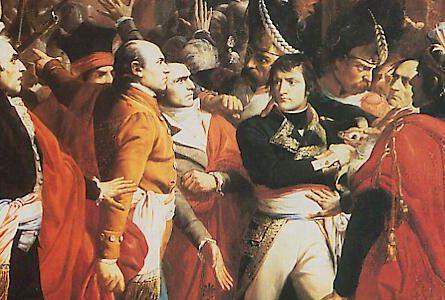
“The reason I talk to myself is because I’m the only one whose answers I accept”*…

One of the stranger rituals performed by the media in the Trump era has been to keep an obsessive count of the president’s lies since he took office. By September 2018, TheWashington Post reported, he had already passed the 5,000 mark, including a new one-day record of 125 on September 7. The Poynter Institute’s nonpartisan fact-checking project PolitiFact keeps a running list, and The New York Times did likewise throughout 2017.
There is a certain pointlessness to these exercises. Anyone who has paid even the slightest attention to Donald Trump should recognize that, since long before his presidential campaign, he lies as easily as he breathes. He says whatever he thinks will get him what he wants, and whatever he thinks he can get away with. But if there is nothing truly revelatory about the number of Trump’s lies, keeping track of them still serves a variety of symbolic purposes for the commentators who repeat the steadily mounting figures with gleeful outrage. One is simply to underline the extent to which this is not a normal presidency. Another, far more debatable, is to hold up Trump as a symptom and symbol of what is often called the “post-truth era.”…
Princeton historian David Bell, reviewing Penn historian Sophia Rosenfeld’s Democracy and History: a Short History…
Not only does she make short work of the “postmodernism is to blame” argument; she provides the historical background necessary to understand our current truth crisis. That a crisis does indeed exist, Rosenfeld has no doubt. But it is not one that came upon the Western world from nowhere, like a meteor strike vaporizing a peaceful pastoral landscape. Instead, it broke along an epistemological fault line that has existed in modern democratic regimes since their founding: Who has the authority, in a democracy, to determine what counts as truth—an elite of the supposedly best, most intellectually capable citizens, or the people as a whole?…
Rosenfeld cannot resist mentioning the Trump lie count at the start of her book. But rather than treat it as a shocking sign of the new “post-truth era,” she uses it to note the obvious fact that truth and democratic politics have “never been on very good terms.” If we are now living in an age of unprecedented mendacity, what was the Nixon administration? For that matter, no less an American icon than George Washington complained, at the end of his presidency, of the “ignorance of facts” and “malicious falsehoods” with which hostile newspapers had tried to destroy his reputation.
Rosenfeld also insists (borrowing, yes, from Foucault) that different societies exist under different “regimes of truth.” Not all truths are self-evident, and not all facts are easily verifiable, so societies need particular evidentiary standards and forms of authority to determine where truth lies. These can change from place to place and from era to era; they are rarely (if ever) stable or uncontested, but continuities are still discernible.
Our own regime of truth dates back to the 18th century, when a host of Enlightenment thinkers challenged established churches and rulers. They insisted that no single individual or institution should “hold a monopoly…on determining what counts as truth in public life” and disputed the idea—long promoted by absolute monarchs—that good rulership involved keeping most information secret and lying when necessary to protect the state. They put a premium on the values of openness, transparency, sincerity, freedom of expression, and unfettered debate. In short, they created the “truth culture of the transatlantic Enlightenment.”…
How does truth fit into democracy? Read in full at “An Equal Say.”
* George Carlin
###
As we contemplate context, we might recall that it was on this date in 1825 that the U.S. House of Representatives elected John Quincy Adams to the Presidency. The election of 1824 had been contested by four candidates from the Democratic-Republican Party: John Quincy Adams, Andrew jackson, William Crawford, and Henry Clay. Jackson won a plurality of the popular vote, and a plurality– but not a majority– of the electoral college vote… so the race went to the House of Representatives. Per the Twelfth Amendment, the House considered the top three vote-getters in the electoral college. That eliminated Clay, who threw his support to Adams– who prevailed.
After the election (the first in which a president did not receive the most popular votes; so far the only race settled in the House), Adams named Clay to the coveted post of Secretary of State– deemed “the corrupt bargain” by Jackson, who went on to form (what evolved into) the Democratic Party. The Democratic-Republicans became the National Republican Party (AKA, the Anti-Jackson Party), then the Whig Party.

You must be logged in to post a comment.