Posts Tagged ‘social media’
“Badger hates Society, and invitations, and dinner, and all that sort of thing”*…

Americans are now spending more time alone– mostly at home– than ever. It’s changing our personalities, our politics, and even our relationship to reality. While the pandemic certainly enforced some of that isolation; the post-COVID world remains extraordinarily atomized.
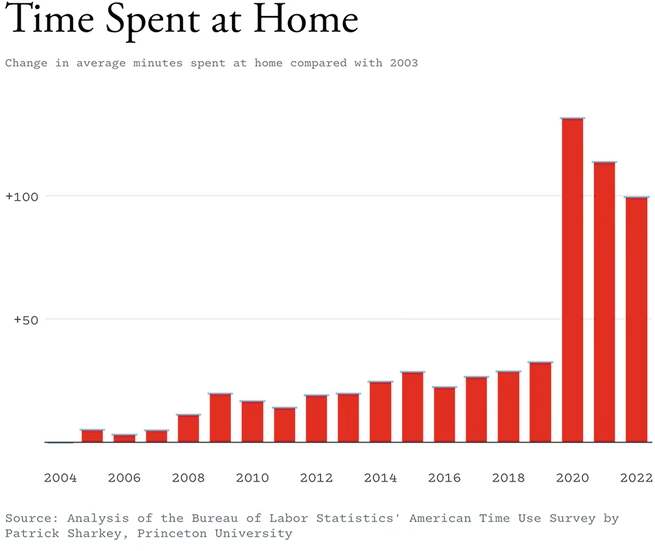

In a bracing essay, Derek Thompson, explores the emergence of this wide-spread isolation, unpacking its drivers, enumerating its considerable (personal and civic) costs, musing on the possible impact of AI, and pondering what might lead to a return to sociability…
… “I have a view that is uncommon among social scientists, which is that moral revolutions are real and they change our culture,” Robert Putnam [author of Bowling Alone] told me. In the early 20th century, a group of liberal Christians, including the pastor Walter Rauschenbusch, urged other Christians to expand their faith from a narrow concern for personal salvation to a public concern for justice. Their movement, which became known as the Social Gospel, was instrumental in passing major political reforms, such as the abolition of child labor. It also encouraged a more communitarian approach to American life, which manifested in an array of entirely secular congregations that met in union halls and community centers and dining rooms. All of this came out of a particular alchemy of writing and thinking and organizing. No one can say precisely how to change a nation’s moral-emotional atmosphere, but what’s certain is that atmospheres do change. Our smallest actions create norms. Our norms create values. Our values drive behavior. And our behaviors cascade.
The anti-social century is the result of one such cascade, of chosen solitude, accelerated by digital-world progress and physical-world regress. But if one cascade brought us into an anti-social century, another can bring about a social century. New norms are possible; they’re being created all the time. Independent bookstores are booming—the American Booksellers Association has reported more than 50 percent growth since 2009—and in cities such as New York City and Washington, D.C., many of them have become miniature theaters, with regular standing-room-only crowds gathered for author readings. More districts and states are banning smartphones in schools, a national experiment that could, optimistically, improve children’s focus and their physical-world relationships. In the past few years, board-game cafés have flowered across the country, and their business is expected to nearly double by 2030. These cafés buck an 80-year trend. Instead of turning a previously social form of entertainment into a private one, they turn a living-room pastime into a destination activity. As sweeping as the social revolution I’ve described might seem, it’s built from the ground up by institutions and decisions that are profoundly within our control: as humble as a café, as small as a new phone locker at school…
On how we spend our time and what that yields: “The Anti-Social Century,” from @dkthomp.bsky.social in @theatlantic.com (gift article).
See also: “You’re Being Alienated From Your Own Attention,” from @chrislhayes.bsky.social (also in @theatlantic.com, also a gift article)
* Kenneth Grahame, The Wind in the Willows
###
As we call a friend, we might recall that it was on this date in 1915 that Alexander Graham Bell placed the first transcontinental phone call, from New York to San Francisco, where the Panama–Pacific International Exposition celebrations were underway and his assistant, his assistant Thomas Augustus Watson stood by. Bell repeated his famous first telephonic words, “Mr. Watson, come here. I want you,” to which Watson this time replied “It will take me five days to get there now!” Bell’s call officially initiated AT&T’s transcontinental service.

And, on ths date 45 years later, in 1959, The first non-stop transcontinental commercial jet trip was made by an American Airlines Boeing 707, from Los Angeles to New York. The sleek silver plane made the flight in airline official time of 4 hours and 3 minutes, half the usual scheduled time for the prop-driven DC- 7Cs then in regular use on that route.

“The purpose of the Great Proletarian Cultural Revolution is to destroy the old culture. You cannot stop us!”*…

… or perhaps (per the title quote above), China in the late 60s and early 70s.
Ryan Broderick, with thoughts on reactions to the recent assassination of United Healthcare’s CEO…
Last week, the CEO of UnitedHealthcare, Brian Thompson, was gunned down by an unknown suspect outside of a Manhattan hotel as he was headed to an investor’s meeting. The New York Police Department is now carrying out a manhunt to find the gunman, who is still at large. Authorities released four, unfortunately, dazzling photos of Thompson’s seemingly very handsome masked killer, revealed that his shell casings had the words “deny,” “defend,” and “depose” carved on them, and, also, found a backpack full of Monopoly money believed to belong to the suspect. Oh, also, the hospital Thompson was sent to after the shooting wasn’t in UnitedHealthcare’s network. All of this has only added to the social media frenzy around the murder.
In fact, the overwhelming response to Thompson’s death online could be summed up as “lol, lmao even.” But it, should be noted, that it’s not just chronically online shitposters celebrating Thompson’s death. It’s possible this is the most aligned America — well, aside from the folks in its highest tax brackets — has been about a news story since the invention of the internet.
An announcement on Facebook from UnitedHealthcare had to have reaction counts turned off because of the amount of laughing emojis users were adding to it. Right-wing pundit Ben Shapiro’s viewers were breaking rank in the comments underneath a video of his about the killing. Reddit moderators couldn’t contain a thread about it on r/medicine. There was a lookalike contest for Thompson’s killer in Washington Square Park over the weekend. There’s a ton of merch with “deny,” “defend,” and “depose” popping up. And there are even some fun conspiracy theories…
… Reporter Taylor Lorenz went long over in User Mag about about how, no, this does not mean that an overwhelming amount of the country is pro-murder, or whatever. “Thousands of Americans (myself included) are fed up with our barbaric healthcare system and the people at the top who rake in millions while inflicting pain, suffering, and death on millions of innocent people,” she wrote. And Today In Tabs’ Rusty Foster put it another way, writing, “A nation full of people absolutely parched for consequences and with nothing to look forward to but rising fascism.”
The only recent story like this that you can really point to is the assassination of Japanese Prime Minister Shinzo Abe in 2022. His killer revealed that he carried out the attack because of Abe’s support of the Unification Church, a cult-like religious order that wields a tremendous amount of political influence in Japan. And the overwhelming response from both the Japanese public and lawmakers, alike, was, yeah, actually, he had a point. I don’t think Thompson’s murder is suddenly going to lead to the dismantling of America’s cruel and inhumane healthcare industry, but it’s certainly been a cathartic few days online.
It has also quickly unraveled a decade-plus of right-wing programming in online spaces for young men. Many of whom are suddenly realizing maybe there are meatier subjects to take their anger out on than the racial makeup of Star Wars casting announcements. The best example being a thread yesterday on the subreddit for the edgelord streamer Asmongold, where users were enthusiastically talking about giving up the culture war to focus on a “class war”. The thread was deleted eventually for being “political,” but the same conversations are happening all over the manosphere right now. Which, you know, I don’t think anyone had an anonymous assassin on their list of possible “Leftist Joe Rogan’s,” but it seems like he’s moved to the head of the pack.
As Bluesky user hayao.lol wrote, “However this ends up [as of this writing, authorities have detained “a person of interest”] the guy won, flat out. This has done more damage to the image of the surveillance state, public complacency around healthcare, and ‘cops’ as a concept than any other single act.” Which I suspect is what’s actually making US elites so uncomfortable about all of this.
Thompson’s death [has] been a real shock to the system for America’s ruling class, who seem to be realizing for the first time that the majority of the country will not mourn their deaths. As podcaster and reporter Michael Hobbes wrote a few years ago, “I think we’ll look back on the last decade as a time when social media gave previously marginalized groups the ability to speak directly to elites and, as a result, elites lost their minds.” Which is why a whole bunch of tedious hall monitors are suddenly tut-tutting about all the memes in every major newspaper. I, personally, am not going super hard on the pro-assassination memes — as funny as they are — because we just don’t know what the motive was. We live in a time of mass accelerationist violence and I don’t feel like publicly cheerleading a guy who might have a compound full of deranged far-right ramblings. But I’m also not stupid enough to think that scolding the entire internet for how they’re acting is a meaningful use of my time on planet Earth. Maybe if I had a paid column somewhere — or proper health insurance — I’d feel different…
History suggests that when a political/economic system needs reset, but those who control it resist, the consequence can be an explosive period of painful brutality… that’s to say, “brutal” in that it is too often too bloody, and “brute” in that it is a blunt instrument, inflicting pain and damage much more broadly than just on its ostensible targets… a period of chaos too often followed by an autocracy (a la Napoleon in France and CCP one-party rule in China). The only way to avoid such an explosion is to begin making the changes that can alleviate pressure– to address the real needs of those whose suffering is fueling their growing anger– before that pressure destroys the system entirely.
Fix it, or it fails completely… and quite possibly catastrophically.
Learning from tragedy– on the warning shot that killed the United Healthcare CEO: Trying to scold the entire internet,” from @ryanhatesthis.bsky.social.
See– do see– also: “Radicalized,” from Cory Doctorow
* An unnamed Red Guard, 1966
###
As we contemplate consequences, we might recall that it was on this date in 1915 that Chinese president Yuan Shikai proclaimed the Empire of China (AKA the Hongxian Monarchy), an attempt to reinstate the monarchy in China, with himself as emperor. His reign was short-lived: a civil war broke out 10 days later; in March of 1916, Yuan “abdicated,” and the republic was restored. The republican cause was set back by several years, and China entered into a period of fracture and conflict among a number of local warlords.

“Be careful what you wish for”*…

… And how you wish for it. Eric Athas, with an all-too-timely reminder…
Whenever I’m thinking about ideas to send to you all, I’m reminded of a principle called Goodhart’s Law, which says: “When a measure becomes a target, it ceases to be a good measure.”
In other words, when you tell people they’re being evaluated by a target they must hit, you risk pushing them to produce the wrong results in the name of reaching the target. The incentives can drive them to fixate on achieving the target, not achieving the overall goal.
The concept is named after the economist Charles Goodhart, who introduced it in a 1975 paper about monetary management. But the theory has been connected to a range of situations.
One of the most famous examples is a story about colonial India, when the British government sought to subdue an overpopulation of cobras in Delhi by placing a bounty on the snakes. Turn in a snakeskin, get some money.
But the plan backfired. People started farming cobras to cash in on the bounties, only exacerbating the population problem. This tale, which you can hear more about in a 2012 Freakonomics episode, spawned a shorthand for this phenomenon—the cobra effect…
… Goodhart’s Law, or the cobra effect, isn’t limited to economic policy or invasive species. You can apply it to everyday situations:
- A fitness tracker rewards you for clocking 10,000 steps a day, so you spend your evenings pacing around your living room. [see here]
- A calorie-counting app pushes you to form an unhealthy diet to stay under the limit.
- You set a resolution to read book a week but soon begin selecting books purely based on length—not interest or relevance—to hit the target.
- A construction firm is given unrealistic milestones and must cut corners to fulfill a contract.
- A school becomes hyper-focused on its test scores and offers incentives for grades instead of providing a well-rounded educational experience.
That last one happened in a years-long cheating scandal in Atlanta that unraveled in the 2010s.
Workplace quotas can have this effect, too. When you’re evaluated based on a quota, you may do anything to meet that quota, even if the quality of the work diminishes.
On the flip side, a quota policy may demotivate workers. Here’s what Adam Cobb, a professor of management at Wharton, said in a Wharton write-up about quotas: “People might start withholding effort … If you can easily meet your monthly quota, why should you try as hard once the goal is reached? Doing so may encourage the company to raise the quota, making your life harder.”
You can find the cobra effect in academic research, too, with the push for publication fueling an increase in fake papers.
Today, we’re surrounded by measurements that can be tempting to use as targets in our behavior. What is inbox zero but a target that may distract us from completing more fulfilling work?
I think a lot about the cobra effect with social media, where your success is tied to your ability to accrue views, likes, comments, and shares. Those targets can create an expectation that you must always be creating something new. Social media managers, influencers, and YouTubers have talked about the pressure to churn out new content to please algorithms and feed their audiences…
… Which brings me back to the point I started with a few hundred words ago, and the title of this post. I send this newsletter every Sunday. The routine is helpful because it provides me with a structure to work within. Absent that framework, I could end up spending too little or too much time on it.
But I must remind myself that the weekly tempo isn’t the target. If it were, I’d be critiquing myself based on arbitrary timing, not on the quality of the information I’m sharing with you. I’d be more prone to “spin up” content, as opposed to finding interesting ideas to share with you. I try to keep Goodhart’s Law in mind each week.
As you go about your day, consider your own goals, personally and professionally. When you take an action, like posting a photo on social media or completing a work task, are you doing it to please a measurement? To hit a target?…
The cobra effect and the dangers of turning measures into targets: “I’m not writing this to hit a weekly target,” from @ericathas.
Apposite: “When workplace bonuses backfire” (Economist gift link)
(Image above: source)
* Aesop’s Fables
###
As we interrogate our intentions, we might recall that it was on this date in 1793 that the Queen of France, Marie Antoinette, was beheaded. The French Revolution had begun in 1789…
… The Storming of the Bastille on 14 July led to a series of radical measures by the Assembly, among them the abolition of feudalism, state control over the Catholic Church in France, and a declaration of rights.
The next three years were dominated by the struggle for political control, exacerbated by economic depression. Military defeats following the outbreak of the French Revolutionary Wars in April 1792 resulted in the insurrection of 10 August 1792. The monarchy was replaced by the French First Republic in September, while Louis XVI was executed in January 1793.
After another revolt in June 1793, the constitution was suspended, and adequate political power passed from the National Convention to the Committee of Public Safety [which decreed Marie Antoinette’s fate]. About 16,000 people were executed in a Reign of Terror, which ended in July 1794. Weakened by external threats and internal opposition, the Republic was replaced in 1795 by the Directory. Four years later, in 1799, the Consulate seized power in a military coup led by Napoleon Bonaparte. This is generally seen as marking the end of the Revolutionary period…

“Great minds discuss ideas; average minds discuss events; small minds discuss people”*…

In his invaluable newsletter, Garbage Day, Ryan Broderick unpacks the full– and forlorn— story of the online travails of Kate Middleton (AKA Catherine, the Princess of Wales) and considers its implications…
… As Charlie Warzel wrote, “It was always going to end this way. The truth about Kate Middleton’s absence is far less funny, whimsical, or salacious than the endless memes and conspiracy theories suggested.” But this also wasn’t a simple case of the unruly masses being Bad Online.
Yes, the #WhereIsKate hashtag was initially spread by the Sussex Squad, a royal fandom subculture that hates Prince William and believes Kate is, at best, sort of racist. And a lot of the early gossip was motivated by an impulse to give Kate a taste of what Meghan Markle is still experiencing at the hands of the UK media. But if you’re looking for someone to blame all of this on, it’s clearly Kate’s press team and, by extension, everyone in her life that supposedly cares about her. There were countless moments where her press team could have squashed all this, but they didn’t. Instead, they let a woman who had just discovered she has cancer become a global laughing stock and, at one point, made her apologize for it! Absolute sicko shit.
But this is also just how our various institutions work — or more accurately do not work — now. Over the last 25 years we have slowly uploaded every part of our lives to a system of platforms run by algorithms that make money off our worst impulses. Well, the ones brands are comfortable advertising around. And for years we have wondered what the world might look like when we crossed the threshold into a fully online world. Well, we did. We crossed it. This is what it looks like. And it is already too vast and complicated and all-encompassing to blame any one individual for how it functions. If we want something new, we’d have to smash the whole thing and I don’t think that’s going to happen. So let’s hope PR people, at the very least, can figure out how to deal with it going forward…
Those of us in post-colonial North America, might ponder the implications of this sad tale for matters closer to home– public health, meme stocks, and perhaps especially our looming elections…
The saga of #WhereIsKate: “How we got here,” from @broderick.
* Eleanor Roosevelt
###
As we lean back and think, we might recall that it was on this date in 1881 that a celebrated hoaxster took on partners: “P.T. Barnum’s Grand Traveling Museum, Menagerie, Caravan, and Circus: The Greatest Show on Earth” joined forces with James Bailey and James Hutchinson. By 1887, the re-branded circus went by the name “The Barnum & Bailey Greatest Show on Earth.”

“The more wonderful the means of communication, the more trivial, tawdry, or depressing its contents seemed to be.”*…

Social media could have been a boon to journalism and the fourth estate; it hasn’t turned out that way. Charlie Warzel‘s thoughts on why that is and where things might go…
Over the past decade, Silicon Valley has learned that news is a messy, expensive, low-margin business—the kind that, if you’re not careful, can turn a milquetoast CEO into an international villain and get you dragged in front of Congress.
No surprise, then, that Big Tech has decided it’s done with the enterprise altogether. After the 2016 election, news became a bug rather than a feature, a burdensome responsibility of truth arbitration that no executive particularly wanted to deal with. Slowly, and then not so slowly, companies divested from news. Facebook reduced its visibility in users’ feeds. Both Meta and Google restricted the distribution of news content in Canada. Meta’s head of Instagram, Adam Mosseri, noted that its newest social network, Threads, wouldn’t go out of its way to amplify news content. Elon Musk destroyed Twitter, apparently as part of a reactionary political project against the press, and made a number of decisions that resulted in its replacement, X, being flooded with garbage. As The New York Times declared recently, “The major online platforms are breaking up with news.”
This is correct, but the narrative is missing something. Journalists tend to fixate on how our work is or isn’t distributed. Doing so allows us to believe that algorithms and shortsighted, mercurial tech executives are fully to blame when our work isn’t consumed. Fair enough: Platforms, especially Facebook, have encouraged news organizations to redefine their publishing strategies in the past, including through disastrous pivots to video, only to change directions with an algorithm update or the falsification of key metrics. They’ve also allowed their platforms to be used for dangerous propaganda that crowds out legitimate information. But there is also a less convenient and perhaps more existential side to tech’s divestiture of news. It’s not just the platforms: Readers are breaking up with traditional news, too.
Last week, the Pew Research Center published a new study showing that fewer adults on average said they regularly followed the news in 2021 or 2022 than in any other year surveyed. (Pew started asking the question in 2016.) There’s some shakiness when you break down the demographics, but overall, 38 percent of American adults are following the news closely, versus a high of 52 percent in 2018. This tracks: In 2022, Axios compiled data from different web-traffic-monitoring companies that showed news consumption took a “nosedive” after 2020 and, despite January 6, the war in Ukraine, and other major events, engagement across all news media—news sites, news apps, cable news, and social media—was in decline.
The struggles of legacy news organizations have no simple explanation. Trust in the media has fallen sharply in the past two decades, and especially the past several years, though much more so among Republicans. Some of this is self-inflicted, the result of news organizations getting stories wrong and the fact that these mistakes are more visible, and therefore subject to both legitimate and bad-faith criticism, than ever before. A great deal of the blame also comes from efforts on the right to delegitimize mainstream media. Local-news outlets have died a slow death at the hands of hedge funds. A generational shift is at play as well: Millions of younger people look to influencers and creators on Instagram and especially TikTok, along with podcast hosts, as trusted sources of news. In these contexts, consumer trust is not necessarily based on the quality of reporting or the prestige and history of the brand, but on strong parasocial relationships.
You can see how public opinion has shifted in surveys covering the 2010s. In 2014—squarely in the halcyon days of social news—75 percent of adults surveyed by Pew said that the internet and social media helped them feel more informed about national news. But by 2020, the conventional wisdom had shifted. That year, a Pew survey of more than 10,000 people found that “U.S. adults who mainly get their political news through social media tend to be less engaged with news” and, notably, less knowledgeable about current events and politics…
[Warzel traces the history of news and its relatioship to social media from 2013…]
It would be wrong to suggest that news—and especially commentary about the news— will vanish. But the future might very well look like slivers of the present, where individual influencers command large audiences, and social networking and text-based media take a back seat to video platforms with recommendation-forward algorithms, like TikTok’s. This seems likely to coincide with news organizations’ continued loss of cultural power and influence.
In a recent New York essay, John Herrman suggested that the 2024 presidential campaign might be “the first modern election in the United States without a minimum viable media” to shape broad political narratives. This might not be a bad development, but it’s likely to be, at the very least, disorienting and powered by ever more opaque algorithms. And although it is obviously self-serving of me to suggest that a decline in traditional media might have corrosive effects on journalism, our understanding of the world, and public discourse, it is worth noting that a creator-economy approach to news shifts trust from organizations with standards and practices to individuals with their own sets of incentives and influences.
Should this era of informational free-for-all come about, there will be an element of tragedy—or at the very least irony—to its birth. The frictionless access and prodigious distribution of social media should have been a perfect partner for news, the very type of relationship that might bolster trust in institutions and cultivate a durable shared reality. None of that came to pass. Social media brought out the worst in the news business, and news, in turn, brought out the worst in a lot of social media…
Speaking as a scenario planner (an explorer of plausible futures), your correspondent would suggest that while there are other potential futures, Warzel’s is entirely possible.
One facet of the kind of Warzel’s future that he doesn’t explore is worth mentioning. Stewart Brand is famously remembered for suggesting that “information wants to be free.” What he actually said (to paraphrase slightly) is that “information wants to be free or very expensive.” In a future like the one Warzel describes, journalism of the “what’s actually going on and what might it entail” variety– information that has a very real economic and political value– will surely survive… for those who can afford to pay for it. In a future like this, that kind of “insider info” becomes (yet another) force leading to an oligopolist landscape and the kind of social, economic, and political inequality that entails.
Lest we passively conspire in that future, we should all support the public media institutions that remain dedicated to democratizing “real news.”
Big Tech’s relationship with journalism is much more complicated than it appears: “The Great Social Media–News Collapse,” (gift article) from @cwarzel in @TheAtlantic.
* Arthur C. Clarke, 2001: A Space Odyssey
###
As we get informed, we might recall that on this date in 1918 newspapers around the world carried the headline that the armistice signed by Allies and Germany ending World War I had come into effect.
At the eleventh hour of the eleventh day of the eleventh month, 1918, the First World War came to an end. The armistice… meant total victory for the Allies and the collapse of Germany. The armistice was not a formal surrender – this would come later with the Treaty of Versailles – but it ended all the active fighting. Celebrations occurred across the world after its announcement as the “war to end all wars” had finally come to an end…
source

You must be logged in to post a comment.