Posts Tagged ‘scale’
“Nothing can better cure the anthropocentrism that is the author of all our ills than to cast ourselves into the physics of the infinitely large (or the infinitely small)”*…

From illustrator John Hendrix, a series of graphics (based on an essay by Gregory Laughlin)– see them all (and in larger sizes) at “How Big Can Life Get?”
* Julio Cortázar, Around the Day in Eighty Worlds
###
As we step on the scales, we might send fiendishly ingenious birthday greetings to Rube Goldberg; he was born on this date in 1883. A cartoonist, sculptor, author, engineer, and inventor, he is best remembered as a satirist of the American obsession with technology for his series of “Invention” cartoons which used a string of outlandish tools, people, plants, and steps to accomplish simple, everyday tasks in the most complicated possible way. (His work has inspired a number of “Rube Goldberg competitions,” the best-known of which, readers may recall, has been profilled here.)
Goldberg was a founder and the first president of the National Cartoonists Society, and he is the namesake of the Reuben Award, which the organization awards to the Cartoonist of the Year.

“Time is a game played beautifully by children”*…

Readers will recall our earlier adventures in space and scale (e.g., here). Now, from Wait But Why, a trip through time. Starting with the near-in (above), Tim Urban has created a series timelines, each of which nests into the next…
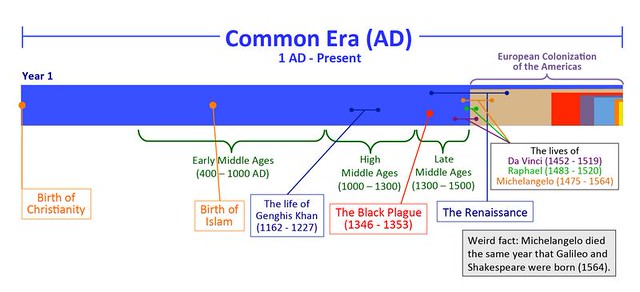
Until one has “traveled” all the way to the entirety of time.

See them all (and larger) at “Putting Time in Perspective.” (G-rated version here)
* Heraclitus, Fragments
###
As we check our watches, we might send culturally-relevant birthday greetings to James Mooney; he was born on this date in 1861. A pioneering ethnographer, he started working in 1885 with the Bureau of American Ethnology in Washington, D.C. He compiled a list of tribes and their members which contained 3,000 names, but quit after the US Army’s 1890 massacre of Lakota people at Wounded Knee, South Dakota.
Mooney did extensive work with the Cherokee and Kiowa tribes. His most notable works were his ethnographic studies of the Ghost Dance after Sitting Bull’s death in 1890, a widespread 19th-century religious movement among various Native American culture groups, and his deciphering of the Kiowa calendar.

A(nother) matter of perspective…
Yesterday’s post located our moment in the larger sweep of time; today’s locates our experience– the things we can touch and see– in the larger hierarchy of scale.
Readers may recall Cary and Michael Huang’s “The Scale of the Universe”— in the spirit of xkcd’s nifty toon, a wonderful Flash re-do of Charles and Ray Eames’ classic Powers of Ten: an animation that lets one scroll through the orders of magnitude of existence. Not content with “pretty terrific,” the Brothers Huang have revised and improved their tour of the universe… Ladies and Gentlemen, “The Scale of the Universe 2“:

[TotH to friend CE]
###
As we ruminate with reverence on our place in the scheme of things, we might spare a thought for Bede (or as he is more frequently remembered, Venerable Bede); he died on this date in 735. An English monk, Bede studied and wrote widely on scientific, historical and theological topics, ranging from music and metrics to exegetical Scripture commentaries. He was an accomplished translator (Pliny the Elder, Virgil, Lucretius, Ovid, Horace, and other classical writers in both Greek and Hebrew). His Historia ecclesiastica gentis Anglorum (The Ecclesiastical History of the English People) has earned him the title “The Father of English History.” Indeed, it was in this work that Bede established as common practice the use of “BC” and “AD” with dates.

Bede as depicted in the Nuremberg Chronicle, 1493
Putting vegetables to exquisite use…
Long-time readers will know of your correspondent’s affection for Charles and Ray Eames, and especially for their cinematic meditation on scale, Powers of Ten. (See, e.g., here and here.) It is a pleasure to report that there’s now a version available that is suitable for vegetarians…
 click the image above, of here, for video
[TotH to Co-Design, where readers will find the backstory.]
As marvel at the menu, we might recall that it was on this date in 1790 that Dr. Joseph-Ignace Guillotin demonstrated his invention, the guillotine, for the first time, in Paris. An opponent of capital punishment, Guillotin believed his device, at least, the most humane way to dispatch the punished. Exactly three years later, on this date in 1793, his device removed the head of King Louis the XVI.
 The execution of Louis XVI (source)
Scaling away…
From Fotoshop on Newgrounds, “The Scale of the Universe“– in the spirit of xkcd’s nifty toon, a wonderful Flash re-do of Charles and Ray Eames’ Powers of Ten— an animation that lets one scroll through the orders of magnitude of existence.

Just click here (and then click “Play”)…
As we try to remember which pill makes us larger and which one makes us small, we might recall that it was on this date in 1960 that Joanne Woodward received the first star on the Hollywood Walk of Fame.

You must be logged in to post a comment.