Posts Tagged ‘records’
“All of our reasoning ends in surrender to feeling”*…

Alvin and the Chipmunks– a group of three anthropomorphic singing chipmunks named Alvin, Simon, and Theodore, managed by their human adoptive father, David “Dave” Seville– came to life on a 1958 novelty record created by Ross Bagdasarian (who also wrote and recorded Witch Doctor). They were such a hit that they spawned three animated television series, several specials, a series of video games, a feature film– and a number of albums.
During the 80s a few of those albums featured the Chipmunks singing rock tunes. You Tube creator Lunar Orbit (@LunarOrbit_) has taken tracks from several of those cover-fests and recorded them at 16 speed (roughly half the speed of a 33 1/3 LP)… resulting in what @EsotericCD calls “the most important postpunk/goth album ever recorded,” Sludgefest…
* Blaise Pascal
###
As we wonder what it sounds like backwards, we might recall that the #1 song on the Billboard Singles chart for the week beginning on this date in 1988 was Rick Astley’s “Never Gonna Give You Up.” You’ve been Rickrolled!

“Technology makes everyone feel old”*…
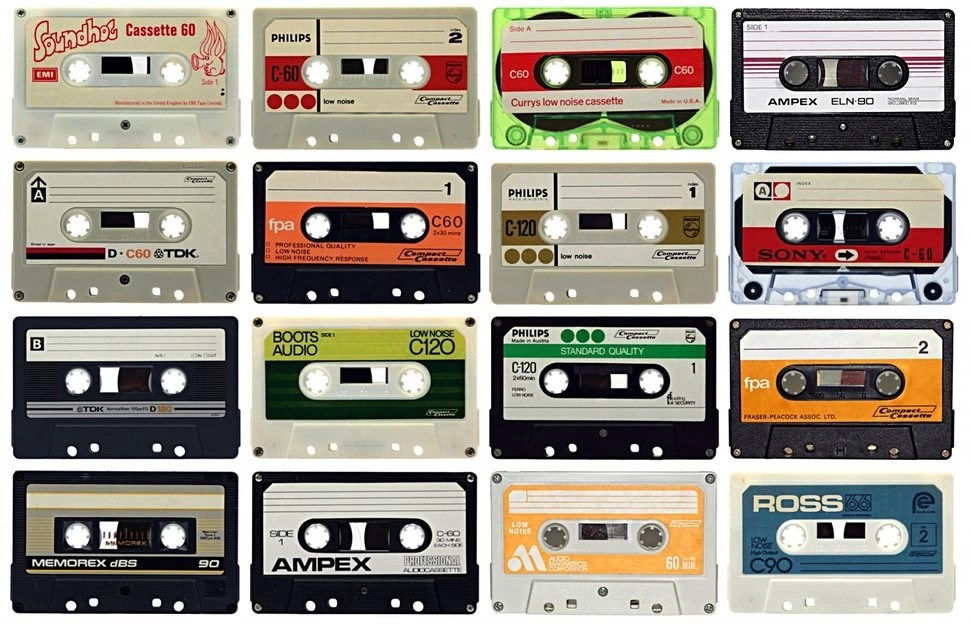
Cassette tapes, the fax machine, overhead projectors… Adrian Willings catalogues some transitional technologies that, he suggests, are headed for the dust bin of history…
… we’re… looking at some of the biggest, best and most memorable gadgets from the last century that have been outdated, outmoded or just forced into irrelevance by better, modern technologies.
You might remember many of these, but there are plenty of the younger generation that don’t…
… and won’t? “39 obsolete technologies that will baffle modern generations,” from @Age_Dub in @Pocketlint.
* Jennifer Egan
###
As we mosey down memory lane, we might send electronic birthday greetings to David Sarnoff; he was born on this date in 1891. An early employee of Marconi Wireless Telegraph, he befriended its owner, and began a a long career in broadcasting.
Unlike many who were involved with early radio communications, who often viewed radio as a point-to-point medium, Sarnoff saw the potential of radio as point-to-mass. One person (the broadcaster) could speak to– inform, entertain, sell to– many. When Owen D. Young of General Electric arranged the purchase of American Marconi and turned it into the Radio Corporation of America, a radio patent monopoly, Sarnoff got his chance.
His colleagues were wary, but in 1921, Sarnoff arranged a broadcast of a heavyweight boxing match between Jack Dempsey and Georges Carpentier. An estimated 300,000 people heard the fight, and demand for home radio equipment bloomed that winter. As head of radio broadcasting for RCA, Sarnoff was instrumental in building and establishing the AM broadcasting radio business that became the preeminent public radio standard for the majority of the 20th century.
In that late 1920s and early 30s Sarnoff (who had become RCA’s President) drove the company’s push to develop television. In April, 1939, regularly scheduled television in America was initiated by RCA under the name of their broadcasting division at the time, The National Broadcasting Company (NBC). The first television broadcast aired was the dedication of the RCA pavilion at the 1939 New York World’s Fairgrounds and was introduced by Sarnoff himself.
Along the way, Sarnoff led the formation of RKO (in which the “R” stood for RCA) and bought Victor Talking Machine Company, the nation’s largest manufacturer of records and phonographs, assuring RCA a piece of the content business.

“Every record I put on was like a baptism”*…

The sensation of being “in the groove” is the holy grail of jazz. As the renowned drummer Charli Persip described it, “When you get in that groove, you ride right down that groove with no strain and no pain—you can’t lay back or go forward. That’s why they call it a groove. It’s where the beat is, and we’re always trying to find that.”
This expression from the Roaring Twenties is an allusion to an insect secretion. The close fit between a phonograph needle and the grooves in early shellac 78 rpm records determined the quality of the playback. Shellac—a resinous, amber-colored secretion of the tiny scale insect Kerria lacca—served as the key ingredient in the first generation of phonographic disks. Odd as it may seem, a gummy substance manufactured by bugs and their human hosts in South Asia was the pioneering medium for the transmission of recorded sound.
The curious story of how a sticky discharge from billions of insect bodies became a vehicle for the globalization of audio culture spans millennia and crosses oceans…
The miraculous properties, and fascinating history, of shellac: “Like Jazz, Bowling, and Old Hollywood Hairdos? Thank Insects.“
* Questlove, Mo’ Meta Blues
###
As we gently lower the needle, we might send tuneful birthday greetings to James Marshall “Jimi” Hendrix; he was born (Johnny Allen Hendrix) on this date in 1942. Though his career as a front man lasted only four years, he is widely regarded as one of the most influential electric guitarists in the history of popular music, and one of the most celebrated musicians of the 20th century. Indeed, the Rock and Roll Hall of Fame describes him as “arguably the greatest instrumentalist in the history of rock music.”

“So sa-a-a-ad that you’re leaving”*…

It happened exactly 36 seconds into the song—a glimpse of the shape of pop to come, a feel of the fabric of the future we now inhabit. The phrase “I can’t break through” turned crystalline, like the singer suddenly disappeared behind frosted glass. That sparkly special effect reappeared in the next verse, but this time a robotic warble wobbled, “So sa-a-a-ad that you’re leaving.”
The song, of course, was Cher’s “Believe,” a worldwide smash on its October 1998 release. And what we were really “leaving” was the 20th century.
The pitch-correction technology Auto-Tune had been on the market for about a year before “Believe” hit the charts, but its previous appearances had been discreet, as its makers, Antares Audio Technologies, intended. “Believe” was the first record where the effect drew attention to itself…
And an era was born. We’ve looked at Auto-Tune before (see here for an example of the difference the technology can make, here, and here); now, from our friends at Pitchfork, an in-depth history of the most important pop innovation of the last 20 years: “How Auto-Tune Revolutionized the Sound of Popular Music.”
* Cher, “Believe”
###
As we pine for authentic imperfection, we might recall that it was on this date in 1901 that the Victor Talking Machine Company was incorporated. A phonograph manufacturer and record company, it operated on disc record patents that it soon licensed to the Columbia Record Company as well (reinforcing Victor’s position as the leading phonograph manufacturer). In 1929, Victor was merged into RCA.

“If you start throwing hedgehogs under me, I shall throw a couple of porcupines under you”*…

In the fourth volume of Brett’s Miscellany, published in Dublin in 1757, readers could find an entry on a custom called “throwing at cocks.” This was an activity where a rooster was tied to a post while the participants, as if playing darts, threw small weighted and sharpened sticks (called coksteles) at the poor bird until it expired. The article explored the sport’s origin: “When the Danes were masters of England, and used the inhabitants very cruelly,” it began, “the people of a certain great city formed a conspiracy to murder their masters in one night.” The English artfully devised “a stratagem,” but “when they were putting it in execution, the unusual crowing and fluttering of the cocks about the place discovered their design.” The Danes, tipped off by the commotion, “doubled their cruelty” and made the Englishmen suffer as never before. “Upon this,” the entry concluded, “the English made custom of knocking the cocks on the head, on Shrove-Tuesday, the day on which it happened.” Very soon “this barbarous act became at last a natural and common diversion, and has continued every since.” Thus the innate human urge to throw things at things entered the early modern era…
On the human desire to hurl (and hurl things at) animals and other humans: “From Throwing Sticks at Roosters to Dwarf Tossing.”
* Nikita Khrushchev
###
As we resist the temptation to toss, we might recall that it was on this date in 1939, in a football match between the Texas Tech Red Raiders and Centenary Gentlemen at Centenary College Stadium in Shreveport, Louisiana, that “one of the weirdest games in NCAA History” was played. A torrential downpour and resultant muddy field conditions prevented either Texas Tech or Centenary from advancing the ball either running or passing. To cope with the conditions, both teams resorted to immediate punting, hoping to recover a fumble at the other end of the field. They combined to punt 77 times; the game ended in a 0-0 tie.
Thirteen records still stand in the NCAA record books:
— Most punts combined both teams: 77 (42 were returned, 19 went out of bounds, 10 were downed, four were blocked, one went for a touchback and another was fair caught; 67 came on first down)
— Most punts by a team: 39, Texas Tech
— Fewest offensive plays: 12, Texas Tech (10 rushes, two passes for a total of minus-1 yard)
— Fewest plays allowed: 12, Centenary
— Fewest yards gained most plays: 30
— Fewest rushing attempts, both teams: 28
— Most punt returns: 22, Texas Tech (for 112 yards)
— Most punt returns, both teams: 42
— Most individual punts: 36, Charlie Calhoun, Texas Tech, for 1,318 yards (36.6 average)
— Punt yardage: 1,318 yards, Calhoun
— Punt returns (and total kick returns): 20, Milton Hill, Texas Tech, 110 yards

The 1939 Texas Tech football team
You must be logged in to post a comment.