Posts Tagged ‘printing’
“They are alone together”*…

Andrew Trousdale and Erik J. Langer bridge the years between Robert Putnam‘s Bowling Alone and Jonathan Haidt‘s The Anxious Generation with a brief history of the trade-off between convenience and connection in America. From Zach Rauch’s introduction…
The Anxious Generation is best understood as a three-act tragedy. Act I begins in the mid-20th century, when new social and entertainment technologies (e.g., air conditioning and television) set in motion a long, gradual collapse of local community. Act II begins in the 1980s, as the loss of local community weakened social trust and helped erode the play-based childhood. Act III begins in the early 2010s, with the arrival of the phone-based childhood that filled the vacuum left behind.
This post, written by Andrew Trousdale and Erik Larson, goes deep into Act I. Andrew is a psychology researcher and human-computer interaction designer who is co-running a project on the psychological tradeoffs of progress. Erik is the author of The Myth of Artificial Intelligence, writes the Substack Colligo, and is completing the MIT Press book Augmented Human Intelligence: Being Human in an Age of AI, due in 2026. Together, they show how the isolation we experience today did not begin with smartphones but began decades earlier, as Americans, often for good and understandable reasons, traded connection for convenience, and place-based relationships for privacy and control.
Tracing these trade-offs across the twentieth century, Andrew and Erik help explain the problem of loneliness we face today, and offer some guidance for how we can turn it around and reconnect with our neighbors. Robert Putnam, who read a recent draft, described it as “easily the best, most comprehensive, and most persuasive piece on the contemporary social capital conundrum I’ve yet read.”…
Trousdale and Langer trace the social, cultural, economic, political, and technological forces that have played out from the the late 1940s to today. It is, at once, familiar and shocking. They conclude…
When we asked Robert Putnam what gives him hope, he pointed to history. In The Upswing, he reminds us that Americans faced a similar crisis before. The Gilded Age brought economic inequality, industrialization, and the rise of anonymous urban life. Small-town bonds gave way to tenements and factory floors. Trust collapsed. By the 1890s, social capital had reached historic lows — roughly where it stands today.
The Progressive reformers found this new world unacceptable, but they didn’t try to turn back the clock. Cities and factories were here to stay. Instead, they adapted, creating new forms of connection suited to their changed reality, from settlement houses for anonymous neighborhoods to women’s clubs that built networks of mutual aid. They didn’t reject modernity; they metabolized it, showing up day after day to create new institutions and communities suited to the industrialized world.
Decades ago Neil Postman observed in Amusing Ourselves to Death that we haven’t been conquered by technology — we’ve surrendered to it because we like the stimulation and cheap amusement. More recently, Nicholas Carr concludes in Superbloom that we’re complicit in our loneliness because we embrace these superficial, mediated forms of connection. Like Postman and Carr, the Progressive Era reformers understood where they had agency when technology upended their world. It isn’t in demanding that others fix systems we willingly participate in, nor is it in outright rejecting technologies that deliver real benefits — it’s in changing how we ourselves live with and make use of the tools that surround us.
There are already signs that people are willing to do this. In a small, three-day survey, Talker Research found that 63% of Gen Z now intentionally unplug — the highest rate of any generation — and that half of Americans are spending less time on screens for their well-being, and their top alternative activity is time with friends and family. And they found that two-thirds of Americans are embracing “slow living,” with 84% adopting analog lifestyle choices like wristwatches and paper notebooks that help them unplug. Meanwhile in Eventbrite’s “Reset to Real” survey, 74% of young adults say in-person experiences matter more than digital ones. New devices like the Light Phone, Brick, Meadow, and Daylight Computer signal a growing demand for utility without distraction.
Unplugging isn’t enough on its own. The time and energy we reclaim has to go toward building social connections: hosting the dinner party despite the hassle, staying for coffee after church when you’d rather go home, sitting through the awkward silence, offering or asking for help.
Ultimately, we can’t expect deep social connection in a culture that prioritizes individual ease and convenience. Nor is community something technology can deliver for us. What’s required is a change of culture, grounded in a basic fact of human nature: that authentic connection requires action and effort, and that this action and effort is part of what makes connection fulfilling in the first place.
We can form new rituals and institutions that allow us to adapt to technology, ultimately changing it to our liking. But it starts with the tools we use and the choices we make each day. If we all prioritize the individual comforts and conveniences we’ve grown accustomed to, no one else will restore the community we say we miss. No one else can. If we want deeper relationships and better communities than we have, we’re going to have to put more of our time, effort, and attention into the people around us.
History shows that we can adapt, building communities suited to changing times. The question is: Will we stay in and scroll? Or will we go out and choose one another?…
Eminently worth reading in full: “Scrolling Alone.”
In the spirit of the call for forward-looking determination, pair with “The Displacement of Purpose” from Peter Adam Boeckel (“If AI automates production, then humanity must automate compassion. Only then will progress remember what it was for.”)
[Image above: source]
* Robert Putnam, Bowling Alone (in which he also observed: “People divorced from community, occupation, and association are first and foremost among the supporters of extremism.”)
###
As we get together, we might spare a thought for Aldus Manutius; he died on this date in 1515. A printer and humanist, he founded the Aldine Press. In the books he published, he introduced a standardized system of punctuation and use of the semicolon. He designed many fonts, and created italic type (which he named for Italy).

And apropos the piece featured above, we might note that on this date in 1965 “You’ve Lost That Lovin’ Feeling,” the first major hit for the Righteous Brothers, simultaneously reached #1 on both the Billboard and Cash Box charts in the US as well as the UK singles chart. The song was produced by Phil Spector (who had discovered the duo at a San Francisco show) for his own label, Philles Records. All the songs previously produced by Spector for Philles featured African-American singers; the Righteous Brothers were his first white vocal act– they had a vocal style, blue-eyed soul, that suited Spector.
“The new media are not ways of relating to us the ‘real’ world; they are the real world and they reshape what remains of the old world at will.”*…

There is a vortex of forces shaping the future of journalism. Censorship, both direct and indirect, is on the rise in the U.S. and around the world. Concentration of media ownership is homogenizing coverage and creating “news deserts.”
At the same time, new technology and new applications of that technology are reshaping the Fourth estate. The Reuters Institute at Oxford surveyed 280 digital leaders from 51 countries and territories to learn what they are seeing– and planning. From the Executive Summary…
We are still at the early stages of another big shift in technology (Generative AI) which threatens to upend the news industry by offering more efficient ways of accessing and distilling information at scale. At the same time, creators and influencers (humans) are driving a shift towards personality-led news, at the expense of media institutions that can often feel less relevant, less interesting, and less authentic. In 2026 the news media are likely to be further squeezed by these two powerful forces.
Understanding the impact of these trends, and working out how to combat them, will be high up the ‘to do list’ of media executives this year, despite the unevenly distributed pace of change across countries and demographics.
Existential challenges abound. Declining engagement for traditional media combined with low trust is leading many politicians, businessmen, and celebrities to conclude that they can bypass the media entirely, giving interviews instead to sympathetic podcasters or YouTubers. This Trump 2.0 playbook – now widely copied around the world – often comes bundled with a barrage of intimidating legal threats against publishers and continuing attempts to undermine trust by branding independent media and individual journalists as ‘fake news’. These narratives are finding fertile ground with audiences – especially younger ones – that prefer the convenience of accessing news from platforms, and have weaker connections with traditional news brands. Meanwhile search engines are turning into AI-driven answer engines, where content is surfaced in chat windows, raising fears that referral traffic for publishers could dry up, undermining existing and future business models.
Despite these difficulties many traditional news organisations remain optimistic about their own business – if not about journalism itself. Publishers will be focused this year on re-engineering their businesses for the age of AI, with more distinctive content and a more human face. They will also be looking beyond the article, investing more in multiple formats especially video and adjusting their content to make it more ‘liquid’ and therefore easier to reformat and personalise. At the same time, they’ll be continuing to work out how best to use Generative AI themselves across newsgathering, packaging, and distribution. It’s a delicate balancing act but one that – if they can pull it off – holds out the promise of greater efficiency and more relevant and engaging journalism.
These are the main findings from our industry survey:
- Only slightly more than a third (38%) of our sample of editors, CEOs, and digital executives say they are confident about the prospects for journalism in the year ahead – that’s 22pp lower than four years ago. Stated concerns relate to politically motivated attacks on journalism, loss of USAID money that previously supported independent media in many parts of the world, and significant declines in traffic to many online news sites.
- By contrast, around half (53%) say they are confident about their own business prospects, similar to last year’s figure. Upmarket subscription-based publishers with strong direct traffic can see a path to long-term profitability, even as those that remain dependent on advertising and print worry about sharp declines in revenue and the potential impact of AI powered search on the bottom line.
- Publishers expect traffic from search engines to decline by more than 40% over the next three years – not quite ‘Google Zero’ but a substantial impact none the less. Data sourced for this report from analytics provider Chartbeat shows that aggregate traffic to hundreds of news sites from Google search has already started to dip, with publishers that rely on lifestyle content saying they have been particularly affected by the roll out of Google’s AI overviews. This comes after substantial falls in referral traffic to news sites from Facebook (-43%) and X, formerly Twitter (-46%) over the last three years.
- In response, publishers say it will be important to focus on more original investigations and on the ground reporting (+91 percentage point difference between ‘more’ and ‘less’), contextual analysis and explanation (+82) and human stories (+72). By contrast, they plan to scale back service journalism (-42), evergreen content (-32), and general news (-38), which many expect to become commoditised by AI chatbots. At the same time, they think it will be important to invest in more video (+79) – including ‘watch tabs’ – more audio formats (+71) such as podcasts but a bit less in text output.
- In terms of off-platform strategies, YouTube will be the main focus for publishers this year with a net score of +74, up substantially on last year. Other video-led platforms such as TikTok (+56) and Instagram (+41) are also key priorities – along with working out how to navigate distribution through AI platforms (+61) such as OpenAI’s ChatGPT, Google’s Gemini and Perplexity. Google Discover remains a critical (+19), if slightly volatile, source of referral traffic, while some publishers are looking to find new audiences via newsletter platforms such as Substack (+8). By contrast, publishers will be deprioritising effort spent on old-style Google SEO (-25) – as well as traditional social networks Facebook (-23) and X (-52)
- Last year we predicted the emergence of ‘agentic AI’, but this year we can expect to start to see real-world impact of these more advanced technologies. Some sources suggest that there will soon be more bots than people reading publisher websites, as tools like Huxe and OpenAI’s Pulse offer personalised news briefings at scale. Three-quarters of our respondents (75%) expect ‘agentic tools’ to have a ‘large’ or ‘very large’ impact on the news industry in the near future.
- Alongside the traffic disruption from AI, news executives also see opportunities to build new revenue from licensing content (or a share of advertising revenue) within chatbots. Around a fifth (20%) of publisher respondents – mainly from upmarket news companies – expect future revenues to be substantial, with half (49%) saying that they expect a minor contribution. A further fifth (20%), mostly made up of local publishers, public broadcasters, or those from smaller countries, say they do not expect any income from AI deals.
- More widely, subscription and membership remain the biggest revenue focus (76%) for publishers, ahead of both display (68%) and native advertising (64%). Online and physical events (54%) are also becoming more important as part of a diversified revenue strategy. Reliance on philanthropic and foundation support (18%) has declined this year, after cuts of media support budgets in the United States and elsewhere.
- Meanwhile news organisations’ use of AI technologies continues to increase across all categories, with back-end automation considered ‘important’ this year by the vast majority (97%) of publisher respondents, many of whom integrated pilot systems into content management systems in the last year. Newsgathering cases (82%) are now the second most important, with faster coding and product development (81%) also gaining traction.
- Over four in ten (44%) survey respondents say that their newsroom AI initiatives are showing ‘promising’ results, but a similar proportion (42%) describe them as ‘limited’. Two-thirds of respondents (67%) say they have not saved any jobs so far as a result of AI efficiencies. Around one in seven (16%) say they have slightly reduced staff numbers but a further one in ten (9%) have added new roles/cost.
- The rise of news creators and influencers is a concern for publishers in two ways. More than two-thirds (70%) of our respondents are concerned that they are taking time and attention away from publisher content. Four in ten (39%) worry that they are at risk of losing top editorial talent to the creator ecosystem, which offers more control and potentially higher financial rewards.
- Responding to the increased competition and a shift of trust towards personalities, three-quarters (76%) of publisher respondents say they will be trying to get their staff to behave more like creators this year. Half (50%) said they would be partnering with creators to help distribute content, around a third (31%) said they would be hiring creators, for example to run their social media accounts. A further 28% are looking to set up creator studios and facilitate joint ventures.
More widely, could 2026 be the year when AI company stock valuations come down to earth with a bump, amid concerns about whether their trillion-dollar bets will pay back their investors? Meanwhile the amount of low-quality AI automated content, including so-called ‘pink slime’ sites, looks set to explode, with platforms struggling to distinguish this from legitimate news.
We can expect more public concern about the role of big tech in our lives. This may include individual acts of ‘Appstinence’ and other forms of digital detox and a desire for more IRL (In Real Life) connection. Governments will also come under pressure to do more to protect young and other vulnerable groups online, even in the United States.
The creator economy will continue to surge, fuelled by investments from video platforms and streamers. At the top end creators will look more like Hollywood moguls with big budgets and their own studio complexes. Within news, we’ll also see the emergence of bigger, more robust, creator-led companies delivering significant revenues as well as value to audiences – offering ever greater competition for traditional journalism…
Read the report in full: “Journalism, media, and technology trends and predictions 2026,” from @reutersinstitute.bsky.social.
* Marshall McLuhan
###
As we ponder the prospects of the press, we might type a birthday note to John Baskerville, a pioneering English printer and typefounder, who was born on this date in 1706. Among Baskerville’s publications in the British Museum’s collection are Aesop’s Fables (1761), the Bible (1763), and the works of Horace (1770)– many printed on a stock he invented, “wove paper”, which was considerably smoother than “laid paper”, allowing for sharper printing results. And as for his fonts, Baskerville’s creations (including the famous “Baskerville,” a predecessor to the very similar Times New Roman) were so successful that his competitors resorted to claims that they damaged the eyes.


“What Orwell feared were those who would ban books. What Huxley feared was that there would be no reason to ban a book because there would be no one who wanted to read one.”*…

In the 4th century BCE, Plato recounts (in the Phaedrus) Socrates’ thoughts on a “technology” that was then moving from specialized (administrative, commercial, religious) to broader (more literary and philosphical) use– writing. Socrates was not a fan. He worried that writing weakened the necessity (and thus, the power) of memory, and that it created the pretense of understanding, rather than real comprehension and mastery.
Still, of course, writing– and the reading that it enabled– became the dominant form of communication.
Today, reading (for anything other than business or formal study) is down. Way down. But not to worry, today’s champions of big tech argue: their streaming and AI will usher in a new golden age of learning and connectivity. Their critics, of course– in an echo of Socrates– suggest that they will do the exact opposite.
James Marriott (and here) puts the skeptic’s case…
… in the middle of the eighteenth century huge numbers of ordinary people began to read.
For the first couple of centuries after the invention of the printing press, reading remained largely an elite pursuit. But by the beginning of the 1700s, the expansion of education and an explosion of cheap books began to diffuse reading rapidly down through the middle classes and even into the lower ranks of society. People alive at the time understood that something momentous was going on. Suddenly it seemed that everyone was reading everywhere: men, women, children, the rich, the poor. Reading began to be described as a “fever”, an “epidemic”, a “craze”, a “madness”. As the historian Tim Blanning writes, “conservatives were appalled and progressives were delighted, that it was a habit that knew no social boundaries.”
This transformation is sometimes known as the “reading revolution”. It was an unprecedented democratisation of information; the greatest transfer of knowledge into the hands of ordinary men and women in history.
In Britain only 6,000 books were published in the first decade of the eighteenth century; in the last decade of the same century the number of new titles was in excess of 56,000. More than half a million new publications appeared in German over the course of the 1700s. The historian Simon Schama has gone so far as to write that “literacy rates in eighteenth century France were much higher than in the late twentieth century United States”.
Where readers had once read “intensively”, spending their lives reading and re-reading two or three books, the reading revolution popularised a new kind of “extensive” reading. People read everything they could get their hands on: newspapers, journals, history, philosophy, science, theology and literature. Books, pamphlets and periodicals poured off the presses.
It was an age of monumental works of thought and knowledge: the Encyclopédie, Samuel Johnson’s Dictionary of the English Language, Edward Gibbon’s Decline and Fall of the Roman Empire, Immanuel Kant’s Critique of Pure Reason. Radical new ideas about God, about history, about society, about politics, and even the whole purpose and meaning of life flooded through Europe.
Even more importantly print changed how people thought.
The world of print is orderly, logical and rational. In books, knowledge is classified, comprehended, connected and put in its place. Books make arguments, propose theses, develop ideas. “To engage with the written word”, the media theorist Neil Postman wrote, “means to follow a line of thought, which requires considerable powers of classifying, inference-making and reasoning.”
As Postman pointed out, it is no accident, that the growth of print culture in the eighteenth century was associated with the growing prestige of reason, hostility to superstition, the birth of capitalism, and the rapid development of science. Other historians have linked the eighteenth century explosion of literacy to the Enlightenment, the birth of human rights, the arrival of democracy and even the beginnings of the industrial revolution.
The world as we know it was forged in the reading revolution.
Now, we are living through the counter-revolution.
More than three hundred years after the reading revolution ushered in a new era of human knowledge, books are dying.
Numerous studies show that reading is in free-fall. Even the most pessimistic twentieth-century critics of the screen-age would have struggled to predict the scale of the present crisis.
In America, reading for pleasure has fallen by forty per cent in the last twenty years. In the UK, more than a third of adults say they have given up reading. The National Literacy Trust reports “shocking and dispiriting” falls in children’s reading, which is now at its lowest level on record. The publishing industry is in crisis: as the author Alexander Larman writes, “books that once would have sold in the tens, even hundreds, of thousands are now lucky to sell in the mid-four figures.”
Most remarkably, in late 2024 the OECD published a report which found that literacy levels were “declining or stagnating” in most developed countries. Once upon a time a social scientist confronted with statistics like these might have guessed the cause was a societal crisis like a war or the collapse of the education system.
What happened was the smartphone, which was widely adopted in developed countries in the mid-2010s. Those years will be remembered as a watershed in human history…
[Marriott explores the impact and some if its implications…]
… This draining away of culture, critical thinking and intelligence represents a tragic loss of human potential and human flourishing. It is also one of the major challenges facing modern societies. Our vast, interconnected, tolerant and technologically advanced civilisation is founded on the complex, rational kinds of thinking fostered by literacy.
As Walter Ong writes in his book Orality and Literacy, certain kinds of complex and logical thinking simply cannot be achieved without reading and writing. It is virtually impossible to develop a detailed and logical argument in spontaneous speech — you would get lost, lose your thread, contradict yourself, and confuse your audience trying to re-phrase ineptly expressed points…
The classicist Eric Havelock argued that the arrival of literacy in ancient Greece was the catalyst for the birth of philosophy. Once people had a means of pinning ideas down on the page to interrogate them, refine them and build on them, a whole new revolutionary way of analytic and abstract thinking was born — one that would go on to shape our entire civilisation. With the birth of writing received ways of thinking could be challenged and improved. This was our species’ cognitive liberation…
Not only philosophy but the entire intellectual infrastructure of modern civilisation depends on the kinds of complex thinking inseparable from reading and writing: serious historical writing, scientific theorems, detailed policy proposals and the kinds of rigorous and dispassionate political debate conducted in books and magazines.
These forms of advanced thought provide the intellectual underpinnings of modernity. If our world feels unstable at the moment — like the ground is shifting beneath us — it is because those underpinnings are falling to pieces underneath our feet…
[Marriott explores what a return to an “oral” society might mean, then contemplates what he fears will be “the end of creativity”– If the literate world was characterised by complexity and innovation, the post literate world is characterised by simplicity, ignorance and stagnation. He turns then to its impact on civil society…]
… Amusingly from the perspective of the present the reading revolution of the eighteenth century was accompanied not only by excitement but by a moral panic.
“No lover of tobacco or coffee, no wine drinker or lover of games, can be as addicted to their pipe, bottle, games or coffee-table as those many hungry readers are to their reading habit”, thundered one German clergyman.
Richard Steele feared that “novels raise expectations which the ordinary course of life can never realise”. Others fretted that reading “excites the imagination too much, and fatigues the heart”.
It is easy to laugh at these anxieties. We have spent our whole lives hearing how virtuous and sensible it is to read books. How could reading be dangerous?
But in hindsight, these conservative moralists were right to worry. The rapid expansion of literacy helped to destroy the orderly, hierarchical, and profoundly socially unequal world they cherished.
The reading revolution was a catastrophe for the ultra-privileged and exploitative aristocrats of the European aristocratic ancien regime — the old autocratic system of government with almighty kings at the top, lords and clergy underneath and peasants squirming at the very bottom.
Ignorance was a foundation stone of feudal Europe. The vast inequalities of the aristocratic order were partly able to be sustained because the population had no way to find out about the scale of the corruption, abuses and inefficiencies of their governments…
… you do not have to believe print is a perfect and incorruptible system of communication to accept it is also almost certainly a necessary pre-condition of democracy.
In Amusing Ourselves to Death Neil Postman argues that democracy and print are virtually inseparable. An effective democracy pre-supposes a reasonably informed and somewhat critical citizenry capable of understanding and debating the issues of the day in detail and at length.
Democracy draws immeasurable strength from print — the old dying world of books, newspapers and magazines — with its tendency to foster deep knowledge, logical argument, critical thought, objectivity and dispassionate engagement. In this environment, ordinary people have the tools to understand their rulers, to criticise them and, perhaps, to change them…
… Politics in the age of short form video favours heightened emotion, ignorance and unevidenced assertions. Such circumstances are highly propitious for charismatic charlatans. Inevitably, parties and politicians hostile to democracy are flourishing in the post-literate world. TikTok usage correlates with increased vote share for populist parties and the far right…
… The big tech companies like to see themselves as invested in spreading knowledge and curiosity. In fact in order to survive they must promote stupidity. The tech oligarchs have just as much of a stake in the ignorance of the population as the most reactionary feudal autocrat. Dumb rage and partisan thinking keep us glued to our phones.
And where the old European monarchies had to (often ineptly) try to censor dangerously critical material, the big tech companies ensure our ignorance much more effectively by flooding our culture with rage, distraction and irrelevance.
These companies are actively working to destroy human enlightenment and usher in a new dark age.
The screen revolution will shape our politics as profoundly as the reading revolution of the eighteenth century.
Without the knowledge and without the critical thinking skills instilled by print, many of the citizens of modern democracies find themselves as helpless and as credulous as medieval peasants — moved by irrational appeals and prone to mob thinking. The world after print increasingly resembles the world before print.
Superstitions and anti-democratic thinking flourish. Scholarship in our universities is shaped by rigid partisanship not by tolerance and curiosity. Our art and literature is cruder and more simplistic…
… As power, wealth and knowledge concentrate at the top of society, an angry, divided and uninformed public lacks a way understand or analyse or criticise or change what is going on. Instead more and more people are impressed by the kinds of highly emotional charismatic and mystical appeals that were the foundation of power in the age before widespread literacy.
Just as the advent of print dealt the final death blow to the decaying world of feudalism, so the screen is destroying the world of liberal democracy.
As tech companies wipe out literacy and middle class jobs, we may find ourselves a second feudal age. Or it may be that we are entering a political era beyond our imagining.
Whatever happens, we are already seeing the world we once knew melt away. Nothing will ever be the same again.
Welcome to the post-literate society…
The end of civilization? A sobering assessment of “The dawn of the post-literate society” from @j-amesmarriott.bsky.social. Eminently worth reading in full.
FWIW, your correspondent would note that while Socrates was surely right that writing diminished the power of memory and at least partially right that text allowed its readers to appear more knowledgeable about things than perhaps they were, it was the development of writing that provided the foundation on which the the print revolution Marriott celebrates was able to emerge.
I’d also note that the earliest days of printing (before the 18th century “revolution in reading”) were pretty fraught: from the publication of Luther’s 95 Thesis (and the religious and civil turmoil– both ideological and “bloody”– they occasioned) on through more than a century of conflict that included the Thirty Years War, The English Civil War, and ultimately, the American and French Revolutions– indeed, also the American Civil War. As Ada Palmer notes, “Whenever a new information technology comes along, and this includes the printing press, among the very first groups to be ‘loud’ in it are the people who were silenced in the earlier system, which means radical voices”… very like the our current situation, as Marriott describes it.
Again FWIW, I find Marriott’s take all-too-resonant with my own (geezer’s) sense of loss (as the epistemological and civic superstructure in which I came of age dissolve). I find his pessimism-unto-despair much more plausible than I’d like. But I hold onto the hope that in this transition– as in the transitions from oral to writing, and then to printing/publishing– we will, as societies, find ways to manage the chaos and establish new foundations for reason, creativity, and coherent, constructive civic life.
It starts with us wanting– and working hard– to find that new, more solid ground.
* Neil Postman, Amusing Ourselves to Death
###
As we buckle up, we might spare a thought for George Grenville; he died on this date in 1770. An English politician who served as Prime Minister in the early years of the reign of George III, Grenville’s primary challenge was to solve the problem of the massive debt resulting from the Seven Years’ War. A centerpiece of his effort was a policy of taxing the American colonies more heavily, starting with his Sugar Act of 1764 and the Stamp Act of 1765– which began the train of events (much discussed in printed material of the time) that led to the American Revolution.

“Every great advance in science has issued from a new audacity of the imagination”*…

Itai Yanai and Martin Lercher on the importance of interdisciplinarity and creativity in science…
The hypothesis-testing mode of science, which François Jacob called “day science,” operates within the confines of a particular scientific field. As highly specialized experts, we confidently and safely follow the protocols of our paradigms and research programs . But there is another side of science, which Jacob called “night science”: the much less structured process by which new ideas arise and questions and hypotheses are generated. While day science is compartmentalized, night science is truly interdisciplinary. You may bring an answer from your home field to another discipline, or conversely, venturing into another field may let you discover a route towards answering a research question in your
main discipline. To be most creative, we may be best off cultivating interests in many areas, much like Renaissance thinkers such as Leonardo da Vinci or Galileo Galilei. But this creativity-enhancing interdisciplinarity comes at a price we may call “expert’s dilemma”: with your loss of status as a highly focused expert comes a loss of credibility, making it harder to get your work accepted by your peers. To resolve the dilemma, we must find our own balance between disciplinary day science expertise and interdisciplinary night science creativity…
Eminently worth reading in full: “Renaissance minds in 21st century science,” from @ItaiYanai and @MartinJLercher.
See also: “Night Science“
And for more: see their project’s home page and listen to their podcast.
Apposite: “8 lessons on lifelong learning from an astrophysicist,” from Ethan Siegel.
* John Dewey
###
As we find a balance, we might send easily-reproducible birthday greetings to a man who was moved by necessity to cross disciplinary boundaries, Alois Senefelder; he was born on this date in 1771. A playwright and actor, was having trouble getting his plays printed; he needed a less expensive and more efficient printing alternative to relief printed hand set type or etched plates. So he invented the technique we call lithography– the biggest revolution in the printing industry since Gutenberg’s movable type.
The principle is simple: oil-based printing ink and water repel each other. The image is drawn on a stone (Bavarian limestone for Senefelder) with greasy crayon, after which the stone is soaked in water, which is absorbed into the part of the stone not covered in greasy paint. The ink is rolled onto the stone. The image areas of the stone accept ink and undrawn areas reject it. Finally, a piece of paper is pressed onto the stone, and the ink transfers onto the paper from the stone.
Senefelder called the technique “stone printing” or “chemical printing,” but the French name “lithography” became more widely adopted. Today photo lithography is used to print magazines and books, but the original process of drawing by hand on litho stones still exists in the fine art world.

“It’s not those who write the laws that have the greatest impact on society. It’s those who write the songs”*…
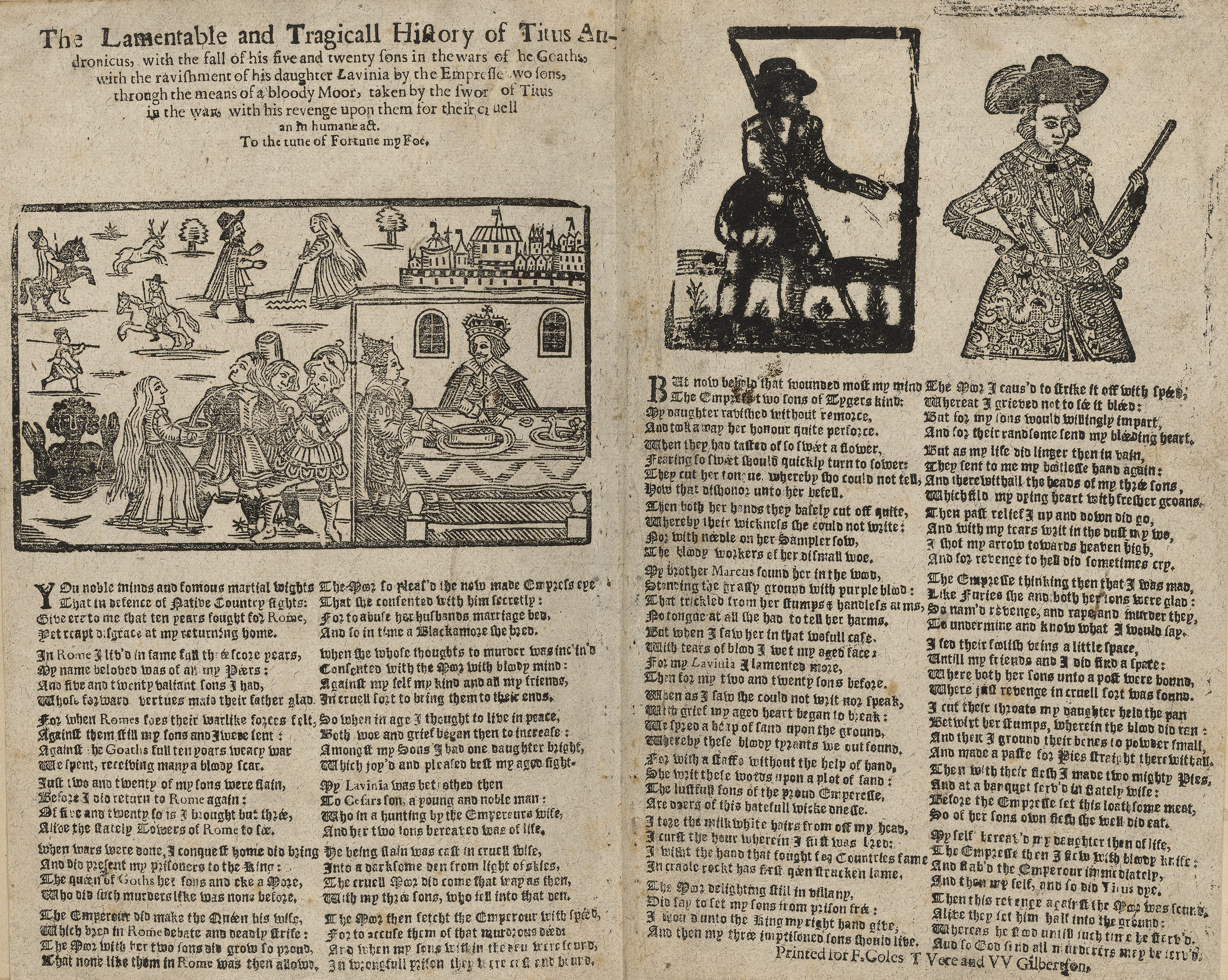
Broadside ballads were single-sheet songs that emerged with the spread of printing and sold for a penny a piece; the most popular of them were the 16th and 17th century equivalent of the Hit Parade. Christopher Marsh and Angela McShane have put together an extraordinary rich collection…
We here identify and present a body of the biggest hits from seventeenth-century England…
This website concentrates on over 100 resoundingly successful examples that you can investigate through recordings, images and a wealth of other materials. Whether you are interested in music, art, love, gender, tragedy, politics, family life, crime, history, humour or death, you will find something to engage you here…
For example, the ballad pictured above:
The Lamentable and Tragicall History of Titus Andronicus seems certain to have been written in c. 1594 as a spin-off from Shakespeare’s play about the fictional general whose final months in late-imperial Rome were even more bloody than the decades of military service that went before. Plays for the stage and songs for the street cross-fertilised throughout the early-modern period, and several of our hit songs reveal the relationship (see, for example, The Lamentation of Master Pages wife and An Excellent Ballad of George Barnwel).
The ballad, like the play, was highly successful. Of the two forms, it was perhaps the ballad that maintained its popularity more consistently after Titus’ first phase of marketability in the Elizabethan and Jacobean periods. There were numerous editions of the ballad in the seventeenth and eighteenth centuries. More occasionally, it was also included in printed song-collections such as Richard Johnson’s Golden garland of princely pleasures (1620).
…
To the tune of ‘Fortune my Foe’ (standard name)
‘Fortune my foe’ was so well known that notation appears in dozens of sources, both printed and manuscript. There are instrumental settings for lute, virginals, cittern and lyra viol, and several of the period’s most celebrated composers – John Dowland and William Byrd, for example – applied their talents to the tune. This was a remarkably solid melody, and renditions are striking in their consistency over time and space…
[Here it here]
99 other Tops of the Pops in the 17th century: “100 Ballads” @100ballads.
* Blaise Pascal
###
As we belt it out, we might recall that on this date in 1994, a different ballad was #1 on the pop charts: Celine Dion singing “The Power of Love”– a cover of its author Jennifer Rush‘s version, which had itself reached the top of the chart nine years earlier.
You must be logged in to post a comment.