Posts Tagged ‘pop’
“I’m not a member of any organized political party…. I’m a Democrat”*…

As we face the prospect of a post-Biden election, a consideration of the mechanics that will come into play. Much ink has been (justifiably) spilled dissecting the differences in the Republican and Democratic approaches to governance, their goals, and their potential implications for our future. Tanner Greer suggests that there are other important differences too– more specifically, he explains the difference between patronage (Republican) and constituent (Democratic) parties…
The Republican and Democratic parties are not the same: power flows differently within them. The two big political news items of this week—the happenings of the Republican National Convention and the desperate attempts of many Democrats to replace their candidate before their own convention next month—reflect these asymmetries. Nevertheless, many discussions of American politics assume that that the structures and operational norms of the two parties are the same. If these party differences were more widely recognized, I suspect we would see fewer evangelicals frustrated with their limited influence over the GOP party platform, fewer journalists shocked with J.D. Vance’s journey from never-Trump land to MAGA-maximalism, and greater alarm among centrist Democrats about the longer-term influence that the Palestine protests will have on the contours of their coalition.
My perspective on all this has been strongly shaped by two research articles penned by political scientist Jo Freeman. In her youth Freeman was a new left activist, one of the founding activist-intellectuals of feminism’s second wave. She is perhaps most famous today for two essays she wrote in her activist days (both under her movement name “Joreen”). The first, “The Tyranny of Structurelessness,” is a biting critique of the counterculture dream of eliminating hierarchy from activist organizations. The second, “Trashing: the Dark Side of Sisterhood,” is one of the original descriptions of “Cancel Culture.” There Freeman provides a psychological account of how cancellation (she calls it “trashing”) works and the paralyzing effect it has within leftist organizations, where cancellations are most common. If you have never read these essays I recommend you do. Freeman’s internal critiques of left-wing movements at work are more insightful than most rightwing jeremiads against them.
Neither of these essays shed much light on the Republican Party. For that we must turn to her later, more academic work. In particular, her 1987 article “Who You Know vs. Who You Represent: Feminist Influence in the Democratic and Republican Parties,” and her 1986 “The Political Culture of the Democratic and Republican Parties.”
Freeman’s academic interests were framed by her activist experiences. She was deeply involved in the seventies attempts to get feminist planks onto the Democratic and Republican party platforms. Up to that juncture the Republican Party had far stronger feminist credentials than the Democrats did; had the feminist of 1960 been forced to predict which party would champion her cause thirty years later, she would have guessed the GOP.
This is not what happened. That is the mystery that drives much of Freeman’s late ‘80s work: why did the feminist movement succeed so brilliantly with the Democrats, but fail so miserably with the Republicans? Freeman argues that this had less to do with demographics or deep ideological alignment than with the structures and operational culture of each party. Although both parties have changed in the days since Freeman stalked the convention floors, many of the differences she observed between the two parties still hold true today.
The place to start is a 1980 vote on the floor of the Democratic National Convention. That year the primary feminist organizations working the convention hall were the National Woman’s Political Caucus (NWPC) and the National Organization for Women (NOW). Their pet cause was the Equal Rights Amendment (ERA). The Democrats had already endorsed the amendment, so NOW and the NWPC decided to up the ante: they would support a party plank that read “the Democratic Party shall offer no financial support and technical campaign assistance to candidates who do not support the ERA.” This measure, known as Minority Report #10, became the focus of their efforts.
Jimmy Carter’s delegates controlled the floor. Though no enemy to feminism, his team thought Ten was ill advised. The Democrat’s existing support for the ERA was robust, Carter balked at draconian single-issue “loyalty tests” that might erode his shaky coalition, and he did not wish to make feminist issues central to his campaign. He had the numbers to defeat this change. NOW and the NWPC understood this. They decided to push for a floor vote anyway. As expected, they lost that vote decisively. The platform was not changed.
What did this public defeat portend for the movement? Victory. Losing the fight on the floor did not set the movement back an inch. Far from it: at the next convention these same women’s organizations were given a greater share of decision making authority. All potential presidential candidates courted NOW’s endorsement months before the 1984 convention began; their preferred amendments were incorporated into the platform without issue. “Because feminists got pretty much everything they wanted prior to the Democratic Convention,” Freeman comments, “there wasn’t much to do there except celebrate.”
This is somewhat mysterious. The feminist movement leaders sought an intentional defeat—but only gained power because of it.
We still see this story play out on the left today. Though the contest for clout has shifted out of the convention halls and out onto social media, when you look at the trajectory of leftist movements over the 2010s—such as the Black Lives Matters movement—you find a similar pattern. Protests that closed with policy defeat, changing nothing but media coverage, did not lead to the marginalization of protest leaders or their moment. Quite the opposite: with each defeat the influence these movements held over the Democratic establishment grew.
Why does this happen? Freeman argues that peculiar features of Democratic Party organization and political culture allow activists to profit from defeat. Here is how she describes the salient Democratic Party features:
Both parties are composed of numerous units, which have a superficial similarity… In addition to these formal bodies, the Democratic Party, especially on the national level, is composed of constituencies. These constituencies see themselves as having a salient characteristic creating a common agenda which they feel the party must respond to. Virtually all of these groups exist in organized form independent of the Party and seek to act on the elected officials of both parties. They are recognized by Democratic Party officials as representing the interests of important blocs of voters which the Party must respond to as a Party. Some groups have been recognized parts of the Democratic coalition since the New Deal (e.g. blacks and labor); others are relatively new (e.g. women and gays). Still others which participated in State and local Democratic politics when those were the only significant Party units have not been active as organized groups on the national level (e.g. farmers ethnics).
Some of the Party’s current constituencies have staff members of the Democratic National Committee identified as their liaisons. In addition, in the last few years an informal understanding has arisen that one of each of the three Vice-Chairs will be a member of and represent women, blacks and hispanics. Labor — still the largest and most important constituency — does not feel the need for a liaison as it has direct contact with the party chair. However, a majority of the 25 at-large seats on the DNC, as well as seats on the Executive Committee and the Rules and Credentials Committees at the conventions are reserved for union representatives. Party constituencies generally meet as separate caucuses at the national conventions. Space for these meetings is usually arranged by the DNC. While caucuses are usually open to anyone, the people who attend are generally those for whom that constituency is a primary reference group; i.e. a group with which they identify and which gives them a sense of purpose. With an occasional exception the power of group leaders derives from their ability to accurately reflect the interests of constituency members to the Party leaders. Therefore, while leaders are rarely chosen by the participants, they nonetheless feel compelled to have their decisions ratified by them through debate and votes in the caucuses. The votes usually go the way the leaders direct, but they are symbolically important.
For Freeman the most important fact about the Democratic Party is that its representative constituent groups exist in an organized form independent of the party apparatus proper. This means that the position (and to a lesser extent the power) of the men and women who lead these constituencies is not dependent on the favor of party leaders. To the contrary, Democratic Party leaders tend to think of their personal power as being dependent on the support of the constituencies the activist leaders represent.
This has two important implications. The first is that the power and career success of Democrats who either lead or strongly identify with a minority constituency “is tied to that of [their minority] group as a whole. They succeed as the group succeeds. When the group obtains more power, individuals within that group get more positions.” Democratic leaders think of their party as a bargaining table: various groups looking for representation in the Democratic Party come to this table, demonstrate what they can do for the party, demand that the party do something for them in turn, and negotiate with competing constituencies on matters of policy and personnel. The more electorally important an identity group is, the more personnel slots it will generally receive.
The preceding paragraph is an imperfect model of actually existing Democratic politics—but it is the mental model of Democratic politics that Democratic politicians use as a reference point when evaluating the real thing. Ideals shape behavior…
…
… This leads to the second implication of the Democrats bottom-up structure. It is not always obvious who speaks for a given constituency. Activists and group leaders thus not only need to pick fights that demonstrate the importance of their group, but also need to pick fights that cement their legitimacy as representatives of this constituency…
This is why the feminist maneuvers in the 1980 convention made sense: whether the feminists won the floor fight was less important than demonstrating that the women’s groups were a constituency capable of forcing a floor fight in the first place. The activists lost their battle, but successfully proved that their army could be mustered, and that its soldiers looked to them for marching orders. They demonstrated that they deserved a larger spot at the negotiating table—and during the next convention they were given one.
The Republicans are different. In the ‘70s and ‘80s Republican feminists refused to bring losing battles to the floor. Where most Democratic activists view their constituency identity as primary and their party identity as secondary, most of the Republican feminists Freeman worked with saw themselves as Republicans first. Many were the wives of sitting Republican officials. They were not outsiders clamoring for clout but insiders maneuvering for influence. Their party worked in a very different way from the Democrats:
The basic components of the Republican Party are geographic units and ideological factions. Unlike the Democratic groups, these entities exist only as internal party mechanisms. The geographic units—state and local parties— are primarily channels for mobilizing support and distributing information on what the Party leaders want. They are not separate and distinct levels of operation.
Ideological factions are also not power centers independent of their relationship to Party leaders. Unlike Democratic caucus leaders, Republican faction leaders do not feel themselves accountable to their followers. Sometimes there are no identifiable followers… The purpose of ideological factions—at least those that are organized— is to generate new ideas and test their appeal. Initially these new ideas are for internal consumption. Their concept of success is not winning benefits, symbolic or otherwise, for their group, so much as being able to provide overall direction to the Party.
…The Republican Party does have several organized groups within it such as the National Federation of Republican Women, National Black Republican Council and the Jewish Coalition, but their purpose is not to represent the views of these groups to the party. Their function is to recruit and organize group members into the Republican Party as workers and contributors. They carry the party’s message outward, not the group’s message inward. Democratic constituency group members generally have a primary identification with their group, and only a secondary one with the Party. The primary identification of Republican activists is with the Republican Party. They view other strong group attachments as disloyal and unnecessary…
…
… the Republican party is fundamentally a leader oriented political organization. Power flows from the top down. Convention battles were not contests between constituencies, but contests between patronage networks. The party is organized around powerful leaders and those who fly their colors under their patron’s banner:
Legitimacy within the Republican Party is dependent on having a personal connection to the leadership. Consequently, supporting the wrong candidate can have disastrous effects on one’s ability to influence decisions. Republican Presidents exercise a monolithic power over their party that Democratic Presidents do not have. With the nomination of Ronald Reagan, many life-long Republicans active on the national level who had supported Ford or Bush had to quickly change their views to conform to those of the winner or find themselves completely cut off. Mavericks, who do not have any personal attachments to identified leaders, may be able to operate as gadflies, but can rarely build an independent power base. Since legitimacy in the Democratic Party is based on the existence of just such a power base, real or imagined, one does not lose all of one’s influence within the Party with a change in leaders as long as one can credibly argue that one represents a legitimate group.
While the importance of personal connections works against those Republicans who have the wrong connections it rewards those who spend years toiling in the fields for the Party and its candidates. The longer one spends in any organization the more personal connections one has an opportunity to make. These aren’t lost when one’s Party or leaders are out of power, and thus can be “banked” for future use. Occasionally a dedicated party worker can develop sufficient ties even to competing leaders to assure continued access, if not always influence, regardless of who’s in power. Those Democrats whose legitimacy derives from leadership of a coalition group find it is quite transitory when they can no longer credibly represent the group. The greater willingness of the Republican Party to reward loyalty and dedication to the Party in preference to any other group makes it is easier for the Party to discourage extra-Party attachments…
…
… There are advantages and disadvantages to both operational cultures. “In the short run [Democratic political culture] appears disruptive,” Freeman argues, but in the long run “it is more stable. Once a consensus develops about the desirability of a particular course of action, whether it be programmatic or procedural, it is accepted as right and proper and is not easily thwarted by party leaders, even when one of them is the President.” In contrast, “the Republican Party is more likely to change directions when it changes leaders.”
Is there a better example than the ascension of Donald Trump? The GOP was once a party of full of men like J.D. Vance, eager to condemn Trump as the American Hitler. The GOP is now a party full of men… like J.D. Vance, eager to fête Trump as the savior of the Republic. How could this happen? The Republican Party offers neither power nor refuge to those who have not hitched their cart to its reigning star. A Republican Party that won in 2012 or lost in 2016 would look fundamentally different—much more fundamentally different than a Democratic Party helmed by Hillary Clinton or Bernie Sanders instead Obama or Biden. The ability of democratic presidents to reshape their party is limited unless, like FDR, they bring in a new suite of constituencies to the coalition…
… It is possible this structure may change in the future. From the 1860s forward Republican Party leaders governed secure in the belief that they defended the American mainstream. In the late 20th century that meant middle and upper-middle class white families. That demographic is not as aligned with the Republicans as it was in the pre-Trump era; the upper-middle class now defaults Democrat. Moreover, the relative share of the population occupied by the old American core is shrinking. In many states it is already a plurality demographic. Increasingly, Republicans see themselves not as defenders of the American mainstream but as the tribunes of the American outcasts.
Some on the right wing would prefer if the GOP adopted Democratic forms. This would mean framing itself as a coalitional party like the Democrats with formally recognized constituencies whose interests must be explicitly catered to. In this vision the white working class would become the most important of these constituencies.
Freeman’s analysis suggests why it will be difficult for the Republicans to follow this path. It will be hard enough for the GOP to abandon an operational culture a century and a half old. It will be harder still to restructure the party apparatus itself, building out caucus-like civic organizations to represent the interests of its constituencies. At the moment it simply is not clear which organizations or individuals might represent the white working class within party circles; with the exception of the evangelicals, most of the potential Republican constituencies lack the group-consciousness needed for Democratic style politics. No GOP leader would wish to create these groups himself—it would mean siphoning away his power. As long as power flows downwards in Republican politics there will be little incentive for Republican leaders to change the system.
It is not clear the party as a whole would benefit from doing so. The Biden succession drama points to the weaknesses of a bottom-up party structure. Unity is much more difficult to achieve in the Democratic Party. The structure and culture of the party encourages small disputes to metastasize. Democratic Party leaders do not want to abandon Biden for the same reasons no one wanted to run against him in the primaries: when fissures in the Democratic Party open, they are difficult to close again. After fighting, the Republicans get back in line; those who will not do so are sidelined. They lack an external base of power to keep up the fight. For Democrats things are different—only the threat of electoral defeat keeps them cohesive. “Ridin’ with Biden” is an easy Schelling point. Remove that point and the knives will come out. Few Democratic politicians imagine they will fare well in a late season knife fight. With a party structure this fissiparous, they are probably right…
Eminently worth reading in full: “Why Republican Party Leaders Matter More Than Democratic Ones,” from @Scholars_Stage.
Apposite (albeit from an orthogonal point of view): “Vance, Trump and the shifting coalitions behind Republican economic policy” from @adam_tooze.
* Will Rogers
###
As we muse on mechanisms, we might send harmonic birthday greetings to John Hall; he was born on this date in 1948. After serving in the legislature of Ulster County, New York and on the Saugerties, New York Board of Education, he was the (Democratic) U.S. representative for New York’s 19th congressional district from 2007 to 2011.
Earlier in his varied career he co-founded and led the pop rock group Orleans (“Dance With Me,” “Still the One”), with whom he performed until his retirement in 2019.


“People haven’t always been there for me but music always has”*…

Well, they’re there now– and of all ages…
Taylor Swift made headlines throughout 2023 thanks to her super successful Eras Tour and her relationship with a certain football player, which launched her already-sky-high popularity into the stratosphere. Now, there’s additional evidence of her global dominance, even among the 2- to 8-year-old set: The Little Golden Book about the pop star sold more than 1 million copies in its first seven months.
This makes the title Taylor Swift: A Little Golden Book Biography the fastest-selling title in Little Golden Book history…
NPD BookScan told The Washington Post that a typical Little Golden Book biography sells 5,000-6,000 copies in its first four weeks, and some become more popular over time. The Taylor Swift book sold 167,872 copies during that same time frame and sales appear to have been boosted by adults, the Wall Street Journal reports…
Laying the foundation for a lasting legacy? “The Taylor Swift Little Golden Book becomes the series’ biggest seller,” from @Simplemostsite.
Apposite? here and here (via the always-illuminating Today in Tabs)
* Taylor Swift
###
As we ponder pop phenomena, we might note that, per the Luminate report issued today, Swift officially surpassed Elvis Presley’s longstanding Billboard 200 album chart record as the solo artist with the most weeks atop the chart. She set a new mark of 68 total weeks, as 1989 (Taylor’s Version) landed atop the chart for a fifth time in the final full tracking week of 2023.
That said, in order to surpass the all-time record, she has a long way to go – that crown is currently held by The Beatles, who maintain a significant lead with an impressive 132 weeks at the top of the chart.

“Who, who, who, who”*…

From 99% Invisible, the remarkable– and revealing– story of an all-time champion earwig…
All kinds of songs get stuck in your head. Famous pop tunes from when you were a kid, album cuts you’ve listened to over and over again. And then there’s a category of memorable songs—the ones that we all just kind of know. Songs that somehow, without anyone’s permission, sneak their way into the collective unconscious and are now just lingering there for eternity. There’s one song that best exemplifies this phenomenon— “Who Let The Dogs Out” by the Baha Men.
The story of how that song ended up stuck in all of our brains goes back decades and spans continents. It tells us something about inspiration, and how creativity spreads, and about whether an idea can ever really belong to just one person. About ten years ago, Ben Sisto was reading the Wikipedia entry for the song when he noticed something strange. A hairdresser in England named “Keith” was credited with giving the song to the Baha Men, but Keith had no last name and the fact had no citation. This mystery sent Ben down a rabbit hole to uncover the true story and eventually lead to a documentary about his decade-long quest called Who Let the Dogs Out…
“Whomst Among Us Let Out The Dogs (Again),” from @99piorg.
* Anslem Douglas, “Who Let the Dogs Out?“
###
As we contemplate catchiness, we might recall that on this date in 1995 the #1 song in America was “Gangsta’s Paradise” by Coolio.
Interpolating Stevie Wonder’s 1976 song “Pastime Paradise,” “Gangsta’s Paradise” features vocals from American singer L.V. who served as a co-composer and co-lyricist with Coolio and Doug Rasheed. (Wonder was also being credited for the composition and lyrics.) The single was certified Platinum in October of 1995 and ultimately sold over 5 million copies.
“Why is God making me suffer so much? Just because I don’t believe in him?”*…

David Shatz on an important important– and surely the funniest– modern philosopher…
Many have heard the story about the British philosopher [Oxford linguisitic philosopher J. L. Austin] who asserted in a lecture that, whereas in many languages a double negative makes a positive, in no language does a double positive make a negative. Instantly, from the back of the room, a voice piped up, “Yeah, yeah.”
While the story is well-known—and true—many do not know that the “yeah, yeah” came from Sidney Morgenbesser (1921-2004), a professor at Columbia University who later became the John Dewey Professor of Philosophy, and whose 10th yahrzeit will be marked this summer. Those who did not experience Morgenbesser could not fully appreciate James Ryerson’s words in his superb portrait in the “The Lives They Lived” issue of The New York Times Magazine: “The episode was classic Morgenbesser: The levity, the lightning quickness, the impatience with formality in both thought and manners, the gift for the knockout punch.” (Ryerson has long been working on a book about Morgenbesser.) Nor could most people know that this comic genius was revered by philosophers and other literati, including people of eminence and fame, as one of the truly spectacular philosophical minds of his time—someone whom, reportedly, no less a figure than Bertrand Russell considered one of the cleverest (that’s British for “smartest”) young men in the United States…
A man who would surely have tickled Wittgenstein’s funny bone: “‘Yeah, Yeah’: Eulogy for Sidney Morgenbesser, Philosopher With a Yiddish Accent,” in @tabletmag.
A few other examples of Morgenbesser’s wit:
• Morgenbesser in response to B. F. Skinner: “Are you telling me it’s wrong to anthropomorphize people?”
• In response to Leibniz’s ontological query “Why is there something rather than nothing?” Morgenbesser answered “If there were nothing you’d still be complaining!”
• Interrogated by a student whether he agreed with Chairman Mao’s view that a statement can be both true and false at the same time, Morgenbesser replied “Well, I do and I don’t.”
* Morgenbesser, a few weeks before his death from complications of ALS, to his friend and Columbia philosophy colleague David Albert
###
As we laugh and learn, we might recall that on this date in 1979, “Ring My Bell” was atop the pop charts.
Written by Frederick Knight, the composition was originally intended for then eleven-year-old Stacy Lattisaw, as a teenybopper song about kids talking on the telephone. But when Lattisaw signed with a different label, Anita Ward was asked to sing it instead.
“Ring My Bell” went to number one on the Billboard Hot 100 chart, the Disco Top 80 chart, and the Soul Singles chart. It also reached number one on the UK Singles Chart. And it garnered Ward a nomination for Best Female R&B Vocal Performance at the 1980 Grammy Awards. It was her only hit.
See (and, of course, hear) Ward perform the song here.

“There is nothing permanent except change”*…
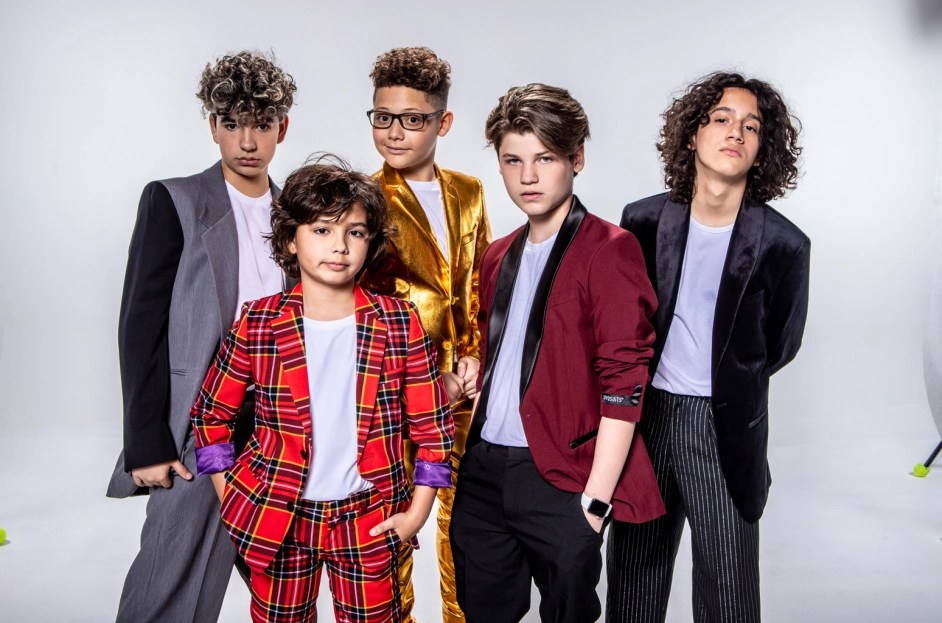
Menudo has been ranked one of the Biggest Boy Bands of All Time by several publications (Billboard, Us Weekly, Seventeen, and Teen Vogue, among others)– the only Latin band on their lists. The Puerto Rican boy band, founded by producer Edgardo Díaz in 1977, has had 39 members– who’ve been routinely replaced as they “age out,” usually at 16. It has launched the careers of a number of popular international stars, including Ricky Martin (in Menudo 1984–89) and Draco Rosa (1984–87), and sold over 20 million albums worldwide.
The band disbanded in 2009, but re-formed on its old template in 2019. And it’s just announced its latest roster, bringing its count of members up to 44…
Nearly a year after Menudo Productions announced they were on the search for new members to form the next generation of Menudo, the band has officially unveiled the five boys that will comprise the group.
On Monday (March 20), Nicolas Calero (10), Gabriel Rossell (13), Andres Emilio (14), Alejandro Querales (15) and Ezra Gilmore (12) were announced as the new faces of the eternally youthful boy band. And, in celebration of the announcement, the group also released their very first single “Mi Amore,” the first song off their upcoming debut album…
What’s old is new again: “New Menudo Boy Band Members Unveiled,” from @billboard.
* Heraclitus
###
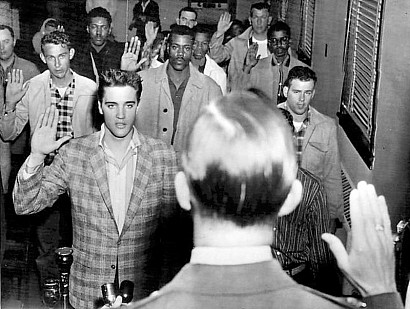
As we board the Ship of Theseus, we might recall that it was on this date in 1958, at 6.35am, that Elvis Presley reported to the Memphis draft board to be inducted in the U.S. Army. From there Elvis and twelve other recruits were taken by bus to Kennedy Veterans Memorial Hospital where the singer was assigned Army serial number 53310761.
You must be logged in to post a comment.