Posts Tagged ‘money’
“The best way to destroy the capitalist system is to debauch the currency”*…

… the capitalist system or for that matter, just about any economic system. So the keepers of those systems, the 169 authorities that issue money around the world, take that threat very seriously. About half of them depend on one company, De La Rue. As Samanth Subramanian explains, the pandemic has been a roller coaster ride for cash– and thus for De La Rue…
… De La Rue… is in the high-stakes business of authentication. It designs and prints national passports, as well as the silver foil labels that mark cigarette packs and alcohol bottles as genuine. Most crucially, it works with roughly half of the world’s central banks on their currency notes: designing them, developing security features to protect them from counterfeiting, and printing them. From its presses in Asia and Europe, De La Rue turns out up to 6 billion banknotes a year, making it the world’s largest commercial printer of currency.
That number is only a fraction of all the notes printed worldwide annually. The biggest central banks—such as those of the US, China, India, and Brazil—tend to have their own presses. Still, many smaller countries outsource their production of money. De La Rue prints British pounds, Fijian and Barbadian dollars, Qatari riyals, Sri Lankan rupees, and dozens more currencies…
[There follows a fascinating history of the company…]
… A major issuer like the Bank of England will place a currency order annually; smaller banks can order once every few years. But the past is not always a reliable guide. During times of inflation, for instance, the demand for notes grows. De La Rue is one of the few companies for which inflation—or, for that matter, regime change—is a good thing. The fall of Saddam Hussein warranted new notes; so did the creation of South Sudan.
Most countries are better prepared for more predictable cycles of cash use. Around the Middle East, central banks arrange to have more currency on hand before Eid al-Fitr, when it’s customary not only to spend money on festivities but also to hand out gifts of crisp new notes. The same goes for the Chinese New Year and Christmas.
The pandemic proved to be unexpectedly disruptive. A casual observer may have expected cash use to plunge in 2020, as people stayed home during lockdowns and worried about catching the virus from banknotes. In fact, disasters tend to drive people toward cash, as a physical store of safety and wealth. As a result, in most countries, the average value of notes drawn from ATMs went up by about 25-30%. Central banks also wanted new, cleaner notes, and larger stocks of notes in general, so they ordered more.
Across the US and Eurozone, total currency in circulation in September 2020 was more than 10% higher than the previous year. In the US, the number of notes circulating usually tends to rise by an annual 1-2 billion. In 2020, that figure surged to 6 billion.
De La Rue welcomed the bonanza. It had suffered a setback in 2019, when it failed to win a £490 million contract to print the new, post-Brexit British passport. (Ironically, the job went to an EU company). But after the pandemic glut of orders for new notes, demand sank to lower-than-normal levels between 2021 and 2022. The currency division’s revenues fell 2.1%, to £280.9 million. The chair of De La Rue’s board resigned in April 2023 after the company put out a profit warning—its third in a year (a new chair was appointed in May). For De La Rue, the hangover from the pandemic has been more challenging than the pandemic itself…
The world’s largest money printer made bank during the pandemic: “De La Rue: Currency printer to the world,” from @samanth_s in @qz.
* Vladimir Lenin
###
As we muse on money, we might recall that it was on this date in 1939 that The Wizard of Oz was first shown to the public in Dennis, MA, one of three test screenings ahead of the official release. Fearing the film would be unpopular, MGM executives opted to gauge audience reaction. The film was of course well received, and the studio proceeded with the star-studded Hollywood premier at Grauman’s Chinese Theater (on August 15).
And on the subject of currency, it’s worth noting that many view Dorothy’s trek to the Emerald City to be a lightly-veiled critique of the Gold Standard…

“The Dunning-Kruger effect is the hemophilia of dynastic capitalism”*…

Anyone too scared to say Thanatos, Elizabeth Schambelan argues, might wind up with Theranos…
… Melinda Cooper thinks family capitalism is a useful term for comprehending our circumstances. The historian Steve Fraser proposes dynastic capitalism, which has a stronger sense of occasion. Either phrase seems like it could appease the nomenclatural martinets among us, the ones who think neo-feudalism is almost as vulgar a term as fascism, and that vulgar rubrics must be avoided as we strive to come to grips with such classy phenomena as private submarines that vaporize on their way to James Cameron’s favorite place, state officials obsessing about high school athletes’ menstrual cycles, children getting chemical burns while working the graveyard shift in slaughterhouses, and Sam Bankman-Fried paying somebody 700 million dollars to introduce him to Orlando Bloom. But I digress. With respect to family or dynastic capitalism, there is an incredible moment in The Inventor, the HBO documentary about Elizabeth Holmes, when one of her investors—the famous venture capitalist, the one in the cowboy hat, if that narrows it down, whose name is escaping me—defends his choice to give her millions of dollars by noting that one of her grandfathers ran a hospital and the other ran a bank (or something to that effect), “so you see, she came by it quite naturally!” Another of the VCs in the documentary is wearing a tie covered in Bitcoin logos, and says he invested in Theranos, Holmes’s company, because Holmes was friends with his daughter, and that if his gut cosigned, he’d be willing to invest in “a guy and a dog, or two girls and a cat,” though presumably only if at least one member of the team could claim friendship with his child or his labradoodle. The Dunning-Kruger effect is the hemophilia of dynastic capitalism. The dynasty is perhaps best understood expansively, as encompassing friends, and relatives’ friends, and loyal retainers with up to four legs, but nevertheless insular and exclusive, rarely open to true upstarts. Entrepreneurship in this system is a euphemism for a set of favors dispensed from above, from a consortium of patrons that might or might not include the innovator’s literal daddy.
Several years ago I read about a scientific study indicating that one out of three people have no internal monologue, no inner homunculus to offer a constant stream of unsolicited opinions and irritating queries. My guess is that a disproportionate number of dynastic scions enjoy this enviable yet hazardous self-congruence. There is no still small voice to muse, “Hmm, does Theranos sound kind of sinister” or “Does OceanGate sound like a Daytona Beach water park that opened in 1995?” Both Holmes and Rush evinced blasé contempt for regulatory agencies and accrediting organizations, because they stifle innovation, are run by bureaucrats, etc. And if a bureaucrat hadn’t shut Holmes down, Theranos would still be operating little slices of purgatory in Walgreens stores across the land. Holmes called them “wellness centers,” which is a weird name for a place where a person with syphilis has a thirty-five percent chance of getting a false negative on their syphilis test. Rush had a similar rhetorical bent. He said there were sensors all over the Titan to provide real-time monitoring of “hull health,” as if the hull were living tissue and the submersible perhaps a gigantic kernel of corn, which for all I know is the vibe his marketing team was going for—organic and plant-based, if a bit high-carb. More to the point, calling the sensors hull-health monitors is like calling a fire alarm a building-health monitor, except in this analogy if the fire alarm goes off, it means the building and everyone in it will cease to exist in two milliseconds.
…
I do think Holmes is a useful comparanda for Rush, but of course, she’s not the only one. Maybe she’s on my mind simply because of that recent profile that offered real-time monitoring of the health of her ability to gull journalists. Or maybe it’s because Theranos, the word, is a kind of twisted emblem for an entire ethos. Even if she never voiced it to herself, Holmes knew what the real namesake of her company was. I’m not the first person to comment on the similarities between the two words. The differences are typical of what is called taboo deformation—little changes to phonemes that permit a dangerous word to be safely said aloud. Persephone’s name was perilous to utter because she was queen of the underworld, so people used variations like Persephassa. Anyone too scared to say Thanatos might wind up with Theranos.
I’m sorry to speak ill of the dead and the recently incarcerated, but I just don’t have the energy for taboo deformations of my sentiments. I’m tired of the sensation of gradually sinking through an abyssopelagic murk where light is a memory kindled by queasy blips of bioluminescence. Lanternfish have bio-lamps attached to their heads by slim appendages; the orbs hang directly in front of their open mouths, attracting prey. But at least lanternfish aren’t pompous megalomaniacs who arrogate the right to steer us all into darkness and then expect to be thanked for letting us exist in the sickening phosphor of their tiny little privatized suns. That’s more than can be said for our era’s plutocratic class, as apotheosized by an unhinged emerald-mine heir who looks like he’s had a marginally successful face transplant—a chilling visage, once mystifying to me in its peculiar lifelessness, finally explicable as the mask of a psychopomp who’s here to usher all of us to the chthonic depths whence came his wealth and ego. On the scale of self-awareness, Stockton Rush was a veritable Socrates compared to the space captain who is currently the world’s richest man. As for the scale of the damage wreaked by each entrepreneur’s risky business—I am not going to engage in that calculus. It is hard to take much satisfaction in the knowledge that chaos agents are vulnerable to the chaos they create. I don’t think I could rejoice in mortal comeuppance even if the most richly deserving person were on the receiving end, and even if the circumstances were less horrific than what befell those aboard the Titan, and even if it really were comeuppance instead of the mere illusion of it. If there is going to be justice it will have to be in life, since death by definition just evens out the scales. Theranos is coming for us all…
Eminently worth reading and pondering in full: “Little Privatized Suns,” from @ESchambelan in @nplusonemag.
Via Ingrid Burrington‘s (@lifewinning) glorious newsletter, Perfect Sentences.
* Elizabeth Schambelan
###
As we reevaluate our esteem of estates, we might recall that it was on this date in 1834 that slavery was abolished in the British Empire, as the Slavery Abolition Act 1833 came into force (though it remained legal in the possessions of the East India Company until the passage of the Indian Slavery Act, 1843).

“The only thing useful banks have invented in 20 years is the ATM”*…

ATM’s have been around in the U.S. since 1969; there were, as of 2018, 470,135 of them in operation, from which $5.1 Billion was withdrawn. The market for the machines and the technology that connects them was $20 Billion in 2020, projected to grow to $30 Billion in 2028. They were originally– and are still primarily used for cash disbursement; but over the years they’ve added a number of other functions: account deposits, bill payment, even lottery and movie ticket purchase– there are over 10 Billion ATM transactions in the U.S. alone. As cash plays a less central role in transactions, the the number of machines and transactions has slightly declined. Still they are a major factor in today’s financial infrastructure– and that few of us really understand. Patrick McKenzie is here to help– and to remind us that their history has lessons that are broader…
The first automated teller machines, which debuted in the late 1960s, were, as the name suggests, strictly cost-saving devices for bank branches. Branches exist as sales offices but have incidental cash-management functions. The denser depositors are around a branch, the more transactions happen during peak windows like e.g. the morning commute and lunchtime. The more transactions you need to support in a window, the more tellers you need to employ. Tellers are both surprisingly inexpensive relative to the degree of trust placed in them but surprisingly costly relative to occupations like e.g. cashiers which look outwardly similar. Banks have long wanted to control the costs of the teller base.
The original thesis behind the ATM was that you could move the most routine teller transactions, like cash withdrawals and balance inquiries, to a machine, and then reserve the teller for higher-complexity routine transactions like cashing checks. The machines gradually gained more features as they achieved ubiquity.
Interestingly, teller employment is actually up substantially since the introduction of ATMs. Secular demand for retail banking grew with the economy and the larger number of branches has compensated for reduced numbers of tellers per branch. See Bessen 2016…
ATMs are a fascinating example of a pattern we see a lot in finance: an internal operations improvement which was built into a business which eventually begat an infrastructure layer that may be a much bigger business. And for all their ubiquity, almost no one, even people professionally involved in finance, understand how they work…
See also: “Automated Teller Machines” (source of the image above)
The plumbing of finance: “The infrastructure behind ATMs,” from @patio11.
* Paul Volcker (2009)
###
As we insert our cards, we might send carefully-denominated birthday greetings to Kaushik Basu; he was born on this date in 1952. An economist, he served as Chief Economist of the World Bank from 2012 to 2016. Having taught at MIT, Harvard University, the Institute for Advanced Study at Princeton, and the London School of Economics, he is currently a professor at Cornell. From 2009 to 2012, during the United Progressive Alliance‘s second term, Basu served as the Chief Economic Adviser to the Government of India. His recent work has been on collective moral responsibilities and the role that individuals play in fulfilling them. In 2021, he was awarded the Alexander von Humboldt Foundation Research Award.

“The real alchemy consists in being able to turn gold back again into something else; and that’s the secret that most of your friends have lost.”*…
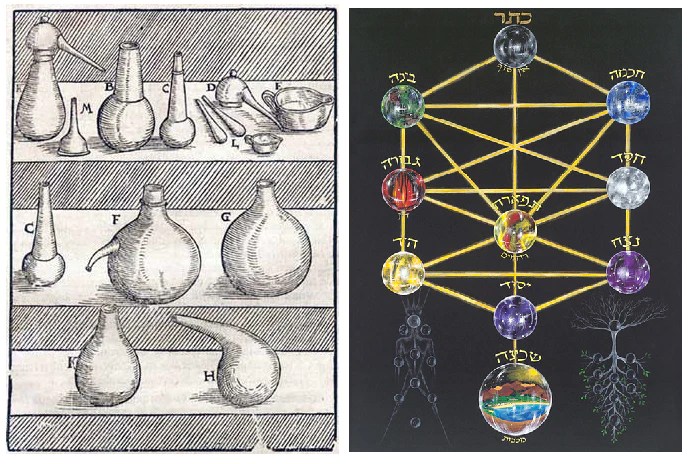
About a decade ago, the formidable Lawrence Weschler was a visiting scholar at the Getty Research Institute in Los Angeles, where he conceived a concept for an exhibit that, sadly, never materialized. Happily, he has shared the design in his wonderful newsletter, Wondercabinet…
Lead into Gold:
Proposal for a little jewel-box exhibit
surveying the Age-Old Quest
To Wrest Something from Nothing,
from the Philosopher’s Stone
through Subprime Loans
The boutique-sized (four-room) show would be called “Lead into Gold” and would track the alchemical passion—from its prehistory in the memory palaces of late antiquity through the Middle Ages

(those elaborate mnemonic techniques whereby monks and clerks stored astonishing amounts of details in their minds by placing them in ever-expanding imaginary structures, forebears, as it were, to the physical wondercabinets of the later medieval period—a sampling of manuscripts depicting the technique would grace a sort of foyer to the exhibition),

into its high classic phase (the show’s first long room) with alchemy as pre-chemistry (with maguses actually trying, that is, to turn physical lead into physical gold, all the beakers and flasks and retorts, etc.) to one side, and astrology as pre-astronomy (the whole deliriously marvelous sixteenth-into-seventeenth centuries) to the other, and Isaac Newton serving as a key leitmotif figure through the entire show (though starting out here), recast no longer in his role as the first of the moderns so much as “the Last of the Sumerians” (as an astonished John Maynard Keynes dubbed him, upon stumbling on a cache of thousands of pages of his Cambridge forebear’s detailed alchemical notes, not just from his early years before the Principia, but from throughout his entire life!).
The show would then branch off in two directions, in a sort of Y configuration. To one side:
1) The Golden Path, which is to say the growing conviction among maguses and their progeny during the later early-modern period that the point was allegorical, an inducement to soul-work, in which one was called upon to try to refine the leaden parts of oneself into ever more perfect golden forms, hence Faustus and Prospero through Jung, with those magi Leibniz and Newton riffing off Kabbalistic meditations on Infinity and stumbling instead onto the infinitesimal as they invent the Calculus, in turn eventually opening out (by way of Blake) onto all those Sixties versions, the dawning of the Age of Aquarius, etc., which set the stage for the Whole Earth Catalog and all those kid-maguses working in their garages (developing both hardware and software: fashioning the Calculus into material reality) and presently the Web itself (latter day version of those original memory palaces from back in the show’s foyer, writ large);
while, branching off to the other side, we would have:
2) The Leaden Path, in which moneychangers and presently bankers decided to cut to the chase, for, after all, who needed lead and who needed gold and for god’s sake who needed a more perfect soul when you could simply turn any old crap into money (!)—thus, for example, the South Sea Bubble, in which Newton lost the equivalent of a million dollars (whereupon he declared that he could understand the transit of stars but not the madness of men), tulipomania, etc., and thence onward to Freud (rather than Jung) and his conception of “filthy lucre” and George Soros (with his book, The Alchemy of Finance), with the Calculus showing up again across ever more elaborate permutations, leading on through Ponzi and Gecko (by way of Ayn Rand and Alan “The Wizard” Greenspan) to the whole derivatives bubble/tumor, as adumbrated in part by my own main man, the money artist JSG Boggs, and then on past that to the purest mechanism ever conceived for generating fast money out of crap: meth labs (which deploy exactly but exactly the same equipment as the original alchemists, beakers and flasks and retorts, to accomplish the literal-leaden version of what they were after, the turning of filth into lucre).
And I appended a xerox of that napkin sketch:

Eminently worth reading– and enjoying–in full. “The age-old human quest to turn nothing into something.”
* Edith Wharton
###
As we appreciate the abiding attraction of alchemy, we might recall that it was on this date in 1933 that President Franklin D. Roosevelt signed the act creating the Tennessee Valley Authority. A feature of the New Deal, the TVA was created to provide navigation, flood control, electricity generation, fertilizer manufacturing, regional planning, and economic development to the Tennessee Valley, a region (all of Tennessee, portions of Alabama, Mississippi, and Kentucky, and small areas of Georgia, North Carolina, and Virginia) which was particularly hard hit by the Great Depression relative to the rest of the nation. While owned by the federal government, TVA receives no taxpayer funding and operates similar to a private for-profit company.
The TVA has been criticized for its use of eminent domain, which resulted in the displacement of over 125,000 Tennessee Valley residents for the agency’s infrastructure projects. But on balance the TVA has been documented as a success in its efforts to modernize the Tennessee Valley and helping to recruit new employment opportunities to the region.

“Their principal dependence is not upon their arms, I believe, so much as upon the failure of our revenue”*…

The ongoing Russia-Ukraine war and subsequent rounds of economic sanctions has underscored the important role of money in conflicts. As Jamie Catherwood explains, for hundreds of years nations have used money as a means of control and geopolitical influence. Financial instruments and economic sanctions have been wielded like any other weapon…
Over the course of centuries, nations have utilized money as a means of control and geopolitical influence. Financial instruments and economic sanctions have been wielded like any another weapon.
In fact, President William Taft’s foreign policy became known as one of ‘Dollar Diplomacy’. President Taft explicitly referenced the interchangeability of traditional weapons and debt in his State of the Union Address in 1912, explaining that his foreign policy was to “substitute dollars for bullets”…
The methods and mediums through which countries wield this economic weapon changes over time, but the objectives of economic sanctions today are the same as those of centuries past: hurt the enemy by hurting their economy and restricting access to financial lifelines.
This article uses historical case studies across multiple centuries to demonstrate how money has been weaponized or used as a geopolitical tool in conflicts…
As the prevalence of “hot wars” continues to decline, the weaponization of money and finance stands to play an increasingly key role in how wars are waged…
“A Brief History of Economic Warfare,” from @InvestorAmnesia.
* “Their principal dependence is not upon their arms, I believe, so much as upon the failure of our revenue. To think they have taken such measures, by circulating counterfeit bills, to depreciate the currency, that it cannot hold its credit longer than this campaign. But they are mistaken.” – John Adams, in 1777, on Britain’s attempts to undermine the U.S. economy
###
As we brandish banknotes, we might recall that it was on this date in 1973 that Pink Floyd’s 8th studio album, The Dark Side of the Moon, reached the top of the Billboard 200 album chart. It had entered the chart on March 17 of that year, just over two weeks after its release, and held the #1 spot for only a week. But it was in the chart for for a record-setting 741 consecutive weeks. It has popped back into the charts over the years, and has currently been ranked for over 900 weeks (and counting). Overall sales of the album are estimated to be close to 50 million copies.
Money
“Money,” Track 6 (Track 1, Side 2) of The Dark Side of the Moon
It’s a crime
Share it fairly, but don’t take a slice of my pie
Money
So they say
Is the root of all evil today

You must be logged in to post a comment.