Posts Tagged ‘J. Edgar Hoover’
“Ritual and ceremony in their due times kept the world under the sky and the stars in their courses. It was astonishing what ritual and ceremony could do.”*…

The estimable Henry Farrell, responding to thoughts from Adam Tooze (here and here) and Paul Krugman (here) in trying to make sense of what happened in Davos last week, draws on the thinking of Michael Chwe’s Rational Ritual: Culture, Coordination and Common Knowledge (on why a game theoretic account of why ritual is important) to suggest that Europe and Carney disrupted Trump’s ceremony of self-anointment…
… I take two lessons from his book. First, that Davos fits very clearly into his definition of `ritual.’ Second, that rituals are important because they create common knowledge.
What we have seen at Davos over the last few days was an effort by the Trump administration to create new common knowledge in the world, an agreement that Trump was in charge, and that politics revolved around him. That effort has failed because of pushback from politicians, both Europeans who were furious at Trump, and Canada’s prime minister, Mark Carney who gave a quite extraordinary speech. However, the result is most certainly not a decisive victory for Europe, Canada, and the other forces allied with them. Instead, it is one significant moment in a longer story of struggle and contention…
… Rituals often take place in consecrated places. British kings are crowned in Westminster Abbey. They also often take place at a particular time of the year (see churches and organized religion, passim). So it is not at all a stretch to see the Davos meeting as a ritual that is held in the same overcrowded place at much the same time every year. Like many rituals, its boredom and its ceremony go hand in hand. For many years, Davos’s most obvious social purpose was to reinforce the consensus about globalization, in predictable ceremonial language. Its very dullness and lack of surprise was a side effect of its power.
That was then; this is now. I don’t think that it is at all implausible to see Trump’s planned descent on Davos this year as a version of a royal progress (see Stacie Goddard and Abe Newman on “neo-royalism”). Swooping into Davos, and making the world’s business and political elite bend their knees, would have created collective knowledge that there was a new political order, with Trump reigning above it all.
Business elites would be broken and cowed into submission, through the methods that Adam describes. The Europeans would be forced to recognize their place, having contempt heaped on them, while being obliged to show their gratitude for whatever scraps the monarch deigned to throw onto the floor beneath the table. The “Board of Peace” – an alarmingly vaguely defined organization whose main purpose seems to be to exact fealty and tribute to Trump – would emerge as a replacement for the multilateral arrangements that Trump wants to sweep away. And all this would be broadcast to the world. Adam’s combination of stage, convening and acting would provide a means to shape the collective understanding of a global audience that Trump was now in charge.
That, of course, is not what happened. First, the Europeans were finally pushed to the point where they pushed back. As Belgium’s prime minister put it, “Living as a happy vassal is one thing, existing as a miserable slave is another.” It was clear that the Europeans were finally becoming willing to retaliate against Trump. That in turn had consequences for business.
As Adam suggests, businesses are unwilling to visibly step up to oppose Trump one on one. But businesses are not only individual participants in the ceremony. They are also members of a vast and depersonalized audience, via the anonymizing mechanism of the market, and, as Chwe suggests, it is the collective understanding of the audience that is most important. Just as the ouija board allows individuals to express their desires without being held accountable to them (thanks to the ‘ideomotor effect’ so too, the invisible hand of the market moves the planchette of stock prices in ways that no business can be held accountable for. When stock markets fall, even at the prospect of trade conflict between Europe and the United States, politicians pay attention. “Market fundamentals” (a loaded and problematic term) provided a very different understanding of the shared consensus than the one Trump sought to impose.
Second, Carney’s speech laid out an entirely different understanding of what was happening, and what had gone before. In his words:
Let me be direct: We are in the midst of a rupture, not a transition. Over the past two decades, a series of crises in finance, health, energy and geopolitics have laid bare the risks of extreme global integration. But more recently, great powers have begun using economic integration as weapons. Tariffs as leverage. Financial infrastructure as coercion. Supply chains as vulnerabilities to be exploited.
… from Chwe’s more immediate perspective, what is more important than the vision of the past and future is where Carney said it and how he framed it. If you are planning a grand coronation ceremony, which is supposed to create collective knowledge that you are in charge, what happens when someone stands up to express their dissent in forceful terms?
The answer is that collective knowledge turns into disagreement. By giving the speech at Davos, Carney disrupted the performance of ritual, turning the Trumpian exercise in building common knowledge into a moment of conflict over whose narrative ought prevail…
… He wasn’t telling people anything that they didn’t know as individuals. He was, instead, turning that private knowledge into a putative collective understanding that countered the alternative collective understanding that Trump wanted to impose upon the world…
… The ceremony was disrupted by European threats of retaliation, which in turn led the market audience to express its unhappiness, and by Carney’s quite deliberate and self-conscious effort to crack the illusion of inevitability.
That does not mean that the Trump political project has been defeated. It is going to be very hard for Europe and Carney to build a viable counter-consensus. Already, Trump is looking to discipline Canada and seize back control of the narrative. What we have seen was a battle, not a war. But to appreciate the weapons that the battle was fought with, and understand the prize that was contended for, it is really helpful to emphasize the relationship between ritual and collective expectations. Chwe’s book is the clearest account of this relationship that I know of…
Eminently worth reading in full: “Davos is a rational ritual,” from @himself.bsky.social.
[Image above: source]
* Terry Pratchett, Pyramids
###
As we grapple with geopolitics, we might send illicit birthday greetings to Frank Costello; he was born Francesco Castiglia on this date in 1891. Having gotten his start in bootlegging during Prohibition, Costello became the head of the the Luciano crime family. a position he held (albeit for a few years in the 1950s remotely, as he served a federal prision sentence for tax evasion) until his retirement in 1957 after he had survived an assassination attempt ordered by Vito Genovese.
Costello had an “unusual” relationship with the man who could/should have been his primary antagonist, J. Edgar Hoover.
During the 1930s, Hoover persistently denied the existence of organized crime, despite numerous organized crime shootings as Mafia groups struggled for control of the lucrative profits deriving from illegal alcohol sales during Prohibition, and later for control of prostitution, illegal drugs and other criminal enterprises. Hoover [protested that] was reluctant to pursue the Mafia as he knew that organized crime investigations typically required excessive man hours while resulting in a relatively small number of arrests. He also feared that placing underpaid FBI agents—who had a starting annual salary $5,500 in the mid 1950s—in close contact with wealthy mobsters could undermine the FBI’s reputation of incorruptibility.
Many writers believe Hoover’s denial of the Mafia’s existence and his failure to use the full force of the FBI to investigate it were due to Mafia gangsters Meyer Lansky and Frank Costello‘s possession of embarrassing photographs of Hoover in the company of his protégé, FBI Deputy Director Clyde Tolson. [E.g., here] Other writers believe Costello corrupted Hoover by providing him with horseracing tips, passed through a mutual friend, gossip columnist Walter Winchell. Hoover had a reputation as “an inveterate horseplayer” and was known to send Special Agents to place $100 bets for him. Hoover once said the Bureau had “much more important functions” than arresting bookmakers and gamblers…
– source

“It is time for parents to teach young people early on that in diversity there is beauty and there is strength”*…

Since 1990, more than 90 percent of U.S. metro areas saw a decline in racial stratification, signaling a trend toward a more integrated America. Yet, while areas like Houston and Atlanta have undergone rapid demographic changes, cities like Detroit and Chicago still have large areas dominated by a single racial group.Some 50 years ago, policies like the Fair Housing Act and Voting Rights Act were enacted to increase integration, promote equity, combat discrimination and dismantle the lingering legacy of Jim Crow laws. But a Post analysis shows that some cities remain deeply segregated — even as the country itself becomes more diverse.
To explore these national changes, The Post analyzed census data from 1990, 2000, 2010 and the latest estimates from the 2016 five-year American Community Survey. Using this data, we generated detailed maps of the United States using six race categories: black, white, Hispanic, Asian/Pacific Islander, Native American and multirace/other for the available years…
The United States is on track to be a majority-minority nation by 2044. But census data show most of our neighbors are the same race. Take stock of where there has been progress and where there has been none using the interactive (and zoomable to zip code level) map at “America is more diverse than ever — but still segregated.”
* Maya Angelou
###
As we turn up the heat on the melting pot, we might recall that it was on this date in 1924 that 29 year old J. Edgar Hoover became the fifth Director of the Bureau of Investigation, which became the Federal Bureau of Investigation in 1935; he remained the FBI’s first director until his death in 1972 at the age of 77.
Hoover has been credited with building the FBI into a larger crime-fighting agency than it was at its inception and with instituting a number of modernizations to police technology, such as a centralized fingerprint file and forensic laboratories. But especially later in his carer and since his death, Hoover became a controversial figure as evidence of his secretive abuses of power began to surface. He was found to have exceeded the jurisdiction of the FBI, and to have used the FBI to harass political dissenters and activists (especially civil rights activists; see here and here), to amass secret files on political leaders and to collect evidence using illegal methods.

“Isn’t Baldwin a well-known pervert?”*…

Your tax dollars at work: the FBI’s files on James Baldwin…
Baldwin was “Jimmy” to most of his friends and to himself as well when he meditated on the various aspects of his personality. The numerous “strangers called Jimmy Baldwin,” he observed of his own diversity, included an “older brother with all the egotism and rigidity that implies,” a “self-serving little boy,” and “a man” and “a woman, too. There are lots of people there.” This secret FBI summary made the mistake of treating variations on Baldwin’s name and identity as a set of potentially criminal pseudonyms. For the Bureau, “James Baldwin,” “James Arthur Baldwin,” “Jim Baldwin,” and “Jimmy Baldwin” were “aliases” needing correlation and correction.

More memos on “aliases,” sexuality, and The Blood Counters at: “A look inside James Baldwin’s 1,884-page FBI file.”
* J. Edgar Hoover
###
As we shake our heads, we might recall that it was on this date in 1868 that Christopher Latham Sholes, Samuel W. Soulé, James Densmore, and Carlos Glidden received the first patent for a commercially-made typewriter. This early version looked like a piano with ivory keys for the alphabetical keyboard. The patent was sold to Remington & Sons who began production and later developed the Remington Typewriter with the now standard Qwerty layout.

Is it the right ear? the left ear?…
Who can remember?!?
Well now, thanks to designer Casey Perez, there’s no need; all uncertainty (if not all ambiguity) is erased with by her “plug rings”:

[TotH to Laughing Squid]
As we revel in semiotic certainty, we might recall that it was on this date in 1953 that FBI Director J. Edgar Hoover, refused an offer– and an annual salary reputed to have been $1 million– to become the president of the International Boxing Club. IBC’s owners were fighting allegations that their organization was a monopoly (it had promoted 47 out of 51 championship bouts in the United States from 1949 to 1955), and hoped that Hoover’s sheen might help. But in 1959 the Supreme Court upheld a lower court ruling that IBC had in fact violated antitrust statutes, and the company was dissolved.
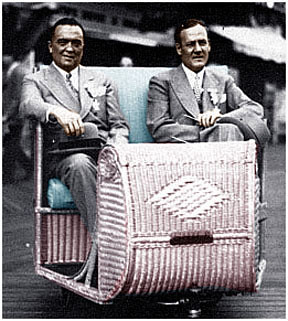 Hoover and companion Clyde Tolson in the ring (source)
You must be logged in to post a comment.