Posts Tagged ‘German History’
“I prefer the company of peasants because they have not been educated sufficiently to reason incorrectly”*…

An excerpt from Lyndal Roper‘s Cundill Prize-Shortlisted Summer of Fire and Blood…
The German Peasants’ War was the greatest popular uprising in western Europe before the French Revolution. Like a vast contagion it spread from southwest Germany through Württemberg, Swabia, the Allgäu, Franconia, Thuringia, and Saxony to Alsace in what is now France, Austria, and Switzerland. Peasants massed in armed bands in one region, then another, and rebellion would break out even in areas far away. At its height it involved well over a hundred thousand people, perhaps many more, who joined with the rebels to bring about a new world of Christian brotherhood. And for several months, they won. Authority and rulership collapsed, and the familiar structures of the Holy Roman Empire were overturned, exposing the fragility of the existing social and religious hierarchies. People even began to dream of a new order.
But this moment did not last. In spring 1525, the ‘Aufruhr,’ or ‘turbulence,’ as contemporaries called it, had reached its height, rolling all before it. By May the tide had turned. The forces of the lords put down the revolt by slaying somewhere between seventy thousand and a hundred thousand peasants. That summer of blood, maybe 1 per cent of the population of the area of the war was killed, an enormous loss of life in just over two months.
Despite its enormity, the Peasants’ War and its bloody defeat have been forgotten in recent years. People remember the era for Martin Luther and his Reformation, which split Western Christendom forever between Catholics and those who would eventually be known as Protestants. The Peasants’ War has come to be seen as a diversion, an interlude important mainly for what it tells us about Luther, for this was the moment when Luther came out in support of the princes and against the ‘mad dogs’, the rebelling peasants. From then on, the Reformation in Germany would be conservative. Mainstream reformers would go on to ally with rulers to advance the goals of the Reformation, and when the new church was set up after the war, it would have the backing of those in power.
The Reformation’s possibilities, as well as its limits, cannot be grasped without an understanding of the Peasants’ War as the giant trauma at its center. Equally, the ideas, dreams, and hopes unleashed by the Reformation shaped the Peasants’ War. And the war, in turn, cannot be understood if it has been severed from the heady atmosphere of religious excitement in which it took place.
To understand why such a massive movement mushroomed from such small, apparently isolated beginnings in a distant corner of the empire, we need to listen to what drove the peasants. It is no accident that just three years after Luther defied the emperor and the estates of the empire, the peasants of first one or two lords and abbots decided to down tools and gather in bands.
In 1520 Luther himself had written a short but powerful tract, one of the three great Reformation writings from that year setting out his theology, titled The Freedom of a Christian. The cover of the German edition was emblazoned with the incendiary word ‘freedom.’ It was all very well for Luther’s supporters to argue later that he had meant spiritual freedom, but the fact was that many peasants in the southwest, particularly those ruled by the Catholic monasteries, convents, and abbots Luther was attacking, were serfs, owned by their masters. For them, freedom meant ending serfdom too. Despite Luther’s later condemnation, the Peasants’ War is unthinkable without the ideas he unleashed.
By standing up to the emperor, Charles V, at Worms in 1521, Luther had provided an unforgettable example of resistance. A lone monk in a borrowed cassock before an audience of dignitaries arrayed in all their finery, he had confronted the mightiest power in the land and had said his piece, refusing to recant unless convinced by ‘Holy Scripture.’ Small wonder that the peasants drew on his ideas for their cause. Small wonder they assumed he would support them.
But he did not. [see below] By late March of 1525, the peasant revolt had become a mass movement whose demands found shape in the Twelve Articles [see here and more fully, here]. These were probably composed by Sebastian Lotzer, a townsman and furrier, on the basis of hundreds of complaints that different groups of peasants had been formulating for weeks beforehand. Influenced by Martin Luther; the preacher Christoph Schappeler, himself a follower of the Swiss reformer Huldrych Zwingli; and a strain of radical evangelicalism, Lotzer helped transform a set of specific, apparently random grievances against particular lords into a wide-ranging theological vision that chimed with radical Reformation ideas.
Local spats could now feed into a mass movement that spread far beyond individual disputes between a peasant and a particularly nasty abbot or lord. Yet Lotzer did not invent this theology, nor was he the first to apply it to agricultural relations—that had already been done by the peasants themselves as they formulated their complaints. The Twelve Articles then became a document that the movement everywhere acknowledged, even when the rebels did not know exactly what the articles contained, and even though many areas revised them to suit local circumstances. Soon they were printed using the new technology made possible by the invention of movable type, and they spread all over Germany. You could pick them up and hold them in your hand, point to each demand and the biblical passages that proved their godliness.
The key thing about the Peasants’ War was that it was a mass movement. For too long, histories of the war have emphasized its leaders, men like Thomas Müntzer in Thuringia, adopted by Friedrich Engels and then by the East German regime as a revolutionary hero to rival the reactionary colossus Luther. There are indeed a series of outsize characters who populated the war: Götz von Berlichingen, the knight with the iron fist, who became a peasant leader after his mother-in-law failed to hand him his liege-lord’s summons to fight against them, or so he later claimed in his mendacious autobiography, written in his nineties. Or Florian Geyer, a noble who also led peasant armies and was finally knifed by an assassin. Or the Black Hofmännin, a peasant woman who claimed she urged on the peasant troops and rubbed the fat of the slaughtered nobles onto her shoes. Or the ‘Bauernjörg,’ Truchsess Georg von Waldburg, who led the lords’ army of the Swabian League and mercilessly torched rebel villages.
But this was a movement, not a drama of Great Men. The peasants’ side of the story has been forgotten because they did not write it down, either because they were illiterate or because they were slain or executed in the war. The winners—the lords and mainstream theologians who were the peasants’ enemies—instead wrote the history…
“How the German Peasants’ War Exposed 16th-Century Europe’s Fragile Foundations,” via @literaryhub.bsky.social.
Read Martin Luther’s (negative) reactions to the Peasants here.
* Montaigne
###
As we ponder the historicity of the history we “know,” we might spare a thought for a victim of a somewhat more successful rebellion, the wife of King Louis XVI, Marie Antoinette, who is famously remembered for responding, on being told that many of her subjects had no bread, “let them eat cake”… except that she (virtually certainly) didn’t: the phrase can actually be traced back to Jean-Jacques Rousseau‘s Confessions in 1765, when Antoinette was nine years old and had never been to France. The phrase was not attributed to Antoinette until decades after her death.
Still, she was was beheaded on this date in 1793 by the Revolutionary Tribunal of the Republican government established after the fall of the monarchy (and the execution of her husband) in the French Revolution.
Bonus: “Marie Antoinette, the original influencer” (?)

“My spirit will arise from my grave”*…
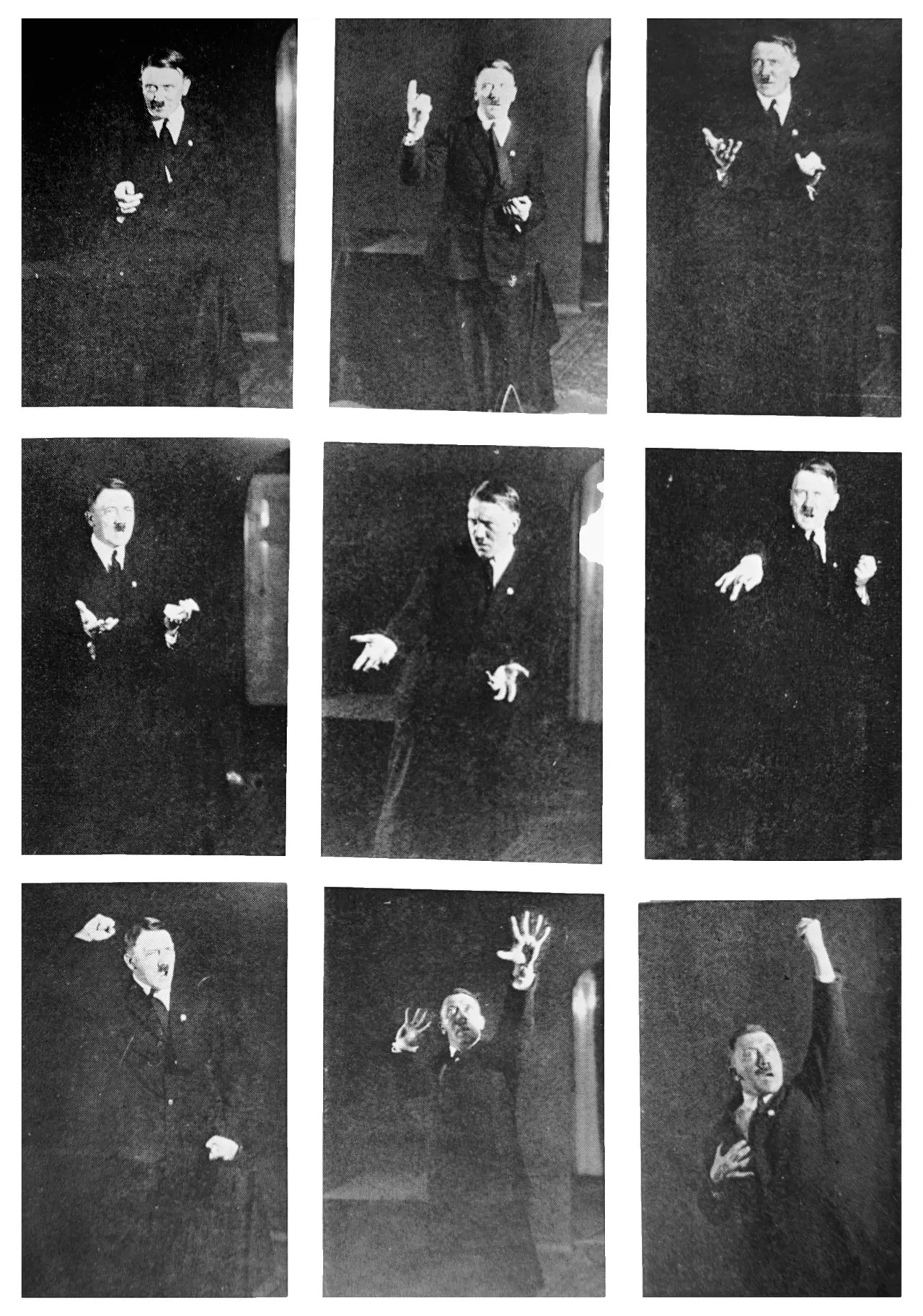
Hitler didn’t seize power; he was given it. As Adam Gopnik reports in a review of Tim Ryback‘s important new book, media lords thought that they could control him; political schemers thought that they could outwit him. The mainstream left had become a gerontocracy. And all of them failed to recognize his immunity to shame…
Hitler is so fully imagined a subject—so obsessively present on our televisions and in our bookstores—that to reimagine him seems pointless. As with the Hollywood fascination with Charles Manson, speculative curiosity gives retrospective glamour to evil. Hitler created a world in which women were transported with their children for days in closed train cars and then had to watch those children die alongside them, naked, gasping for breath in a gas chamber. To ask whether the man responsible for this was motivated by reading Oswald Spengler or merely by meeting him seems to attribute too much complexity of purpose to him, not to mention posthumous dignity. Yet allowing the specifics of his ascent to be clouded by disdain is not much better than allowing his memory to be ennobled by mystery.
So the historian Timothy W. Ryback’s choice to make his new book, “Takeover: Hitler’s Final Rise to Power” (Knopf), an aggressively specific chronicle of a single year, 1932, seems a wise, even an inspired one. Ryback details, week by week, day by day, and sometimes hour by hour, how a country with a functional, if flawed, democratic machinery handed absolute power over to someone who could never claim a majority in an actual election and whom the entire conservative political class regarded as a chaotic clown with a violent following. Ryback shows how major players thought they could find some ulterior advantage in managing him. Each was sure that, after the passing of a brief storm cloud, so obviously overloaded that it had to expend itself, they would emerge in possession of power. The corporate bosses thought that, if you looked past the strutting and the performative antisemitism, you had someone who would protect your money. Communist ideologues thought that, if you peered deeply enough into the strutting and the performative antisemitism, you could spy the pattern of a popular revolution. The decent right thought that he was too obviously deranged to remain in power long, and the decent left, tempered by earlier fights against different enemies, thought that, if they forcibly stuck to the rule of law, then the law would somehow by itself entrap a lawless leader. In a now familiar paradox, the rational forces stuck to magical thinking, while the irrational ones were more logical, parsing the brute equations of power. And so the storm never passed. In a way, it still has not…
Both the review and the book on which it focuses are eminently worth reading in full: “The Forgotten History of Hitler’s Establishment Enablers” (possible paywall; in which case, archived copy here), from @adamgopnik in @NewYorker.
* Hitler, as quoted in a letter from von Ribbentrop (to Churchill and Atlee) sent just before von Ribbentrop was captured at the end of the war
###
As we hear the echo, we might spare a thought for Ludwig van Beethoven; he died on this date in 1827. A crucial figure in the transition between the Classical and Romantic eras in Western music, he remains one of the most famous and influential of all composers. His best-known compositions include 9 symphonies, 5 concertos for piano, 32 piano sonatas, and 16 string quartets. He also composed other chamber music, choral works (including the celebrated Missa Solemnis), a single opera (Fidelio), and numerous songs.
Relevantly to the piece above…
Beethoven admired the ideals of the French Revolution, so he dedicated his third symphony to Napoleon Bonaparte… until Napoleon declared himself emperor. Beethoven then sprung into a rage, ripped the front page from his manuscript and scrubbed out Napoleon’s name. Some modern reproductions of the original title page have scrubbed out Napoleon’s name to create a hole for authenticity’s sake!
Beethoven’s temper and Symphony No. 3 ‘Eroica’
But, of course, it was too late…

“Comparisons are odious”*…

… but sometimes instructive in the very ways that they fail…
The innovations which make their appearance in East Asia round about the year 1000 … form such a coherent and extensive whole that we have to yield to the evidence: at this period, the Chinese world experienced a real transformation. … The analogies [with the European Renaissance] are numerous – the return to the classical tradition, the diffusion of knowledge, the upsurge of science and technology (printing, explosives, advance in seafaring techniques, the clock with escapement …), a new philosophy, and a new view of the world. … There is not a single sector of political, social or economic life in the eleventh to thirteenth centuries which does not show evidence of radical changes in comparison with earlier ages. It is not simply a matter of a change of scale (increase in population, general expansion of production, development of internal and external trade) but of a change of character. Political habits, society, the relations between town and country, and economic patterns are quite different from what they had been. … A new world had been born.
Jacques Gernet. A History of Chinese Civilization, pp. 298-300
Doug Jones, on what the remarkable story of the Song Dynasty can and can’t tell us about other periods…
Scholars contemplating the sweeping economic, social, and political transformation of China under the Song dynasty (960-1279) seem compelled to draw analogies with later dramatic occurrences in Europe – with the Renaissance (as in the quote above) or with the Economic Revolution in England on the eve of the Industrial Revolution.
The changes are dramatic. Population roughly doubles, from about 50 million to about 100 million. Cities grow. Both internal and external trade boom. The division of labor advances, with different households and different parts of the country specializing in “goods such as rice, wheat, lighting oil, candles, dyes, oranges, litchi nuts, vegetables, sugar and sugarcane, lumber, cattle, fish, sheep, paper, lacquer, textiles and iron.” In a number of fields of technology – iron production, shipbuilding – China reaches heights which the West will not attain for many centuries.
With changes in the economy come changes in the relation between society and state. Taxes come to be mostly collected in cash rather than kind, Eventually revenues from taxes on commerce, including excise taxes and state monopolies, will greatly exceed those from land tax. A Council of State will put constitutional checks on the power of the emperor.
Yet Imperial China will ultimately follow a different, less dramatic developmental pathway than Europe. Some reasons why…
On the ways in which history doesn’t repeat itself: “A cycle of Cathay,” from @logarithmic_h.
* Proverb
###
As we listen for the rhyme, we might recall that today is Schicksalstag (“Day of Fate”) in Germany. On this date five momentous events took place: Robert Blum, a leader in the Vienna revolts, was executed in 1848; Kaiser Wilhelm II resigned, marking the end of German monarchies in 1918; the Hitler’s Beer Hall Putsch failed in 1923; Kristallnacht (the Night of Broken Glass) and the Nazi antisemitic pogroms raged in 1938; and the Berlin Wall fell in 1989.

East and West Germans at the Brandenburg Gate in 1989 (source)
“Every decent man is ashamed of the government he lives under”*…

The majority of countries are democracies, but how many people enjoy what we think of as democratic rights? A nifty interactive map from Our World In Data charts the changes in political regimes across the globe, country by country, over the last 200 years. By way of explaining its categories:
• In closed autocracies, citizens do not have the right to choose either the chief executive of the government or the legislature through multi-party elections.
• In electoral autocracies, citizens have the right to choose the chief executive and the legislature through multi-party elections; but they lack some freedoms, such as the freedoms of association or expression, that make the elections meaningful, free, and fair.
• In electoral democracies, citizens have the right to participate in meaningful, free and fair, and multi-party elections.
• In liberal democracies, citizens have further individual and minority rights, are equal before the law, and the actions of the executive are constrained by the legislative and the courts.
As Visual Capitalist observes…
Do civilians get a representative say in how the government is run where you live?
While it might seem like living with a basic level of democratic rights is the status quo, this is only true for 93 countries or territories today—the majority of the world does not enjoy these rights.
It also might surprise you that much of the progress towards democracy came as late as the mid-20th century…
An interactive look at the state of democracy around the world, and how it has evolved. From @OurWorldInData, via @VisualCap.
* H. L. Mencken
###
As we ruminate on representation, we might recall that it was on this date in 1933, the day after an arsonist ignited the Reichstag building, home of the German parliament in Berlin (and four weeks after Nazi leader Adolf Hitler had been sworn in as Chancellor of German), that Adolf Hitler attributed the fire to a conspiracy of Communist agitators.
Marinus van der Lubbe, a Dutch “council communist”, was the apparent culprit; but Hitler insisted on a wider network of villains. He used it as a pretext to claim that Communists were plotting against the German government, and induced President Paul von Hindenburg to issue the Reichstag Fire Decree suspending civil liberties, and to pursue a “ruthless confrontation” with the Communists. A court later found that van der Lubbe had in fact acted alone. But Hitler’s orchestrated reaction to the Reichstag Fire began the effective rule of the Nazi Party and the establishment of Nazi Germany.

What’s Up, Doc?…

Radioactive rabbit trapped near Richland
A radioactive rabbit caught at Hanford [see here] just north of Richland had Washington State Department of Health workers looking for contaminated droppings Thursday…
[Hanford was] used during the Cold War for testing highly radioactive materials, particularly fuel elements and cladding that were irradiated at Hanford reactors as part of plutonium production for the nation’s nuclear weapons program…
Liquid waste with radioactive salts was discharged into the ground near central Hanford during the Cold War. Rabbits and other animals were attracted to the salts and spread radioactive droppings across as much as 13.7 square miles of sage-covered land before the waste sites were sealed to keep out animals in 1969. Federal economic stimulus money has been used to survey for the radioactive hot spots that remain four decades later.
In a more recent case, so many radioactive wasp nests were found spread across six acres by H Reactor in northern Hanford that up to a foot of soil was dug up to remove the nests. The nests were built by mud dauber wasps in 2003. Water was sprayed to control dust during demolition of a basin attached to the reactor, and the mud created was collected by the wasps to build nests under straw that had been spread nearby to protect newly planted sagebrush seedlings.
There have been a couple of cases in the past two decades of contaminated animals in areas where they potentially could come in contact with the public. In 1996, a contaminated mouse apparently crawled into a box of food collected by an employee food drive in central Hanford. It was trapped and tested in an abandoned Hanford building previously used by the Tri-Cities Food Bank.
Two years later, gnats and flies were suspected of eating a sugary coating used to fix some radioactive contamination. They then spread the contamination to waste left by workers in offices, such as banana peels and apple cores. That required 35 tons of trash that could contain the office waste to be dug up from the Richland landfill and returned to Hanford.
Read the full story at Tricityherald.com (and more, here or here).
As we contemplate the prospect of Easter egg hunts after dark, we might recall that it was on this date in 1989 that a failing east German regime opened the Berlin Wall, allowing free East-West passage. A few weeks earlier Hungarian officials had opened the border between Hungary and Austria, effectively rendering the Berlin Wall redundant, as East German citizens could then circumvent it by going through Hungary into Austria, and thence into West Germany. Virtually immediately, Germans on both sides began to demolish the Wall.
 Germans climbing the Wall at the Brandenburg Gate in celebration of its demise (source)
You must be logged in to post a comment.