Posts Tagged ‘competition’
“All reality is a game”*…
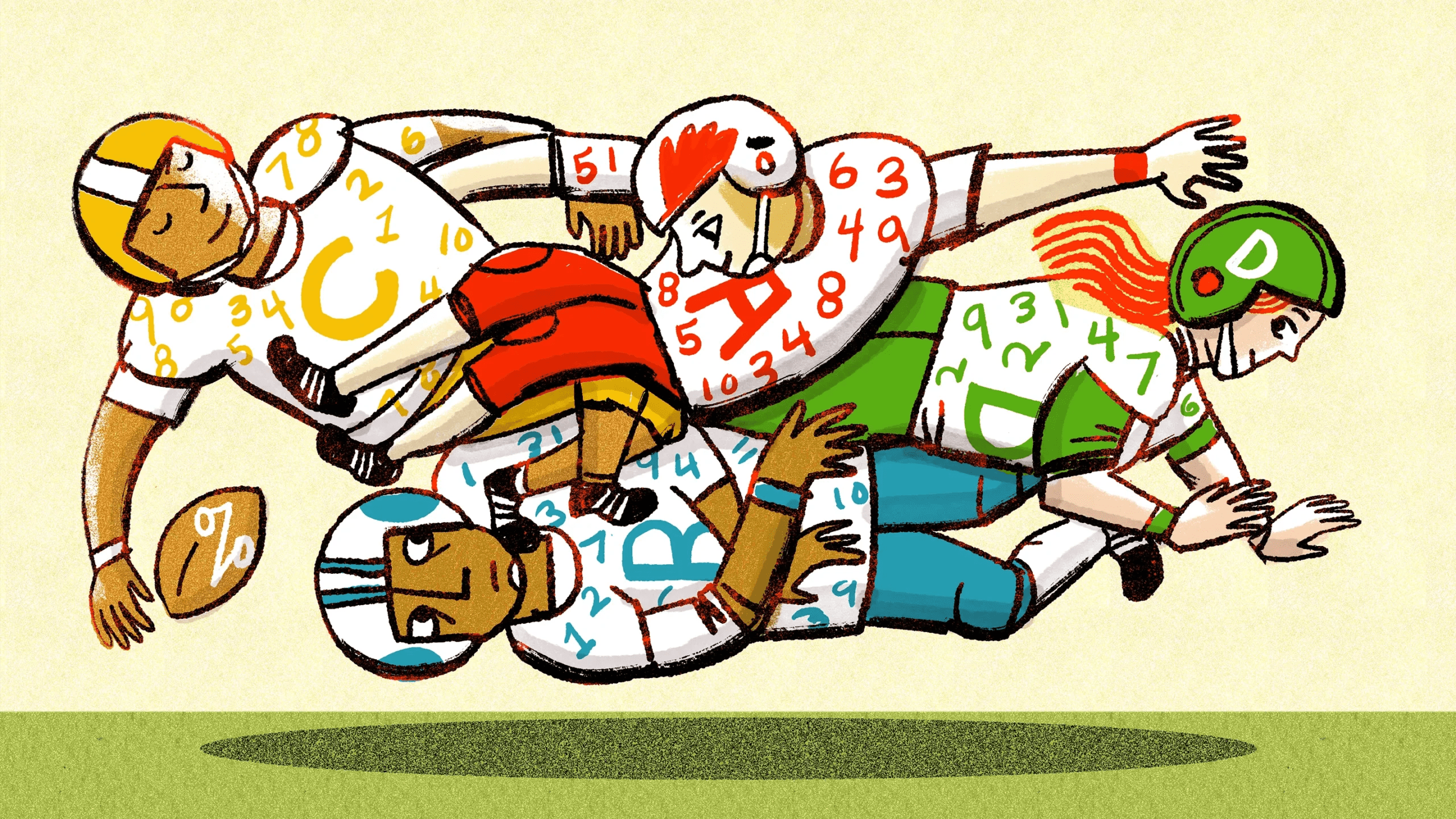
If Anna beats Benji in a game and Benji beats Carl, will Anna beat Carl? Patrick Honner unpacks the principle of transitivity…
It’s the championship game of the Imaginary Math League, where the Atlanta Algebras will face the Carolina Cross Products. The two teams haven’t played each other this season, but earlier in the year Atlanta defeated the Brooklyn Bisectors by a score of 10 to 5, and Brooklyn defeated Carolina by a score of 7 to 3. Does that give us any insight into who will take the title?
Well, here’s one line of thought. If Atlanta beat Brooklyn, then Atlanta is better than Brooklyn, and if Brooklyn beat Carolina, then Brooklyn is better than Carolina. So, if Atlanta is better than Brooklyn and Brooklyn is better than Carolina, then Atlanta should be better than Carolina and win the championship.
If you play competitive games or sports, you know that predicting the outcome of a match is never this straightforward. But from a purely mathematical standpoint, this argument has some appeal. It uses an important idea in mathematics known as transitivity, a familiar property that allows us to construct strings of comparisons across relationships. Transitivity is one of those mathematical properties that are so foundational you may not even notice it…
Read on: “The Surprisingly Simple Math Behind Puzzling Matchups,” from @MrHonner in @QuantaMagazine.
* Iain M. Banks, The Player of Games
###
As we tackle transitivity, we might spare a thought for Charlemagne; he died on this date in 814. A ruler who united the majority of western and central Europe (first as King of the Franks, then also King of the Lombards, finally adding Emperor of the Romans), he was the first recognized emperor to rule from western Europe since the fall of the Western Roman Empire three centuries earlier; the expanded Frankish state that he founded is called the Carolingian Empire, the predecessor to the Holy Roman Empire.
Committed to educational reform and extension, he began (in 789) the establishment of schools teaching the elements of mathematics, grammar, music, and ecclesiastic subjects; every monastery and abbey in his realm was expected to have a school for the education of the boys of the surrounding villages. The tradition of learning he initiated helped fuel the expansion of medieval scholarship in the 12th-century Renaissance.
Charlemagne is considered the father of modern Europe. At the same time, in accepting Pope Leo’s investiture, he set up ages of conflict: Charlemagne’s coronation as Emperor, though intended to represent the continuation of the unbroken line of Emperors from Augustus, had the effect of creating up two separate (and often opposing) Empires– the Roman and the Byzantine– with two separate claims to imperial authority. It led to war in 802, and for centuries to come, the Emperors of both West and East would make competing claims of sovereignty over the whole.

“There are only two ways to establish competitive advantage: do things better than others or do them differently”*…

… so why is it that there’s so much emulation, so much sameness in the marketplace? Byrne Hobart explains Hotelling’s Law…
The economist Harold Hotelling has already inspired one Diff piece, on the optimal extraction rate for finite resources ($), but Hotelling has another rule that explains political non-polarization, fast-followers in tech, and the ubiquity of fried chicken sandwiches. Companies, parties, subcultures tend to converge over time, and a simple model can illustrate how.
Consider a stretch of beach 100 feet long, running east to west. Beachgoers are positioned randomly on the beach. There are two hot dog vendors who are both selling to beachgoers. Where should they position their hot dog stands?
One option is for one vendor to be a quarter of the way from one side, and the other to be a quarter of the way from the other side. This means that everyone is, at most, 25 feet away from a snack. That’s socially optimal. But let’s suppose the vendor on the eastern side moves a bit to the west. Everyone east of them will still patronize them, because they’re still closer, if not the closest. But some customers in the middle will switch! So the other hot dog seller responds by moving east, and the same result ensues. Eventually, you end up with two vendors in the middle of the beach, and now the median distance customers travel, 25 feet, is the former maximum distance anyone used to travel.
You can substitute any other cost or one-dimensional positioning feature for this. If there are two snack food manufacturers, the socially-optimal setup might be for one of them to sell something sweet and the other to offer something salty, but the same convergent force will eventually lead both of them to sell a salty-sweet combo; customers with specific preferences will be worse-off, but they’ll still have a favorite, while any convergence captures some of the customers who were close to indifferent before.
Making the model more reflective of the real world illustrates some of the assumptions it depends on. For example, we were always assuming exactly two competitors, but now let’s add in new entrants and departures. The model gets simpler if one of the initial two hot dog vendors quits—ironically, in this case the monopolist’s profit-maximizing position is also the social welfare-maximizing position (though they’ll probably respond to their new monopoly power with higher prices). In snack foods, if the formerly diverse market is now just a choice between salty-sweet and sweet-and-salty, a new entrant might introduce some product for the flavor purists and capture the market that way.
The model does describe cases where there are limits to new entrants. For example:
- In a voting system that tends to disproportionately reward winners, you’ll expect some convergence between parties. They want enough differentiation for voters to feel like they’re making a choice, but beyond that it makes sense for both sides to compete on similarity rather than difference.1
- Businesses that are dependent on continuously delivering products with low value density will tend to have a few national brands and lots of regional ones, as with Coke and Pepsi. Both beverages are pretty similar, and retain just enough differentiation for customers to feel like they’re making a choice. The amount is small, but nonzero: in the 1980s, when Coke was losing to the sweeter Pepsi in blind taste tests, they introduced a new, sweeter formula, a decision they reversed after a consumer backlash.
- Software products with high switching costs tend to get more complex over time, as standalone products get subsumed as features of a larger suite. As long as the pace of increased complexity is controlled, this doesn’t hurt user experience too much. It does eventually lead to a sprawling mess, but by then a new kind of switching cost kicks in—the sunk cost of learning to use the system is so high that it feels wasteful to switch.
- This model also describes regulated industries that lack extraordinary returns on capital. It’s hard for a bank to become a monopoly because it takes so much capital to grow, and while even the largest banks have some regional skew to their branch networks, they tend to settle on a similar model. They also diversify in similar ways: issuing credit cards, getting into investment banking, having a capital markets business of some sort, etc…
Hotelling’s simplified model describes an iron law: under the right set of assumptions, sellers end up homogenizing their products, and niche interests end up under-served. In the real world, there are countervailing forces, and in practice the dimensions on which companies compete are messy enough that “adjacent” doesn’t really work. But Hotelling’s Law also illustrates why there’s relentless pressure for homogeneity: if some people like product A and some people prefer product B, something halfway between the two will capture part of that audience. And the producer of A or B is probably in a better position to make this new compromise product C…
One can observe that this dynamic often leads, beyond sameness, to steadily declining value/quality as well. So, one might wonder why, if all it takes is an innovative new entrant to stir up a market, that’s not going on all the time. The answer is, of course, complicated (and varies from sector to sector). But if there is a root cause, your correspondent would suggest, it’s the concentration of power and control in a market that yields oligopolies that can effectively preempt new competitors. (See, e.g., here, here, and here.)
The economics of every burger chain launching a chicken sandwich: “Hotelling’s Law,” from @ByrneHobart.
###
As we noodle on normalization, we might spare a thought for a man who innovated, then (for a time) enjoyed the benefits of an oligopolist, Thomas Crapper; he died on this date in 1910. Crapper popularized the one-piece pedestal flushing toilet that still bears his name in many parts of the English-speaking world.
The flushing toilet was invented by John Harrington in 1596; Joseph Bramah patented the first practical water closet in England in 1778; then in 1852, George Jennings received a patent for the flush-out toilet. Crapper’s contribution was promotional (though he did develop some important related inventions, such as the ballcock): in a time when bathroom fixtures were barely mentionable, Crapper, who was trained as a plumber, set himself up as a “sanitary engineer”; he heavily promoted “sanitary” plumbing and pioneered the concept of the bathroom fittings showroom. His efforts were hugely successful; he scored a series of Royal Warrants (providing lavatories for Prince, then King Edward, and for George V) and enjoyed huge commercial success. To this day, manhole covers with Crapper’s company’s name on them in Westminster Abbey are among London’s minor tourist attractions.

“The roots of the word ‘compete’ are the Latin con petire, which meant ‘to seek together'”*…

Peter Thiel would have us believe that “competition is for losers.” The FTC begs to differ. Earlier this month, it introduced a proposed rule that would eliminate employee noncompete agreements. Scott Galloway explains why this is a very good plan…
… Yesterday’s iconoclasts pull the ladder up behind them the moment they become today’s icons. We’re in general agreement that “anti-competitive” behavior is bad, and have laws against it. Yet companies have been able to convince regulators to look the other way on an increasingly popular weapon of mass entrenchment. They’re passing out OxyContin during an AA meeting. The Oxy? Noncompete agreements…
Noncompete clauses are what firms use to sequester your human capital from competitors. When a new employee signs a noncompete with, say, Johnson & Johnson, they agree that when their employment ends, they won’t work at another pharmaceutical company for a designated period — usually one to two years. If you’re familiar with noncompetes, you likely associate them with technology jobs, where employers want to protect valuable intellectual property. And that’s the defense most often offered for the restrictions. BTW, the argument is bullshit … a confidentiality agreement does the trick.
The irony of noncompetes is they only serve to dampen growth. One of the few places where they’re banned is also home to the world’s most innovative tech economy: California. Job-hopping and seeding new acorns have been part of Silicon Valley since the beginning. In 1994 a Berkeley economist theorized that California’s ban on noncompetes was one of the main reasons Silicon Valley existed at all, and in 2005, economists at the Federal Reserve put forward statistical evidence supporting the theory. Apple, Disney, Google, Intel, Meta, Netflix, Oracle, and Tesla were able to succeed without limiting the options of their employees.
Yet outside California, corporate boardrooms love noncompetes. Historically they were attached only to high-skilled, high-paying jobs. Now they’re becoming ubiquitous across different industries at all levels. Fast-food workers are being forced to sign noncompetes, as are hairstylists and security guards. Roughly a third of minimum wage jobs in America now require such agreements. If forcing noncompetes on America’s lowest-paid workers sounds like indentured servitude, trust your instincts.
Employers claim noncompetes give them the assurance to pay for training and other investments in their employees. There is some evidence that noncompetes are associated with more worker training. But there’s a catch: They also decrease wages. The good news is we’ll train you to operate the fryer, the bad news is we won’t pay you a living wage to do it — and you can’t take a better job across the street.
The FTC estimates that noncompetes reduce employment opportunities for 30 million people and suppress wages by $300 billion per year. That’s far more than the total value of property stolen outright every year. Multiple studies also show that noncompetes reduce entrepreneurship and business formation. Which makes sense — it’s difficult to start a business when talent pools are not accessible or allocated to their best use. Downstream, the lack of competition leads to entrenchment, which eventually results in higher prices for consumers — as one study found has occurred in health care. Everybody loses. Except, of course, the incumbent’s shareholders…
It’s worth remembering the insight of W. Edwards Deming, one of the architects of Japan’s rise to industrial leadership after World War II: “In 1945, the world was in a shambles. American companies had no competition. So nobody really thought much about quality. Why should they? The world bought everything America produced. It was a prescription for disaster.”
The case against noncompete agreements: “Compete,” from @profgalloway.
See also: “Noncompete Agreements Reduce Worker Pay — and Overall Economic Activity” (source of the image above).
* Mihaly Csikszentmihalyi
###
As we remove the shackles, we might recall that it was on this date in 1915 that Ralph Chaplin, a Wobblie (a member of the Industrial Workers of the World) finished his poem “Solidarity Forever“– which, sung to the tune of “John Brown’s Body”/The Battle Hymn of the Republic,” has become a labor movement anthem.

“Virtue is more to be feared than vice, because its excesses are not subject to the regulation of conscience”*…

Regulation often addresses real public needs/concerns. But the costs of compliance often favor the largest players in a regulated market– which can lead to consolidation. From the Oxford Martin School, a current example…
Exploiting the timing and territorial scope of the European Union’s General Data Protection Regulation (GDPR), this paper examines how privacy regulation shaped firm performance in a large sample of companies across 61 countries and 34 industries. Controlling for firm and country-industry-year unobserved characteristics, we compare the outcomes of firms at different levels of exposure to EU markets, before and after the enforcement of the GDPR in 2018. We find that enhanced data protection had the unintended consequence of reducing the financial performance of companies targeting European consumers. Across our full sample, firms exposed to the regulation experienced a 8% decline in profits, and a 2% reduction in sales. An exception is large technology companies, which were relatively unaffected by the regulation on both performance measures. Meanwhile, we find the negative impact on profits among small technology companies to be almost double the average effect across our full sample. Following several robustness tests and placebo regressions, we conclude that the GDPR has had significant negative impacts on firm performance in general, and on small companies in particular…
“Privacy Regulation and Firm Performance: Estimating the GDPR Effect Globally,” from @oxmartinschool via @benedictevans
[Image above: source]
* Adam Smith
###
As we seek balance, we might recall that it was on this date in 1969 that the U.S. officially withdrew $500, $1,000, $5,000, and $10,000 bills from circulation, pursuant to an executive order by President Richard Nixon. The larger bills had been used by banks and the government for large financial transactions, but had been rendered obsolete by the electronic money transfer system.
Those large-denomination bills were last printed on December 27, 1945 and are still considered legal tender. Indeed, (a version of) the $500 is still used in the game of Monopoly.

“Money laundering is giving oxygen to organized crime”*…

The United States Treasury Department is putting art galleries and museums on notice over the high risks of financial crime in their trade, warning that various aspects of the art industry makes “it attractive to those engaged in illicit financial activity, including sanctions evasion.”
The advisory, published on Oct. 30, calls out the art industry’s heavy use of shell companies. Citing the “high degree of confidentiality and anonymity” in the art trade, the advisory cautions that art dealers may find themselves unwittingly working with criminals seeking to move illicit funds. It also notes that artwork’s often “subjective value” creates an additional attractive value to financial criminals — who are known to manipulate invoice prices to covertly shift money around the globe.
“The advisory serves as another reminder that the $28.3 billion American art market is the largest unregulated industry in the United States,” [said] Tess Davis, executive director of the Antiquities Coalition, which advocates the return of stolen relics to their home countries…
The U.S. Treasury urges new safeguards against financial crime, money laundering, and sanctions evasion: “Secretive high-end art world can be vehicle for dirty money.” From the International Consortium of Investigative Journalists, part of their on-going investigation of international money laundering, FinCEN Files.
Turns out that a U.S. Senate investigation led to the same conclusions: “The art world has a money laundering problem.” So did a House investigation: “Art and Money Laundering.”
And for the curious, here is a look at how it’s done: “Laundering money through art, if you’re into that sort of thing.”
All-too-appropriately, Hasbro has released, in collaboration with the Metropolitan Museum of Art, a fine-arts edition of its flagship game: “Monopoly: The Met Edition.”
* then-President of Mexico, Enrique Peña Nieto, June 2012. It’s alleged that he spoke with authority based on personal experience: in 2020, his successor as President, Andrés Manuel López Obrador, asked Mexicans if they would like to see former Mexican presidents face trial against allegations of corruption (a move deemed constitutional by the Mexican court and laws); the people will vote to decide in a referendum in 2021. According by a survey by newspaper El Universal, 78% of Mexicans polled do indeed want the former presidents of Mexico to face trial– and Enrique Peña Nieto is the one they most want to be incarcerated.
###
As we note that cleanliness isn’t always next to godliness, we might spare a thought for Jean-Baptiste Say; he died on this date in 1832. An economist and businessman, Say argued in favor of competition, free trade, and the lifting of restraints on business, and was among the was among the first economists to study entrepreneurship– and to valorize entrepreneurs as organizers and leaders of the economy.
He is probably best remembered for the assertion that supply creates its own demand– “Say’s Law“– a label first used by John Maynard Keynes, who went on to argue that it is wrong… the debate (e.g., as between Steven Kates and Paul Krugman) continues to this day.

You must be logged in to post a comment.