Posts Tagged ‘prison’
“Labor is prior to, and independent of, capital. Capital is only the fruit of labor, and could never have existed if labor had not first existed. Labor is the superior of capital, and deserves much the higher consideration.”*…

Today is, of course, Labor Day, a recognition of the American labor movement and the works and contributions of laborers to the development and achievements in the U. S. that dates from the latter 19th century. Livia Gershon reminds us that, earlier that century, labor had an important champion…
Today, the idea that the value of all commodities comes from the labor power used to produce them is closely associated with Karl Marx. But Marx was far from the only thinker in the mid-nineteenth century to believe this. Literature scholar Owen Cantrell looks at another: Abraham Lincoln [and here].
In 1847, Lincoln wrote that goods rightfully “belong to those whose labour has produced them,” and any good government should ensure that workers receive the entire product of their labor “or as nearly as possible.”
However, unlike Marx, Lincoln saw no problem with the private ownership of property, or even of some people becoming rich. Cantrell argues that his view was the product of his own background in rural middle America. As a young man, Lincoln’s father had worked odd jobs in Kentucky, sometimes alongside enslaved laborers. This became increasingly difficult as the growing use of enslavement crowded out free workers. But he was eventually able to help his community with his carpentry skills and establish a homestead in Indiana. There, Lincoln grew up doing manual labor on the homestead and at neighboring farms.
In 1861, the newly elected president warned that slavery threatened a system of free labor in which “the prudent, penniless beginner in the world, labors for wages for awhile, saves a surplus with which to buy tools or land for himself; then labors on his own account another while, and at length hires another new beginner to help him.”
Cantrell writes that Lincoln believed that both human advancement and political stability for the American democratic republic depended on workers’ dignity and ability to improve their conditions. He envisioned the Civil War as a fight between a slave economy that left workers powerless and a kind of capitalism in which they could use the cash economy to advance, improve production techniques, and create better material conditions for the country as a whole.
Marx had a very different view of the capitalist system, seeing wage work as the mark of an oppressed class making up the majority of industrial nations’ populations. But, like Lincoln, he saw the Civil War as an opportunity to secure better lives for all workers. When Lincoln was reelected in 1864, Marx—on behalf of the First International—wrote to him with hopes that the “American Antislavery War” would essentially function as a revolution bringing the working class to power.
In the end, the post-Civil War era did bring a new labor system, though not one for which either Marx or Lincoln had hoped. It saw the rise of large corporate employers and the consignment of an increasing part of the workforce to lifelong wage work—thanks in significant part to Lincoln’s Republican Party choosing to ally itself with the corporations.
“If he had witnessed the capitalist excesses of the Gilded Age, it would have proved the lie to his conception of capital and labor in the starkest possible way,” Cantrell writes…
Abraham Lincoln was no Marxist, but his ideas resonated—albeit with a rural American flavor: “Abraham Lincoln’s Labor Theory of Value,” from @liviagershon.bsky.social in @jstordaily.bsky.social.
If Lincoln would have been appalled at the Gilded Age, what might he think of what’s transpiring now? “How Did Trump Do on His Labor Day Report Card?” (“Spoiler alert: He flunked…” From @timothynoah.bsky.social in @newrepublic.com.)
* Abraham Lincoln
###
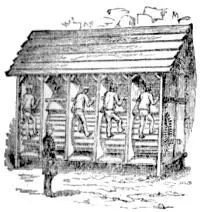
As we take the day off, we might recall that it was on this date in 1822 that a prisoner-powered treadmill for grinding corn began operation at the Bellevue County Penitentiary in New York City, located where 26th Street meets the East River. Up to 16 prisoners at a time walked on two paddle-wheel like treadmills, grinding about 50 bushells of corn per day.
“Your silence will not protect you”*…

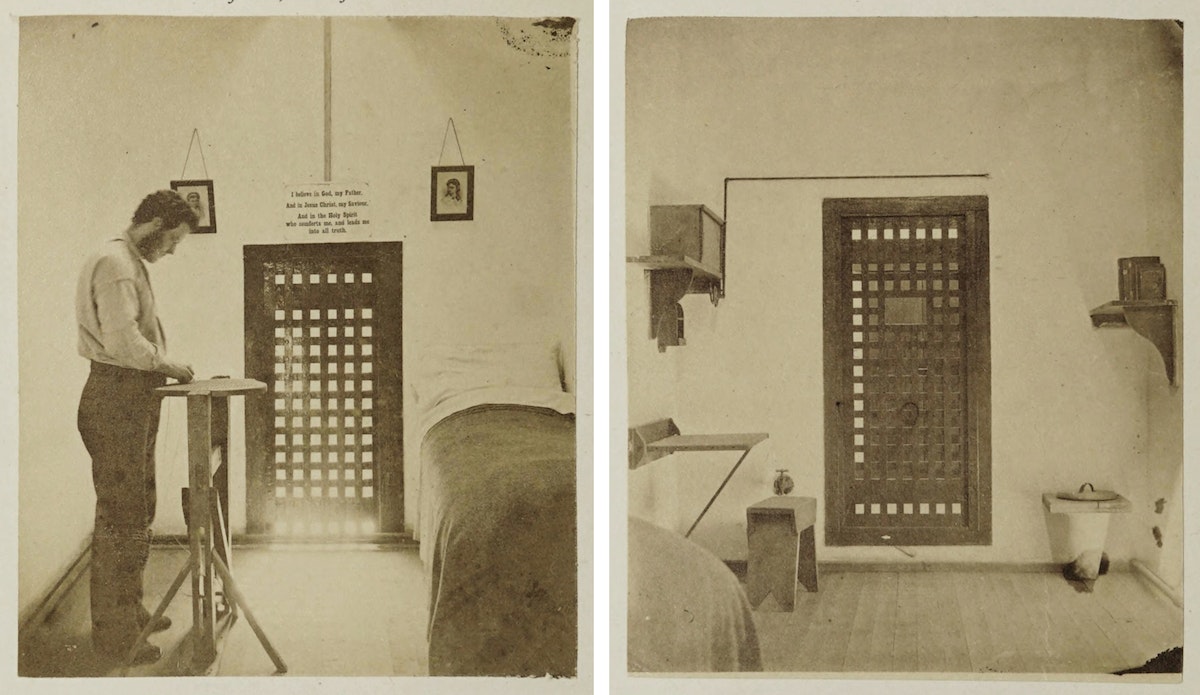
Characterized today by the noise of banging, buzzers, and the cries of inmates, solitary confinement was originally developed from Quaker ideas about the redemptive power of silence, envisioned as a humane alternative to the punitive violence of late-18th century jails. Revisiting Pennsylvania’s Eastern State Penitentiary, Jane Brox discovers the spiritual origins and reformist ambitions of solitary’s early advocates, and sees their supposedly progressive desires come to ruin by the 20th century…
On any given day in the United States, of the more than one million men and women incarcerated in jails and prisons, over 120,000 are locked in solitary confinement. None have been sentenced by a court to their isolation. They are serving a punishment within punishment, having been placed in solitary by prison officials for a variety of reasons: violent crime, petty theft, speaking out, gang involvement, political activism. Some are in protective custody; others have mental health issues and are considered too difficult to control. A disproportionate percentage are people of color. Their sentence might last weeks or months and is subject to extension. More than a few spend years, even decades in cells whose dimensions are commonly compared to the size of a parking space, but which are often smaller — six-by-nine feet, or eight-by-ten. Reading material is sparse. Confined prisoners don’t participate in educational or rehabilitation programs. Other than meals — which are often more meager than those provided to the general prison population — and an hour of exercise a day, little exists to distract them from the heaviness of time, and nothing at all suggests that the historic roots of such punishment can be traced to the concept of redemption.
The idea of the solitary cell as an integral part of the American prison system arose during the Early Republic, the specific vision of Philadelphia physician and Founding Father Benjamin Rush, who advocated for time in solitude and silence — the active, searching silence of Quakerism — as an alternative to the bodily pain, injury, and humiliation of public hangings and whippings. He saw it as a means not only of punishment but of reformation for housebreakers, forgers, highway robbers, horse thieves, and even murderers, and his vision of justice eventually led to the construction of the world’s first penitentiary, Eastern State, designed by architect John Haviland, and raised on the grounds of an old cherry orchard three miles outside of Philadelphia’s city limits.
When Cherry Hill — as it was sometimes called — admitted its first prisoners in 1829, it stood in stark contrast to traditional jails, where debtors and those awaiting trial were housed in filthy, noisy, and disorderly common rooms. In the penitentiary, not only were the confined to remain in their individual cells for the duration of their sentence, according to the board of inspectors for Philadelphia’s prisons, there was to be “such an entire seclusion of convicts from society and from one another, as that during the period of their confinement, no one shall see or hear, or be seen or heard by any human being, except the jailer, the inspectors, or such other persons, as for highly urgent reasons may be permitted to enter the walls of the prison.”…
How a Quaker’s good intentions went awry: “The Silent Treatment- Solitary Confinement’s Unlikely Origins,” in @PublicDomainRev.
* Audre Lorde
###
As we ponder penitentiaries, we might send reformist birthday greetings to Roscoe Pound; he was born on this date in 1870. A lawyer and law school professor and Dean, he was one of the most cited legal scholars of the 20th century.
While serving as Dean of Harvard Law School, Pound founded the movement for “sociological jurisprudence” and was one of the early leaders of the movement for American Legal Realism, which argued for a more pragmatic and public-interested interpretation of law and a focus on how the legal process actually occurred, as opposed to (in his view) the arid legal formalism which prevailed in American jurisprudence at the time. In Pound’s view, these jurisprudential movements advocated “the adjustment of principles and doctrines to the human conditions they are to govern rather than to assumed first principles.” While Pound was dean, law school registration almost doubled, but his standards were so rigorous that one-third of those matriculated did not receive degrees. Among those that did were many of the great political innovators of the New Deal years.
Pound also had a PhD in botany, and before turning to the law, served as director of the Nebraska state botanical survey (1892-1903), during which time he discovered a rare fungus, subsequently named Roscopoundia.

“I made bongs”*…

Alderson Federal Prison Camp, home to Martha Stewart for five months in 2004-5
From Town and Country Magazine, offered here without comment…
So you got caught. That porn star wasn’t about to pay herself to stay mum about her night with your boss, so you stepped up and took one for the team. Or perhaps your daughters were better at Instagram than calculus, so you spent half a million bucks pretending they were the best college athletic prospects since O.J. Simpson. Or maybe the SEC decided you were less of a “cryptoguru” and more of a charlatan.
From Felicity Huffman to Michael Cohen, nearly every day brings a notable figure face to face with a possible jail sentence—which, in turn, has given rise to a cottage industry: the prison consultancy. From companies like California’s White Collar Advice, which boasts a team of professionals with penal experience (as convicts or as employees of the Federal Bureau of Prisons) to individual entrepreneurs like Federal Prison Handbook author Christopher Zoukis, they have made it positively de rigueur for those more accustomed to sleeping between Pratesi than polyester to hire an insider who will lay out what to expect when expecting to be incarcerated…
Counsel for connected cons-to-be– the Emily Post of prison etiquette: “Inside the World of Prison Consultants Who Prepare White Collar Criminals to Do Time.”
* Tommy Chong, of his time at Taft Correctional Institute, where he built a kiln to fire his ceramic creations
###
As we ponder privilege, we might recall that it was on this date in 1966 that one of Rolling Stone‘s 500 Greatest Songs of All Time, “96 Tears,” by ? and the Mysterians (AKA Question Mark and the Mysterians), reached #1 on the pop chart.
“Any workout which does not involve a certain minimum of danger or responsibility does not improve the body – it just wears it out”*…

If you are one of the 51.8 million people in the U.S. who use a treadmill for exercise, you know there’s much pain for your muscle-and-fitness gain. On your next 30-minute jog, as you count down the final seconds, ponder whether the hard work made you a better person. Consider whether the workout would feel different if you had powered something, even a fan to cool yourself off.
Two hundred years ago, the treadmill was invented in England as a prison rehabilitation device. It was meant to cause the incarcerated to suffer and learn from their sweat. It would mill a bit of corn or pump some water as a bonus…
How an early-19th century penal innovation became the top selling piece of exercise equipment in the U.S.: “Treadmills were meant to be atonement machines.”
* (That well-known fitness expert) Norman Mailer
###
As we try to find our rhythm, we might send well-constructed birthday greetings to Frank Hornby; he was born on this date in 1863. A visionary toy designer, he created the Meccano construction set (in 1901), a toy that used perforated metal strips, wheels, rods, brackets, clips, and assembly nuts and bolts to allow kids to build unlimited numbers of models. A huge success, it spawned a monthly magazine– and U.S. competition (e.g., the Erector Set). He introduced Hornby model trains in 1920 (originally clockwork and eventually electrically powered with tracks and scale replicas of associated buildings); the “Dinky” range of miniature cars and other motor vehicles was added in 1933 (spawning such competitors as Corgi, Matchbox, and Mattel’s Hot Wheels).

“Books are the quietest and most constant of friends; they are the most accessible and wisest of counselors, and the most patient of teachers”*…

Discover a new book every time you open a new tab: add 100 Million Books to your browser.
* Charles William Eliot
###
As we turn the page, we might recall that it was on this date in 1717 that Voltaire (François Marie Arouet), the “Father of the Age of Reason.” was imprisoned for the first time in the Bastille for writing “subversive literature.” He would subsequently be imprisoned again, and forced in exile.

You must be logged in to post a comment.