Jason Kottke on one artist’s attempt to illuminate those talents and the lives of those who practiced them…
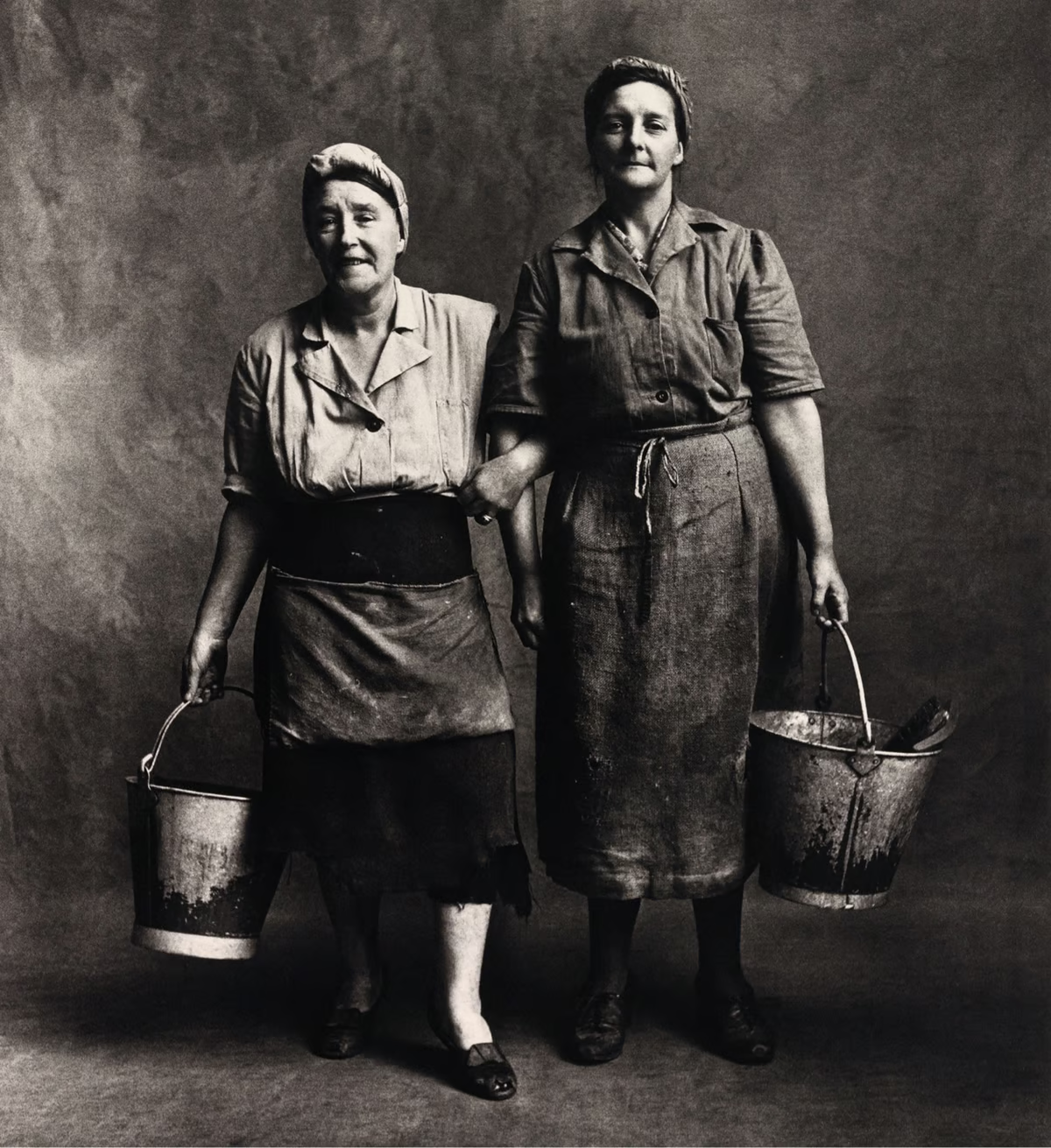
In 1950, master photographer Irving Penn set up a simple studio in Paris and started to photograph people of all kinds of professions, each wearing their work clothes and carrying the tools of their trade.
Working in the tradition of representing the petits métiers, Penn photographed fishmongers, firefighters, butchers, bakers, divers, baseball umpires, chefs, bike messengers, and sellers of goods of all kinds.
Penn continued photographing workers in New York and London, collecting the photos into a project called Small Trades.
Like everyone else who has recorded the look of tradesmen and workers, the author of this book was motivated by the fact that individuality and occupational pride seem on the wane. To a degree everyone has proved right, and since these photographs were made, London chimney sweeps have all but disappeared and in New York horseshoers — hard to find in 1950 — now scarcely exist…
As we peruse professions, we might send muckraking birthday greetings to Upton Sinclair; he was born on this date in 1878. A writer, activist, and politician, he is probably best remembered for his classic novel, The Jungle, which exposed labor and sanitary conditions in the U.S. meatpacking industry, causing a public uproar that contributed in part to the passage a few months later of the 1906 Pure Food and Drug Act and the Meat Inspection Act.
Many of his novels can be read as historical works. Writing during the Progressive Era, Sinclair describes the world of the industrialized United States from both the working man’s and the industrialist’s points of view: e.g., King Coal (1917, covering John D. Rockefeller and the 1914 Ludlow Massacre in the coal fields of Colorado), Oil! (1927, the Teapot Dome Scandal), and The Flivver King (1937, Henry Ford– his “wage reform,” his company’s Sociological Department, and his decline into antisemitism) describe the working conditions of the coal, oil, and auto industries at the time.
Sinclair ran (as a Democrat) for Governor of California in 1934, during the Great Depression, under the banner of the End Poverty in California campaign, but was defeated in the general election.
He was awarded he Pulitzer Prize for Fiction in 1943 for Dragon’s Teeth, which portrayed the Nazi takeover of Germany during the 1930s.
It is difficult to get a man to understand something, when his salary depends upon his not understanding it.
Upton Sinclair, ruminating on his gubernatorial loss
… so desperate, an increasing number of pundits argue, that globalization– the “flat world” proclaimed by Tom Friedman– that was to totem of the turn of the century, is no longer possible. But as the estimable Martin Wolf argues, we shouldn’t be too hasty– nor too sweeping and blunt– in our judgements. Trade in goods may be slowing, but the potential for technology-enabled trade in services remains huge…
What is the future of globalisation? This is among the biggest questions of our time. In June, I argued that, contrary to increasingly widespread opinion, “Globalisation is not dead. It may not even be dying. But it is changing.” Among the most important ways in which it is changing is via the growth of services provided at a distance.
…
A crucial point is that the expansion of trade in such services has depended little on trade agreements. The regulation of service activities focuses on final services, not intermediate ones. There exist, for example, strict rules on selling accounting services in the US. Yet there are few rules on the qualifications of the workers that do the paperwork behind the provision of such services.
Thus, a “US accountant can employ pretty much anybody to tally up a client’s travel expenses and collate them with expense receipts”. Examples of occupations that provide intermediate as opposed to final services include book-keepers, forensic accountants, screeners of CVs, administrative assistants, online help staff, graphic designers, copy-editors, personal assistants, X-ray readers, IT security consultants, IT help staff, software engineers, lawyers who check contracts, financial analysts who write reports. The list goes on. As Baldwin argues in The Globotics Upheaval, the potential for this sort of technology-enabled trade is huge. It will also be highly disruptive: the white-collar workers who provide these services in high-income countries are an important part of the middle class. But it will be hard to protect them.
In all, the evidence suggests that natural economic forces have largely been responsible for past changes in the pattern of world trade. Growing concern over the security of supply chains will no doubt add to these changes, though whether the result will be “reshoring” or “friendshoring” is doubtful. More likely is a complex pattern of diversification. Meanwhile, technology is opening up new areas of growth in services…
As we contemplate commerce, we might send muckraking birthday greetings to Upton Sinclair; he was born on this date in 1878. A writer, activist, and politician, he is probably best remembered for his classic novel, The Jungle, which exposed labor and sanitary conditions in the U.S. meatpacking industry, causing a public uproar that contributed in part to the passage a few months later of the 1906 Pure Food and Drug Act and the Meat Inspection Act.
Many of his novels can be read as historical works. Writing during the Progressive Era, Sinclair describes the world of the industrialized United States from both the working man’s and the industrialist’s points of view. Novels such as King Coal (1917, covering John D. Rockefeller and the 1914 Ludlow Massacre in the coal fields of Colorado), Oil! (1927, the Teapot Dome Scandal), and The Flivver King (1937, Henry Ford– his “wage reform” and his company’s Sociological Department, to his decline into antisemitism) describe the working conditions of the coal, oil, and auto industries at the time.
Sinclair ran unsuccessfully for Congress as a nominee from the Socialist Party. Then he ran, as a Democrat, for Governor of California during the Great Depression, under the banner of the End Poverty in California campaign, but was defeated in the 1934 election.
He was awarded he Pulitzer Prize for Fiction in 1943 for Dragon’s Teeth, which portrayed the Nazi takeover of Germany during the 1930s.
It is difficult to get a man to understand something, when his salary depends upon his not understanding it.
Upton Sinclair, ruminating on his gubernatorial loss
As we simmer at the shelves, we might send muckraking birthday greetings to Upton Beall Sinclair Jr.; he was born on this date in 1878. Sinclair paid his way through City College and Columbia writing dime novels, then turned to journalism. Moved by what he saw (and heard and smelled) in covering the Chicago stockyards, he wrote his first novel, The Jungle. Unable to find a publisher willing to release an expose of conditions in the U.S. meatpacking industry, he published it himself– and created a public uproar sufficient to drive, within months, the Pure Food and Drug Act and the Meat Inspection Act. Sinclair tried his hand as a politician, but stayed true to his typewriter: before he died in 1968, he had written over 100 books of fiction and non-fiction– including the novel Oil, which was the basis of Paul Thomas Anderson’s film There Will Be Blood.
Writing of Sinclair in 1957, Time pronounced him, “a man with every gift except humor and silence.”




You must be logged in to post a comment.