Posts Tagged ‘Hollywood’
“Mangoes will make you forget anything but mangoes”*…
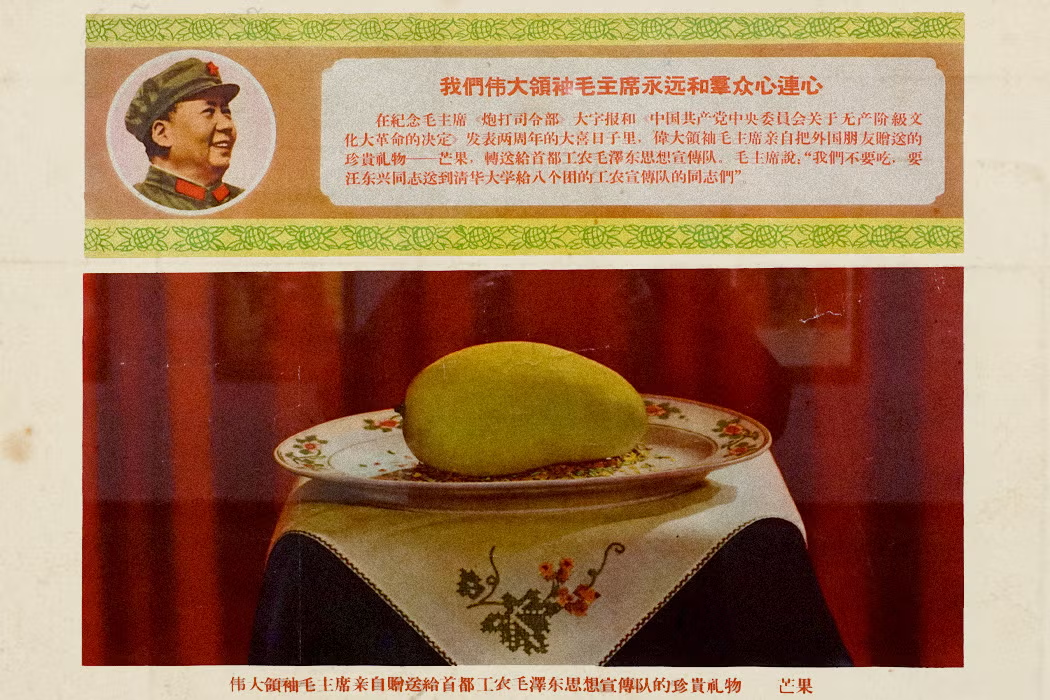
… Or not. As Christin Bohnke explains, sometimes a mango is more than just a mango…
What happens when ideologies are destroyed? When beliefs that shaped generations dissolve overnight? In the wreckage of old traditions, new symbols are created, and meaning is projected onto what was previously trivial. But not all of these new symbols are coherent or easily legible. Some are outright weird. Few events in history demonstrate the absurdity of political symbolism as clearly as the Mao Mango Mania that swept China during the infancy of the Cultural Revolution.
In 1966, Mao Zedong, Chairman of the Communist Party and China’s supreme leader, set in motion the Great Proletarian Cultural Revolution, a campaign to realign China with his revolutionary vision. His goal was to transform society, both economically and ideologically, by purging everything deemed traditional or capitalist. Over the next ten years, the Cultural Revolution changed the country in profound and painful ways, leading to more than a million estimated deaths as well as to immense human suffering.
Historian Lü Xiuyuan describes the period between 1966 and 1968 as the most destructive years of the entire movement. Following Mao’s directive to destroy the “Four Olds” (ideas, cultures, customs, and habits), his paramilitary youth groups, the Red Guards, swept the country with violence. They identified, tortured, and killed so-called “counterrevolutionaries,” raided temples and schools, and destroyed priceless artifacts. In 1968, university campuses, middle schools, and other public spaces became the sites of bloody battles, not only between Red Guards and alleged counterrevolutionaries but also between revolutionary factions. The chaos of the “Red Terror” couldn’t continue indefinitely, so Mao determined that Chinese workers would help suppress the Red Guard, restore order, and continue the revolution in a more measured manner. In this endeavor, Mao was helped, improbably, by a box of yellow-fleshed fruit.
In August 1968, a visiting foreign minister from Pakistan, Mian Arshad Hussain, gave Mao a box of mangoes as a gift during a state visit. Presenting mangoes has a long tradition in Pakistan, but in China, the fruit was virtually unknown. Mao passed the box to workers occupying the Tsinghua campus in Beijing, who were attempting to control the Red Guards stationed there. The scholar of Chinese visual culture Alfreda Murck writes that the mangoes carried an implicit message: from now on, the workers, not the Red Guards, would be in charge of education and the transformation of China in Mao’s image.
According to Murck, even Mao could not have anticipated the consequences of his gift. Because the mangoes came from the supreme leader, they were transformed, in the eyes of the workers, from a simple fruit into an object endowed with attributes of the divine. William H. Hinton, the author of Fanshen, compiled eyewitness accounts of workers who reported staying up all night, touching the mangoes, and marveling at their new station as protégés of the Chairman. Using the momentum, the official party cadres concocted a propaganda campaign surrounding the mangoes, workers, and Mao, and in doing so, according to the political scientist Richard Baum, effectively signed “the death warrant of the Red Guards.”
Quickly, the Red Guards were disbanded, many of them sent for reeducation in the countryside where they labored and lived alongside rural peasants. By contrast, the workers who received Mao’s mangoes, a sign of his favor, were energized and became Cultural Revolution leaders. Yet, their promotion was an illusion. True power lay with the People’s Liberation Army. Despite, or because of that, the workers—and the mangoes—played a significant role in official propaganda in the months to come.
When the workers returned to their factories after putting down the Red Guards, Mao had a fresh mango delivered to them. Workers held welcoming ceremonies for the fruit, preserved it in wax, placed it on altars, and bowed to it when walking by. In one factory, the fruit was boiled down into sacred mango water; each devotee drank a spoonful. From there on, the cult of the mango escalated. Wax and even plastic mangoes were quickly produced in Chinese factories and appeared all over the country, often displayed in glass cases. Images of the mango adorned plates, wedding gifts, and cigarette packages. It was stitched onto blankets, and propaganda teams armed with wax replicas were sent into the remotest corners of the country to spread its lore. More than seventy different types of mango badges to stitch onto clothes were given away for free or sold at a low price to those who couldn’t afford more expensive mango-themed items. Alongside the mangoes were mentions of Mao’s selflessness and love for the people (though no reference to the fate of the Red Guards), and many badges bore the slogan “With each mango profound kindness.”…
… During the 1968 National Day parade in Beijing, the mango was front and center. At least three mango-themed floats participated in the parade, decorated with slogans that emphasized the significance of the working class, as well as a colossal white statue of Mao. The parade reinforced the importance of Mao as the supreme leader and the mango as a symbol of his power.
According to development studies scholar Xing Li, Mao viewed ideology as the primary means of mobilizing the masses and driving change, putting special emphasis on themes such as dedication, self-sacrifice, and hard work. The mango was a perfect vessel for Mao’s “love” for the workers. Unlike already established symbols such as the peony, peach, or pomegranate, the mango had no preexisting meaning in China and, importantly, no association with emperors or divinity. Quickly, rumors spread that mango trees only blossom every century—or every thousand years, according to others—and that eating the fruit would bring about a long life, similar to the peaches of immortality that feature prominently in Chinese legends. Mao’s refusal to keep the mangoes for himself was therefore seen as a great sacrifice on behalf of his people.
The veneration of the mango coincided with a high point in Mao’s personality cult. In the 1960s, one billion copies of the “Little Red Book,” a collection of Mao’s quotes, were printed. The book had to be waved and quoted at the beginning of each workday and whenever someone made a political statement. Mao was everywhere. And so were his mangoes. They became inextricably linked, and criticism of one meant criticism of the other. Murck tells of a dentist in Sichuan province, for example, who, after seeing a mango paraded through his town, said that the fruit resembled a sweet potato. He was arrested, tried as a counterrevolutionary, marched through the streets, and executed. His children were sent to the countryside for reeducation. Given the serious consequences of even the slightest criticism, it’s impossible to say how many people genuinely participated in the mango cult and how many complied out of fear.
Political movements need symbols to foster cohesion and emotional connection, but for these to thrive and remain, they must have at least some internal logic, cultural coherence, or tradition. The mango was an artificial symbol, created randomly, and the people’s devotion to the fruit must have been at least partially performative. By 1969, the mango cult had already begun to decline; it was no longer featured in official campaigns, although the sheer volume of mango-themed products ensured that it didn’t disappear entirely until the mid-1970s. After Mao’s death in 1976 and the 1980s reassessment of his personality cult, it became acceptable to discard mango ephemera that some Chinese still kept in their homes, or more prudently, to repurpose the wax mangoes as candles. Because the mango was so closely linked to Mao, it couldn’t remain a meaningful symbol without him.
Still, the mango as a political symbol never entirely faded. US-based Chinese author Ha Jin, who served in the Chinese army at the time of the Cultural Revolution and has been an outspoken critic of the Chinese government, wrote in his 2019 poem “A Sacred Mango:”
The mango was exhibited in the center of the hall.
We lined up to look at it
and to show our gratitude and respect.But that night some curious child tasted the fruit
and was not caught.
Our mayor, frightened and outraged, said,
“Damn it, if I knew which son of a rabbit bit the mango
I would turn his whole family
into counter-revolutionaries!”But what could we do?
We substituted a wooden mango for a real one.For Ha Jin, as for others, the mango remains not a sign of Mao’s power, but a reminder of the Cultural Revolution’s absurdity and the arbitrary labeling of counterrevolutionaries. Despite being a short-lived propaganda tool, the mango’s symbolism endures as a testament to the irrationality of Mao’s extreme personality cult.
Commercial production of the mango in China began around that time, but only really accelerated in the 1980s. Although some people still recall the mango cult and spoke about it in their interviews with Murck, today the meaning of this particular fruit is largely forgotten, and the mango, far from symbolizing Mao’s eternal love and sacrifice for the working class, has transformed once again. This time, into a refreshing summer treat…
A fleeting cult built around a fruit exposes the logic, and illogic, of Mao’s personality cult: “When Mao’s Mango Mania Took Over China,” from @jstordaily.bsky.social.
* Eve Babitz
###
As we pare away the peel, we might send decorative birthday greetings to Maria do Carmo Miranda da Cunha; she was born on this date in 1909. Better known by her stage name, Carmen Miranda (and her nickname, “the Brazilian Bombshell”), she was a successful singer, dancer, and actress.
As a young woman, Miranda designed clothes and hats in a boutique before making her debut as a singer, recording with composer Josué de Barros in 1929. Miranda’s 1930 recording of “Taí (Pra Você Gostar de Mim),” written by Joubert de Carvalho, catapulted her to stardom in Brazil as the foremost interpreter of samba. In 1939 she was invited to Broadway by producer Lee Shubert, and quickly lured from there to Hollywood, where she made 14 films in as many years.
Miranda did much to popularize Brazilian music and raise American awareness of Latin culture, for which she has been honored (e.g., with a museum) in Brazil. Here, she is largely remebered for her style, in particular for her large “fruit hats.”

“Present at the creation”*…

The estimable Alan Jacobs on what we can learn from our elders…
There are a lot of stories about the intense conflicts between old Hollywood and new Hollywood. An oft-told one says that at a party Dennis Hopper went up to George Cukor, pointed a finger in his face, and said, “We’re gonna bury you.” This sense that the new Hollywood was at war with the old one — that the new could only live if the old died — was a commonplace idea at the time. But it was not a view held by one of the hot new directors of the Sixties, Peter Bogdanovich…
… When he came to Hollywood, Bogdanovich made a point of getting to know the people who had made so many of the movies he loved. He compiled a book of interviews with old-time directors — he also did one with old-time actors, but the one with directors is particularly noteworthy.
Of all those interviews, the most fascinating is the very first one, with Allan Dwan, because Dwan was present at the creation. He had played football at Notre Dame, got an engineering degree there, worked on designing lights for early filmmakers in Chicago — no one had thought of going to Los Angeles yet — and gradually drifted into making movies himself. He sold some stories, then became a scenario manager (that is, someone who sought and recommended stories for turning into screenplays) and ultimately a director, making dozens and dozens of films — none of them especially famous. His attitude towards movie-making was workmanlike, and he just accepted the tasks set before him.
(He told Bogdanovich that when directors started taking seventeen weeks to make a picture that he would have made in seventeen days, that brought in the producers to manage everything. After that, no director was safe from studio interference. This reminds me of something Christopher Nolan said in his Desert Island Discs interview a few years ago: that right from the beginning of his career he made a particular point of bringing his movies in ahead of schedule and under budget because that was the only way to keep the studio execs away from his sets.)
Dwan’s stories are wonderful because they show what it was like for Hollywood to be invented. Nobody knew what they were doing. He tells about his days as a writer and scenario manager: he showed up at a shoot in Arizona only to discover that the director had disappeared and the actors were just sitting around. He called his bosses in Chicago to report what had happened, and they told him, “Well, you’re the director now.” He had no idea what a director did — but, with the help of the actors, he directed the movie. This happened in 1911. Dwan kept directing movies until 1961.
He tells another story about getting his car repaired and talking to the mechanic, who turned out to be interested in photography. Dwan hired him as a cameraman because he desperately needed one and in those days they weren’t easy to find. That mechanic-turned-cameraman eventually became a director — his name was Victor Fleming, and one of his pictures was Gone with the Wind. Dwan remembered a prop man who liked to wear fake teeth and prosthetic noses. Dwan asked him, “Why are you doing this? Do you want to be on the other side of the camera?” The guy said, “Well, kind of.” That was Lon Chaney.
He also tells of watching a pickup baseball game near the Paramount lot and seeing a girl — maybe 11 or 12 — who was the best player out there and made sure everybody knew it. She was whacking the ball all over the field and taunting the boys mercilessly. Dwan talked to her; he thought she’d make a great impression in the pictures. Her name was Jane Peters, but eventually a studio changed it to Carole Lombard. (Lombard, by the way, was quite an athlete: Clark Gable fell in love with her after she thrashed him in a tennis match.)
Dwan had a thousand stories like this. It’s fascinating to see how this industry — this art form — developed when nobody knew how to make movies. Dwan himself was the first to figure out that you could dolly a camera backwards, putting it on rails or a truck and backing up. (This actually disoriented viewers at the time, made them feel woozy). He helped D.W. Griffith figure out how to do a crane shot for Intolerance. All such techniques had to be improvised — and when an improvisation worked it became an invention. You basically had to think like an engineer, and Dwan was an engineer.
And when you put all the improvised and then repreated techniques together, you get the dominant artistic medium — and the dominant form of entertainment — of the 20th century. But nobody could possibly have guessed any of that when Dwan was just getting started. It’s to Bogdanovich’s great credit that he listened to these people…
“Allan Dwan’s stories,” from @ayjay.bsky.social.
* a reference to the belief that Jesus was involved in the creation of the universe, appropriated by Dean Acheson as the title of his memoir.
###
As honor those on whose shoulders we stand, we might recall that it was on thus date in 1985 that Pee-wee’s Big Adventure premiered. Following the success of The Pee-wee Herman Show in 1981, Pee-wee (Paul Reubens) was hired by Warner Bros. to write (ultimately with help from Phil Hartman and Michael Varhol) the script for Pee-wee’s Big Adventure. Impressed with Burton’s work on the short film Frankenweenie (1984), the producers and Reubens hired him to direct. The film was scored by Danny Elfman, marking his first among many collaborations with Burton. It was a success in its initial release and has, of course, become a cult classic.

“Hollywood is a place where a man can get stabbed in the back while climbing a ladder.”*…

While William Faulkner spent most of his life in the Oxford, Mississippi area that he made famous, he did a considerable– and fascinating– stetch in Hollywood. John Meroney reports…
… It all started in 1932, when, riding on the success of his novel Sanctuary, Faulkner got word that Leland Hayward, a prominent Hollywood talent agent, had secured for him a $500-a-week contract (the equivalent of $8,500 today) to write scripts at Metro-Goldwyn-Mayer. Faulkner was a modernist, and film was still a new, exciting form of storytelling. But that wasn’t the reason Faulkner accepted. It was the money.
At the same time Faulkner received the offer from Metro, he got news that his publisher, Cape & Smith, was bankrupt. Faulkner had been planning on $4,000 ($68,000 in today’s money) from the company for Sanctuary but was informed he wouldn’t see any of it. Suddenly, he was broke. Word apparently got around Oxford. When he tried writing a check for three dollars at a sporting goods store, the owner told him, I’d rather have cash. All at once, Hollywood became attractive. Faulkner didn’t even have the money to send a wire to answer yes. Eventually MGM advanced him some cash and paid for his train ticket, and days later he arrived in Culver City.
He was so naive about the industry that he entertained hopes he would be writing for the famous movie star Mickey Mouse. But the folks at Metro informed him, No, Mickey lives at another studio out in the Valley—we want you for a Wallace Beery picture. “Who’s he?” Faulkner asked…
… Faulkner completed four story treatments in four weeks. That kind of productivity earned him a meeting with up-and-coming director Howard Hawks [see almanac entry here]. He liked Faulkner’s writing and purchased a Saturday Evening Post short story by him that he wanted Faulkner to adapt into a script for Hawks to direct. Over a “couple of quarts of whiskey,” as Hawks recalled in an interview, they clicked and found common cause. “[Faulkner] got up the next morning and started to work, and in five or six days, he had a script,” Hawks said. “It was one of the finest scripts I’ve ever read.” Hawks showed it to Metro’s head of production, Irving Thalberg, who concurred. “Go out and make it!” he ordered Hawks. The result was Today We Live, a drama starring Gary Cooper and Joan Crawford, released in 1933. William Faulkner now had a hit movie to his credit. And, more important, the beginning of what would become an ongoing professional connection with Hawks…
…Faulkner sometimes hunted with Hawks, and on one dove hunting trip recounted by the director, Hawks invited along Clark Gable, already a star. Faulkner and Hawks began discussing literature and eventually Gable asked, “Mr. Faulkner, what do you think somebody should read if he wants to read the best modern books? Who would you say are the best living writers?” Faulkner replied, “Thomas Mann, Willa Cather, John Dos Passos, Ernest Hemingway, and myself.” Gable asked, “Oh, do you write, Mr. Faulkner?” Faulkner replied, “Yeah. What do you do, Mr. Gable?”…
And so much (so very much) more: “William Faulkner’s Hollywood Odyssey” from Garden and Gun.
* William Faulkner
###
As we fathom fish out of water, we might recall that it was on this date in 1987 that the United States Postal Service issued a 22-cent postage stamp in Faulkner’s honor. Very early in his career, Faulkner had briefly served as Postmaster at the University of Mississippi, and in his letter of resignation in 1923 wrote:
As long as I live under the capitalistic system, I expect to have my life influenced by the demands of moneyed people. But I will be damned if I propose to be at the beck and call of every itinerant scoundrel who has two cents to invest in a postage stamp. This, sir, is my resignation.

“Hollywood will rot on the windmills of Eternity”*…

… or possibly, Daniel Bessner argues, sooner…
… Thanks to decades of deregulation and a gush of speculative cash that first hit the industry in the late Aughts, while prestige TV was climbing the rungs of the culture, massive entertainment and media corporations had been swallowing what few smaller companies remained, and financial firms had been infiltrating the business, moving to reduce risk and maximize efficiency at all costs, exhausting writers in evermore unstable conditions.
“The industry is in a deep and existential crisis,” the head of a midsize studio told me in early August. We were in the lounge of the Soho House in West Hollywood. “It is probably the deepest and most existential crisis it’s ever been in. The writers are losing out. The middle layer of craftsmen are losing out. The top end of the talent are making more money than they ever have, but the nuts-and-bolts people who make the industry go round are losing out dramatically.”
Hollywood had become a winner-takes-all economy. As of 2021, CEOs at the majority of the largest companies and conglomerates in the industry drew salaries between two hundred and three thousand times greater than those of median employees. And while writer-producer royalty such as Shonda Rhimes and Ryan Murphy had in recent years signed deals reportedly worth hundreds of millions of dollars, and a slightly larger group of A-list writers, such as Smith, had carved out comfortable or middle-class lives, many more were working in bare-bones, short-term writers’ rooms, often between stints in the service industry, without much hope for more steady work. As of early 2023, among those lucky enough to be employed, the median TV writer-producer was making 23 percent less a week, in real dollars, than their peers a decade before. Total earnings for feature-film writers had dropped nearly 20 percent between 2019 and 2021.
Writers had been squeezed by the studios many times in the past, but never this far. And when the WGA went on strike last spring, they were historically unified: more guild members than ever before turned out for the vote to authorize, and 97.9 percent voted in favor. After five months, the writers were said to have won: they gained a new residuals model for streaming, new minimum lengths of employment for TV, and more guaranteed paid work on feature-film screenplays, among other protections.
But the business of Hollywood had undergone a foundational change. The new effective bosses of the industry—colossal conglomerates, asset-management companies, and private-equity firms—had not been simply pushing workers too hard and grabbing more than their fair share of the profits. They had been stripping value from the production system like copper pipes from a house—threatening the sustainability of the studios themselves. Today’s business side does not have a necessary vested interest in “the business”—in the health of what we think of as Hollywood, a place and system in which creativity is exchanged for capital. The union wins did not begin to address this fundamental problem.
Currently, the machine is sputtering, running on fumes. According to research by Bloomberg, in 2013 the largest companies in film and television were more than $20 billion in the black; by 2022, that number had fallen by roughly half. From 2021 to 2022, revenue growth for the industry dropped by almost 50 percent. At U.S. box offices, by the end of last year, revenue was down 22 percent from 2019. Experts estimate that cable-television revenue has fallen 40 percent since 2015. Streaming has rarely been profitable at all. Until very recently, Netflix was the sole platform to make money; among the other companies with streaming services, only Warner Bros. Discovery’s platforms may have eked out a profit last year. And now the streaming gold rush—the era that made Dickinson—is over. In the spring of 2022, the Federal Reserve began raising interest rates after years of nearly free credit, and at roughly the same time, Wall Street began calling in the streamers’ bets. The stock prices of nearly all the major companies with streaming platforms took precipitous falls, and none have rebounded to their prior valuation.
The industry as a whole is now facing a broad contraction. Between August 2022 and the end of last year, employment fell by 26 percent—more than one job gone in every four. Layoffs hit Warner Bros. Discovery, Netflix, Paramount Global, Roku, and others in 2022. In 2023, firings swept through the representation giants United Talent Agency and Creative Artists Agency; Netflix, Paramount Global, and Roku again; plus Hulu, NBCUniversal, and Lionsgate. In early 2024, it was announced that Amazon was cutting hundreds of jobs from its Prime Video and Amazon MGM Studios divisions. In February, Paramount Global laid off roughly eight hundred people. It’s unclear which streamers will survive. As James Dolan, the interim executive chair of AMC Networks, told employees in late 2022 as he delivered news of massive layoffs—roughly 1,700 people (20 percent of U.S. staff) would lose their jobs—“the mechanisms for the monetization of content are in disarray.”
Profit will of course find a way; there will always be shit to watch. But without radical intervention, whether by the government or the workers, the industry will become unrecognizable. And the writing trade—the kind where one actually earns a living—will be obliterated…
Film and television writers face an existential threat; viewers, a drab future: “The Life and Death of Hollywood,” from @dbessner in @Harpers. A bracing piece, eminently worth reading in full.
* Allen Ginsberg
###
As we study streaming, we might recall that it was on this date in 1964 that AT&T connected the first Picturephone call (between Disneyland in California and the World’s Fair in New York). The device consisted of a telephone handset and a small, matching TV, which allowed telephone users to see each other in fuzzy video images as they carried on a conversation. It was commercially-released shortly thereafter (prices ranged from $16 to $27 for a three-minute call between special booths AT&T set up in New York, Washington, and Chicago), but didn’t catch on… though, of course, it augured the “future” in which now we live.

“Words are sacred. They deserve respect. If you get the right ones, in the right order, you can nudge the world a little.”*…

And as Gail Sherman observes, that principle operates at a pretty basic level…
There is a Royal Order of Adjectives, and you follow it without knowing what it is—a particular sequence to use when more than one adjective precedes a noun. There are exceptions, of course, because English is three languages in a trenchcoat. According to the Cambridge Dictionary, in general, the proper order is:
Opinion
Size
Physical quality
Shape
Age
Color
Origin
Material
Type
PurposeMost people couldn’t tell you this rule, but everyone follows it. If you use the wrong order, it just sounds weird. If you have a fancy new blue metal lunchbox but call it a metal new fancy blue lunchbox, people might be worried you are having a stroke…
“There is a Royal Order of Adjectives, and you follow it without knowing what it is,” from @CambridgeWords via @BoingBoing.
* Tom Stoppard
###
As we parse, we might send powerfully-phrased birthday greetings to a spare but graceful user of adjectives, Seymour Wilson “Budd” Schulberg; he was born on this date in 1914. A screenwriter, television producer, novelist, and sportswriter, Schulberg is best remembered for his novels What Makes Sammy Run? (1941) and The Harder They Fall (1947), as well as his screenplays for On the Waterfront (1954, for which he received an Academy Award) and A Face in the Crowd (1957).
As a sportswriter, Schulberg was most famously chief boxing correspondent for Sports Illustrated. He wrote some well-received books on boxing, including Sparring with Hemingway and was inducted into the International Boxing Hall of Fame (in 2002).
The son of B. P. Schulberg, head of Paramount Studios in its golden age, Budd wrote Moving Pictures: Memoirs of a Hollywood Prince, an autobiography covering his youth in Hollywood, growing up in the 1920s and 1930s among the famous.

You must be logged in to post a comment.