Posts Tagged ‘sculpture’
“Sculpture is a parable in three dimensions”*…

… and now, as Kate Mothes reports, we can appreciate that remotely…
In the age of the internet, we’re fortunate to have virtual access to museum collections around the world, thanks to objects in the public domain and programs like The Metropolitan Museum of Art’s Open Access Initiative. Through a searchable digital catalogue, visitors to the museum’s website can see hundreds of thousands of objects, many images of which are available for download. And it’s not alone—other institutions like the Art Institute of Chicago, The National Gallery of Art, and The Cleveland Museum of Art, among others, make pieces in their collections accessible to all.
The thing is, digital images don’t always give us the full picture, so to speak. Even two-dimensional paintings and drawings have unique textures, structural details, and materials that we can only really appreciate in person. This won’t ever really change—nothing beats the real thing. But one caveat is that even in person, much of the work remains hidden. We can’t see the backs of oil paintings, for example, and edges are often hidden within frames. Thanks to The Met’s continued emphasis on imaging, we can now experience every detail in three-dimensional renderings of nearly 140 significant objects in its holdings…


More at: “The Met Introduces High-Definition 3D Scans of Dozens of Art Historical Objects,” from @thisiscolossal.com.
See more on the Met’s site.
###
As we dig depth, we might send artfully-formed birthday greetings to François Girardon; he was born on this date in 1628. A sculptor of the French Baroque, he best known for his statues and busts of Louis XIV and for his statuary in the gardens of the Palace of Versailles. Several of his busts are in the Met’s collection— and on the list, one may hope, for 3-D rendering.

“Everything in the physical environment—everything—either raises our spirits or dampens them”*…

The venerable Witold Rybczynski on how, starting with Adolf Loos and the Vienna Secession, ornament was “banished” from modernist architecture– and on what that’s cost us…
… The abandonment of ornament has levied a heavy toll on the practice of architecture, tantamount to misplacing a crucial instrument of one’s toolbox. With ornament, an architect could give meaning to a building not only by incorporating specific references to what went on inside… but also by simply dialing the intensity up or down. Thus the main entrance of the Philadelphia Board of Education Building is not merely larger than the service entrance, it is more elaborately decorated, topped by two winged female figures and a medallion containing what looks like a coat of arms. Without subjunctive ornament, a building risks being less nuanced, but without meaningful ornament, it risks becoming, well, meaningless.
The banishment of ornament means an end to the close collaboration between architects and artists. It is difficult to imagine an architect today saying, “I should like to do the plan and the massing of the building; then … turn the ornament over to a perfectly qualified sculptor, and the color and surface direction to an equally qualified painter.” Today, the art in public buildings tends to be divorced from the architecture. A large travertine sculpture, Henry Moore’s Reclining Figure, stands outside Marcel Breuer’s UNESCO Building in Paris. Inside is a Picasso mural, The Fall of Icarus. The sculpture and the mural are beautiful works of art, but they have nothing to do with the architecture. They are simply “a Henry Moore” and “a Picasso.” The days when architects and artists worked closely together are long gone, and the results are not necessarily architecture that is worse, but architecture that is more one-dimensional: a long solo unenlivened by the occasional duet.
Take away ornament, and what are you left with? When we get close to a building today, we are confronted by gaskets, caulking, nuts and bolts—the minutiae of building construction. Or worse: exit signs, ventilation grills, and fire-hose cabinets. There is an architectural consequence to this. Traditionally, buildings were built as relatively straightforward boxes, their distinctive quality provided by ornament. Lacking the latter, architects feel obliged to provide dramatic cantilevers, unusual shapes, vertiginous space, and soaring roofs. But these big moves are not balanced by the finer-grained experience of small moves—that is, by ornament…
Why ornament matters in architecture: “Give Us Something to Look At,” from @witoldr in @TheAmScho. Eminently worth reading in full.
* Christopher Alexander, in conversation with Rybczynski
###
As we make with meaning, we might spare a thought for Pier Luigi Nervi; he died on this date in 1979. An exemplar of the trend against which Rybczynski argues, Nervi was an architect who drew on his deep engineering expertise– especially in reinforced concrete– to create notable “thin shell” structures worldwide.


“Art is an outsider, a gypsy over the face of the earth”*…

A man’s death revealed his secret masterpiece—his rented home, illegally transformed into a classical villa. What happened next questions how we define art. Max Olesker explains…
It’s a cold February morning, and I’ve come to Birkenhead, just outside Liverpool, to visit the former home of a man named Ron Gittins, a property affectionately known as Ron’s Place. Over the course of 33 years, Gittins painstakingly transformed almost every surface of this flat with a series of artworks in a variety of styles and mediums, from friezes on the walls of his living room to a Roman altar in his kitchen and enormous, ambitious fireplaces (yes, multiple). It’s a singlehanded labor of love. But, because Gittins was renting the flat—with no right to modify the property to this extent—it’s also illegal. As a result, the work was created almost entirely in secret. It was only after Gittins’ death at age 79 that word gradually began to trickle out about the existence of this strange cave of wonders…
“Outsider art,” “folk art,” and “art brut” are designations frequently applied to artists—often untrained—who work outside the classical tradition (and frequently the law). If the work is a large-scale installation, permanent or semi-permanent, it might be deemed an “outsider environment” or “visionary environment.” Outside Madrid, a former monk named Justo Gallego Martínez spent 60 years singlehandedly building his own cathedral, working on it daily until he passed away in 2021. In Westbourne Grove, London, retired postal porter and factory worker Gerry Dalton, an “Irishman and self-proclaimed gardener” according to his site’s Instagram bio, created a series of remarkable outdoor sculptures along the Grand Union Canal, in a collection he dubbed Gerry’s Pompeii. In South Africa’s Eastern Cape, Helen Martins, who lived from 1897 to 1976, created The Owl House, which features over 300 sculptures made from concrete and ground glass. And there are many, many more across the globe, each with its own infinitely rich backstory.
…
“It’s all quite powerful, isn’t it?” says Martin Wallace, as he shows me around the flat. Wallace, 55, is a warm, articulate Scouser and BAFTA-nominated filmmaker who frequently collaborates with Jarvis Cocker, the frontman of ’90s Britpop band Pulp. Together, they made a documentary series, Journeys Into the Outside, traveling the planet to investigate extraordinary places built by regular people. Wallace, who lives nearby, is now working on a feature-length documentary about Gittins, and in the process has become inexorably drawn into the orbit of Ron’s Place. Initially, this only involved helping cover the flat’s rent—as a trustee—after Gittins passed, and thinking of a long-term strategy to preserve the unique interior. But it’s rapidly become far more problematic. Ron’s Place is under threat: After months of stasis, the landlord and owner, Salisbury Management Services, has finally decided enough is enough. The building is to be sold at auction.
The front door flies open and Jan Williams and Chris Teasdale hurry in. They huddle with Wallace in the Egyptian corridor; urgent crisis talks begin. Jan Williams, 61, is Gittins’ niece. Together with her partner, Teasdale, 71, they work as artists under the name The Caravan Gallery. Along with Wallace, they have now dedicated themselves to preserving Gittins’ legacy. The current discussions, hushed and frantic, are about potential investors who might work with them—but they don’t sound promising. One man claiming to have the money also had quite a lot of snot on his jumper. The housing associations who expressed interest the previous summer have all gone quiet, the occasional sympathetic voice inevitably getting lost in the mundane realities of running a large business. In order to be eligible to apply for funding, the trio has created a legal entity, The Wirral Arts and Culture Community Land Trust. But, with time now of the essence, it’s not clear how that will save the property…
Read on for more of the story, the (happy) ending– and many more photos: “Ron’s Place,” from @maxolesker in @Longreads (though it’s not really that long :).
###
As we embrace outsiders, we might send agitated birthday greetings to painter Giacomo Balla; he was born on this date in 1871. An early member of the Italian Futurist movement, he emphasized light, movement, and speed in his work. But unlike most of his Futurist colleagues, Balla tended toward the witty and whimsical, not the machines and violence (and ultimately Fascists sentiments) that characterized so many other Italian Futurists.

“The library is inhabited by spirits that come out of the pages at night”*…

A graphic designer (and here) by day, Doyle has spent the last few years expanding his Hypertexts series. Grace Ebert explores…
Stephen Doyle describes his interconnected book sculptures as “miniature monuments, testaments to the power of language and metaphors of imagination.” Featuring angled scaffolding and interlocking constructions that appear to grow directly from the bound pages, the sprawling sculptural forms that comprise his Hypertexts series are unruly and enchanting reimaginings of how information is communicated.
The New York City-based artist lobs off parts of sentences, tethers phrases together with an unrelated word, and generally obscures the author’s intended meaning, producing arbitrary and striking connections within the text. Although the paper sculptures are tangible manifestations of language, Doyle tells Colossal that he originally envisioned the spliced works as satirical commentaries on digital diagramming. “I first started when ‘hypertext’ was a novel term of the internet: blue underlined text was a portal, linked to another document in the ether. Linking one text to another seemed rather DADA in intent, abstract, random, and capricious,” he says, explaining further:
I conjured sculptures in which the lines of text shook off the shackles of the page, leapt up, out of the book, and started conferring with their neighboring lines of text, creating an aerial network of language, turning text into synapse, circulation… I soon realized that these three-dimensional diagrams seemed to have a poetic power of their own, recontextualizing language and ideas into sculptural forms, inspired by the books themselves…

More at “Interlocking Lines of Text Spring from Stephen Doyle’s Poetic Book Sculptures,” @Colossal.
* Isabel Allende
###
As we ponder prose, we might send birthday greetings to two writers whose words are ripe for Doyle’s enshrinement…
Dorothy Parker was born on this date in 1893. A poet, writer, critic, and satirist based in New York, she was best known for her wit, wisecracks, and eye for 20th-century urban foibles, routinely published in The New Yorker— and for her membership in the Algonquin Round Table.
“There’s a hell of a distance between wise-cracking and wit. Wit has truth in it; wise-cracking is simply calisthenics with words.”

Ray Bradbury was born on this date in 1920. One of the most celebrated 20th-century American writers, he worked in a variety of modes, including fantasy, science fiction, horror, mystery, and realistic fiction– but is best remembered for his speculative fiction, perhaps especially for his novel Fahrenheit 451 and his short-story collections The Martian Chronicles and The Illustrated Man. he New York Times called Bradbury “the writer most responsible for bringing modern science fiction into the literary mainstream.”
Summertime, 1950, I recognized [Christopher] Isherwood browsing in a Santa Monica bookstore. My book had just come out, so I grabbed a copy off the shelf, signed it and gave it to him. His face fell and my heart sank, but two days later he called and said, “Do you know what you’ve done?” I asked, “What?” And he simply told me to read his review in the Times. His rave turned my life around; the book immediately made the best-seller lists and has been in print ever since.
Bradbury, on his chance meeting with Christopher Isherwood just after publication of The Martian Chronicles which led to fame and acclaim outside of SF fandom
He was very kind in introducing me to various people he thought I should know, like Aldous Huxley, who had been my literary hero since Brave New World came out.

“The medieval principles led up to Raphael, and the modern principles lead down from him”*…
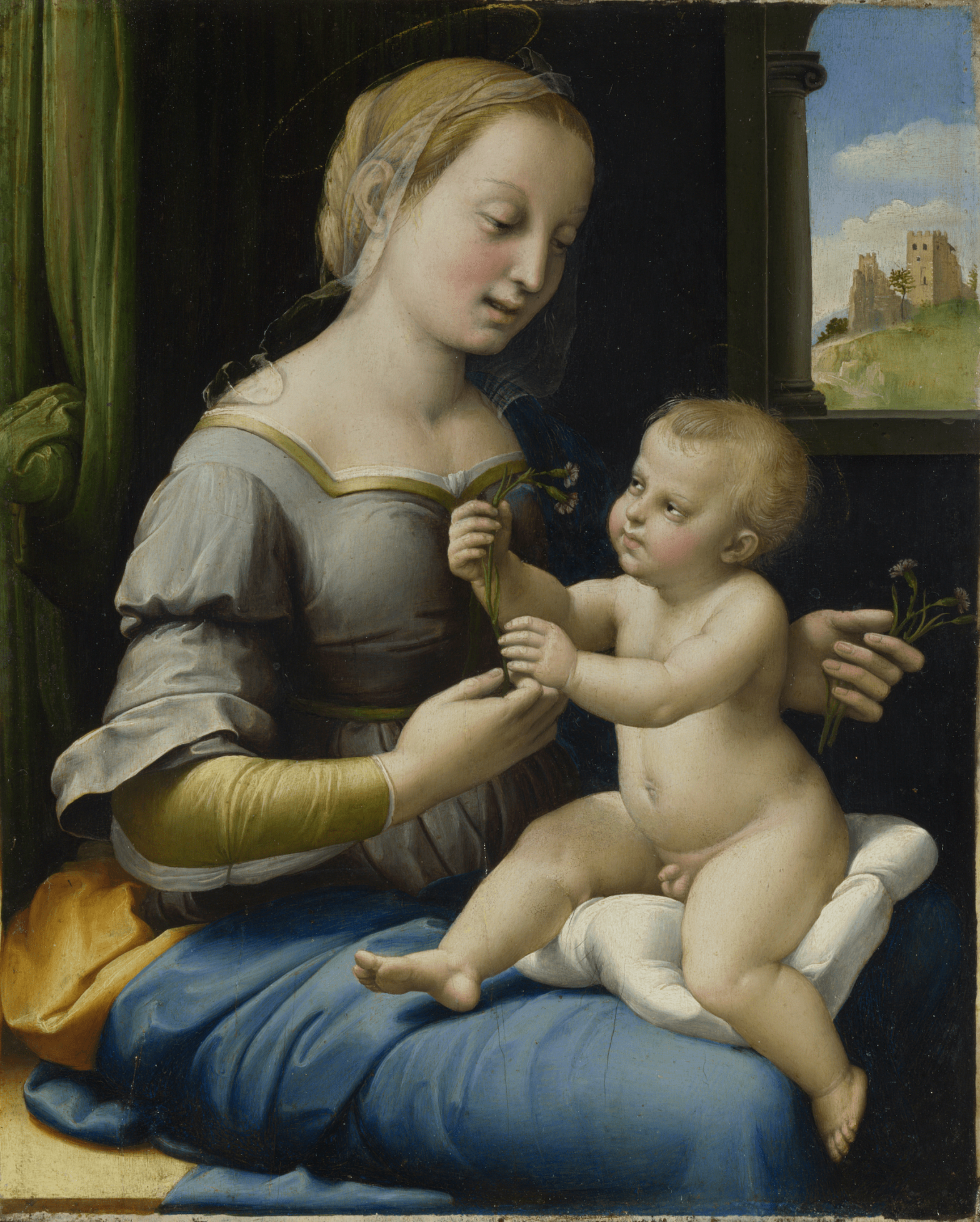
On the occasion of a major National Gallery show in London, Michael Glover on Raphael…
… he was born a mere man, a citizen of Urbino in the Marche, the son of a court painter, who was orphaned very young and raised by an uncle who also happened to be a priest. Perhaps the reverence is due to his talents, which were superabundant, and moved in so many directions at once. He was a painter, printmaker, architect, designer, sculptor, and much else. His industriousness, and the consistent quality of his output, were superhuman. That is undeniable.
Raphael painted relatively few portraits… during his short lifetime, and even fewer in which he could be said to have painted them in order to please himself, because he was always so much in demand by immensely rich and powerful male patrons for the kinds of things that they wanted him to do. They wanted him to beautify public (and private) spaces, all the greater to reflect their own power and importance — beneath the ever-watchful eye of the Christian God, their chief sponsor, in whose revered name they splashed all this cash.
Raphael was the very well remunerated servant of these rich masters, and this was entirely a matter of choice. He was boundlessly ambitious and intimidatingly energetic (he was already running a studio by the age of 17), charming, good-looking (though not to an excessive degree), diplomatic, and utterly opportunistic. Michelangelo loathed him because, though much younger, Raphael seemed to sweep all before him. What a break for the irascible, prickly Michelangelo that his young rival died, quite unexpectedly, of a fever, when he did, leaving him unchallenged for decades!
And Raphael, the name, the work, the style, has resonated and resonated across the centuries…
On the Renaissance painter described by Vasari, his first biographer, as the universal artist: “Raphael Between Heaven and Earth,” in @hyperallergic.
Raphael paints wisdom, Handel sings it, Phidias carves it, Shakespeare writes it, Wren builds it, Columbus sails it, Luther preaches it, Washington arms it, Watt mechanizes it.
Ralph Waldo Emerson
###
As we appreciate art, we might recall that it was on this date in 1890 that Vincent Van Gogh shot himself in the chest with a revolver; he died two days later. A post-impressionist painter, he was not commercially successful in his lifetime and, struggling with severe depression and poverty, committed suicide at the age of 37. But he subsequently became, with Raphael, one of the most famous and influential figures in Western art history.

You must be logged in to post a comment.