Posts Tagged ‘outsider art’
“One must still have chaos in oneself to be able to give birth to a dancing star”*…
Long-time readers will know of your correspondent’s fascination with– and affection for– outsider art. We’ve looked at Henry Darger, Ron Gittins, Grandma Moses, and others– so many of whom have been fueled by fervent faith. From Jeff MacGregor, another wonderful example…
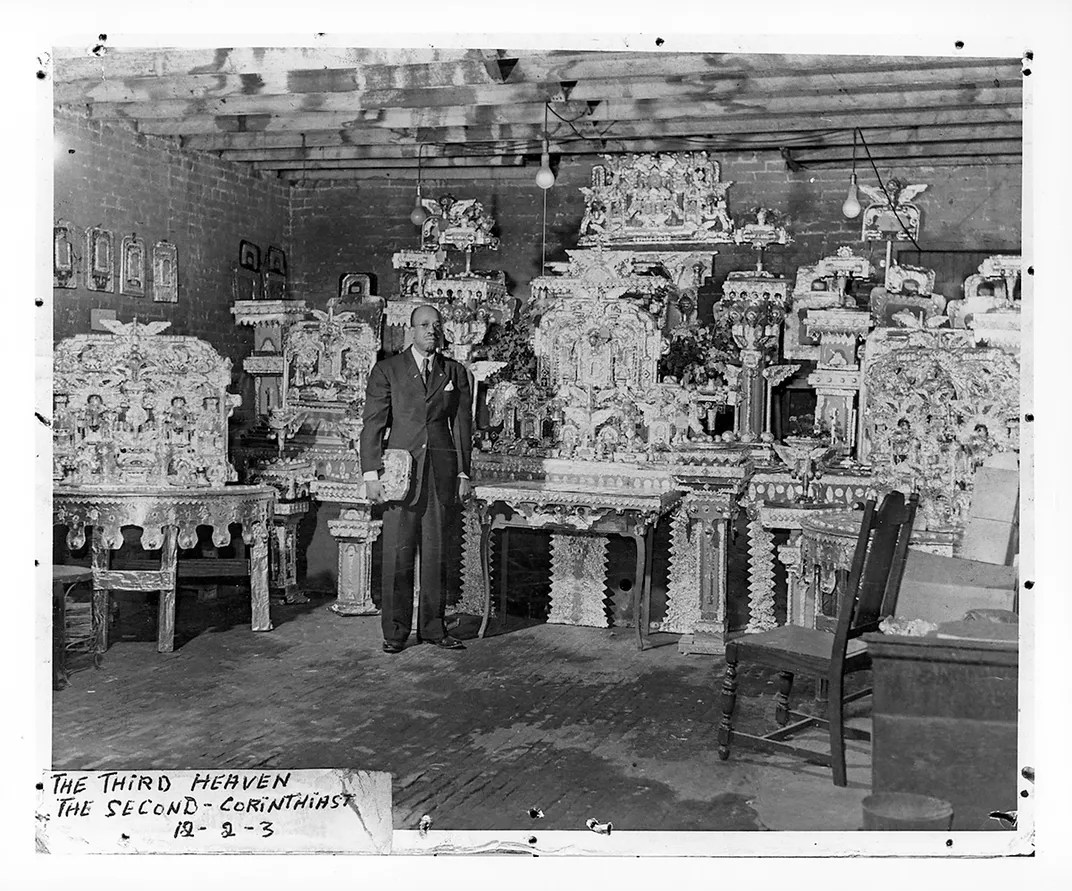
For some 14 years he labored in solitude. Lovingly. Obsessively. Every night after work, in a rented garage on 7th Street NW in Washington, D.C., James Hampton, a World War II veteran and janitor for the General Services Administration with no artistic training, methodically built what he came to call The Throne of the Third Heaven of the Nations’ Millennium General Assembly. Hampton prepared the throne to receive Jesus, flanked by a dozen angels, at the time of the Second Coming.
Born in 1909 to a South Carolina preacher, Hampton, who may have lived with schizophrenia, had his first religious vision at the age of 22—a visitation from the patriarch Moses. He later said Adam and the Virgin Mary had come to him as well. Why he began the Throne in 1950, no one can say. Passion. Devotion. Divine inspiration. But it came to comprise a handmade masterpiece of 180 or so separate components, each crafted from found and scavenged parts. Hampton embellished discarded furniture and light bulbs, tin cans and jelly jars with gold and silver foils and wrapping paper—materials reflecting light and inspiring something like awe at the prospect of an apocalyptic end to this world and the peace and glory to come in the next. Leslie Umberger, a curator at the Smithsonian American Art Museum, describes the part of the sculpture on display as the “central section of a spiritually driven, pulpit-style array” that Hampton created “as a sacred space for sharing his faith.” The “third heaven” is a reference to God’s home, an exalted heaven-within-a-heaven; the Throne, Hampton is reported to have said, “is my life. I’ll finish it before I die.”
Hampton’s materials were an inventory of junked 1950s office supplies: inks and desk blotters, construction paper and sheets of transparent plastic. The chairs and altars and offering tables are made of what he carted home from used furniture sellers, often cut in two. Each half of the assembly is beautifully symmetrical with the other. It is a miracle of craft and art and carpentry, of architecture and engineering, ingenuity and loneliness and holy madness. With a million featherlight hammer taps, Hampton built batches of trim molding and sawtooth decoration. Wings upon wings upon wings. Above the throne, Hampton placed these words of reassurance from Revelation 1:17: “Fear not.”
The Throne’s story has since hardened into legend. Hampton died of cancer at a Veterans’ Administration hospital in 1964. The work was unfinished. But then his landlord, Myer Wertlieb, came to the garage to collect the overdue rent, not knowing Hampton had died. Instead, he found the Throne. For months, Wertlieb searched without much success to find someone, anyone, who might want it. Then Harry Lowe got involved.
“It was like opening Tut’s tomb,” Lowe, head of exhibitions and design at what was then the National Collection of Fine Arts, told the Washington Post about entering that garage for the first time. Lowe paid the landlord Hampton’s back rent and arranged the purchase of the entire assembly for the museum. A selection from the center section was first exhibited in 1971. The illustrious art critic Robert Hughes wrote in Time magazine that the Throne “may well be the finest work of visionary religious art produced by an American.” Just as often, though, critics marginalized it as “outsider” art…
How deep faith created one of the loveliest—and most curious—sacred objects in the Smithsonian collections: “In His Garage, an Untrained Artist Created a Work of Sublime Divinity,” from @Jeff__MacGregor in @SmithsonianMag… where you’ll find more of the story and more wonderful photos.
* Friedrich Nietzsche
###
As we appreciate art, we might recall that it was on this date in 1866 that Charles Elmer Hires created a faith-inspired addition to the culinary (well, gustatory) arts: he formulated his eponymous “root beer.” Hires was inspired by root tea, but thought that “beer” would be a more attractive name to “the working class”– for whom Hires, a supporter of temperance, saw it as an alternative to alcohol. While he failed in weaning the working man from his suds, his concoction was a hit that helped establish the “soft drink” category and attracted numerous competitors.

“Art is an outsider, a gypsy over the face of the earth”*…

A man’s death revealed his secret masterpiece—his rented home, illegally transformed into a classical villa. What happened next questions how we define art. Max Olesker explains…
It’s a cold February morning, and I’ve come to Birkenhead, just outside Liverpool, to visit the former home of a man named Ron Gittins, a property affectionately known as Ron’s Place. Over the course of 33 years, Gittins painstakingly transformed almost every surface of this flat with a series of artworks in a variety of styles and mediums, from friezes on the walls of his living room to a Roman altar in his kitchen and enormous, ambitious fireplaces (yes, multiple). It’s a singlehanded labor of love. But, because Gittins was renting the flat—with no right to modify the property to this extent—it’s also illegal. As a result, the work was created almost entirely in secret. It was only after Gittins’ death at age 79 that word gradually began to trickle out about the existence of this strange cave of wonders…
“Outsider art,” “folk art,” and “art brut” are designations frequently applied to artists—often untrained—who work outside the classical tradition (and frequently the law). If the work is a large-scale installation, permanent or semi-permanent, it might be deemed an “outsider environment” or “visionary environment.” Outside Madrid, a former monk named Justo Gallego Martínez spent 60 years singlehandedly building his own cathedral, working on it daily until he passed away in 2021. In Westbourne Grove, London, retired postal porter and factory worker Gerry Dalton, an “Irishman and self-proclaimed gardener” according to his site’s Instagram bio, created a series of remarkable outdoor sculptures along the Grand Union Canal, in a collection he dubbed Gerry’s Pompeii. In South Africa’s Eastern Cape, Helen Martins, who lived from 1897 to 1976, created The Owl House, which features over 300 sculptures made from concrete and ground glass. And there are many, many more across the globe, each with its own infinitely rich backstory.
…
“It’s all quite powerful, isn’t it?” says Martin Wallace, as he shows me around the flat. Wallace, 55, is a warm, articulate Scouser and BAFTA-nominated filmmaker who frequently collaborates with Jarvis Cocker, the frontman of ’90s Britpop band Pulp. Together, they made a documentary series, Journeys Into the Outside, traveling the planet to investigate extraordinary places built by regular people. Wallace, who lives nearby, is now working on a feature-length documentary about Gittins, and in the process has become inexorably drawn into the orbit of Ron’s Place. Initially, this only involved helping cover the flat’s rent—as a trustee—after Gittins passed, and thinking of a long-term strategy to preserve the unique interior. But it’s rapidly become far more problematic. Ron’s Place is under threat: After months of stasis, the landlord and owner, Salisbury Management Services, has finally decided enough is enough. The building is to be sold at auction.
The front door flies open and Jan Williams and Chris Teasdale hurry in. They huddle with Wallace in the Egyptian corridor; urgent crisis talks begin. Jan Williams, 61, is Gittins’ niece. Together with her partner, Teasdale, 71, they work as artists under the name The Caravan Gallery. Along with Wallace, they have now dedicated themselves to preserving Gittins’ legacy. The current discussions, hushed and frantic, are about potential investors who might work with them—but they don’t sound promising. One man claiming to have the money also had quite a lot of snot on his jumper. The housing associations who expressed interest the previous summer have all gone quiet, the occasional sympathetic voice inevitably getting lost in the mundane realities of running a large business. In order to be eligible to apply for funding, the trio has created a legal entity, The Wirral Arts and Culture Community Land Trust. But, with time now of the essence, it’s not clear how that will save the property…
Read on for more of the story, the (happy) ending– and many more photos: “Ron’s Place,” from @maxolesker in @Longreads (though it’s not really that long :).
###
As we embrace outsiders, we might send agitated birthday greetings to painter Giacomo Balla; he was born on this date in 1871. An early member of the Italian Futurist movement, he emphasized light, movement, and speed in his work. But unlike most of his Futurist colleagues, Balla tended toward the witty and whimsical, not the machines and violence (and ultimately Fascists sentiments) that characterized so many other Italian Futurists.

“The vitality of the ordinary members of society is dependent on its Outsiders. Many Outsiders unify themselves, realize themselves as poets or saints.”*…

Sister Gertrude Morgan in her Everlasting Gospel Revelation Mission; some of her work, hanging behind her. New Orleans, Louisiana, 1974
In a new book, Walks to the Paradise Garden, author Jonathan Williams, editor Phillip March Jones, and photographer Roger Manley gather interviews and encounters with artists they met along their road trips through the American South in the 1970s. Some of the artists they spoke with, like Sister Gertrude Morgan, would eventually be discovered by the art-world establishment, while others they met—like former mechanic Vernon Lee Burwell—continued to labor in obscurity.
Along with a deep sense of religious wonder, there is a sense of urgency to the work featured in Walks to the Paradise Garden, a compulsion to make more and more of it until it covered the walls of their homes, crowded the hallways, and spilled onto the front lawn. As Williams writes in the introduction to the book, “We’re talking about a South that is both celestial and chthonian,” pertaining to both heaven and hell. “They are often one and the same.”…
Outsider artists and their work: “Finding Jesus on the Front Yard.”
* Colin Wilson, The Outsider
###
As we see through different eyes, we might recall that it was on this date in 1886 that a different kind of “outsider” made its first appearance: Coca-Cola was first sold to the public at the soda fountain in Jacob’s Pharmacy in Atlanta, Georgia. It was formulated by pharmacist John Stith Pemberton, who mixed it in a 30-gallon brass kettle hung over a backyard fire. Pemberton’s recipe, which survived in use until 1905, was marketed as a “brain and nerve tonic,” and contained extracts of cocaine and (caffeine-rich) kola nut. The name, using two C’s from its ingredients, was suggested by his bookkeeper Frank Robinson, whose excellent penmanship provided the famous scripted “Coca-Cola” logo.

Outside in…

Outsider Art— the sort of work exemplified by Henry Darger, with whom we’ve visited before— is making it’s way into the mainstream. So artists like Charles Dellschau (1830-1923), one of whose watercolors is pictured above, are being adopted by the Academy. But while the respect is better late than never, it does nothing to penetrate the exotic puzzles at the heart of Dellschau’s work…
His story is one shrouded in mystery, almost lost forever, intertwined with secret societies, hidden codes, otherworldly theories and seemingly impossible inventions before his time. Unseen for decades and salvaged by a junk dealer in the 1960s from a trash heap outside a house in Texas, his entire body of work would later go on to marvel the intellectual world. But during his lifetime, Charles Dellschau had only been known as the grouchy local butcher.
In 1969, used furniture dealer Fred Washington bought 12 large discarded notebooks from a garbage collector, where they found a new home in his warehouse under a pile of dusty carpets. In 1969, art history student, Mary Jane Victor, was scouring through his bazaar of castaways when she came upon the mysterious works of a certain Charles Dellschau. Inside the scrapbooks she discovered a remarkable collection of strange watercolours and collage pieces. More than 2,500 intricate drawings of flying machines alongside cryptic newspaper clippings filled the pages, crudely sewn together with shoelaces and thread…

He had arrived in the United States at 25 years old from Hamburg in 1853 and documents show he lived in both California and Texas with his family, working as a butcher. After his retirement in 1899, he took to filling his days by filling notebooks with a visual journal of his youth. He called the first three books, Recollections and recounts a secret society of flight enthusiasts which met in California in the mid-19th century called the ‘Sonora Aero Club’.
The Wright Brothers wouldn’t even make their famous first flight until 1903, but Dellschau draws dapperly-dressed men piloting brightly-coloured airships and helicopters with revolving generators and retractable landing gear. No records have ever been found of the Sonora Aero Club but Dellschau’s artworks hide a secret coded story. Whatever it was that he had to say was apparently too private even for his own notebooks and even today, much of the mystery has yet to be revealed…

As for how they ended up in a trash heap in the 1960s? The books had been hiding in Charles Dellschau’s attic where he worked for many years before his death. In the 1960s, the husband of Dellschau’s step-daughter, Anton Stelzig was living in the home during the 1960s with his two aging sisters and a nurse hired to care for them, when the fire department assessed that the house was a hazard and ordered that it be cleared of debris. The nurse was given the task of “cleaning-up”. Her way of doing things resulted in many of the family’s treasures being thrown out onto the street, including Dellschau’s books. Anton’s grandson Leo, painfully recalls the nurse saying, “I took care of that mess and cleaned it all up.” Some of Dellschau’s work is still believed to be missing, possibly lost forever…
Read this fascinating story– see more examples of Dellschau’s work and find more links to explore– at Messy Nessy Chic.
###
As we resolve to keep our dream journals in color, we might send challenging birthday greetings to Georges Albert Maurice Victor Bataille; he was born on this date in 1897. A “public intellectual” who worked in literature, anthropology, philosophy, economics, sociology, and art history, Bataille became known as the “metaphysician of evil.” An early fellow-traveler of the Surrealists, he co-founded the College of Sociology, a group of lapsed Surrealists that met to discuss and debate sovereignty, transgression, and the obscene.
Bataille founded several other groups and journals; and while he was scorned by Sartre as a “mystic,” he had an important influence on thinkers like Foucault, Lacan, and Baudrillard. Indeed, Bataille’s thinking on Hegel and Nietzsche was foundational in Jacques Derrida’s development of Deconstructionism.

You must be logged in to post a comment.