Posts Tagged ‘sculpture’
“There is a similarity between juggling and composing on the typewriter”*…

… and indeed making art with a typewriter…
Jeremy Mayer challenges the notion that typewriters’ creative output is confined to the written word. The artist scours shops and trash bins near his Bay Area studio for analog processors in disrepair that he then disassembles, sorts, and reconstructs into metallic sculptures. His previous works include symmetrical assemblages, anatomical recreations, and an ongoing series of birds, the most recent of which are shown here. Mayer builds every piece solely from original parts rather than soldering or gluing, and some sculptures, including the black crow with a Corona-brand typewriter logo on its back [above], feature spring-like components that allow the creatures to bob their heads.
Mayer is currently at work on a few large-scale reliefs, a kinetic lotus, skull, and additional birds, and you can follow updates and news about purchasing pieces on his Instagram. For more about his practice, check out the 2016 film California Typewriter, which documents his work alongside other enthusiasts…

More at “Vintage Typewriters Are Reassembled into Amazing Metallic Bird Sculptures by Jeremy Mayer,” in @Colossal.
* Tom Robbins
###
As we reassemble, we might recall that it was on this date in 1935 that the world’s first parking meter (Park-O-Meter No. 1, AKA “the Black Maria”) was installed on the southeast corner of what was then First Street and Robinson Avenue in Oklahoma City, Oklahoma. The design, by Holger George Thuesen and Gerald A. Hale, was done for Carl Magee, who patented and installed the device.
Magee, a journalist who’d earlier helped expose the Teapot Dome Scandal, and whose day job in 1935 was editor of the Oklahoma City News, is perhaps best remembered as coiner (more accurately adaptor, from Dante) of publisher E.W. Scripps Company’s motto: “Give Light and the People Will Find Their Own Way.”

Magee and the Meter (source)
“Which painting in the National Gallery would I save if there was a fire? The one nearest the door of course.”*…

The remarkable tale of the Louvre’s successful efforts to protect its treasures from Nazi looting…
… With due respect to the Monuments Men (and unsung Monuments Women), before the Allies arrived to rescue many of Europe’s priceless works of art, French civil servants, students, and workmen did it themselves, saving most of the Louvre’s entire collection. The hero of the story, Jacques Jaujard, director of France’s National Museums, has gone down in history as “the man who saved the Louvre” — also the title of an award-winning French documentary (see trailer below). Mental Floss provides context for Jaujard’s heroism:
After Germany annexed Austria in March of 1938, Jaujard… lost whatever small hope he had that war might be avoided. He knew Britain’s policy of appeasement wasn’t going to keep the Nazi wolf from the door, and an invasion of France was sure to bring destruction of cultural treasures via bombings, looting, and wholesale theft. So, together with the Louvre’s curator of paintings René Huyghe, Jaujard crafted a secret plan to evacuate almost all of the Louvre’s art, which included 3600 paintings alone.
On the day Germany and the Soviet Union signed the Nonaggression Pact, August 25, 1939, Jaujard closed the Louvre for “repairs” for three days while staff, “students from the École du Louvre, and workers from the Grands Magazines du Louvre department store took paintings out of their frames… and moved statues and other objects from their displays with wooden crates.”
The statues included the three ton Winged Nike of Samothrace (see a photo of its move here), the Egyptian Old Kingdom Seated Scribe, and the Venus de Milo. All of these, like the other works of art, would be moved to chateaus in the countryside for safe keeping. On August 28, “hundreds of trucks organized into convoys carried 1000 crates of ancient and 268 crates of paintings and more” into the Loire Valley.
Included in that haul of treasures was the Mona Lisa, placed in a custom case, cushioned with velvet. Where other works received labels of yellow, green, and red dots according to their level of importance, the Mona Lisa was marked with three red dots — the only work to receive such high priority. It was transported by ambulance, gently strapped to a stretcher. After leaving the museum, the painting would be moved five times, “including to Loire Valley castles and a quiet abbey.” The Nazis would loot much of what was left in the Louvre, and force it to re-open in 1940 with most of its galleries starkly empty. But the Mona Lisa — at the top of Hitler’s list of artworks to expropriate — remained safe, as did many thousands more artworks Jaujard believed were the “heritage of all humanity”…
How France Hid the Mona Lisa & Other Louvre Masterpieces During World War II, from @openculture.
* George Bernard Shaw
###
As we say thanks for safekeeping, we might send Romantic birthday greetings to a painter whose works were among those saved by the Louvre; he was born on this date in 1798. Breaking with the neoclassical tendencies of contemporaries (like his rival Ingres), Delacroix took his inspiration from Reubens and the Venetian Renaissance, emerging from the outset of his career as a leader of the French Romantic movement. Together with Ingres, Delacroix is considered one of the last old Masters of painting, and one of the few who was ever photographed (see below).
Also a fine lithographer, Delacroix illustrated various works of Shakespeare, Walter Scott, and Goethe.


“The wind has its reasons”*…
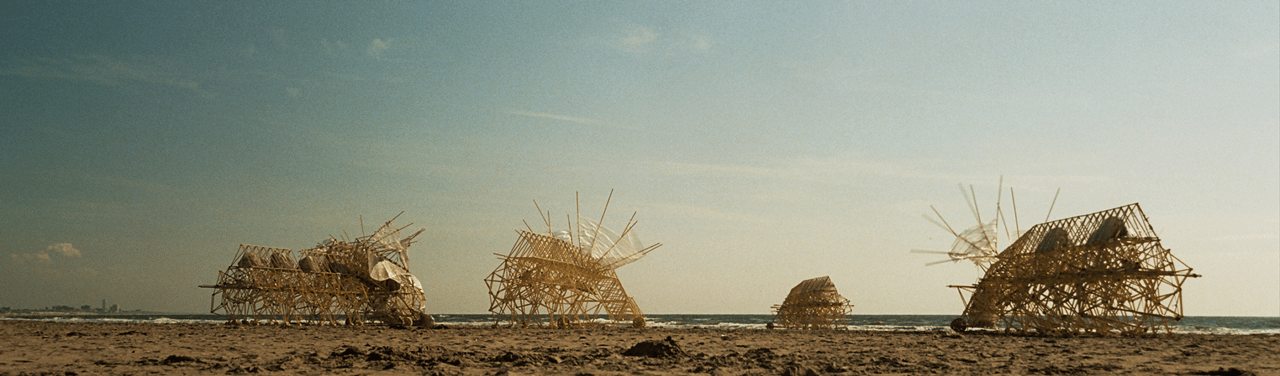
For Theo Jansen, it’s all about the wind…
Many of us hit the beach to enjoy some sunshine or catch a wave. But for Dutch artist Theo Jansen it’s all about the wind. Jansen’s been working with this limitless natural resource for 30 years to create a fabulous array of giant beach creatures—brought to life by the wind. With every gust, his wondrous seaside sculptures become more lifelike, ambling along the coast like creatures in their own right…
Jansen started designing them in the 1990s after reading about rising sea levels threatening the low-lying Netherlands—a country famous for the fact that one third of it is below sea level. He had a dream of creating a herd of wind-powered coastal sentinels, perpetually piling sand high onto the dunes to keep the water at bay.
What he ended up building took a different turn, with Jansen developing the idea to explore evolution as the primary creative force behind all life on Earth, capturing people’s imaginations in the process…
An artist’s moving tribute to nature’s powerful resource: “Fantastic Beasts Brought to Life by the Wind,” @HoeveMarie in @NautilusMag on @StrandBeests.
* Haruki Murakami
###
As we feel the breeze, we might recall that it was on this date in 1896 that Richard Strauss‘ Also sprach Zarathustra (Opus 30) was first performed (in Frankfurt).
“As long as art lives never shall I accept that men are truly dead”*…

An appreciation of Giorgio Vasari’s seminal The Lives of the Most Excellent Painters, Sculptors, and Architects, the beginning of art history as we know it…
I found Giorgio Vasari through Burckhardt and Barzun. The latter writes: “Vasari, impelled by the unexampled artistic outburst of his time, divided his energies between his profession of painter and builder in Florence and biographer of the modern masters in the three great arts of design. His huge collection of Lives, which is a delight to read as well as a unique source of cultural history, was an amazing performance in an age that lacked organized means of research. […] Throughout, Vasari makes sure that his reader will appreciate the enhanced human powers shown in the works that he calls ‘good painting’ in parallel with ‘good letters’.”
Vasari was mainly a painter, but also worked as an architect. He was not the greatest artist in the world, but he had a knack for ingratiating himself with the rich and powerful, so his career was quite successful. Besides painting, he also cared a lot about conservation: both the physical preservation of works and the conceptual preservation of the fame and biographies of artists. He gave a kind of immortality to many lost paintings and sculptures by describing them to us in his book.
His Lives are a collection of more than 180 biographies of Italian artists, starting with Cimabue (1240-1302) and reaching a climax with Michelangelo Buonarroti (1475-1564). They’re an invaluable resource, as there is very little information available about these people other than his book; his biography of Botticelli is 8 pages long, yet on Botticelli’s wikipedia page, Vasari is mentioned 36 times…
…
Giorgio Vasari was one of the earliest philosophers of progress. Petrarch (1304-1374) invented the idea of the dark ages in order to explain the deficiencies of his own time relative to the ancients, and dreamt of a better future:
My fate is to live among varied and confusing storms. But for you perhaps, if as I hope and wish you will live long after me, there will follow a better age. This sleep of forgetfulness will not last forever. When the darkness has been dispersed, our descendants can come again in the former pure radiance.
To this scheme of ancient glory and medieval darkness, Vasari added a third—modern—age and gave it a name: rinascita. And within his rinascita, Vasari described an upward trajectory starting with Cimabue, and ending in a golden age beginning with eccentric Leonardo and crazed sex maniac Raphael, only to give way to the perfect Michelangelo in the end. It is a trajectory driven by the modern conception of the artist as an individual auteur, rather than a faceless craftsman.
The most benign Ruler of Heaven in His clemency turned His eyes to the earth, and, having perceived the infinite vanity of all those labours, the ardent studies without any fruit, and the presumptuous self-sufficiency of men, which is even further removed from truth than is darkness from light, and desiring to deliver us from such great errors, became minded to send down to earth a spirit with universal ability in every art and every profession.
This golden age was certainly no utopia, as 16th century Italy was ravaged by political turbulence, frequent plague, and incessant war. Many of the artists mentioned were at some point taken hostage by invading armies; Vasari himself had to rescue a part of Michelangelo’s David when it was broken off in the battle to expel the Medici from Florence.
And yet Vasari saw greatness in his time, and the entire book is structured around a narrative of artistic progress. He documented the spread of new technologies and techniques (such as the spread of oil painting, imported from the Low Countries), which—as an artist—he had an intimate understanding of.
This story of progress is paralleled with the rediscovery (and, ultimately, surpassing) of the ancients. It would take until the 17th century for the querelle des Anciens et des Modernes to really take off in France, but in Florence Vasari had already seen enough to decide the question in favor of his contemporaries—the essence of the Enlightenment is already present in 1550…
Art history, cultural history, tech history, the history of ideas– a review of Vasari’s The Lives of the Most Excellent Painters, Sculptors, and Architects by @AlvaroDeMenard.
* Giorgio Vasari
###
As we frame it up, we might recall that it was on this date in 1946 that the first Cannes Film Festival opened. It had originally been scheduled for September, 1939 as an “answer” to the Venice Film Fest, which had become a propaganda vehicle for Mussolini and Hitler; but the outbreak of World War II occasioned a delay.

“No great artist ever sees things as they really are”*…

Indeed, sometimes they see nothing at all…
Earlier this month, an Italian artist named Salvatore Garau went viral when his “immaterial sculpture”—that is, a work of art made of literally nothing—sold for €15,000 ($18,300) at auction.
Articles about the sale was shared widely, often accompanied by captions of the “I could have done that” variety. Users posted pictures of blank spaces—their own invisible sculptures which could surely be had for a fraction of Garau’s price. Many bemoaned the fact that they didn’t think of it first.
Then there was Tom Miller, a performance artist from Gainesville, Florida, who says he actually did do it first—and now he’s filing a lawsuit against Garau to prove it.
The Florida artist says that, in 2016, he installed his own invisible sculpture in Gainesville’s Bo Diddley Community Plaza, an outdoor event space. He titled it Nothing and erected it over the course of five days with a team of workers who moved blocks of air like mimes building the Great Pyramid of Giza. Tens of people were on hand to see the opus unveiled that June.
Miller even made a short film about the work, a mockumentary that features fake artists and curators as talking heads. He compares his respective take on nothingness to John Cage’s “4′33″ and Seinfeld.
“All I can say personally is that Nothing is very important to me,” Miller told Artnet News in an email. “I should be credited with Nothing (specifically the idea of Nothing fashioned into sculpture form), and Gainesville, Florida—not Italy—is where Nothing happened first.”
It’s worth pointing out, of course, that immaterial art has a long history stretching back to the 20th century. Yves Klein exhibited an empty gallery space in 1958 and envisioned an “architecture of air” a couple of years later. Tom Friedman installed an invisible object atop a plinth in 1992—and it sold for £22,325 nine years later.
…
Miller may have even more competition than he realizes. Since Artnet News first published an article about Garau’s work, numerous other artists have written to me about their own invisible sculpture practices. It turns out it’s hard to get noticed when you’re an artist who makes… nothing.
Tom Miller, who says he made an invisible sculpture in 2016, is demanding visibility: “A Florida Man Is Threatening to Sue an Artist Whose Invisible Sculpture Sold for $18,000, Saying He Came Up With the Idea First”; from Taylor Dafoe (@tddafoe) in @artnet
* Oscar Wilde
###
As we muse on the missing, we might might recall that it was on this date in 1989 that Northrop Grumman did its best to make something all-too-tangible disappear: it first flew what became the B-2 Spirit— better known as the Stealth Bomber.

You must be logged in to post a comment.