Posts Tagged ‘Turing Test’
“Things that are so far removed from our daily experience… are inherently hard to understand”*…

That’s certainly true of numbers. And as the numbers grow, the cognitive challenges grow with them. (Indeed, by way of example: 1 million seconds, is roughly 11.5 days; 1 billion seconds is almost 32 years.)
We’ve looked before at the mysterious extremes of math: zero and infinity [and here]. But as Dan Falk reminds us, the numbers in between can seem pretty strange as well– especially the extremely large ones. In a review of Richard Elwes‘ Huge Numbers: A Story of Counting Ambitiously, From 4½ to Fish 7, Falk spotlights some of the largest numbers humans have ever contemplated…
… Aficionados of huge numbers are called “googologists,” a reference to the number 10100, known as a googol. Such numbers have a peculiar sort of existence. For the vast majority of us, they’re of limited everyday value. Calculations at the supermarket checkout, or at tax time in April, typically involve far more modest figures. Perhaps we’ve read that the U.S. national debt is in excess of $38 trillion — a mind-numbing figure, to be sure, but it’s not as though any one individual needs to count it up in stacks of $20 bills.
And yet, much larger numbers await those who seek them out. Consider the kinds of numbers that crop up in problems involving combinations and permutations. For example, in how many distinct ways can one shuffle a deck of cards? Elwes takes us through the calculation, and we end up with a figure of about 8×1067. Compared to that number, the odds of getting a royal flush when dealt a five-card poker hand seem pretty decent, sitting at a mere 1 in 649,740 (still rare enough that many poker players have never held such a hand). Or consider that famous 1980s cultural touchstone, the Rubik’s cube. In how many ways can one scramble the cube? It turns out that the figure is about 43 quintillion, or 4.3×10¹⁹ — but in spite of that ridiculously large figure, people do routinely solve the puzzle, and champions can do it in mere seconds. In fact, as Elwes explains, no Rubik’s cube arrangement is more than 20 moves away from any other arrangement.
Or consider the age of the universe, estimated to be about 13.8 billion years. This may seem like a lengthy span of time, but our cosmic future is where the really big numbers come up. Elwes examines the so-called heat death of the universe, in which all matter has broken down into subatomic particles. We may reach this point in [10 raised to the 10th power, raised again to the 120th power] years — this dizzying figure is 10 raised to the power of 10120 — at which point, Elwes says, the universe will have ballooned up to a diameter of 10 to the power of 10 to the power of 10120 light years. (Yes, that’s [10 raised to the 10th power, again to the 10th power, then to the 120th power] light years.) Elwes adds a footnote: “At this point, the choice of units hardly matters; the distance is so immense that whether we choose to measure it in Planck lengths or giga-light years makes little difference.” Let that sink in!
As mind numbing as such figures are, the highest numbers contemplated by humans come not from physics but from pure mathematics and computer science. Like “Graham’s number” — an immense figure put forward as the upper-bound for solutions to a problem in a branch of mathematics known as Ramsey theory. Some readers may find the ensuing discussion of multi-dimensional hypercubes a bit challenging, but one can enjoy the payoff regardless: We end up with a number that can’t even be expressed in conventional notation, and which earned a mention in the 1980 edition of the “Guinness Book of World Records” as “the highest number ever used in a mathematical proof.”
Reading this book is a little bit like sitting in the back row of an auction house where a rare Picasso (let’s say) is up for grabs: How high is this thing going to go? And indeed, Elwes keeps going. We eventually meet the so-called busy beaver numbers, a set of numbers that crop up in theoretical computer science, when one tries to deduce whether a particular computer program will eventually stop, or keep going forever — a conundrum known as the “halting problem.” As Elwes explains, it’s not at all straightforward to distinguish the two types of programs (and if it was, it would help mathematicians tackle some of the most vexing problems in their field).
The fifth busy beaver number, known as BB(5) — associated with a computer program that can access five internal states — works out to 47,176,870. And that’s as far as we’ve gotten, Elwes explains. No one has worked out the value of BB(6), but he assures us that it’s beyond the range of any physical computer; and BB(16) leaves even Graham’s number in the dust.
But wait, there’s more! “Rayo’s number,” concocted by Agustín Rayo — a dean and professor at MIT — using set theory, is bigger still (here’s a fun video about it); and “Fish 7,” mentioned in the book’s subtitle, named for a Japanese googologist who goes by the pseudonym “Fish,” builds on Rayo’s number, and … well, the details are not easily digested, but the mind-melting nature of these numbers comes across as a feature, not a bug, of Elwes’s story… the narrative is enlivened by explorations of the peculiarities of math history…
… Archimedes tried to estimate how many grains of sand would be needed to fill up the known universe, back in the third century B.C. Did he simply have too much time on his hands? Not at all, insists Elwes: The Greek thinker was articulating an important idea — that no matter how unfathomably large a quantity may be, we can describe it with precision, thanks to mathematics. “Archimedes,” he writes, “was penning a manifesto for the expressive power of large numbers.”…
… [Elwes focuses] on numbers that are ridiculously large and yet finite. In the end, perhaps this is the most mind-boggling fact of all: that these enormous numbers, from Graham’s number to Fish 7 and beyond, fall as far short of infinity as does the humble number 1…
The mysteries of the massive: “The Mind-Boggling Science of Enormous Numbers,” @danfalk.bsky.social on @richardelwes.bsky.social in @undark.org.
###
As we enumerate enormity, we might spare a thought for a seminal mathematician, Alan Turing; he died on this date in 1954. He was a foundational computer science pioneer (inventor of the Turing Machine (an influential model for the general-purpose computer), creator of the “Turing Test” (only too relevant in these AI-infected times), inspiration for “The Turing Award” (the “Nobel Prize of computing“), and cryptographer (leading member of the team that cracked the Enigma code during WWII).

“If you are confused by the underlying principles of quantum technology – you get it!”*…
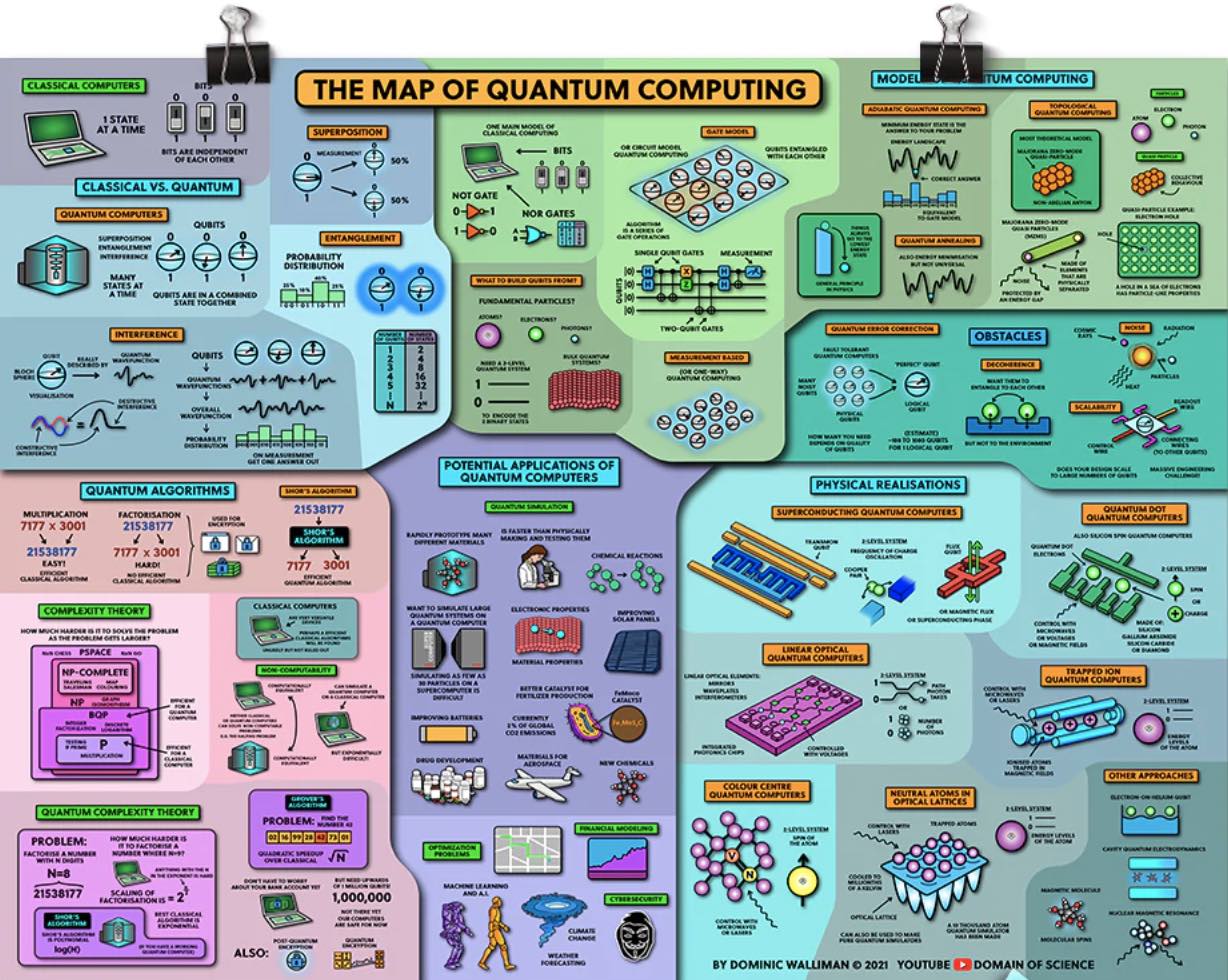
A tour through the map above– a helpful primer on the origins, development, and possible futures of quantum computing…
From Dominic Walliman (@DominicWalliman) on @DomainOfScience.
* Kevin Coleman
###
As we embrace uncertainty, we might spare a thought for
Alan Turing; he died on this date in 1954. A British mathematician, he was a foundational computer science pioneer (inventor of the Turing Machine, creator of the “Turing Test” (perhaps to b made more relevant by quantum computing :), and inspiration for “The Turing Award“) and cryptographer (leading member of the team that cracked the Enigma code during WWII).

I for one welcome our new computer overlords…

In the aftermath of Watson’s triumph over humanity’s best, your correspondent thought it wise to remind readers (and himself) that this is not the first time that we mortals have faced the onslaught of astounding new technology.
The good folks at Dark Roasted Blend have compiled a nifty through-the-ages recap of attempts to create “life” in new-fangled ways; from Leonardo’s “robot” and John Dee’s “flying beetle” to an “steam-powered hiker” and an “electric milk man” from Victorian England, there’s quite a selection in “Amazing Automatons: Ancient Robots & Victorian Androids.”
It’s all fascinating; but the sweet spot is surely the selection of creations from the 18th (and early 19th) centuries, when the then-highly-developed crafts of metal working and watchmaking were turned to automata. Consider, for example…

Jacques Vaucason created numerous working figures, including a flute player, which actually played the instrument, in 1738, plus this duck from 1739. The gilded copper bird could sit, stand, splash around in water, quack and even give the impression of eating food and digesting it.


Pierre Jaquet-Doz created three automata, The Writer, The Draughtsman and The Musician, which are still considered scientific marvels today. The Draughtsman is capable of producing four distinct pictures, while the Writer dips his pen in the ink and can write as many as forty letters. The Musician’s fingers actually play the organ and the figure ends her performance with a bow.
More, at Dark Roasted Blend.
As we remind ourselves to re-read Kevin Kelly’s excellent What Technology Wants and then to retake the Turing Test, we might stage a dramatic memorial dramatist and scenic innovator James Morrison Steele (“Steele”) MacKaye; he died on this date in 1894. He opened the Madison Square Theatre in 1879, where he created a huge elevator with two stages stacked one on top of the other so that elaborate furnishings could be changed quickly between scenes. MacKaye was the first to light a New York theatre– the Lyceum, which he founded in 1884– entirely by electricity. And he invented and installed overhead and indirect stage lighting, movable stage wagons, artificial ventilation, the disappearing orchestra pit, and folding seats. In all, MacKaye patented over a hundred inventions, mostly for the improvement of theatrical production and its experience.

You must be logged in to post a comment.