Posts Tagged ‘Vanity Fair’
“A strange idea was pecking at his brain like a chicken in the egg, and very, very much absorbed him”*…

The estimable Brad DeLong shares the prose outline of one of his lectures…
[In] my “roots of property, exchange, and the division of labor” lecture [I try] to make novel and strange the idea people think that they “own” things: to impress students with how just plain weird that is. And then there are the next steps: That people enter into reciprocal gift-exchange relationships with or using things they “own” is really weird. That reciprocal gift-exchange transforms into cash-on-the-barrelhead one-shot economic “trade” is perhaps the weirdest of all. Where do these things come from? And what are the chances that any Turing-Class intelligent social creature would ever develop them? And how much less efficient and functional as an action-taking anthology-intelligence could the East African Plains Ape possibly be without these social-institutional things that underpin the global-scale societal coördination mechanism we call the “market economy”?
What if we see the idea of “owning” something is one of humanity’s strangest inventions? Before markets, before money, there was a peculiar leap: the belief that things could be “mine” even when I’m not looking. Explore how property and exchange, far from being “natural”, are peculiar to the East African Plains Ape, are societal-scale technologies that turned us into a market-making species, and how that leap—property and exchange—became the foundation of our economic world and of a great deal of our success as an action-taking anthology-intelligence.
That we believe in property and exchange is absolutely key to the “market” institutional mode of organizing the practical-action coördination side of humanity as a successful anthology intelligence. And that is not all that property is key to, for spheres of ownership, action, and control that can be readjusted are very important parts of our conceptual map for a great deal of our additional collective modes and mechanisms of societal organization. And these ideas—not just “I will growl and bite you if you try to drag this zebra carcasse I am eating right now away from me”, but that this is mine and it stays mine even if I am not right here growling—is really weird.
Where and how does it originate?
And why did it make sense for the first of the homines erecti who added this to their shared conceptual maps?…
Touching on the thinking of Doug Jones (who locates the cultural emergence of “property” in the development of the hand-axe), Adam Smith, Aristoteles of Stagire, John Locke, Jean-Jacques Rousseau, and Friedrich Engels, DeLong concludes…
However, once we have constructed this jenga tower on top of its foundations of reciprocity and ownership, one of very key pieces of humanity’s glory and power as an action-taking coördinated anthology-intelligence has fallen into place.
The true genius of the market system lies in its capacity to decentralize decision-making, to push choices and authority out to the periphery—out to the individuals and enterprises who are closest to the ground, who possess the granular, local knowledge that no distant central planner or bureaucratic committee could ever hope to match. In this way, the market harnesses and aggregates the dispersed intelligence of society, transforming millions of individual judgments, preferences, and bits of information into a coherent pattern of production and allocation.
The result is an astonishingly adaptive and responsive system, one that can, at its best, direct resources toward their most valued uses with a minimum of wasted effort. But, and this is crucial, this remarkable coördination is only truly effective for rival and excludible commodities—goods and services for which one person’s consumption precludes another’s, and for which access can be limited to those who pay. In these domains, the market’s invisible hand is real and powerful, allocating goods through the interplay of supply, demand, and price.
When markets are functioning well—when property rights are secure, when contracts are enforced, when information is sufficiently available—they become the central nervous system of a vast, intricate organism. They coordinate sprawling networks of production and exchange, linking together farmers, manufacturers, merchants, workers, and consumers in a web of mutual interdependence. It is the division of labor, enabled and deepened by the existence of wide and deep markets, that serves as the engine of productivity and prosperity. As Adam Smith observed, the specialization of tasks allows individuals to become more skilled and efficient, unleashing a flood of innovation and output that no autarkic household or command economy could hope to rival.
Yet—and this is a point too often ignored—the benefits of this productivity are not distributed evenly or automatically. Who gets what, and how much, is determined by the prevailing structure of bargaining power and the existing arrangements of property. The market does not guarantee justice, only efficiency; it delivers abundance, but it apportions that abundance according to the rules of the game, rules that are themselves the product of history, law, and politics. Thus, while the market is a marvel of coordination, it is never a substitute for vigilance about the distributional consequences it generates…
How ownership and trade have made us truly weird: “‘Property’ & ‘Exchange’ as a Coördination Mechanism at Societal Scale,” from @delong.social.
Apposite (and in the spirit of both DeLong’s concluding observation and Aristotle’s injunction: “Property should be in a general sense common, but as a general rule private… In well-ordered states, although every man has his own property, some things he will place at the disposal of his friends, while of others he shares the use of them.”): “Think LIke a Commoner“
* Fyodor Dostoyevsky, Crime and Punishment
###
As we ponder property, we might send insightful birthday greetings to one of its most sardonic observers, William Makepeace Thackeray; he was born on this date in 1811. A novelist and illustrator, he is best known for his satirical works, particularly his 1847–1848 novel Vanity Fair, a panoramic– and piercing– portrait of British society, and the 1844 novel The Luck of Barry Lyndon (which was, of course, adapted for a 1975 film by Stanley Kubrick.

“For some of us, books are as important as almost anything else on earth”*…
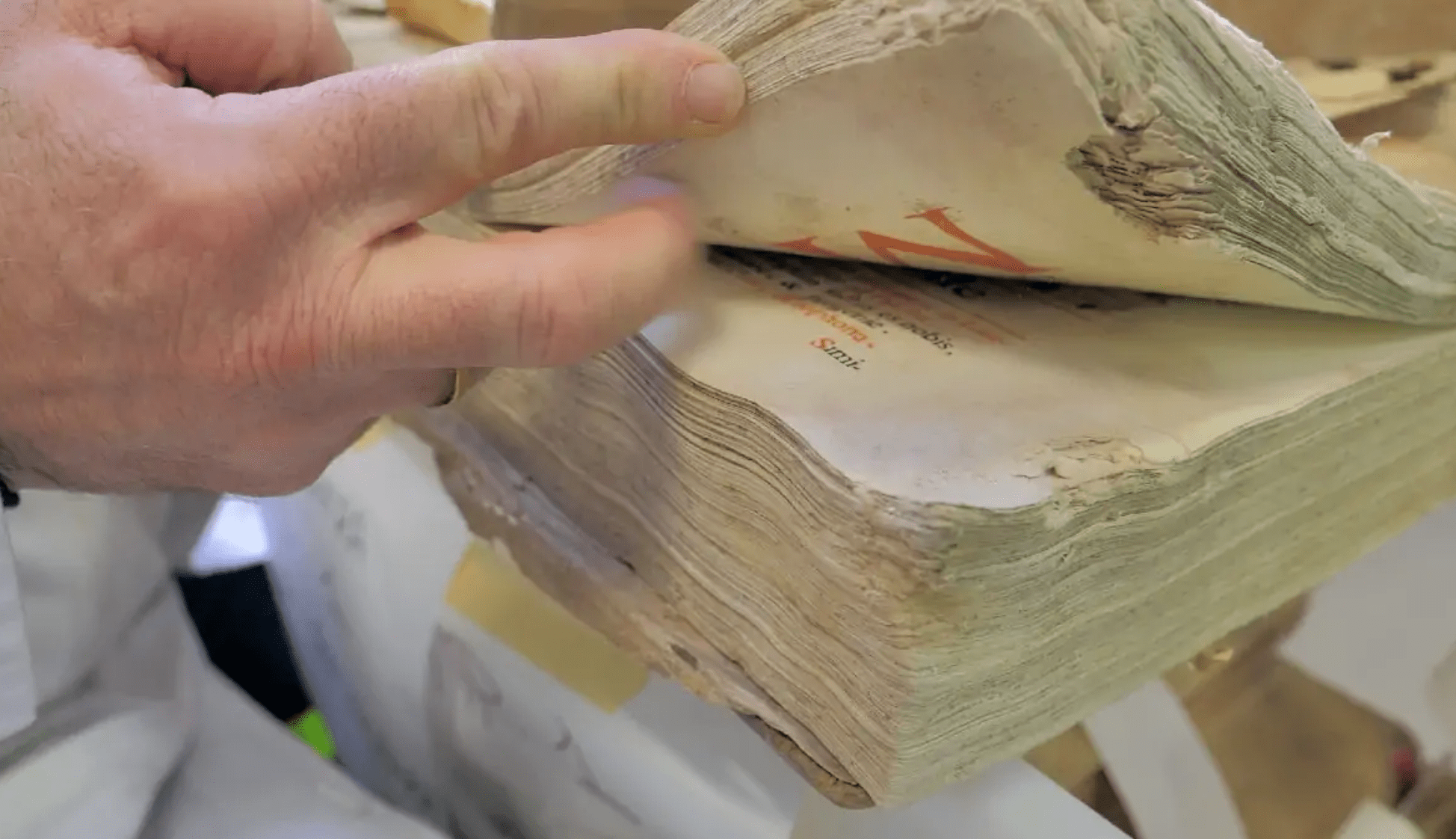
Preserving precious publications…
It all started in 1994. The flooding of the Po river and its tributaries had just swept away entire villages in the Piedmont region of northern Italy, leaving behind only death and debris. The whole of Italy was shocked. Of all the damage broadcast on television, one caused a particular sensation: In the village Santo Stefano Belbo, the historical archive of Cesare Pavese, one of the most famous and beloved Italian writers, was buried in mud.
The debacle particularly impressed a man named Pietro Livi, president of Frati & Livi in Bologna, a company that had been restoring and conserving ancient texts for nearly 20 years. At that time, however, no one in Italy was equipped for this kind of rescue. In the past, flooded and muddy documents were entrusted to companies that used basic restoration methods that proved both invasive and ineffective: The books were simply placed in ovens or air-dried in large rooms, which often left the texts unusable and made mold only proliferate.
So Livi decided to find out if anyone in Europe had found a more effective way to save these invaluable records of human achievement. Finally, in Austria, Livi found a freeze dryer that held some promise, but it was too big and costly for a small artisanal company like his. Then, in 2000, the Po river overflowed again. In the city of Turin, entire archives belonging to distinguished institutes and libraries ended up underwater.
At a loss for what to do, Italy’s Archival Superintendency of the Ministry of Cultural Heritage summoned Livi. By this time, Livi had established a solid reputation as a master restorer, having studied the art of book restoration with Benedictine friars. But he realized that for a project of this scope, his expertise was no longer enough; he needed a kind of Renaissance workshop, where he could collaborate with professionals from a variety of disciplines. Livi believed that the time had come where the world of artisan knowledge and the world of technology, too often considered as opposites, had to talk to each other—for the benefit of one another…
Then, on November 12, 2019, the city of Venice, one of the world’s most mythical and most admired locales, suffered its worst flood in 53 years. The swollen lagoon soaked roughly 25,000 valuable texts, including the last surviving original of one of Vivaldi’s musical scores. Frati & Livi was quickly called to the scene…
In the city of Bologna, home to the western world’s oldest university, Pietro Livi developed an unusual machine shop—part artisanal and part high-tech—built to restore damaged ancient texts to their former glory. And then came Venice’s historic floods of 2019: “Italy’s Book Doctor,” from @CraftsmanshipQ.
* “For some of us, books are as important as almost anything else on earth. What a miracle it is that out of these small, flat, rigid squares of paper unfolds world after world after world, worlds that sing to you, comfort and quiet or excite you. Books help us understand who we are and how we are to behave. They show us what community and friendship mean; they show us how to live and die.” – Anne Lamott
###
As we celebrate craft, we might we spare a thought for publishing pioneer Condé Montrose Nast; he died on this date in 1942. After serving as Advertising Director at Colliers, then a brief stint in book publishing, Nast bought a small New York society magazine called Vogue— which he proceeded to turn into the nation’s, then the world’s leading fashion magazine. While other periodical publishers simply sought higher and higher circulation, Nast introduced the “lifestyle” title, targeted to a group of readers by income level or common interest. By the time of his death, his stable of monthlies also included House & Garden, British, French, and Argentine editions of Vogue, Jardins des Modes, (the original) Vanity Fair, and Glamour; subsequently, the group added such resonant lifestyle books as Gourmet, New Yorker, and Wired.

And a’one and a’two…

German composer Michael Petermann has assembled an orchestra (from vintage appliances purchased on eBay) to perform “Blödes Orchester” (Stupid Orchestra), a “symphonic piece for home appliance,” now appearing at the Museum für Kunst und Gewerbe in Hamburg.
[TotH to the ever-extraordinary Laughing Squid]
As we ask the blender to tone down the vibrato, we might wish a stylish happy birthday to publishing pioneer Condé Montrose Nast; he was born on this date in 1873. After serving as Advertising Director at Colliers, then a brief stint in book publishing, Nast bought a small New York society magazine called Vogue— which he proceeded to turn into the nation’s, then the world’s leading fashion magazine. While other periodical publishers simply sought higher and higher circulation, Nast introduced the “lifestyle” title, targeted to a group of readers by income level or common interest. By the time of his death, his stable of monthlies also included House & Garden, British, French, and Argentine editions of Vogue, Jardins des Modes, (the original) Vanity Fair, and Glamour; subsequently, the group added such resonant lifestyle books as Gourmet, New Yorker, and Wired.
 Condé Nast (source)
You must be logged in to post a comment.