Posts Tagged ‘football’
“To the victor go the spoils”*…
… Yes… but Maitreyi Anantharaman asks, which victors. A Sunday football installment…
In late July, before a game against the Boston Red Sox, Bryce Harper sat slumped in a chair in the Philadelphia Phillies clubhouse, a baseball bat in hand. Philadelphia was the latest stop on Rob Manfred’s leaguewide speaking tour; ahead of a CBA negotiation that virtually everyone in baseball expects to involve a 2027 work stoppage, the MLB commissioner spent the summer visiting all 30 teams, trying to get players on board with his plans to restructure the league’s economics. When the subject of a salary cap came up late in the meeting, Harper rose from his seat. He walked closer to Manfred until their noses almost touched, and told the commissioner that if Manfred wanted to talk salary cap, he could “get the fuck out of our clubhouse.”
A couple months later, at the Minnesota Lynx’s end-of-season press conference, Napheesa Collier had some words for her league’s commissioner, too. The WNBA is in the thick of labor talks these days: The league and players’ union recently agreed to extend their collective bargaining negotiating period through January. Collier’s sport is undergoing its own economic transformation. Amid a women’s basketball boom, WNBA team prices have skyrocketed, and the league’s new media rights deal is valued at a figure six times the old one. Today’s labor fight pits players who feel they’ve driven this growth against the owners who feel they’re owed for years of losses. In Collier’s telling, commissioner Cathy Engelbert is a poor steward for the moment, a leader who takes the WNBA’s talent for granted. “The league believes it succeeds despite its players, not because of them,” Collier said, adding later that “the best players in the world” had “the worst leadership in the world.” The measure she took was public and not so lurid a confrontation as Harper’s—no baseball bats involved. But the basic idea was the same: to establish whose clubhouse it really is.
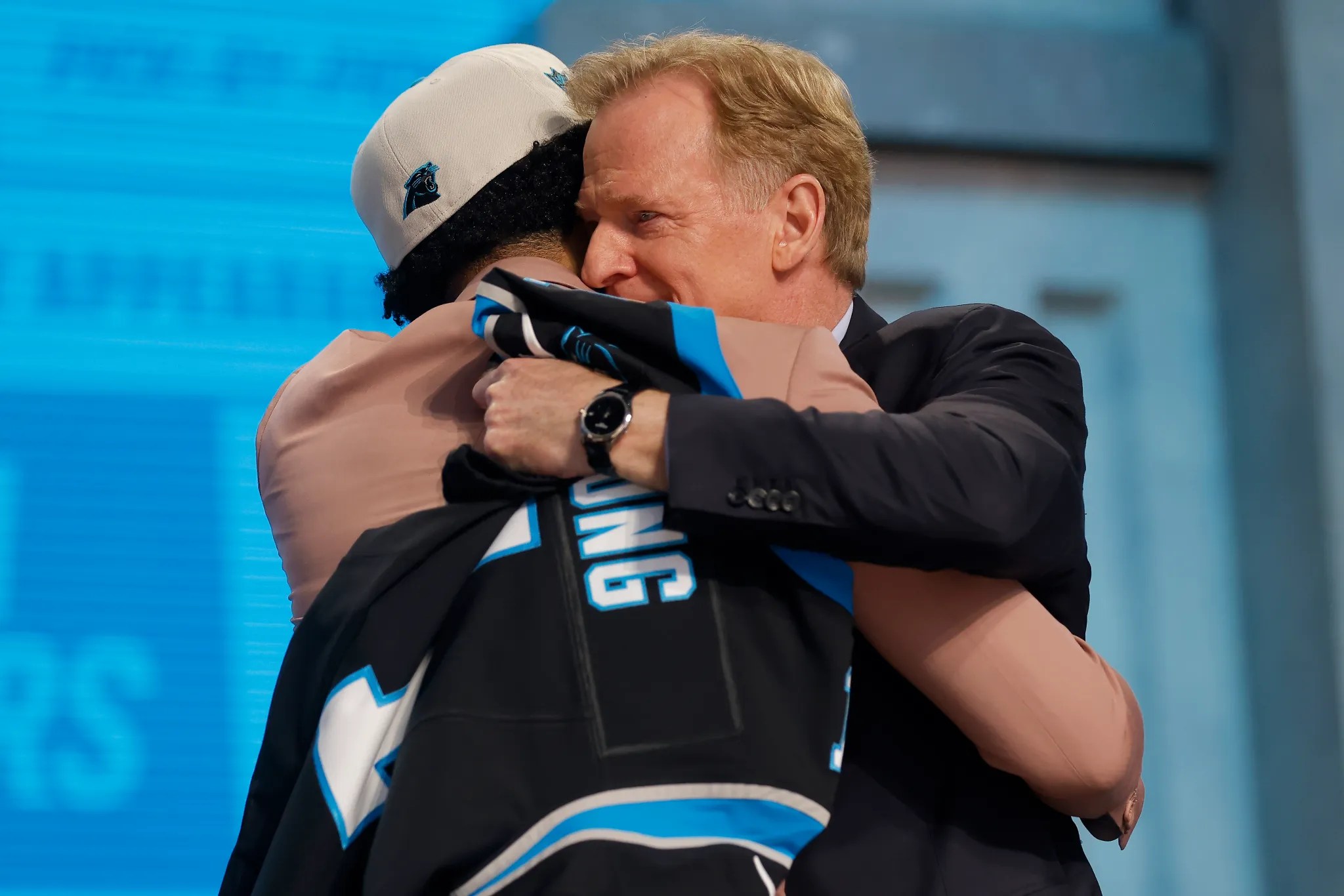
For an emblem of player-commissioner relations in the NFL today, the New York Times reporter Ken Belson writes, look to the “Roger Goodell Bro Hug.” [see the picture above] Every spring, the newest first-round picks bound across the NFL draft stage and wrap their arms around the commissioner. Sometimes they lift him off his feet. A hug Goodell shared with Baltimore Ravens draftee Malaki Starks this past April lasted 21 seconds. Speaking to Belson, an agent laments the annual show of affection for management, though he can’t help but admire the bleak triumph it signals: “You have to give kudos to the NFL for making it that way.”
Belson’s new book, Every Day Is Sunday: How Jerry Jones, Robert Kraft, and Roger Goodell Turned the NFL into a Cultural & Economic Juggernaut, is a sobering account of how the NFL made the world this way, its way, totally in its image…
“Whose league is it anyway?” from @maitreyiaa.bsky.social in the always-illuminating @defector.com.
Apposite: “Big Blue Machine“- on big money in sports and what it can buy (“When the Dodgers spend nearly $500 million on salaries, including deferred payments and tax penalties, one sees the American way of life come into focus anew: a few at the top thriving in the abundance of Ezra Klein’s wet dreams, the rest of us surviving on scraps…”)
And on a different Sunday institution: “The Legacy of Nicaea” from @hedgehogreview.bsky.social.
* William L. Marcy (a U. S. Senator in 1832, justifying President Jackson’s “spoils system”)
###
As we ponder plutocrats, we might spare a thought for George “The Gipper” Gipp; he died on this date in 1920. Notre Dame’s first All-American football player, he succumbed at age 25 to a streptococcal throat infection and pneumonia three weeks after a victory over Northwestern in his senior season and was the subject of Rockne’s “Win just one for the Gipper” speech. In the 1940 film Knute Rockne, All American, he was portrayed by Ronald Reagan.

“Oops, I did it again”*…
(Roughly) Daily has contemplated game theory a number of times (e.g., here). The Generalist Academy offers a particularly poignant example…
Football [or, as it’s called in the U.S., soccer] has a lot of strange rules – like Ted Lasso, I still don’t understand exactly how the offside rule works. But the basic game is pretty simple: get the ball into your opponent’s goal, and prevent them from getting the ball into your goal. Scoring a goal against your own side is a rare and accidental embarrassment. Usually.
The qualification round for the 1994 Caribbean Cup had some unusual rules. No match could end in a draw; if the teams were tied at the end of regular time, they would go into sudden death extra time. But! Any goal scored in extra time would count as two goals. This was presumably done because this tournament, like many, used goal difference to break ties in the qualifying groups. (Goal difference = total number of goals they’ve scored minus the number of goals they’ve conceded.) So that extra time “golden goal” would give a team an edge in the overall competition. Little did the organisers know that it would also lead to one of the strangest football games ever seen…
A truly remarkable match: “Own-Goal Football,” from @GeneralistAcad.
* Britney Spears (Songwriters: Martin Max / Rami Yacoub)
###
As we work backwards, we might send carefully-calculated birthday greetings to Félix Édouard Justin Émile Borel; he was born on this date in 1871. A mathematician (and politician, who served as French Minister of the Navy), he is remembered for his foundational work in measure theory and probability. He published a number of research papers on game theory and was the first to define games of strategy.
But Borel may be best remembered for a thought experiment he introduced in one of his books, proposing that a monkey hitting keys at random on a typewriter keyboard will – with absolute certainty – eventually type every book in France’s Bibliothèque Nationale de France. This is now popularly known as the infinite monkey theorem.

“Wade tried to imagine Florida before the advent of man, but couldn’t. The landscape seemed too thoroughly colonized”*…

The state of Florida, in the United States, is bordered to the south, east, and west by the Atlantic Ocean, with a coastline of over two thousand kilometers in length, and is characterized by extensive areas of lakes, rivers, and ponds. Land booms during the early and mid-20th century resulted in the development of new communities and the expansion of low-density suburbia across many parts of the state, which frequently incorporated the abundant water resources, sometimes failing in their efforts.
Land-use trends throughout the state’s history have been directly influenced by the natural resources, geomorphology, and climate that exist within the state. Since 1900, Florida has seen substantial changes in land-use patterns and land cover due to significant increases in population and tourism, coincident with new development, facilitated by new railroads and highways, and inspired by an aggressive marketing campaign for new residents and visitors to come to the state…
By observing aerial images of these locations, it is possible to notice the different ways in which the urban layouts, lakes, and canals were developed and incorporated into the territorial planning of each city. Variables such as land use, the possibility of carrying out aquatic activities (such as fishing, swimming, and navigation), and the integration with other nearby navigable canals have shaped these water bodies alongside the land distribution, resulting in sinuous and winding patterns.
However, water resource management has not always been successful. Before the development of the area where the city of Cape Coral is located, in the southwest of the state, water was widely distributed on the surface and in shallow aquifers. According to Hubert Stroud, professor of geography at Arkansas State University, these resources degraded as soon as the Cape Coral developers began subdivision operations. According to Stroud, the layout, design, and construction techniques were particularly devastating for the water resources. Instead of using phased development, the area was dredged, filled, and segmented long before it was occupied. The resulting gridiron pattern of roads is interrupted by occasional sinuous canals…
Florida is a state marked by a large number of water resources, whether on the coast or inland, on the surface or underground, and many cities and communities have considered them to be key elements in urban planning, exploring their most diverse potentials. The alliance between planned cities and water resources in Florida not only reveals the curious patterns of roads and canals, seen in aerial photographs, but also the complex relationship between water and land in the context of the city, showing that water is more than just a resource for landscaping or aesthetics, it is a fundamental element in urban infrastructure…

A history of Florida’s love affair with the water (with lots of mesmerizing aerial photos): “Urban Planning and Water Bodies: Florida’s Aquatic Land Cover.”
* Douglas Coupland, All Families are Psychotic
###
As we try to bend nature to our will, we might recall that it was on this date in 2005 that the “I’m Going to Disney World” commercial featuring a player (usually the MVP) on the winning team, did not air at the end of the Superbowl telecast.
The commercial has aired after every Super Bowl since 1987, except for one. In 2005, the commercial did not air, though the reason for the absence is still unclear. The NFL was still reeling from Janet Jackson’s wardrobe malfunction in 2004, and may have been leery of any advertising relying on spontaneity. Disney may have also felt that the campaign was losing its effectiveness after 19 years.
source
In any case, it returned the following year and (largely) runs still… it did not run in 2016, at Superbowl LX, but Peyton Manning went to Disneyland to celebrate anyway.
“A helluva, helluva, helluva, helluva, hell of an engineer”*…

College fight songs are Saturday staples, memorized in freshman orientation and blasted by marching bands at every game. The best ones are shouted from the rooftops and during Heisman Trophy presentations; the worst barely register with alumni.
We gathered the fight songs of 65 schools — all those in the Power Five conferences (the ACC, Big Ten, Big 12, Pac-12 and SEC), plus Notre Dame — to see exactly how these teams are musically willed to victory. We counted which clichéd elements (like shouting “Rah!” or spelling something out) appear in each song’s lyrics and determined how fast the song is played and how long it lasts (for the version available on Spotify)…
Saturday’s anthems get the FiveThirtyEight treatment: “Our Guide To The Exuberant Nonsense Of College Fight Songs.”
* “(I’m a) Ramblin’ Wreck from Georgia Tech”
###
As we pick up the tempo, we might recall that it was on this date in 1897 that The (New York) Sun ran an editorial entitled “Is There a Santa Claus?” Written by Francis Pharcellus Church in response to a letter from 8 year-old Virginia O’Hanlon, it is now remembered best by one of its lines: “Yes, Virginia, there is a Santa Claus.”

“If you start throwing hedgehogs under me, I shall throw a couple of porcupines under you”*…

In the fourth volume of Brett’s Miscellany, published in Dublin in 1757, readers could find an entry on a custom called “throwing at cocks.” This was an activity where a rooster was tied to a post while the participants, as if playing darts, threw small weighted and sharpened sticks (called coksteles) at the poor bird until it expired. The article explored the sport’s origin: “When the Danes were masters of England, and used the inhabitants very cruelly,” it began, “the people of a certain great city formed a conspiracy to murder their masters in one night.” The English artfully devised “a stratagem,” but “when they were putting it in execution, the unusual crowing and fluttering of the cocks about the place discovered their design.” The Danes, tipped off by the commotion, “doubled their cruelty” and made the Englishmen suffer as never before. “Upon this,” the entry concluded, “the English made custom of knocking the cocks on the head, on Shrove-Tuesday, the day on which it happened.” Very soon “this barbarous act became at last a natural and common diversion, and has continued every since.” Thus the innate human urge to throw things at things entered the early modern era…
On the human desire to hurl (and hurl things at) animals and other humans: “From Throwing Sticks at Roosters to Dwarf Tossing.”
* Nikita Khrushchev
###
As we resist the temptation to toss, we might recall that it was on this date in 1939, in a football match between the Texas Tech Red Raiders and Centenary Gentlemen at Centenary College Stadium in Shreveport, Louisiana, that “one of the weirdest games in NCAA History” was played. A torrential downpour and resultant muddy field conditions prevented either Texas Tech or Centenary from advancing the ball either running or passing. To cope with the conditions, both teams resorted to immediate punting, hoping to recover a fumble at the other end of the field. They combined to punt 77 times; the game ended in a 0-0 tie.
Thirteen records still stand in the NCAA record books:
— Most punts combined both teams: 77 (42 were returned, 19 went out of bounds, 10 were downed, four were blocked, one went for a touchback and another was fair caught; 67 came on first down)
— Most punts by a team: 39, Texas Tech
— Fewest offensive plays: 12, Texas Tech (10 rushes, two passes for a total of minus-1 yard)
— Fewest plays allowed: 12, Centenary
— Fewest yards gained most plays: 30
— Fewest rushing attempts, both teams: 28
— Most punt returns: 22, Texas Tech (for 112 yards)
— Most punt returns, both teams: 42
— Most individual punts: 36, Charlie Calhoun, Texas Tech, for 1,318 yards (36.6 average)
— Punt yardage: 1,318 yards, Calhoun
— Punt returns (and total kick returns): 20, Milton Hill, Texas Tech, 110 yards

The 1939 Texas Tech football team
You must be logged in to post a comment.