Posts Tagged ‘NFL’
“It’s very hard to buy a sports team and lose money.”*…

Just 14 months after agreeing to buy the controlling interest in the L.A. Lakers at a valuation of $10 billion, Mark Walter found himself in a spot of trouble and needed to sell. Joshua Kushner (who recently tried to buy a big stake in the World Cup) and Bob Iger stepped right up, and agreed to buy his share at a valuation of @$12.5 billion. Kushner is a bona fide billionaire; Iger is an almost-billionaire; together, their net worth is something like $6 billion. Under the NBA’s rules, Mr, Kushner’s investment vehicle, Thrive Eternal, cannot invest more than 20 percent in the Lakers; so, unless they get a waiver, it’s likely that Kushner and Iger will finance the balance of their purchase personally (and/or with funds from rich friends).
As Eben Novy-Williams observes, this transaction is just the latest in a long line of folks with relatively fresh fortunes buying into the big leagues…
Sports team sales tend to reflect what’s happening in the broader economy. During the dot-com boom, many of those newly-minted millionaires found their way to sports (Ted Leonsis, Mark Cuban, Paul Allen, Henry Samueli and John Moores). That gave way to the real estate boom, and those buyers followed (Stephen Ross, Stan Kroenke, Jimmy Haslam, the Lerners, the Wilfs). More recently, it’s been the finance, private equity and hedge fund titans (Josh Harris, Wes Edens, Marc Lasry, Tony Ressler, David Tepper, Tom Gores, the list goes on and on)… – source
And as the title quote (from Carlyle [and here] co-founder and Baltimore Orioles co-owner David Rubenstein) suggests, this make a very straightforward kind of mercenary sense– major professional sports franchises have historically outperformed traditional indexes like the S&P 500 over the long term. And it stands to reason: scarcity value, legal local monopolies, and lucrative media rights make for a heady brew.
In a recent Substack post, Derek Thompson takes stock of the situation. After his own review of the Lakers deal, he puts it into context…
… In an age of surging wealth inequality, where stock market valuations routinely outpace median income growth by surreal factors, there is a live debate over whether billionaires should exist at all. The strongest argument for their rightfulness is that some people amass ten-figure wealth by building companies; by working within free markets to invent new technologies that millions or billions of people choose to use; and by managing complex enterprises that create billions or trillions of dollars in consumer welfare and investor value. But even this steelman case for billionaires presents as a kind of taunting insult to what often passes for sports ownership today. Professional-sports ownership offers the already-impossibly-rich a unique opportunity to become vastly richer, not necessarily by working, building, inventing, or doing anything positive at all, but rather by merely sitting on top of an asset that American law has conspired to make absurdly scarce and luridly profitable.
A thought experiment. Imagine if a diabolical oligarchic elite wanted to build an efficient and low-risk machine for turning their already-elevated wealth into exospherically extreme wealth. What might such a devious group of self-serving plutocrats want?
- Unleash the forces of capitalism! you might think. But no, absolutely not. Capitalism is markets, and markets are ruthless. What you should want is legal permission to create a monopoly that builds a moat deep enough to keep all competition out. That way, you’ve got something much better than capitalism: artificial scarcity and pricing power without the risk of unwanted rivals.
- Get the government off your back! you might say. Wrong again. You know what’s nicer than getting the government off your back? Getting the government on your side. You should crave dependable government subsidies to pad your profits.
So say, for example, that you wanted to set up this money machine in American professional sports. Your devious plan: shield leagues from antitrust law so owners can enjoy monopoly profits; use that market power to extract money from local governments; and rewrite the tax code to hand sports owners special advantages.
Lo and behold, all of this exists…
[Thompson unpacks the particulars: sports leagues are basically legal oligopolies; labor law makes sports ownership even sweeter; sports stadiums have become legal ransom; and team-owner tax benefits put the cherry on top. He concludes…]
… People sometimes compare buying sports franchises to buying works of fine art—say, a Monet, a Calder, or a Rodin. In both cases, the simplest answer to the common question “Why is that thing worth so much?” is always “Because someone rich was willing to pay it.”
But there is an important difference between the factors that push up the value of Monet paintings and those of sports franchises. Think about why a Monet painting is so valuable. Setting aside the irresolvable debate about the ineffable nature of beauty and quality and artistic pleasure, the underlying fact is that a Monet painting is valuable because it was painted by Claude Monet, a famous individual who once lived, and is now dead. The finality and scarcity of the Impressionist oeuvre—the fact that one can buy a painting from Monet’s Rouen Cathedral series and not worry that he will paint 100 more tomorrow—is a function of his mortality. There is no scientific or technological means by which anyone can exhume and reanimate Monet’s skeleton, sit the zombie upright in a chair, hand him a paintbrush, an easel, and a cup of tea, and say, “Now that you’re all settled, I’d like 500 additions to the Rouen Cathedral series.”
But the scarcity of sports franchises emerges from the laws of mankind, not the laws of nature. It benefits from a set of rules, laws, and customs that we made up and that can be redrawn in a way that Rouen’s facade never will be.
I am not a fan of conspiracies, and I am not a socialist. But nothing makes me feel more socialist than the public, out-in-the-open conspiracy to buttress the value of sports assets, whose lush beneficiaries tend to be impossibly rich already. Solutions here are hard. Many fans like the weird, market-warping rules of professional sports, which often promote parity and competition and keep favorite players on long contracts; plus, I don’t think doubling the number of NBA or NFL teams is particularly desirable among most fans. But ameliorations are possible. Tax law could further restrict the ability to team owners to amortize. And honestly, I don’t know why some local governments shouldn’t own stakes in the professional sports teams that they often directly finance. I’m not sure exactly how this would work, and I’m sure that there would be some negative side effects of literally socializing the already-kinda-socialist dynamic of professional sports. But the status quo is vile enough to justify some experiments. What we have today is a handful of lucky, franchise-owning billionaires who get to sit at a poker table where every card they turn over has a face or an ace. I wouldn’t call it cheating. I wouldn’t call the legal structure of American sports cheating or corrupt. I would call it … the law. But the law is bad.
An out-in-the-open conspiracy to help a lucky few billionaires get much, much richer: “The American Sports Plutocracy Is Bullshit,” from @dkthomp.bsky.social.
For a peek at an Lakers ownership sideshow, see Giri Nathan‘s “The Buss Children Are Squabbling Over Their Remaining Lakers Stake.”
And for a different kind of context, see the source of the pull quote in the intro, “The Lakers Are a Massive Bet on AI Disruption,” in which Novy-Williams suggests that Kushner is “buying the Lakers because sports are relatively insulated from the economic havoc looming from the rest of his portfolio. That’s not a hedge against AI, it’s a doubling down.”
###
As we play ball, we might recall that it was on this date in 1920 that the owners of the Canton Bulldogs, Akron Pros, Cleveland Indians, and Dayton Triangles met in Canton, Ohio, and formed the American Professional Football Association– which proceeded to add teams and, in 1922, renamed itself the National Football League– the NFL.
At the outset, the APFA/NFL was very different from the behemoth it would become:
This new organization did not resemble a league as we would know it today, but was more like a professional association whose sole functions were membership and articulation of some general principles. Perhaps the best modern-day analogy would be a weak form of the NCAA. As can be imagined, the league office had no influence on anybody. It set no schedules, leaving each team to arrange its own slate. – Pro Football: The Early Years: An Encyclopedic History, 1895–1959
Still, there were hints even then of what was to come. The owners who created the “league” agreed to introduce a salary cap for the teams, to refrain from signing players under contract with another team, and to hold a league championship competition.

“To the victor go the spoils”*…
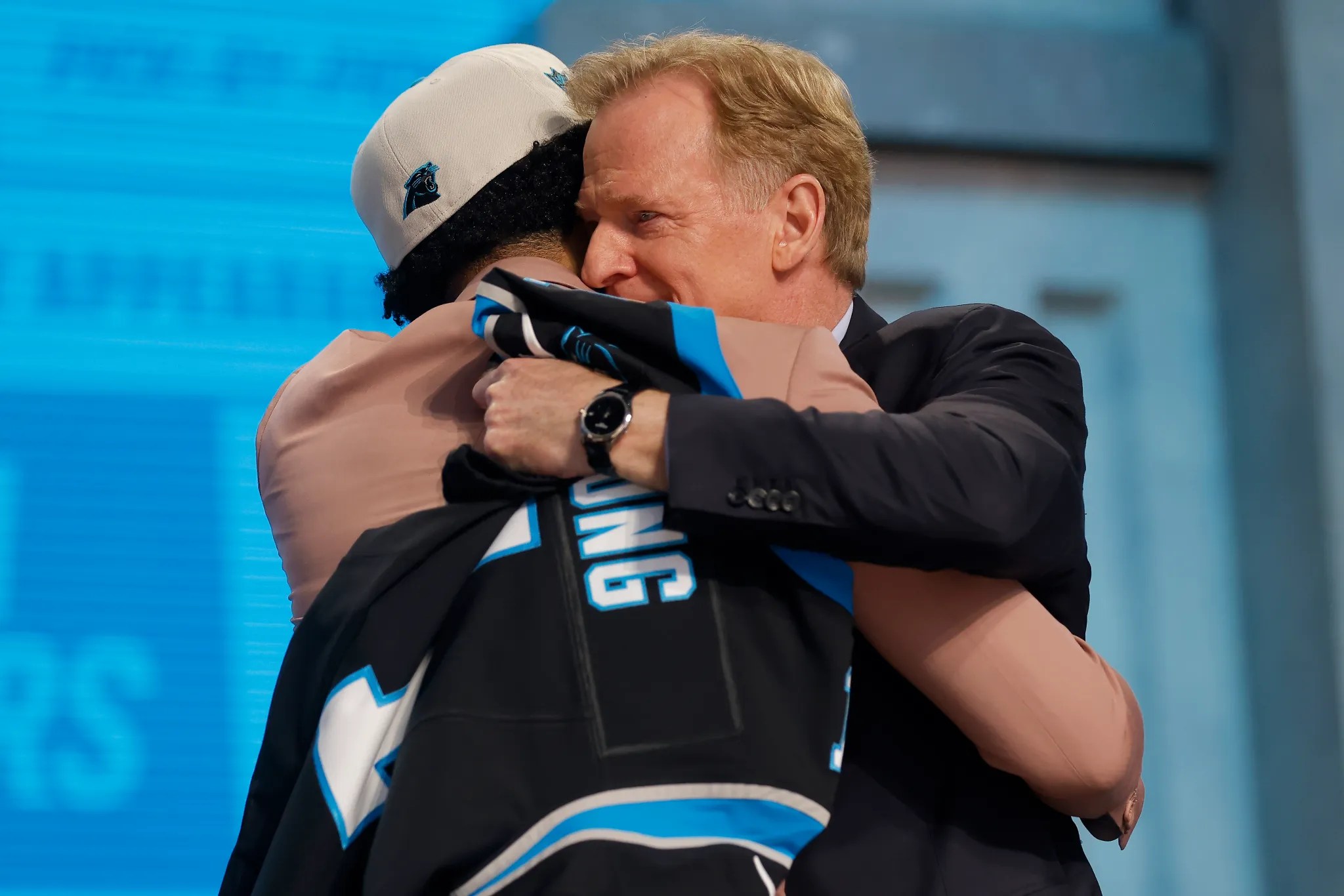
… Yes… but Maitreyi Anantharaman asks, which victors. A Sunday football installment…
In late July, before a game against the Boston Red Sox, Bryce Harper sat slumped in a chair in the Philadelphia Phillies clubhouse, a baseball bat in hand. Philadelphia was the latest stop on Rob Manfred’s leaguewide speaking tour; ahead of a CBA negotiation that virtually everyone in baseball expects to involve a 2027 work stoppage, the MLB commissioner spent the summer visiting all 30 teams, trying to get players on board with his plans to restructure the league’s economics. When the subject of a salary cap came up late in the meeting, Harper rose from his seat. He walked closer to Manfred until their noses almost touched, and told the commissioner that if Manfred wanted to talk salary cap, he could “get the fuck out of our clubhouse.”
A couple months later, at the Minnesota Lynx’s end-of-season press conference, Napheesa Collier had some words for her league’s commissioner, too. The WNBA is in the thick of labor talks these days: The league and players’ union recently agreed to extend their collective bargaining negotiating period through January. Collier’s sport is undergoing its own economic transformation. Amid a women’s basketball boom, WNBA team prices have skyrocketed, and the league’s new media rights deal is valued at a figure six times the old one. Today’s labor fight pits players who feel they’ve driven this growth against the owners who feel they’re owed for years of losses. In Collier’s telling, commissioner Cathy Engelbert is a poor steward for the moment, a leader who takes the WNBA’s talent for granted. “The league believes it succeeds despite its players, not because of them,” Collier said, adding later that “the best players in the world” had “the worst leadership in the world.” The measure she took was public and not so lurid a confrontation as Harper’s—no baseball bats involved. But the basic idea was the same: to establish whose clubhouse it really is.
For an emblem of player-commissioner relations in the NFL today, the New York Times reporter Ken Belson writes, look to the “Roger Goodell Bro Hug.” [see the picture above] Every spring, the newest first-round picks bound across the NFL draft stage and wrap their arms around the commissioner. Sometimes they lift him off his feet. A hug Goodell shared with Baltimore Ravens draftee Malaki Starks this past April lasted 21 seconds. Speaking to Belson, an agent laments the annual show of affection for management, though he can’t help but admire the bleak triumph it signals: “You have to give kudos to the NFL for making it that way.”
Belson’s new book, Every Day Is Sunday: How Jerry Jones, Robert Kraft, and Roger Goodell Turned the NFL into a Cultural & Economic Juggernaut, is a sobering account of how the NFL made the world this way, its way, totally in its image…
“Whose league is it anyway?” from @maitreyiaa.bsky.social in the always-illuminating @defector.com.
Apposite: “Big Blue Machine“- on big money in sports and what it can buy (“When the Dodgers spend nearly $500 million on salaries, including deferred payments and tax penalties, one sees the American way of life come into focus anew: a few at the top thriving in the abundance of Ezra Klein’s wet dreams, the rest of us surviving on scraps…”)
And on a different Sunday institution: “The Legacy of Nicaea” from @hedgehogreview.bsky.social.
* William L. Marcy (a U. S. Senator in 1832, justifying President Jackson’s “spoils system”)
###
As we ponder plutocrats, we might spare a thought for George “The Gipper” Gipp; he died on this date in 1920. Notre Dame’s first All-American football player, he succumbed at age 25 to a streptococcal throat infection and pneumonia three weeks after a victory over Northwestern in his senior season and was the subject of Rockne’s “Win just one for the Gipper” speech. In the 1940 film Knute Rockne, All American, he was portrayed by Ronald Reagan.

It may be a “guy thing,” still…
Your correspondent is no particular fan of the Dallas Cowboys. Still, he is grateful to Jerry Jones and the boys for sharing this remarkable “inside” video of the old stadium coming down:
 Click on the image, or here
External views of the demolition, here.
As we duck to avoid the score board in the Cowboys’ new stadium, we might recall that it was on this date in 1965 that the “Say Hey Kid,” Willie Mays, set the National League Home Run Record. May’s 512th career home run broke (with sweet irony, famous Dodger) Mel Ott’s League record. Mays finished his career with 660 home runs– third on the all-time list at the time of his retirement.

You must be logged in to post a comment.