Archive for April 2013
“Intelligence is really a kind of taste: taste in ideas.”*…

Two researchers have proposed a new way of thinking about intelligence: one in which intelligence is related to entropy– one in which intelligence is a fundamentally thermodynamic process…
Alexander Wissner-Gross, a physicist at Harvard University and the Massachusetts Institute of Technology, and Cameron Freer, a mathematician at the University of Hawaii at Manoa, developed an equation that they say describes many intelligent or cognitive behaviors, such as upright walking and tool use.
The researchers suggest that intelligent behavior stems from the impulse to seize control of future events in the environment. This is the exact opposite of the classic science-fiction scenario in which computers or robots become intelligent, then set their sights on taking over the world…
Read the full story at the always-illuminating 3 Quarks Daily; read the paper in the journal Physical Review Letters.
* Susan Sontag
###
As we reckon that maybe “hot air” isn’t so bad after all, we might send intelligent birthday greetings to Claude Elwood Shannon; he was born on this date in 1916. A mathematician, electronic engineer, and cryptographer, Shannon is best remembered as the “father of information theory” (for his 1948 paper that launched the field); but he is also credited with founding both digital computer and digital circuit design theory in 1937, when, as a 21-year-old master’s degree student at MIT, he wrote his thesis demonstrating that electrical applications of boolean algebra could construct and resolve any logical, numerical relationship– widely considered to be the most important master’s thesis of all time.

Imitation is the sincerest form of…

Canadian/French/Moroccan photographer and performer 2Fik considers himself a stateless person; his work is a self-described “soap opera” of mashed-up cultures, in which he plays all the roles, darting and weaving through questions of identity.
His newest exhibition, “2Fik’s Museum” (through May 18 at The Invisible Dog in Brooklyn), is a collection of photos that feature the artist in re-creations of some of European art history’s best-known works.

[TotH to CH, from whence the photos above]
###
As we imagine that we were there, we might send melodious birthday greetings to Edward Kennedy “Duke” Ellington; he was born on this date in 1899. A composer, pianist, and bandleader, Ellington composed over 1,000 works. And while he created and performed in genres that ranged from blues and gospel to film scores and classical, he is best remembered a titan of jazz (though Ellington himself much preferred the label “American music”). Ellington was recommended by the judges panel for the Pulitzer Prize in Music in 1965, but was denied it by the Board. In 1999, after his death, the Pulitzer Board awarded him a special posthumous prize.
In the century since his birth, there has been no greater composer, American or otherwise, than Edward Kennedy Ellington.
– Bob Blumenthal, Boston Globe, April 25, 1999

A rose by any other name…

In the Fall of 1955, the Ford Motor Company had dedicated two plants to produce the new “E-car” that was to anchor its future… but hadn’t yet settle on the new auto’s name. Stumped, Ford called on one of America’s foremost poets, Marianne Moore to come up with “inspirational names.” Ms. Moore obliged, submitting a list that included: “Resilient Bullet,” “Ford Silver Sword,” “Mongoose Civique,” “Varsity Stroke,” “Pastelogram,” “Andante con Moto,” and “Utopian Turtletop.”
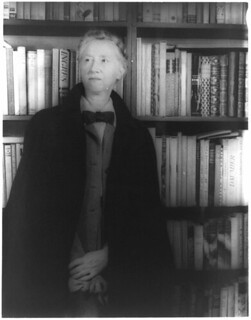
Ford settled on “Edsel.”
[TotH to Edsel Pages; faux ad via; Carl Van Vechten’s portrait of Moore via]
###
As we ruminate on nomination, we might send speedy birthday greetings to Ferruccio Lamborghini; he was born on this date in 1916. After World War II, Lamborghini built a smal engineering and manufacturing empire, starting with tractors made from reconfigured surplus military vehicles, then air-conditioning and heating systems. As his wealth grew, he began to buy luxury sports cars, ultimately a Ferrari, the pinnacle of the day. But Lamborghini found his Ferrari (especially its clutch) wanting, so decided to start a rival sports car company, Automobili Lamborghini, in 1963. That same year he debuted its first car, the Lamborghini 350 GTV, a two-seater coupe with a V12 engine– and a killer clutch.

“The Creator, if He exists, has an inordinate fondness for beetles”…

J. B. S. Haldane was moved to utter the quote that gives this post its title by his observation that there are more types of beetles than any other form of insect, and more insects than any other kind of animal. Cataloguing beetles, then, is a formidable challenge… But not too daunting for Dr. Udo Schmidt of Selbitz, in Germany. Dr. Schmidt has photographed and catalogued thousands of them– which readers can find here.
(Dr. Schmidt, something of a taxonomical overachiever, has also photographed and collected thousands of mollusks.)
###
As we wonder where we left that roach, we might recall that it was on this date in 1871 that the American Museum of Natural History opened to the public in New York City. Organized into a series of exhibits, the Museum’s collection–which had been gathered from the time of the Museum’s founding in 1869– went on view for the first time in the Central Park Arsenal, the Museum’s original home, on the eastern side of Central Park. The cornerstone of the Museum’s first building was laid in Manhattan Square (79th Street and Central Park West), the Museum’s current location, in 1874; but it is obscured from view by the many Museum buildings in the complex that today occupy most of the Square.

From A to B…

Dutch designer Ruben van der Vleuten wondered what happened to the packages he sent between the time he shipped them and their arrival.
What happens when you send something by mail? What happens in between you sending it off and someone else receiving it? What people and processes are involved and how many steps does it take?
Those all were questions I was dealing with and wanted to find out. So instead of sitting back I started a simple project to actually see it myself. I put a small camera in a box, build a timer circuit using Arduino and shipped it.
That’s as simple as it is. The timer circuit was set to make a 3 sec video every minute and make longer videos while the box was moving: to not miss on the ‘interesting’ parts.
See the resulting video, “From A to B”.
[TotH to Flowing Data]
###
As we add some extra bubble wrap, we might send stoic birthday greetings to Marcus Aurelius Antoninus Augustus; he was born on this date in 121 CE. The last the “five good emperors” of Rome, Marcus Aurelius is considered one of the most important Stoic philosophers. His Meditations, written in Greek while on campaign during the Marcomannic Wars between 170 and 180, and describing how to follow nature to find and preserve equanimity in the midst of turmoil, is considered by many to be the urtext of the philosophy of service and duty.
Look beneath the surface; let not the several quality of a thing nor its worth escape thee.
– Meditations, Book VI, 3

You must be logged in to post a comment.