Posts Tagged ‘theater’
“What nourishes me, destroys me”*…

On the occasion of the publication of Stephen Greenblatt‘s new book, Dark Renaissance, Nina Pasquini profiles its subject, the remarkable Christopher Marlowe…
He was a radical, the inventor of blank verse, a master of internal monologue, and a victim of murder. This was the English playwright Christopher Marlowe, a contemporary and rival of William Shakespeare—and perhaps the Bard’s key creative influence.
At 14, young Marlowe—the son of a poor Canterbury cobbler—won a scholarship to the prestigious King’s School, becoming the first in his family to receive a formal education. He excelled, went on to the University of Cambridge, and there studied the great works of antiquity, from Virgil’s Aeneid to Ovid’s Metamorphoses. Where his classmates saw musty mandatory reading, Marlowe found something else: worlds of ecstatic violence and erotic excess, of vengeful outcasts and capricious gods, worlds that upended the Christian moral order in which he was raised.
After graduation, Marlowe faced an uncertain future—unlike his wealthy classmates, his education didn’t secure for him a place in society. So, he decided to take a risk, moving to London to try his hand at an unstable, disreputable profession: writing for the stage.
When Marlowe was born in 1564, says Stephen Greenblatt, the Cogan University Professor of the Humanities, England was still stuck in the Middle Ages, even as the Renaissance bloomed on the continent. Public entertainment revolved around bearbaiting and hangings; poetry was weighed down by moralizing and clumsy rhymes; brutal censorship stifled any art that challenged the crown’s authority.
By the time Marlowe died in 1593, at just 29 years old, England was in the midst of a cultural and intellectual flourishing. Greenblatt credits Marlowe with sparking this transformation. In a new book, Dark Renaissance: The Dangerous Times and Fatal Genius of Christopher Marlowe, Greenblatt—one of the world’s foremost Shakespeare scholars—argues that Marlowe didn’t merely precede Shakespeare, he made Shakespeare’s career possible.
“It was Marlowe who cracked something open,” Greenblatt says, “and enabled Shakespeare to walk through—how should we say?—over his dead body.”
Marlowe’s story, Greenblatt adds, is also relevant to many of academia’s current preoccupations. He was a “first-gen” student who glimpsed radical possibilities in the supposedly conservative texts of “great books courses.” He faced a “vocational crisis” familiar to many humanities students today—and pursued his passion despite the risk.
That career began with Marlowe’s debut play, Tamburlaine the Great, written in 1587 or 1588. “Virtually everything in the Elizabethan theater,” Greenblatt writes, “is pre- and post-Tamburlaine.”
Part of the play’s shock value lay in its plot. Loosely based on the rise of the fourteenth century Central Asian conqueror Timur (also known as Tamerlane), Tamburlaine the Great tells the story of a Scythian shepherd who ascends from obscurity to become a dominating tyrant. The violence is unrelenting, and the ambition unchecked: Tamburlaine faces no moral comeuppance for his pride. This rags-to-riches arc may have mirrored Marlowe’s own desires, Greenblatt writes—and defined many of the other outsider characters Marlowe would go on to write.
But the play’s most revolutionary element was formal: the use of “this hallucinatory blank verse, which Marlowe basically invented,” Greenblatt says. Marlowe’s characters spoke in unrhymed iambic pentameter—“elegant, musical, and forward-thrusting,” Greenblatt writes—which gave English drama a new expressive register.
Before Tamburlaine, English playwrights were trapped in stiff structures such as Poulter’s measures—couplets in which 12-syllable iambic lines rhyme with 14-syllable iambic lines. Blank verse enabled Marlowe’s characters to sound like they were “actually speaking English,” Greenblatt says, dramatized by some structure, but still alive. Shakespeare would come to rely heavily on blank verse in his own work.
A few years later came Doctor Faustus, first performed in 1594. It was Marlowe’s most famous play and the first dramatization of the Faust legend, in which a scholar makes a deal with the devil, trading his soul for magical powers. This work, Greenblatt argues, marked the first time “a powerful, complex inner life” was represented on the stage.
Before Marlowe, English theater externalized psychology through allegory: morality plays populated by characters such as Pride and Shame. In Doctor Faustus, by contrast, Marlowe relies on soliloquy and dialogue about the characters’ internal states. “It was from Doctor Faustus that the author of Hamlet and Macbeth learned how it could be done,” Greenblatt writes.
Marlowe’s life ended as dramatically as one of his plays: he was stabbed to death in a tavern in Deptford. Officials claimed the death resulted from a quarrel over a dinner bill—but Greenblatt points to a more complicated story. While still a student at university, Greenblatt writes, Marlowe was likely recruited as a spy for Queen Elizabeth’s secret service, possibly to monitor Catholic dissidents or plots against the crown.
But over the years, Marlowe drew scrutiny for his radical ideas and was accused at times of atheism—a grave offense in Elizabethan England. Greenblatt believes that Marlowe was killed for his beliefs, possibly on orders carried out by an “overly zealous servant” of Queen Elizabeth herself.
To Greenblatt, Marlowe’s life serves as a reminder of how repressive Elizabethan England was: “It was basically wise to keep your head down, unless you wanted your head to be chopped off.” Marlowe didn’t and paid the price. Shakespeare was watching, Greenblatt argues, and learned he had to be more careful. But Shakespeare’s blend of conservatism and radicalism was only possible because Marlowe had first ventured too far. Shakespeare relied, Greenblatt writes, on Marlowe’s legacy of “reckless courage and genius.”
And Greenblatt believes Shakespeare was aware of his debt. Greenblatt’s Dark Renaissance ends with a line from Shakespeare’s As You Like It, a reference to Marlowe’s mysterious death in that small tavern room in Deptford: “When a man’s verses cannot be understood…it strikes a man more dead than a great reckoning in a little room.”…
Without Christopher Marlowe, there might not have been a Bard: “Shakespeare’s Greatest Rival,” from @harvardmagazine.bsky.social.
See also: “Why One of Shakespeare’s Rivals Is Still Making Trouble.”
* translation of the phrase– “Quod me alit, me extinguit”– found on the portrait of Marlowe above (at Corpus Christi College, Cambridge)
###
As we ponder profundity, we might spare a thought for a more modern playwright, August Wilson; he died on this date in 2005. Often referred to as “theater’s poet of Black America,” Wilson is best known for a series of 10 plays, collectively called The Pittsburgh Cycle (or The Century Cycle), which chronicle the experiences and heritage of the African-American community in the 20th century. (Plays in the series include Fences and The Piano Lesson, each of which won the Pulitzer Prize for Drama, as well as Ma Rainey’s Black Bottom and Joe Turner’s Come and Gone.) In 2006, Wilson was inducted into the American Theater Hall of Fame.

“If vaudeville had died, television was the box they put it in”*…

Perhaps… but as Laurie Winer explains in an excerpt from her Oscar Hammerstein II and the Invention of the Musical, at a time when immigrants were pouring into the United States from Eastern and Southern Europe, the vaudeville circuit became a venue for the expression of those arriving cultures– and ultimately gave us so much more…
The term ‘melting pot’ comes from the theater — it was popularized by a 1908 drama with that title about a Russian composer who loses his family in the 1903 Bessarabia pogroms, emigrates to America, and falls in love with the daughter of the officer responsible for his family’s murder. Such was the compression of migrants in the first decades of the new century. In fact, about fifteen million eastern and southern Europeans arrived in the United States between 1900 and 1915. In 1907 Ellis Island received its highest number of immigrants in a single year, processing more than one million arrivals. In the public sphere, all these cultures introduced themselves on the stages and in the audiences of vaudeville, the American equivalent of the British music hall.
Willie Hammerstein managed the country’s premiere vaudeville house from 1904 until 1913, so his son Oscar II grew up at the epicenter of a cultural mashup unlike anything that had come before. In an oral history he recorded for Columbia University, Oscar remembered going to his father’s theater, the Victoria, every Sunday, where the performers taught him everything he needed to know about comedy and pacing.
Ticket prices were low and audiences comprised many nationalities. Since a good number of performers and spectators alike had escaped famine or pogroms or the social rigidity of the Old World, their evenings together at the theater were fueled by a giddy sense of possibility, both for themselves and for their new country. For instance, ‘It Isn’t What You Used to Be, It’s What You Are Today’ was a staple song for comedian Al Shean, born Abraham Adolph Schönberg in Germany in 1868.
From the 1880s to the early 1930s, peaking from 1905 to 1915, vaudeville presented a unique parade of cultures. Here is where theater became integral to constructing a multihued American identity, a space to figure out who we were and who we wanted to become. A dictionary defines vaudeville as ‘a comedy without psychological or moral intentions,’ and it was this very insignificance that lent the form its power.
With political correctness a concept far in the future, ethnic stereotyping was the entire point of acts like ‘Harry Harvey, the Quaint Hebrew Comedian,’ ‘The Original Wop,’ ‘The Wop and the Cop,’ ‘9 Orientals 9,’ ‘Two Funny Sauerkrauts,’ and ‘The Sport and the Jew.’ Al Shean’s sister Minnie managed and sometimes acted with her five sons, later known as the Marx Brothers, who presented several nationalities in one family. Their first stab at ethnic comedy was an act from 1911 or 1912 called ‘Fun in Hi Skule’: Groucho, playing a thickly accented German teacher, tried, and failed, to control his students, including Harpo (representing the Irish in a bright red wig), Gummo (with a Yiddish accent), and Paul Yale, who played a gay man with a limp wrist. (Chico, who would play the Italian, had not yet joined the act.) Groucho remembered the skit as a big hit, evoking lots of laughter.
In 1905, journalist Hartley Davis wrote an appreciation of vaudeville in Everybody’s Magazine, declaring it to be the ‘most significant development in American amusements of the last decade’:
There is a cheerful frivolity in vaudeville which makes it appeal to more people of widely divergent interests than does any other form of entertainment. It represents the almost universal longing for laughter, for melody, for color, for action, for wonder-provoking things. It exacts no intellectual activity on the part of those who gather to enjoy it; in its essence it is an enemy to responsibility, to worries, to all the little ills of life. It is joyously, frankly absurd …. Vaudeville brings home to us the fact that we are children of a larger growth. It supports the sour Schopenhauer theory — one of those misleading part truths — that life consists in trying to step aside to escape the immediate trouble that menaces us.
Later, when the musical evolved to embrace virtually any subject that could be broached by a play or novel, it kept something of this cheerful frivolity. Even tragic and historically illuminating musicals, like The Scottsboro Boys (2010) or Shuffle Along (2016), employ the percussive delights of tap or the offhand elegance of a hat-and-cane number, if only to emphasize the cruel distance between representation and reality. That these songs are performed on the very stages that hosted legends like George M. Cohan and the Nicholas Brothers adds a visceral link between the past and present.
An era’s popular culture can tell us more than its high art, though critics at the time often have trouble seeing it. About vaudeville, most contemporary commentators sniffed. For instance, critic and playwright Channing Pollock wrote in 1911 that vaudeville ‘addresses itself to amusement seekers incapable of giving, or unwilling to give, concentrated or continuous attention.’ For his part, J. Brooks Atkinson of the New York Times enjoyed the Yiddish-accented vaudevillians Potash and Perlmutter’s 1926 play Abe and Mawruss (God Forbid!), but allowed that the act ‘makes no pretense to mental clarity.’ Audiences, less exacting, showed up to absorb the jabs and jokes, and the country expanded itself nightly in their laughter. In this way vaudeville provided context and backstory to the progressive nature of American theater and its playwrights, from Eugene O’Neill to August Wilson, Tony Kushner, Anna Deavere Smith, and Lin-Manuel Miranda.
In Willie’s day, a typical vaudeville bill consisted of nine acts, the order of which spilled over into the Broadway musical of the 1920s. First up was a ‘dumb act,’ mimes or dancers or animals, so that latecomers would not annoy fellow audience members too much, just as, on Broadway, the introductory song was a throwaway having little to do with story, such as it was. The biggest names-acts like Will Rogers, the Three Keatons, or Mrs. Patrick Campbell — took either the third slot or the penultimate place, just as, on Broadway, songwriters reserved their most rousing treat, known as ‘the eleven o’clock number,’ for second to last. And the evening ended with something graceful or otherworldly, like an equestrian or trapeze artist, an act that sent the audience out into the night feeling buoyant or revived…
On one of the under-appreciated gifts that immigrants have given America: Vaudeville, from @lauriewiner.bsky.social via @delanceyplace.
###
As we tread the boards, we might send entertaining bitrthday greetings to George M. Cohan; he was born on this date in 1878. A playwright, composer, lyricist, actor, singer, dancer and theatrical producer, wrote more than 50 shows and published more than 300 songs during his lifetime, including the standards “Over There,” “Give My Regards to Broadway'” “The Yankee Doodle Boy” [AKA “(I’m a) Yankee Doodle Dandy”], and “You’re a Grand Old Flag.”
Known in the decade before World War I as “the man who owned Broadway,” Cohan is considered (with Oscar Hammerstein II) one of the fathers of American musical comedy. He got his start performing with his parents and sister in a vaudeville act known as “The Four Cohans.”

“I’m Your Puppet”*…

Your correspondent is hitting the road again. (Roughly) Daily will be on hiatus until July1…
The first English language history of puppets…
Anybody who grew up with Shari Lewis’ Lamb Chop, Fred Rogers’ King Friday XIII, or Jim Henson’s Muppets will surely feel that they have entered a more expansive puppet realm at the outset of Helen Haiman Joseph’s A Book of Marionettes (1920). Late one evening in Cleveland, Ohio as she makes alterations to their costumes, a cast of stringed characters from Anglo-Irish dramatist Lord Dunsany’s otherworldly drama The Golden Doom — the Chief Prophet of the Stars, the Chamberlain, a pair of Spies, and a Priest — treat Joseph as rudely and defiantly as Pinocchio abused Geppetto. Beating her retreat from this imagined Lilliputian assault, the weary marionette seamstress overhears them vainly reciting their august, cosmopolitan ancestry, from the ancient Indian Ramayana, Japanese jōruri dramas, and medieval Passion plays to pugilistic stars like Pulcinella, Punch, Kasperle and Karaghöz, on down to the devotion of modern immortals spanning from Shakespeare, Voltaire, and Goethe to George Bernard Shaw and Maurice Maeterlinck.
The first comprehensive history of marionette artistry in the English language, A Book of Marionettes appeared at a watershed moment in both American and world puppetry, after a century of artistic and technical innovation, and before the cinema’s global supplanting of human attention and storytelling. Drawing on her field study of European puppetry, Helen Haiman Joseph magisterially surveys the millennia-long world history of string and silhouette marionettes. Born seemingly simultaneously with organized religion, the little creatures never leave their creators’ sides, fully capable of expressing the entire range of human emotion and experience in every corner of the globe, in every age. Enlisted as surrogate actors, marionettes perform with their necessarily circumscribed mechanical gestures deeds of immense gravity, all while barely touching the earth. As Joseph moves adeptly through the ever-dynamic world of marionette theaters, one gets the feeling that she is actually narrating a kind of alternate history of the world, one that is altogether more joyously humane than any epic recounted about mere human beings.
Granted the power to subvert any worldly authority, marionettes, as Joseph proves, perennially overthrow all social, political, religious, and even artistic conventions. When Martin Luther’s Calvinist confrères refused to administer the sacrament to actors, they became puppeteers. On more than a few occasions, both puppeteers and puppets found themselves behind bars, so effective was their satire against oppressive ecclesiastics and governments. Since the modern Western state arose at a time when marionette theaters were ubiquitous, the diminutive legion was always at hand to model courage and stoutheartedness for their momentarily cowed audiences. That Shakespeare’s Julius Caesar, Christopher Marlowe’s Massacre of Paris, and Ben Jonson’s Every Man Out of His Humour were inspired by puppet plays, or that Lord Byron drew his model of Don Juan from a Punch & Judy piece titled The Libertine Destroyed, suggests the deep fraternity of modern drama with its little brother…
More history– and illustrations: “Strings Attached: Helen Haiman Joseph’s A Book of Marionettes (1920)” from @publicdomainrev.bsky.social.
Browse the book in full at the invaluable Internet Archive.
* a song written by Dan Penn and Spooner Oldham, best known in the version recorded by James & Bobby Purify (Hear here)
###
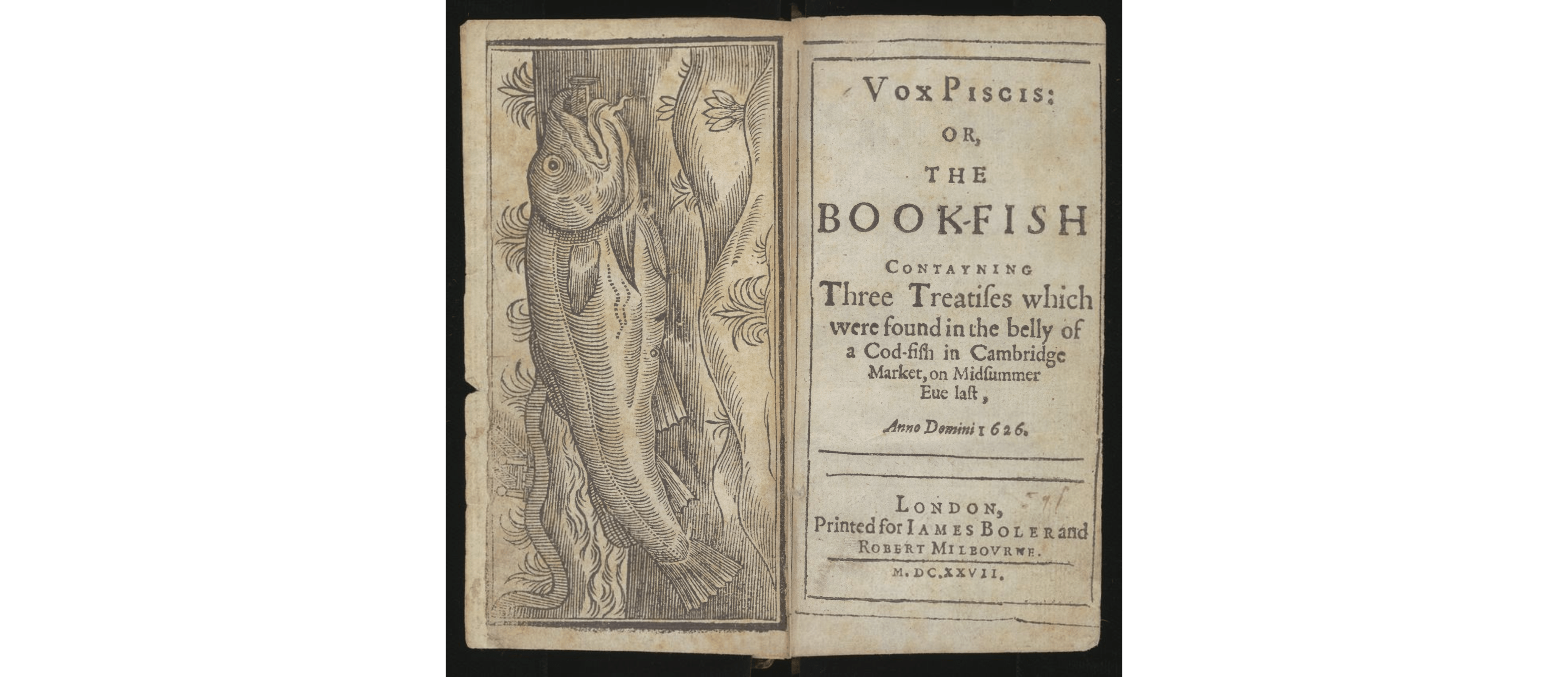
As we untangle the strings, we might recall that it ws on this date in 1623 that a large codfish, split open at a Cambridge market, was found to contain a copy of a book of religious treatises by John Frith.
“Just remember: Abraham Lincoln didn’t die in vain, he died in Washington D.C.”*…

Ken Goffman (better known as R. U. Sirius, the co-founder and first editor of the seminal Mondo 2000) on an equally-seminal comedy group…
If you were a college student or Western counterculture person in the late 1960s-70s, the albums of Firesign Theatre occupied more space on your shelf and in your hippocampus than even The Beatles or Pink Floyd. If you were an incipient techno-geek or hacker, this was even more the case. Firesign was the premier comedy recording act of the very first media-saturated technofreak tribe.
In his tremendously informative and enjoyable history of Firesign Theatre titled Firesign: The Electromagnetic History of Everything as told in Nine Comedy Albums, author Jeremy Braddock starts by giving us the roots of a band of satirists that started out (to varying degrees) as social activists with a sense of humor. He shows them slowly coming together in Los Angeles while infiltrating, first, the alternative Pacifica radio stations like KPFK in Los Angeles, and eventually, briefly, hosting programs in the newly thriving hip commercial rock radio stations of the times, before they lost that audience share to corporatization.
Braddock takes us through the entire Firesign career and doesn’t stint on media theory and the sociopolitics of America in the 20th century that were a part of the Firesign oeuvre.
For those of us out in the wilds of the youth counterculture of the time, without access to their radio programs, it was Columbia Records albums that captured our ears and minds, starting with Waiting For the Electrician or Someone Like Him in early 1968. Their third album, Don’t Crush That Dwarf Hand Me the Pliers sold 300,000 right out of the gate and, in the words of an article written for the National Registry in 2005, “breaking into the charts, continually stamped, pressed and available by Columbia Records in the US and Canada, hammering its way through all of the multiple commercial formats over the years: LPs, EPs, 8-Track and Cassette tapes, and numerous reissues on CD, licensed to various companies here and abroad, continuing up to this day.” As covered toward the end of the book, they have been frequently sampled in recent years by hip-hop artists.
My introduction to Firesign came as the result of seeing the cover of their second album How Can You Be In Two Places At Once When You’re Not Anywhere At All in the record section of a department store in upstate New York. It was the cover, with pictures of Groucho Marx and John Lennon and the words “All Hail Marx and Lennon” that caught my eye.
It was the mind-breaking trip of Babe, as he enters a new car purchased from a then-stereotypical, obnoxiously friendly car salesman, and finds himself transitioning from one mediated space to another, eventually landing in a Turkish prison and witnessing the spread of plague, as an element of a TV quiz show.
The album ends with a chanteuse named Lurlene singing “We’re Bringing the War Back Home.” This was all during the militant opposition to the US war in Vietnam. Probably few listeners would have recognized “Bring The War Home” as the slogan of The Weatherman faction of Students for a Democratic Society (SDS), but Braddock gets it, like he gets the seriousness of Firesign’s satire. Indeed, Braddock notes that several reviewers, writing with appreciation about one of their albums, averred that its dystopia was “not funny.”
Most fans would agree with me that the peak of the Firesign run on Columbia Records was the exceedingly multivalent Don’t Crush That Dwarf, Hand Me The Pliers and the futuristic, AI-saturated I Think We’re All Bozos on this Bus, which I note in this interview predicted the future better than any of the self-described futurists of the 1970s. But to apprehend the richness of those two psychedelic assaults on the senses and on the idiocracy of its times, you will need to read the book and listen to the recordings or at least read this interview…
Read on for his conversation with Jeremy Braddock: “Firesign Theatre: The Greatest Satirists of 20th Century Media Culture and its Techno-romanticism were… Not Insane!” from @rusirius.bsky.social and @jbraddock.bsky.social
* Firesign Theatre, How Can You Be In Two Places At Once When You’re Not Anywhere At All
###
As we cherish canny comedy, we might recall that it was on this date in 1932 that Walk a Little Faster opened on Broadway at the St. James Theatre. A “musical review with sketches,” it featured “April in Paris” (by E. Y “Yip” Harburg, who seven years later provided all of the songs– including “Over the Rainbow— for the film The Wizard of Oz) and writing by S. J. Perelman (who had just scripted the Marx Brothers films Monkey Business and Horse Feathers).

“We live in an age when the traditional great subjects – the human form, the landscape, even newer traditions such as abstract expressionism – are daily devalued by commercial art”*…

… But it wasn’t always so. A current exhibit at the Metropolitan Museum in New York is devoted to the work of (often anonymous) artists who illustrated commercial catalogs in the late 19th and early 20th centuries…
Art of Commerce: Trade Catalogs in Watson Library features a selection of the library’s extensive holdings of sale catalogs. Watson Library has almost two thousand trade catalogs published in many countries from the eighteenth century to the present. Objects featured include furniture, jewelry, tiles, ironwork, glasswork, lighting, stoves, tableware, textiles, decorative paper, artist’s materials, fashion, typography, automobiles, and musical instruments. Numerous catalogs illustrate works of art or related objects now in The Met collection.
The library has strong holdings of Art Deco trade catalogs including Modern furniture design = Le dessin moderne des meubles—a colorful furniture portfolio by Czech architect Karel Vepřek—and Van Clef Arpels présentent, an elegantly illustrated accessories publication designed by Draeger Frères, the most innovative graphic designers and printers of the period. Both catalogs are on display in the exhibition.
Trade or sale catalogs — also called commercial or manufacturer’s catalogs —are printed publications advertising products of a particular trade or industry. Sale catalogs were often used in shops or showrooms to promote a company’s products. Examples include the massive Reed and Barton catalog Artistic workers in silver & gold plate from 1885 that illustrates the entire inventory of the company…
Among the more unusual and appealing trade catalogs in the exhibition is a German Art Nouveau-inspired cake decorating book from 1910 and a baby carriage catalog from 1934 offering Art Deco styled tubular steel baby prams. These trade catalogs demonstrate the distillation of major art movements applied to quotidian objects.
The earliest trade catalog in the exhibition is Muster zu Zimmer-Verzierungen und Ameublements, a neo-classical interior design catalog by luxury German manufacturer Voss und Compagnie, offering entire rooms that can be bought en masse or as separate pieces. It is illustrated with richly toned hand-colored engravings that detail the design and color of the objects.
One of the library’s most fragile and weighty catalogs is Album des principaux modeles de verres: produits spéciaux en verre coulé. It is a magical trade catalog with sixty-five intact glass samples manufactured by French glassmaker Saint-Gobain. Founded during the time of Louis XIV, the company remains a manufacturer of glass for construction.
The majestic ironwork catalogue of Maison Garnier has pink-tinted papers and was bound in Morocco leather as a special copy for Rémy Garnier, the son of the firm’s founder. The firm’s initials are boldly blind stamped on the cover.
The most unusual and perhaps unexpected catalog, Urinoirs, illustrates the decorative ironwork structures of urinals (or pissoirs) that adorned the streets of Paris from the 1840s to the mid-twentieth century. The ornamentation of these structures demonstrates an impulse to beautify the animated street life of Paris and other cities…
See the items mentioned at the links above, and other articles in the exhibit here.
Beauty in the service of business: “Art of Commerce: Trade Catalogs in Watson Library,” from @metmuseum (where one can see the works on exhibit through March 4, 2025).
* Andy Warhol
###
As we browse, we might spare a thought for Oscar Fingal O’Flahertie Wills Wilde; the novelist, essayist, playwright, poet, and master of the bon mot died on this date in 1900.
As he said: “There are moments when art attains almost to the dignity of manual labor.”

You must be logged in to post a comment.