Posts Tagged ‘teeth’
“Always be yourself. Unless you can be a narwhal. Then always be a narwhal.”*…

Nicola Jones talks with Dr. Martin Nweeia, an independent scientist working with the Inuit to unravel the many mysteries of the one-tusked “unicorn of the sea”…
Martin Nweeia is a modern Renaissance man. He has a degree in English and biology, a working dental practice, and a side interest in zoology and anthropology; he has composed for documentary films and has become an expert on narwhals — the mysterious, one-toothed “unicorns of the sea.”
The male narwhal typically hosts a roughly eight-foot-long, single exterior tusk, whose function has been a mystery for centuries. Nweeia has obtained many grants to investigate the narwhal and, in more than 20 trips to the Arctic, he has compiled ambitious logs of Indigenous knowledge about the tusk, conducted in-depth studies on the material it is composed of, and attached heart and brain monitors to narwhals to try to determine what they can sense through the protrusion.
The male narwhal typically hosts a roughly eight-foot-long, single exterior tusk, whose function has been a mystery for centuries. Nweeia has obtained many grants to investigate the narwhal and, in more than 20 trips to the Arctic, he has compiled ambitious logs of Indigenous knowledge about the tusk, conducted in-depth studies on the material it is composed of, and attached heart and brain monitors to narwhals to try to determine what they can sense through the protrusion.
Nweeia wrote about the narwhal in the 2024 Annual Review of Animal Biosciences. He spoke with Knowable Magazine about his work on teeth and narwhals and the insights he has gained from the Inuit who live with and hunt these whales….
…
… There are so many properties of the narwhal tusk that defy every principle I ever learned in dental school. The diet of the narwhal includes some pretty large fish. This whale has the capability of producing more than a dozen teeth in its mouth, but it genetically shuts this off — says “No, we don’t need those teeth. Instead, what we’d rather have is this giant tusk that erupts into the ocean.”
All mammalian teeth patterns are symmetrical. But a narwhal typically has this eight- to nine-foot tusk on the left, and on the right side, nothing visible. Typically, in mammals, females have the same distribution of teeth as males; narwhals couldn’t be more different. The males typically have the tusk and the females typically do not.
The story was that this gigantic tusk was just for social hierarchy, like a lion’s mane or a peacock tail. The more I read, the less sense this made. Just to get the best girl of the lot? It doesn’t seem plausible to me. This animal has gone through an enormous sacrifice to create this thing. I thought, this animal deserves a better story…
…
… The Inuit already had a much better description of the tusks than anything in Western science. They could tell from a tusk where a particular animal was from, which I found extraordinary: A shorter, thicker task would mean that they came from further north; longer and more thin tusks came from further south.
They knew the female tusk, when present, is thinner and more tightly wound. The tusk seems very rigid, but when we were in the field the hunters would say, oh, no, no, this thing bends and flexes. We thought, that’s impossible. So we get the material back in the lab and sure enough, it can bend and flex 12 degrees. I realized that they were going to be the most important key link for me to get the knowledge I needed to inform the science…
…
… It is kind of opposite from our teeth, which are hard on the outside and softer as they go in; narwhal teeth are very flexible on the outside, and as you get to the core where the nerve is, it’s like an iron rod.
In 2005, we released work suggesting the tusk is a sensory organ. Our team found that over about an eight-foot section of tusk there were about 10 million sensory connections to its ocean environment, through dentinal tubules. All mammals have dentinal tubules — the difference with narwhal is that they’re open, from the inside nerve to the outside of the tooth.
In people, these tubules are below our gum line. People who have bone recession or receding gums can expose them, and this makes them sensitive to cold foods. So having the tubules open is unusual, especially for an animal living in the cold Arctic environment — it’s the last place you would expect to see this.
Current evolutionary evidence shows that teeth are derived from ancient fish scales, which had the capability to detect pressure, temperature and gradients of particles (like salt). We have slowly evolved to use our teeth for chewing and biting. But as we know from going to a dentist, our teeth can sense pain, and temperature. After all, they were, originally, sensory organs…
…
… I’m interested in “ocean osteoporosis.” As the ocean absorbs more carbon dioxide, it gets harder to form calcium carbonate. This affects shells. I’m looking at different trophic levels in the Arctic, to see how high up the levels this possibly can go. I’m also looking at nanoplastics, and their impacts on animals in the Arctic. To tell a story, you need a charismatic animal. You need a good storyteller. And I think narwhals are great storytellers…
Modern science and indigenous wisdom partner to understand a unique animal: “A lifetime of love for the charismatic narwhal,” from @nicolakimjones in @KnowableMag.
* Anonymous
###
As we ponder protrusions, we might note that today is World Oceans Day. An occasion to celebrate “the ocean, its importance in our lives, and how we can protect it,” Canada’s International Centre for Ocean Development (ICOD) and the Ocean Institute of Canada (OIC) had first proposed the event at the Earth Summit– the UN Conference on Environment and Development (UNCED) in Rio de Janeiro– in 1992. The Ocean Project started global coordination of World Ocean Day starting in 2002. “World Oceans Day” was officially recognized by the United Nations in 2008. The international day supports the implementation of worldwide Sustainable Development Goals (SDGs) and fosters public interest in the protection of the ocean and the sustainable management of its resources.

“I am not rich enough to eat baklava every day”*…
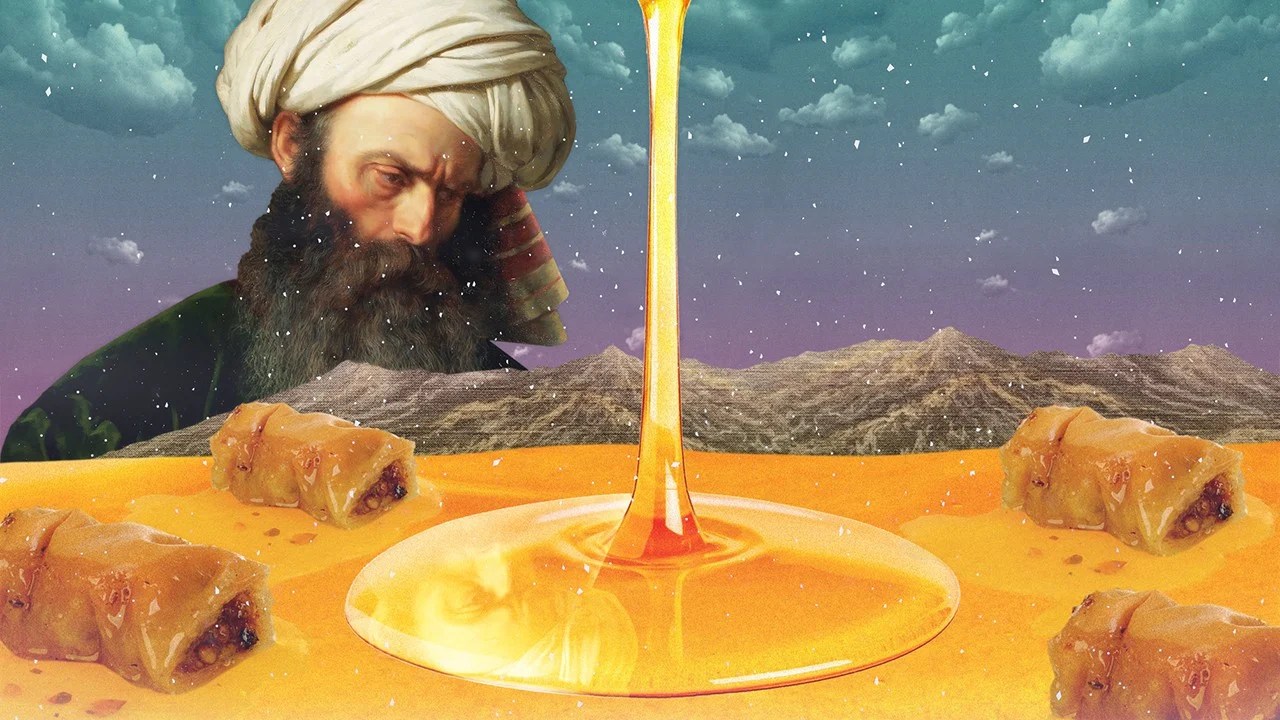
The social centrality of sweets…
Each country finds its own way to get its sugar fix. The crackly burnished sugar on top of a pot of crème brûlée in France. The grainy buttery sugar of a slab of Scottish tablet. The caramelised, milky sugar of dulce de leche, slathered on toast or pancakes. The intensely processed sugar of the high-fructose corn syrup that sweetens the chocolate drizzle, ice cream and brownie chunks of an American sundae.
A taste for sweetness makes sense in evolutionary terms: sugary foods are a quick and easy source of energy. But despite its universal appeal, says Anissa Helou, a Lebanese-Syrian author and chef (whose surname means “sweet”), Middle Easterners seem to be particularly enamoured by sugar. Five of the top 20 countries that consume the most sugar per person are in the Middle East.
Why is the region so enchanted by sweet stuff? Sugar was widely available in the Middle East long before that was true in the West. Helou also points to the Islamic prohibition on alcohol, which in other countries is used as a celebratory treat, luxury or distraction (though the ban on drinking is observed to varying degrees across the Muslim world). If you can’t do shots in Dubai, you can belly up to the milkshake bar and get a high from guzzling a chocolatey ice cream concoction. After dinner, sweetened tea takes the place of an aperitif. Juice and sugar-cane stalls replace pubs and bars on street corners.
Across the Middle East and Turkey, bakery shelves heave with a variety of syrup-soaked pastries. You can find diamonds of basbousa (which in Arabic sweetly translates as “just a kiss”), a cake made from semolina and drenched with syrup scented with rose or orange blossom. Coils of m’hanncha, an almond-packed roll of pastry, curled to look like a sleeping snake. Kunafa, shredded pastry filled with a creamy cheese or nuts and doused in yet more floral syrup. Znoud el-sit, which literally means “women’s upper arms”, crunchy, plump little cigars of filo pastry, stuffed with cream, fried and steeped in syrup or honey. But the best known by far, at least in the rest of the world, are sheets of fine filo pastry filled with nuts and bathed in syrup and butter: baklava.
Versions of layered, nutty pastries may have been made as early as the eighth century BC by the Assyrians, but it was the Ottomans who perfected the sticky glory of baklava. The imperial kitchens of the Topkapi palace in Istanbul were said to have turned out trays of the stuff in the 15th century. Most notably, on the 15th day of Ramadan, when the sultan would visit the hirka-i-serif (a relic believed to be part of the cloak of the Prophet Muhammad), baklava was given to his janissaries, an elite group of soldiers. It was a food of occasion, so much so that even today there’s a common saying in Turkey: “I am not rich enough to eat baklava every day.” (Boxes of baklava regularly feature as carry-on luggage at airports in Turkey, especially around the holidays, both religious and secular.)
In 2013 the European Commission bestowed a “protected designation-of-origin” status on baklava from Gaziantep, a southern Turkish city – the first Turkish product to be recognised in this way. Bakers across Greece, the Middle East and beyond may challenge the Turks’ claims on baklava, but whether their versions pre-date the reach of the Ottomans or are the result of their expansion, baklava pops up everywhere from Morocco to Iran. The shapes differ, the nuts vary and the spices change but the syrupy richness does not.
Even without the sultans and their acolytes, baklava still evokes a sense of ceremony. Feast days, religious or otherwise, to celebrate both the living and the dead, are occasions for baklava. So, too, are visits by friends. Claudia Roden, a grandee of Middle Eastern cooking born to an Egyptian-Jewish family, writes that baklava (along with other sweets) is associated, for her, with “feelings of well-being, warmth and welcome, of giving and receiving, of crowds of people smiling, kissing, hugging and showering hospitality”. Whereas Christians often forgo foodstuffs such as sugar during the 40 days of Lent, Ramadan brings a nightly feast in which sweets play an important role. In Turkey, Eid al-Fitr, the feast to celebrate the end of Ramadan, is known as Seker Bayrami, the feast of sweets…
In the absence of alcohol, sweet treats unite the Middle East: “Go nuts: the multilayered history of baklava,” from Josie Delap (@josiedelap) in @1843mag— with a recipe!
* traditional Turkish saying
###
As we lick our lips (and our fingers), we might spare a thought for Chapin Aaron Harris; he died on this date in 1860. Trained as a physician, he specialized in matters of the mouth. He helped found the American Society of Dental Surgeons (ASDS), the first national dental organization in the U.S., and founded the Baltimore College of Dental Surgery (now the University of Maryland School of Dentistry), the first dental college in the U.S. (and, it’s believed, the world).

You must be logged in to post a comment.