Posts Tagged ‘secrets’
“Conspiracy theories also bring another reward: power.”*…

Barrett Brown interrogates our fascination with conspiracies and conspiracy theories…
Over a period of several years in the early seventeenth century, there appeared in Western Europe three manifestos laying out the history of the theretofore unheard-of Rosicrucian order, whose secret directorate was said to employ powerful magical-scientific techniques in service to sociopolitical reform. This naturally led to quite a bit of public speculation, which gradually abated in the absence of further pronouncements; within a few generations the only parties ascribing any significance to the incident tended to be dubious characters claiming to be Rosicrucians themselves, rarely with much to show for it. Thus, as a result of its gradual association with cranks, the Rosicrucian story developed a kind of inoculation against serious scrutiny.
It wasn’t until the sixties that the British historian Dame Frances A. Yates breached the actual nature and extent of the thought movement that informed both the manifestos and its audience. In her book The Rosicrucian Enlightenment, she demonstrates that the texts were written as anti-Hapsburg, proreformist propaganda drawing on doctrines associated with the sixteenth-century philosopher Francis Bacon, and that this was understood by commentators on both sides; that the surreal “alchemical wedding” described therein references the 1613 marriage of England’s Elizabeth Stuart and Frederick V of the Palatinate, widely heralded as the linchpin of a proto-Protestant alliance capable of establishing such reform by force; that the broader proposals were indeed taken seriously by scholars, not as scripture but rather as a set of visionary policy proposals dressed in metaphor, akin to Bacon’s The New Atlantis; and that enthusiasts such as Elias Ashmole would directly implement those proposals by founding the Royal Society, establishing the primacy of science. Rather than being a footnote to premodern folly, the Rosicrucian affair turns out to sit at the narrative center of the modern world.
There’s a lesson here that bears attention today, at the apparent twilight of the same modern world, when the fundamental problem we face involves the degree to which the truth must now compete with such a vast multiplicity of falsehoods that discovering truth itself becomes unviable. Consider that so much of consequence to our own heritage should have been so misunderstood for as long as the Rosicrucian manifestos; it seems that crucial facts can be effectively concealed from serious attention simply by being visibly subject to the unserious sort. Such facts are gradually imbued with a sort of de facto defense mechanism against scrutiny, whereby the mere act of taking an interest in them serves to discredit professional researchers and journalists…
From the 1600s to recent history and the insights of Umberto Eco, what’s going on– and why: “The Ur-“Conspiracy”: History of a Pseudoconcept,” from @parisreview.bsky.social.
Apposite: “Revisionist History — Aliens, Secrets and Conspiracies,” by Steve Blank
* “The emotional appeal of a conspiracy theory is in its simplicity. It explains away complex phenomena, accounts for chance and accidents, offers the believer the satisfying sense of having special, privileged access to the truth. For those who become the one-party state’s gatekeepers, the repetition of these conspiracy theories also brings another reward: power.” – Anne Applebaum, Twilight of Democracy: The Seductive Lure of Authoritarianism
###
As we ponder perspicacity, we might we send inquisitive birthday greetings to Michel Eyquem de Montaigne; he was born on this date in 1533. Best known during his lifetime as a statesman, Montaigne is remembered for popularizing the essay as a literary form. His massive volume Essais (translated literally as “Attempts” or “Trials”)– contain what are, to this day, some of the most widely-influential essays ever written. Montaigne had a powerful impact on writers ever after, from Descartes, Pascal, and Rousseau through Hazlitt, Emerson, and Nietzsche, to Zweig, Hoffer, and Asimov. Indeed, he’s believed to have been an influence on the later works of Shakespeare.
And while he pre-dates the “Rosicrucian” publications mentioned above, he observed (in Essais) “the truth of these days is not that which really is, but what every man persuades another man to believe.”

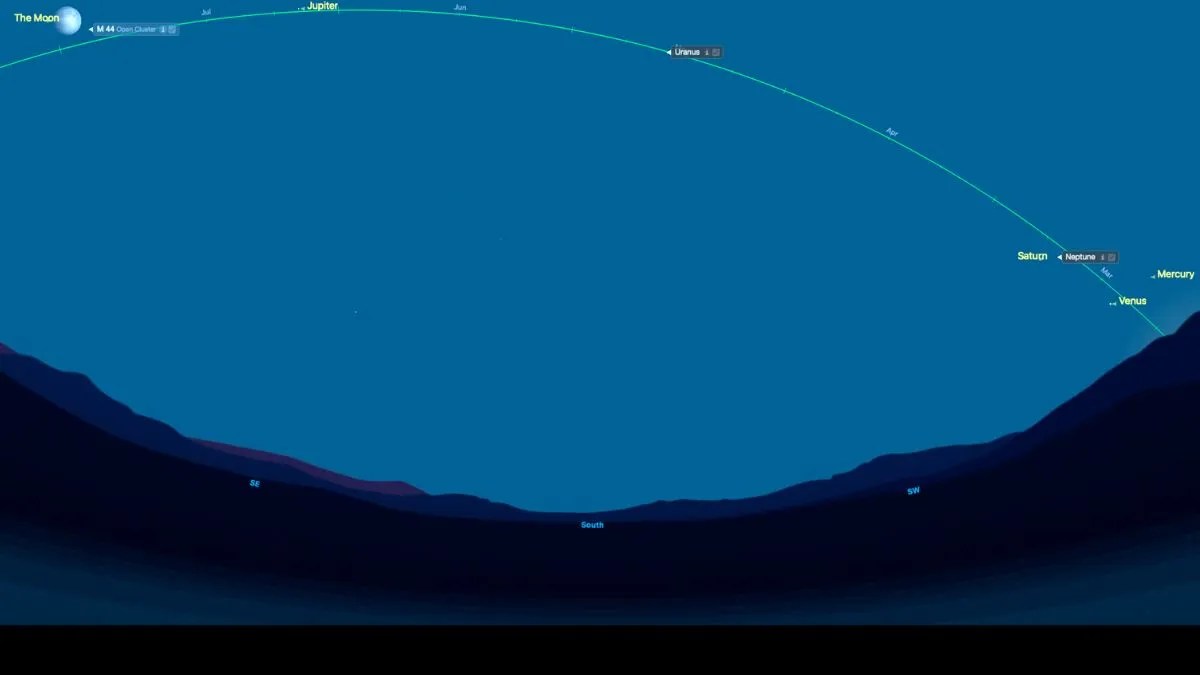
Lastly, a good reason to step outside and look up early this evening: “February’s ‘rare planetary alignment’ is coming — here’s what to expect from the planet parade“
“Whoever wishes to keep a secret must hide the fact that he possesses one”*…

… or, as Sheon Han explains, maybe not…
Imagine you had some useful knowledge — maybe a secret recipe, or the key to a cipher. Could you prove to a friend that you had that knowledge, without revealing anything about it? Computer scientists proved over 30 years ago that you could, if you used what’s called a zero-knowledge proof.
For a simple way to understand this idea, let’s suppose you want to show your friend that you know how to get through a maze, without divulging any details about the path. You could simply traverse the maze within a time limit, while your friend was forbidden from watching. (The time limit is necessary because given enough time, anyone can eventually find their way out through trial and error.) Your friend would know you could do it, but they wouldn’t know how.
Zero-knowledge proofs are helpful to cryptographers, who work with secret information, but also to researchers of computational complexity, which deals with classifying the difficulty of different problems. “A lot of modern cryptography relies on complexity assumptions — on the assumption that certain problems are hard to solve, so there has always been some connections between the two worlds,” said Claude Crépeau, a computer scientist at McGill University. “But [these] proofs have created a whole world of connection.”…
More about how zero-knowledge proofs allow researchers conclusively to demonstrate their knowledge without divulging the knowledge itself: “How Do You Prove a Secret?,” from @sheonhan in @QuantaMagazine.
* Johann Wolfgang von Goethe
###
As we stay sub rosa, we might recall that today (All Saints Day) is the (fictional) birthday of Hello Kitty (full name: Kitty White); she was born in a suburb of London. A cartoon character designed by Yuko Shimizu (currently designed by Yuko Yamaguchi), she is the property of the Japanese company Sanrio. An avatar of kawaii (cute) culture, Hello Kitty is one of the highest-grossing media franchises of all time; Hello Kitty product sales and media licensing fees have run as high as $8 billion a year.

“The greatest enemy of knowledge is not ignorance, it is the illusion of knowledge”*…

After the fall of the Berlin Wall, East German citizens were offered the chance to read the files kept on them by the Stasi, the much-feared Communist-era secret police service. To date, it is estimated that only 10 percent have taken the opportunity.
In 2007, James Watson, the co-discoverer of the structure of DNA, asked that he not be given any information about his APOE gene, one allele of which is a known risk factor for Alzheimer’s disease.
Most people tell pollsters that, given the choice, they would prefer not to know the date of their own death—or even the future dates of happy events.
Each of these is an example of willful ignorance. Socrates may have made the case that the unexamined life is not worth living, and Hobbes may have argued that curiosity is mankind’s primary passion, but many of our oldest stories actually describe the dangers of knowing too much. From Adam and Eve and the tree of knowledge to Prometheus stealing the secret of fire, they teach us that real-life decisions need to strike a delicate balance between choosing to know, and choosing not to.
But what if a technology came along that shifted this balance unpredictably, complicating how we make decisions about when to remain ignorant? That technology is here: It’s called artificial intelligence.
AI can find patterns and make inferences using relatively little data. Only a handful of Facebook likes are necessary to predict your personality, race, and gender, for example. Another computer algorithm claims it can distinguish between homosexual and heterosexual men with 81 percent accuracy, and homosexual and heterosexual women with 71 percent accuracy, based on their picture alone. An algorithm named COMPAS (Correctional Offender Management Profiling for Alternative Sanctions) can predict criminal recidivism from data like juvenile arrests, criminal records in the family, education, social isolation, and leisure activities with 65 percent accuracy…
Knowledge can sometimes corrupt judgment, and we often choose to remain deliberately ignorant in response. But in an age of all-knowing algorithms, how do we choose not to know? Two scientists at the Max Planck Institute for Human Development argue that “We Need to Save Ignorance From AI.”
* Daniel J. Boorstin
###
As we consider closing our eyes, we might send discoverable birthday greetings to Tim Bray; he was born on this date in 1955. A seminal software developer and entrepreneur, he is probably best known as the co-author of the original specifications for the XML and XML namespace, open standards that fueled the growth of the internet (by setting down simple rules for encoding documents in a format that is both human-readable and machine-readable), and as the co-founder of the Open Text Corporation, which released the Open Text Index, one of the first popular commercial web search engines.

“Three may keep a secret, if two of them are dead”*…

What kinds of secrets does the average person keep? In a new paper, Columbia University researchers Michael L. Slepian and colleagues carried out a survey of secrets…
Take a peek at (and find larger versions of this chart and others) at “A Survey of Our Secret Lives.”
* Benjamin Franklin, Poor Richard’s Almanack
###
As we keep it under our hats, we might send vocal birthday greetings to Melvin Jerome “Mel” Blanc; he was born on this date in 1908. A voice actor, actor, radio comedian, and recording artist, he began his 60-plus-year career performing in radio, but is best remembered for his work in animation– as the voices of Bugs Bunny, Daffy Duck, Porky Pig, Tweety Bird, Sylvester the Cat, Yosemite Sam, Foghorn Leghorn, Marvin the Martian, Pepé Le Pew, Speedy Gonzales, Wile E. Coyote, Road Runner, the Tasmanian Devil, and many of the other characters from the Looney Tunes and Merrie Melodies theatrical cartoons that helped define the golden age of American animation. He was, in fact, the voice for all of the major male Warner Bros. cartoon characters except Elmer Fudd, whose voice was provided by fellow radio actor Arthur Q. Bryan (though Blanc later voiced Fudd as well after Bryan’s death). Blanc died in 1989, just a year after voicing Daffy Duck in his classic Who Framed Roger Rabbit duel with Donald.

You must be logged in to post a comment.