Posts Tagged ‘privacy’
“Neither privacy nor publicity is dead, but technology will continue to make a mess of both”*…

Indeed, as neurotech advances, privacy concerns grow. Devices that connect brains to computers are increasingly sophisticated. But as Fletcher Reveley asks, can the nascent neurorights movement catch up?…
One afternoon in May 2020, Jerry Tang, a Ph.D. student in computer science at the University of Texas at Austin, sat staring at a cryptic string of words scrawled across his computer screen:
“I am not finished yet to start my career at twenty without having gotten my license I never have to pull out and run back to my parents to take me home.”
The sentence was jumbled and agrammatical. But to Tang, it represented a remarkable feat: A computer pulling a thought, however disjointed, from a person’s mind.
For weeks, ever since the pandemic had shuttered his university and forced his lab work online, Tang had been at home tweaking a semantic decoder — a brain-computer interface, or BCI, that generates text from brain scans. Prior to the university’s closure, study participants had been providing data to train the decoder for months, listening to hours of storytelling podcasts while a functional magnetic resonance imaging (fMRI) machine logged their brain responses. Then, the participants had listened to a new story — one that had not been used to train the algorithm — and those fMRI scans were fed into the decoder, which used GPT1, a predecessor to the ubiquitous AI chatbot ChatGPT, to spit out a text prediction of what it thought the participant had heard. For this snippet, Tang compared it to the original story:
“Although I’m twenty-three years old I don’t have my driver’s license yet and I just jumped out right when I needed to and she says well why don’t you come back to my house and I’ll give you a ride.”
The decoder was not only capturing the gist of the original, but also producing exact matches of specific words — twenty, license. When Tang shared the results with his adviser, a UT Austin neuroscientist named Alexander Huth who had been working towards building such a decoder for nearly a decade, Huth was floored. “Holy shit,” Huth recalled saying. “This is actually working.” By the fall of 2021, the scientists were testing the device with no external stimuli at all — participants simply imagined a story and the decoder spat out a recognizable, albeit somewhat hazy, description of it. “What both of those experiments kind of point to,” said Huth, “is the fact that what we’re able to read out here was really like the thoughts, like the idea.”
The scientists brimmed with excitement over the potentially life-altering medical applications of such a device — restoring communication to people with locked-in syndrome, for instance, whose near full-body paralysis made talking impossible. But just as the potential benefits of the decoder snapped into focus, so too did the thorny ethical questions posed by its use. Huth himself had been one of the three primary test subjects in the experiments, and the privacy implications of the device now seemed visceral: “Oh my god,” he recalled thinking. “We can look inside my brain.”
Huth’s reaction mirrored a longstanding concern in neuroscience and beyond: that machines might someday read people’s minds. And as BCI technology advances at a dizzying clip, that possibility and others like it — that computers of the future could alter human identities, for example, or hinder free will — have begun to seem less remote. “The loss of mental privacy, this is a fight we have to fight today,” said Rafael Yuste, a Columbia University neuroscientist. “That could be irreversible. If we lose our mental privacy, what else is there to lose? That’s it, we lose the essence of who we are.”
Spurred by these concerns, Yuste and several colleagues have launched an international movement advocating for “neurorights” — a set of five principles Yuste argues should be enshrined in law as a bulwark against potential misuse and abuse of neurotechnology. But he may be running out of time…
“Advances in Mind-Decoding Technologies Raise Hopes (and Worries),” from @FletcherReveley in @undarkmag. Eminently worth reading in full.
And to complicate things further (though appropriately), see Eric Hoel‘s “Neuroscience is pre-paradigmatic. Consciousness is why.”
* danah boyd
###
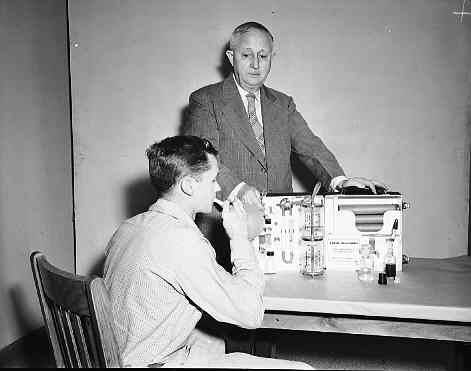
As we ponder the personal, we might send telling birthday greetings to Rolla Harger; he was born on this date in 1890. Biochemistry and pharmacology department chairman of the Indiana University School of Medicine, he invented (in 1931) and patented (in 1936) the first field test for inebriation, the Drunkometer (the forerunner of the Breathalyzer), to test for driving under the influence.
“The only advantage of not being too good a housekeeper is that your guests are so pleased to feel how very much better they are”*…

Roomba is on the rise, but is the humble carpet sweeper poised for a rebound? Edward Tenner considers…
Every so often technology critics charge that despite the exponential growth of computer power, the postwar dreams of automated living have been stalled. It is true that jetpacks are unlikely to go mainstream, and that fully autonomous vehicles are more distant than they appear, at least on local roads. And the new materials that promised what the historian of technology Jeffrey L. Meikle has called
“damp-cloth utopianism”—the vision of a future household where plastic-covered furnishings would allow carefree cleaning—have created dystopia in the world’s oceans.Yet a more innocent dream, the household robot, has come far closer to reality: not, it is true, the anthropomorphic mechanical butler of science-fiction films, but a humbler machine that is still
impressive, the autonomous robotic vacuum cleaner. Consider, for example, the Roomba®. Twenty years after introducing the first model, the manufacturer, iRobot, sold itself to Amazon in August 2022 for
approximately $1.7 billion in cash. Since 2013, a unit has been part of the permanent collection of the Smithsonian’s National Museum of American History.As the museum site notes, the first models found their way by bumping into furniture, walls, and other obstacles. They could not be programmed to stay out of areas of the home; an infrared-emitting
accessory was needed to create a “virtual wall.” Like smartphones, introduced a few years later, Roombas have acquired new features steadily with a new generation on average every year. (They have also inspired a range of products from rival manufacturers.) Over 35 million units have been sold. According to Fortune Business Insights Inc., the worldwide market was nearly $10 billion in 2020 and is estimated to increase from almost $12 billion in 2021 to $50.65 billion in 2028.…
Adam Smith might applaud the Roomba as a triumph of the liberal world order he had endorsed. Thanks to the global market- place for design ideas, chips, and mechanical parts, he might remark,
a division of labor—Roomba is designed mainly in the United States by an international team and manufactured in China and Malaysia—has benefited consumers worldwide. Smith would nonetheless
disapprove of the economic nationalism of both the United States and China that has made managing high-technology manufacturing chains so challenging.Yet Smith might also make a different kind of observation, high-lighting the technology’s limits rather than its capabilities…
Yet Smith might also make a different kind of observation, high-lighting the technology’s limits rather than its capabilities… Could household automation be not only irrelevant to fundamental human welfare, but harmful? As an omnivorous reader, Smith would no doubt discover in our medical literature the well-established dangers of sedentary living (he loved “long solitary walks by the Sea side”) and the virtues of getting up regularly to perform minor chores, such as turning lights on and off, adjusting the thermostat, and vacuuming the room, the same sorts of fidgeting that the Roomba and the entire Internet of Things are hailed as replacing. In fact the very speed of improvement of robotic vacuums may be a hazard in itself, as obsolescent models add to the accumulation of used batteries and environmentally hazardous electronic waste.
As the sustainability movement grows, there are signs of a revival of the humble carpet sweeper, invented in 1876, as sold by legacy brands like Fuller Brush and Bissell. They offer recycled plastic parts, independence of the electric grid, and freedom from worry about hackers downloading users’ home layouts from the robots’ increasingly sophisticated cloud storage…
Via the estimable Alan Jacobs and his wonderful Snakes and Ladders: “Adam Smith and the Roomba®” from @edward_tenner.
(Image above: source)
* Eleanor Roosevelt
###
As we get next to godliness, we might spare a thought for Waldo Semon; he died on this date in 1999. An inventor with over 100 patents, he is best known as the creator of “plasticized PVC” (or vinyl). The the world’s third most used plastic, vinyl is employed in imitation leather, garden hose, shower curtains, and coatings– but most frequently of all, in flooring tiles.
For his accomplishments, Semon was inducted into the Invention Hall of Fame in 1995 at the age of 97.

“There are no private lives. This a most important aspect of modern life.”*…

The idea that China gives every citizen a “social credit score” continues to capture the horrified imagination of many. But it is more bogeyman than reality. Instead, we should be worrying about other, more invasive surveillance practices – and not just in China, argues MERICS analyst Vincent Brussee…
“What if every action that you took in your life was recorded in a score like it was a video game?” … “If your score drops to 950, you will be subject to re-education.” … “It is the beginning of slavery, complete control, and the disappearance of all freedoms … In China, they call it social credit.” These are just some of the statements made in parliamentary debates in Europe and online commentaries about China’s Social Credit System. Given the vehemence of these views, and the attention they attract, it must have come as a real headscratcher to many when China recently pledged that would ban the use of AI for social scoring.
So, what are the facts relating to China’s Social Credit System (SoCS)? First, a system does exist, but it is very different from what is imagined by many critics outside China. The biggest disconnect is around the notion of scores. Some commentators seem to imagine that a magic algorithm draws from AI cameras and internet surveillance all over the country to calculate a score that determines everyone’s place in society. In reality, the SoCS is not the techno-dystopian nightmare we fear: it is lowly digitalized, highly fragmented, and primarily focuses on businesses. Most importantly, such a score simply does not exist.

… this does not mean that the SoCS is benign. It also does not imply that China’s broader surveillance apparatus is a myth – quite to the contrary. However, public debates typically do not focus on these aspects. Rather, the interest in the system often stems from broader anxieties about digital technologies, as reflected in the UN pledge and similar actions taken by other countries. Often, the SoCS is merely invoked as a metaphor: either to depict some technological threat at home or to portray a techno-dystopian China.
This is symptomatic of a tendency to see China not as a real place with real people, but as an abstract “negative opposite” of “us.” While our discussions on tech in China remain overshadowed by largely fictional scoring, we ignore real threats of surveillance to exactly those people in China. And when we use the SoCS to invoke the image of a technological threat at home, we lose sight of potentially acute technological threats much closer to reality.
In both cases, the real losers are the people that those making the claims say they want to protect…
More at “China’s social credit score – untangling myth from reality,” from @Vincent_WDB at @merics_eu.
See also: “China just announced a new social credit law. Here’s what it means- The West has largely gotten China’s social credit system wrong. But draft legislation introduced in November offers a more accurate picture of the reality,” in @techreview.
[Image above: source]
* Philip K. Dick, who also said “There will come a time when it isn’t ‘They’re spying on me through my phone’ anymore. Eventually, it will be ‘My phone is spying on me’.”
###
As we ponder the panopticon, we might recall that it was on this date in 1942 that a team of scientists led by Enrico Fermi, working inside an enormous tent on a squash court under the stands of the University of Chicago’s Stagg Field, achieved the first controlled nuclear fission chain reaction… laying the foundation for the atomic bomb and later, nuclear power generation– that’s to say, inaugurating the Atomic Age.
“…the Italian Navigator has just landed in the New World…”
– Coded telephone message confirming first self-sustaining nuclear chain reaction, December 2, 1942.

Indeed, exactly 15 years later, on this date in 1957, the world’s first full-scale atomic electric power plant devoted exclusively to peacetime uses, the Shippingport Atomic Power Station, reached criticality; the first power was produced 16 days later, after engineers integrated the generator into the distribution grid of Duquesne Light Company.

“There are only two different types of companies in the world: those that have been breached and know it and those that have been breached and don’t know it.”*…

Enrique Mendoza Tincopa (and here) with a visualization of what’s on offer on the dark web and what it costs…
Did you know that the internet you’re familiar with is only 10% of the total data that makes up the World Wide Web?
The rest of the web is hidden from plain sight, and requires special access to view. It’s known as the Deep Web, and nestled far down in the depths of it is a dark, sometimes dangerous place, known as the darknet, or Dark Web…
Visual Capitalist

For a larger version, click here
And for a look at the research that underlies the graphic, click here.
What’s your personal information worth? “The Dark Web Price Index 2022,” from @DatavizAdventuR via @VisualCap.
(Image at top: source)
###
As we harden our defenses, we might recall that it was on this date in 1994 that arguments began in the case of United States vs. David LaMacchia, in which David LaMacchia stood accused of Conspiracy to Commit Wire Fraud. He had allegedly operated the “Cynosure” bulletin board system (BBS) for six weeks, to hosting pirated software on Massachusetts Institute of Technology (MIT) servers. Federal prosecutors didn’t directly charge LaMacchia with violating copyright statutes; rather they chose to charge him under a federal wire fraud statute that had been enacted in 1952 to prevent the use of telephone systems for interstate fraud. But the court ruled that as he had no commercial motive (he was not charging for the shared software), copyright violation could not be prosecuted under the wire fraud statute; LaMacchia was found not guilty– giving rise to what became known as “the LaMacchia loophole”… and spurring legislative action to try to close that gap.
Background documents from the case are here.

The MIT student paper, covering the case (source)
“Round and round she goes, where she stops, nobody knows”*…

Low Earth Orbit Satellites are objects that orbit the earth at lower altitudes than geosynchronous satellites, usually at between 160 km and 1000 km above the earth. They’re primarily used for imaging (think Google Maps/Earth, military reconnaissance, spying, and the like) or communications (signal relay, a la Starlink‘s new satellite internet service).
Even as there are concerns about the proliferation of objects in the sky at that altitude– ranging from the occlusion of the view into space through privacy to the accumulating layer of junk that defunct satellites could become— the rush to launch is on.
Leo Labs (@LeoLabs_Space) is a platform that aims to support developers and operators of LEOs. They provide a handy (and mesmerizing) real-time visualization of all of the LEOs aloft.
* a recurring line on Major Bowes Original Amateur Hour, a radio show that aired from 1934-1948 (then became Ted Mack Original Amateur Hour on television).
###
As we look up, we might recall that it was on this date in 1962 that President John F. Kennedy (and Vice-President Lyndon B. Johnson) visited newly-minted American hero John Glenn at Cape Canaveral to congratulate Glenn on becoming the first American to orbit the earth. Piloting Friendship 7, he had orbited the earth three times before splashing down in the Atlantic.

You must be logged in to post a comment.