Posts Tagged ‘mystery’
“Anonymity is the fame of the future”*…

So… late last spring, a strange, beguiling novel began arriving, in installments, in the mail, addressed to writer Adam Dalva at his parents’ apartment. Who had written it?…
It arrived at the height of the pandemic, in a brown envelope with no return address and too many stamps, none of which had been marked by the post office. It was addressed to me at my parents’ New York City apartment, where I haven’t lived in more than a decade. My mother used the envelope as a notepad for a few weeks, then handed it off to me in July; it was the first time I’d seen her after months of quarantine. Inside the envelope was a small, stapled book—a pamphlet, really—titled “Foodie or The Capitalist Monsoon that is Mississippi,” by a writer named Stokes Prickett. On the cover, there was a photograph of a burrito truck and a notice that read “Advance Promotional Copy: Do Not Read.” The book began with a Cide Hamete Benengeli-style introduction attributed to a Professor Sherbert Taylor. Then a fifty-five-page bildungsroman written in short sections with boldface titles. The prose reminded me a bit of Richard Brautigan.
Because I write book reviews, dozens of unsolicited books are sent to my house every month. Many of them, I confess, barely catch my attention before they’re added to a stack on the floor. But I sat down and read this one all the way through. The narrator of “Foodie” is Rusty, who thinks back on his days in high school, when he worked as a thumbtack-maker’s apprentice, then in a floor-mat factory. Rusty meets another kid from school, an idealist called Foodie whose real name is Gourmand, and whom Rusty describes as “a tetherball champ, a king of the taco stands,” in a town “at the edge of the 8-track suburbs.” Foodie, Rusty says, “was the kindest werewolf on the warfront, and I was his hairdresser.” They start spending time with a hulking, ruthless classmate named Dale, who is “right-handed and immoral as parchment,” and fated to die young because he has a white-collar job that causes him to move through time more quickly than his friends do. After Dale’s death, Foodie and Rusty part ways.
The book was good. But who was Stokes Prickett, and how did this person get my parents’ address?…
A most marvelous mystery, solved by @adalva: “On the Trail of a Mysterious, Pseudonymous Author.”
###
As we get to the bottom of it, we might recall that it was on this date in 1901 that William Sydney Porter was released (on good behavior) after serving three years in the Ohio Penitentiary for bank fraud and embezzlement; a licensed pharmacist, he had worked in the prison’s infirmary. But on his release, he turned to what had been a pastime, writing. Over the next several years he wrote 381 short stories under the pen name by which we know him, “O. Henry,” including a story a week for over a year for the New York World Sunday Magazine.
His wit, characterization, and plot twists– as evidenced in stories like “The Gift of the Magi” and “The Ransom of Red Chief”– were adored by his readers but often panned by critics… though academic opinion has since come around: O. Henry is now considered by many to be America’s answer to Guy de Maupassant.

“In a world of diminishing mystery, the unknown persists”*…

But what is it for?…
In the first episode of Buck Rogers, the 1980s television series about an astronaut from the present marooned in the 25th century, our hero visits a museum of the future. A staff member brandishes a mid-20th-century hair dryer. “Early hand laser,” he opines. As an observation of how common knowledge gets lost over time, it’s both funny and poignant. Because our museums also stock items from the past that completely baffle the experts.
Few are as intriguing as the hundred or so Roman dodecahedrons that we have found… In 1739, a strange, twelve-sided hollow object from Roman times was discovered in England. Since then, more than a hundred dodecahedrons have been unearthed.. We know next to nothing about these mysterious objects — so little, in fact, that the various theories about their meaning and function are themselves a source of entertainment.
So, what do we know?
Roman dodecahedrons — or more properly called Gallo-Roman dodecahedrons — are twelve-sided hollow objects, each side pentagonal in shape and almost always contain a hole. The outer edges generally feature rounded protrusions.
Most of the objects are made from bronze, but some are in stone and don’t have holes or knobs. The dodecahedrons are often fist-sized yet can vary in height from 4 to 11 cm (about 1.5 to 4.5 in). The size of the holes also varies, from 6 to 40 mm (0.2 to 1.5 in). Two opposing holes typically are of differing sizes.
Objects of this type were unknown until the first one was found in 1739 in Aston, Hertfordshire. In all, 116 have been dug up from sites as far apart as northern England and Hungary. But most have been found in Gaul, particularly in the Rhine basin, in what is now Switzerland, eastern France, southern Germany, and the Low Countries. Some were found in coin hoards, indicating their owners considered them valuable. Most can be dated to the 2nd and 3rd century AD.
No mention of the dodecahedrons from Roman times has survived. Any theory as to their function is based solely on speculation. Some suggestions:
• A specific type of dice for a game since lost to history.
• A magical object, possibly from the Celtic religion. A similar small, hollow object with protrusions was recovered from Pompeii in a box with either jewellery or items for magic.
• A toy for children.
• A weight for fishing nets.
• The head of a chieftain’s scepter.
• A kind of musical instrument.
• A tool to estimate distances and survey land, especially for military purposes.
• An instrument to estimate the size of and distance to objects on the battlefield for the benefit of the artillery.
• A device for detecting counterfeit coins.
• A calendar for determining the spring and autumn equinoxes and/or the optimal date for sowing wheat.
• A candle holder. (Wax residue was found in one or two of the objects recovered.)
• A connector for metal or wooden poles.
• A knitting tool specifically for gloves. (That would explain why no dodecahedrons were found in the warmer regions of the Empire.)
• A gauge to calibrate water pipes.
• A base for eagle standards. (Each Roman legion carried a symbolic bird on a staff into battle.)
• An astrological device used for fortune-telling. (Inscribed on a dodecahedron found in Geneva in 1982 were the Latin names for the 12 signs of the zodiac.)
The geographic spread of the dodecahedrons we know of is particular: they were all found in territories administered by Rome, inhabited by Celts. That enhances the theory that they were specific to Gallo-Roman culture, which emerged from the contact between the Celtic peoples of Gaul and their Roman conquerors.
Intriguingly, archaeologists in the 1960s have found similar objects along the Maritime Silk Road in Southeast Asia, except smaller and made of gold. They do not appear to predate the Gallo-Roman artefacts and may be evidence of Roman influence on the ancient Indochinese kingdom of Funan…
The first of many was unearthed almost three centuries ago, and we still don’t know what they were for: “Mysterious dodecahedrons of the Roman Empire.”
* Jhumpa Lahiri
###
As we ponder the puzzle, we might send compressed birthday greetings to Aaron “Bunny” Lapin; he was born on this date in 1914. In 1948, Lapin invented Reddi-Wip, the pioneering whipped cream dessert topping dispensed from a spray can. First sold by milkmen in St. Louis, the product rode the post-World War Two convenience craze to national success; in 1998, it was named by Time one of the century’s “100 great consumer items”– along with the pop-top can and Spam. Lapin became known as the Whipped Cream King; but his legacy is broader: in 1955, he patented a special valve to control the flow of Reddi-Wip from the can, and formed The Clayton Corporation to manufacture it. Reddi-Wip is now a Con-Agra brand; but Clayton goes strong, now making industrial valves, closures, caulk, adhesives and foamed plastic products (like insulation and cushioning materials).


“Like the elite of ancient Egypt, most people in most cultures dedicate their lives to building pyramids. Only the names, shapes and sizes of these pyramids change from one culture to the other.”*…

“Corporate personhood” is– justifiably– a hot topic in the U.S. By dint of a questionable precedent and the legal superstructure that’s grown atop it, corporations here now have have the rights enjoyed by individuals (including the “free speech” right to make unlimited political contributions to PACs) even as they are free of many of a “real” person’s responsibilities.
But there corporations in other countries that are, in a very meaningful way, actually a person. The ever-illuminating McKinley Valentine points us to the intrigue surrounding one of South Korea’s leading chaebols (enormous conglomerates controlled by a single owner/family):
… if, like me, you enjoy mystery and conspiracy and watching too many political thrillers until they permanently damage your brain you will find this story fascinating.
A thread by John Yoo. He’s far from the only person talking about it, but he sums it up really well.
Chairman of Samsung is probably dead but we are all pretending he is alive because if he dies, the country will probably go into an economic death-spiral.
Samsung usually accounts for 20% of the exports of the entire country of South Korea. As a single group, it’s a conglomerate with either large or controlling market share in tech, construction, finance & insurance, hospitality, security, travel, food, retail producing 12% of GDP.
Almost $1 in every $5 in the country brought in from abroad is by Samsung.
[McK paraphrase: a whole ecosystem of suppliers and purchases has built up around Samsung, and is completely reliant on it. These would fail within months if Samsung collapsed] [not a whalefall situation, apparently]
Enter Korean tax code. Korea has 50% inheritance tax on assets above $2.5m. When Lee Gunhee dies, his family will owe the government $7b.
It is a fact that Chairman Lee Gunhee suffered a heart attack in 2014 and was hospitalized. Nobody but close family members have reported seeing him. People who claimed he was dead have either disappeared or been arrested.
When his death was reported in 2014, the entire country flipped and the story was deleted because the news site said that the whistleblower disappeared.
It’s been five years and nobody can tell us his condition with certainty. Nobody has seem him…
“The chairman of Samsung is almost certainly dead.” Do read the entire thread. And do consider following McKinley’s newsletter, The Whippet.
For more on the Samsung saga, see here (the source of the photo above); and for an explainer on chaebols, here.
* Yuval Noah Harari, Sapiens: A Brief History of Humankind
###
As we stew over Succession, we might wish a stony-faced Happy Birthday to “the greatest actor-director in the history of the movies” (quoth Roger Ebert); Joseph Frank “Buster” Keaton was born on this date in 1895.
As a young vaudevillian, Keaton met silent star Fatty Arbuckle. Keaton borrowed Arbuckle’s crew’s camera, took it back to his boarding house, disassembled and reassembled it, then returned to ask for a job. He was hired as co-star and gag man on “The Butcher Boy”– and soon became Arbuckle’s “second director” and his entire gag department. Keaton soon earned his own unit, and began churning out two-reelers. Leo McCarthy (director of Charlie Chase, Laurel and Hardy, the Marx Brothers, Mae West, and others) recalled, “All of us tried to steal each other’s gagmen. But we had no luck with Keaton, because he thought up his best gags himself and we couldn’t steal him!”
From 1920 through 1929, Keaton made Our Hospitality, The Navigator, Sherlock Jr., Seven Chances, Steamboat Bill Jr., The Cameraman, and The General— gems all. Indeed, Henson collaborator Orson Welles considered The General to be, “the greatest comedy ever made, the greatest Civil War film ever made, and perhaps the greatest film ever made.”
With the advent of sound, Keaton’s career took a sideways turn. While he appeared in a number of feature films, guested on many television series, and even served as an advisor to Lucille Ball on I Love Lucy, he was never again the monster star that he had been on the silent screen… which adds to the power– and the poignancy– of his penultimate role: the lead in the only movie written by Samuel Beckett, the (nearly) silent Film.

“I have a great respect for the semicolon; it’s a very useful little chap.”*…

Consider the semicolon. It’s beloved by some and assailed by others; in the annals of punctuation lore, no other symbol has sparked as much debate. A handful of years ago it was even the subject of a very funny parody song by The Lonely Island and Solange that poked fun at hashtag rap. (Though, in fairness to the semicolon, the song’s punchline is that it was using the semicolon incorrectly all along.) In her new book Semicolon: The Past, Present, and Future of a Misunderstood Mark, Cecelia Watson ventures into the long history and usage of semicolons, and the results are tremendously enlightening.
Semicolon is a slim book, but it deftly covers a lot of ground. Watson explores the origin of the semicolon, demonstrates how it’s gone in and out of linguistic favor over the centuries, and thoughtfully explored how a host of disparate writers — including Rebecca Solnit, Irvine Welsh, and Martin Luther King, Jr. — have memorably used it in their work. Watson also explores some of the surprisingly severe impacts the semicolon has had on society, such as the semicolon in a Massachusetts law that wreaked havoc on the state’s alcohol consumption, or the way the semicolon in a judicial sentence caused one man’s life to hang in the balance…
Tobias Carroll gets the lowdown from Cecelia Watson on how she learned to stop worrying and love the semicolon: “My Teachers Said We Weren’t Allowed To Use Them.”
* Abraham Lincoln
###
As we pause to connect, we might spare a thought for Georges Joseph Christian Simenon; he died on this date in 1984. A prolific author (who published nearly 500 novels and numerous short works), he is best known as the creator of the fictional detective Jules Maigret. His work is featured in the collection La Pléiade (inspiration for the Library of America), and in 1966 he was awarded the Mystery Writers of America’shighest honor, the Grand Master Award.

SIMENON, Georges, 1963, Ecrivain (F) © ERLING MANDELMANN ©
“There is only one thing a philosopher can be relied upon to do, and that is to contradict other philosophers”*…
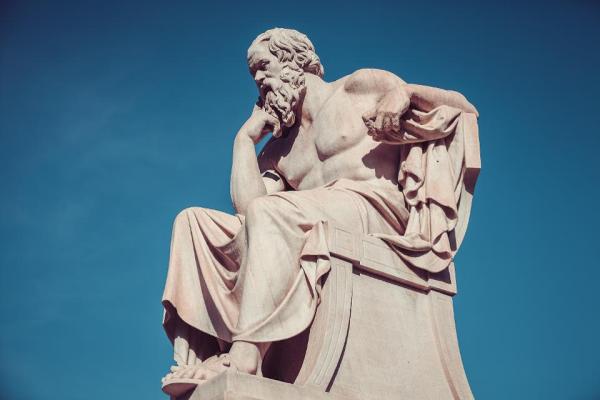
In the July/August 2001 issue of the late, great magazine Lingua Franca, James Ryerson [now a New York Times writer/editor] published an enthralling article about an anonymous benefactor who was paying professors huge sums of money to review a strange 60-page philosophical manuscript…
Read Ryerson’s fascinating intellectual detective story at “The Mystery of the Millionaire Metaphysician.” And after you’ve done that (lest you spoil the ending), read what became of that anonymous benefactor.
[Image above: source]
* William James
###
As we search for the moral in moral philosophy, we might spare a thought for William Penn; he died on this date in 1718. An English real estate entrepreneur, philosopher, early Quaker, and founder of the English North American colony the Province of Pennsylvania, he was an early advocate of democracy and religious freedom, notable for his good relations and successful treaties with the Lenape Native Americans. he directed the planning and development of the city of Philadelphia.

You must be logged in to post a comment.