Posts Tagged ‘music’
“I don’t consider it my violin. Rather, I’m its violinist. I am passing through its life.”*…

Jennifer Sandlin is (perfectly understandably) blown away by cellist-turned-photographer Charles Brooks’ images of the interiors of rare musical instruments…
… Each instrument appears as if it’s straight out of a dream — some look like futuristic structures, some like fantasy castles, and others like secret lairs of fantastical creatures. It’s hard to believe they’re real, and I’m just in awe of Brooks’ photography talent.
The photographs are part of Brooks’ “Architecture in Music” series, where, he explains, he “explore[s] the hidden spaces inside fine instruments” which have included a Steinway Grand Piano, the St. Mark’s Pipe Organ, and the Lockey Hill Cello (c. 1780, England), among many others…

Read on for more of the story: “Photographer captures the stunning interiors of rare musical instruments,” from @boingboing.net. See more of Brooks’ remarkable photos on his site. And hear him tell his story here:
* Ivry Gitlis (speaking of his 1713 Stradivarius violin)
###
As we cherish craftsmanship, those among us with a preference for reeds might note that today is Saxophone Day– a commemoration of the birth (on this date in 1814) of Adolphe Sax, a musician and inventor who created several new musical instruments (e.g., a redesigned bass clarinet still in use today), most notably the one that bears his name– the saxophone…

… while the brassier might celebrate the birthday (in 1854) of John Philip Sousa. A composer and conductor known primarily for American military marches (e.g., “The Stars and Stripes Forever,” National March of the United States of America. and “Semper Fidelis,” official march of the United States Marine Corps) he is widely acknowledged in the U.S. as “The March King.”

The press of unusually-intensive meetings is going to prevent posting tomorrow, so (R)D will be away for a day, returning on Saturday…
“The sound must seem an echo to the sense”*…

Of all the senses cultivated throughout the 19th century, it was the sense of hearing that experienced the most dramatic transformation, as the science of sound underwent rapid advancement. Lucas Thompson delves into a particular genre of popular acoustics primers aimed at children and amateurs alike, which reveal the pedagogical, ludic, and transcendental strivings of Victorian society…
In 1777, the German physicist Ernst Chladni, who would later be crowned the Father of Acoustics, designed an experiment that revolutionized our understanding of sound. After placing grains of sand on a thin metal plate and drawing a violin bow along one edge, Chladni watched in wonder as the sand danced and jiggled into surprising shapes — all perfectly even and symmetrical, but changing their formations depending on how the bow was used. In their beauty and complexity, these shapes (which the physicist himself cannily called “Chladni figures”) seemed to be arranged by invisible hands. In one simple and elegant experiment, sound had become visible.
Here at last was clear proof that sound was not produced by generating tiny particles of matter within air, as the dominant theorists of the seventeenth and eighteenth centuries had insisted, but was instead the result of vibrations from waves. While earlier claims about the wave-like properties of sound (which in fact date back to Aristotle’s Physics) had fallen mostly on deaf ears, Chladni’s experiment provided undeniable evidence that sound was caused by waves that could move through both air and matter.
Chladni’s ingenious demonstration also showed that sound could be observed in a variety of new ways, and would no longer be consigned to the invisible aether. Moreover, it was an easy experiment to replicate for anyone who could get their hands on a copper plate, a violin bow, and some sand. In fact, it was so widely reproduced that, in 1901, Annie Besant and Charles Leadbetter, in their wonderful (and completely bizarre) theosophical study Thought-Forms, could write that Chladni figures were “already familiar to every student of acoustics”, being “continually reproduced in every physical laboratory”…
[Thompson recounts a number of the more fascinating examples of the “citizen science” that Chladni inspired, with excerpts– and lovely illustrations– from some of the books that resulted…]
… Nowadays, the term “pop-science” is often used disapprovingly, as though something important is always lost when genuine scientific research is translated into less nuanced terms that the public can comprehend. But the hard distinction between professional and amateur science in our own era — between expertise and general interest — was not yet fully present in the nineteenth century.
To read these surprising, delightful, and often beautiful popular science books is to be made aware of the enormous gulf that has opened up between professional scientists and the public. As science became increasingly specialized in the twentieth century, the public were no longer able to follow along with new findings, let alone have any hope of reproducing important experiments. It is difficult to imagine an amateur enthusiast recreating the latest research, regarding the quantum phenomena of sound, for example, or the way that spiders “listen” to their surroundings via vibrations in their webs, at home. Of course, contemporary publishers still put out science primers, textbooks, and explainers, but something vital has vanished. The frontier of scientific discovery has receded from view, moving far beyond what non-specialists can comprehend. These nineteenth-century popularizing books arose during a brief period in which even children could somewhat keep pace with scientific advancement. They offer a crucial window into what has been lost, and reveal how new understandings of sound filtered through Victorian culture and beyond…
Experimenting with sound in 19th-century popular science: “Hooked on Sonics,” from @publicdomainrev.bsky.social.
Keep an ear out for a chance to experience the remarkable 32 Sounds (exhibition schedule here).
* Alexander Pope
###
As we listen, we might send sonorous birthday greetings to Mahalia Jackson; she was born on this date in 1911. A gospel singer and civil rights activist, she is considered one of the most influential vocalists of the 20th century. Through a career spanning 40 years, Jackson was integral to the development and spread of gospel blues in black churches throughout the U.S. During a time when racial segregation was pervasive in American society, she had considerable (albeit unexpected) success in her recording career, selling an estimated 22 million records and performing in front of integrated and secular audiences in concert halls around the world, making her one of the best-selling gospel music artists.

“We are the first generation to feel the effect of climate change and the last generation who can do something about it”*…

One of the issues that vexes coordinated response is a paradox that lies at the heart of the phenomenon: Earth’s climate is chaotic and volatile. Climate change is simple and predictable. How can both be true? Joseph Howlett explains…
The Earth’s atmosphere is nothing but freely roaming molecules. Left alone, they would drift and collide, and eventually even out into a mixture that’s dynamic, yet stable and broadly unchanging.
The sun’s rays complicate things. Energy enters the Earth system in daily cycles, the bulk of it going to whichever half of the planet is tilted toward the sun (and experiencing summer). The molecules in that half acquire more energy than others, which sets the global atmosphere steadily swirling. Depending on the season and location, molecules in our atmosphere might traverse warm land, then cold seas. They might encounter a mountain range that forces them to high altitudes, where the air pressure is low and water condenses. Then they might become part of large-scale phenomena, such as currents, atmospheric rivers, turbulent jet streams and continental fronts.
These phenomena are erratic. They interact at every scale and manifest as weather, from clear sunny days to blustery blizzards and the anomalous events — from hurricanes and polar vortices to hailstorms and tornadoes — that are happening with increasing intensity. Any thought of stability is illusory; no patch of molecules dances in isolation.
The result, from seemingly simple inputs of molecules and energy, is emergent, incalculable chaos. Some individual molecule in the room you are sitting in is careening about blindly and colliding with its immediate neighbors. Zoom out — block to city, field to landscape, region to continent — and patterns appear and intermix. Complexity abounds and compounds. Nothing in the atmosphere is untethered from the rest of the global picture.
We live with this unpredictable mess of an atmosphere every day. We tote around unopened umbrellas, or refresh weather apps and watch our weekend plans dissolve. Anticipating conditions any further out than a week or two is a fool’s errand. The Earth is a complex dynamical system — an interwoven mass of moving parts, each of which requires a different branch of science to understand. Even with advanced knowledge, sophisticated algorithms and modern instruments, it defies and eludes us.
Yet this engine of chaos is now under our influence. It is incontrovertible fact that we are changing the Earth’s temperature by adding more carbon dioxide to the atmosphere. We know exactly how we are changing it — that when we double the proportion of carbon dioxide in the thin layer that rests over the surface of the Earth, the planet will become 2 to 4 degrees Celsius warmer, overall, than it is today. This conclusion has remained essentially unchanged since 1896, when the Swedish scientist Svante Arrhenius arrived at an estimate of 2 to 5 degrees. (Using an extraordinarily simplified picture of Earth, he made a number of mistakes that, in the end, balanced out.) Some details may remain uncertain, some chaos untamable, but the basic conclusion is a matter of unwavering scientific agreement — 97% is a rare degree of consensus on almost any subject. We are nearly as sure of this as we are of the causes of infectious disease, or how stars form, or the fact that life evolves through natural selection.
oth things are true: The climate system is vastly complex, and we’re certain about what we are doing to it. How can we be so confident in a hundred-year projection when we can’t predict the weather with any reliability more than a week out?
“How can it be that both are true?” said Nadir Jeevanjee, an atmospheric physicist at NOAA’s Geophysical Fluid Dynamics Laboratory, a leading institution for cutting-edge simulations of the atmosphere. “It’s a huge tension that’s lurking behind the whole conversation.”
It turns out that complexity can be a veil concealing more basic truths. An enormously complicated system can yield simple answers. You just have to ask a simple enough question…
Read on for Howlett’s fascinating– and important– explanation: “The Climate Change Paradox,” from @quantamagazine.bsky.social.
And for a reminder that this matters (as though we need one…): “Human-Caused Warming Tripled the Death Toll of European Heat Waves This Summer, New Report Shows,” from @insideclimatenews.org.
* Barack Obama
###
As face reality, we might recall that on this date in 1988, the #1 song in the U.S. was Bobby McFerrin‘s “Don’t Worry, Be Happy,” the first a cappella song to reach the top of the Billboard Hot 100 chart, a position it held for two weeks.
(Produced by Colossal Pictures, Directed by Drew Takahashi)
“Power tends to corrupt, and absolute power corrupts absolutely”*…
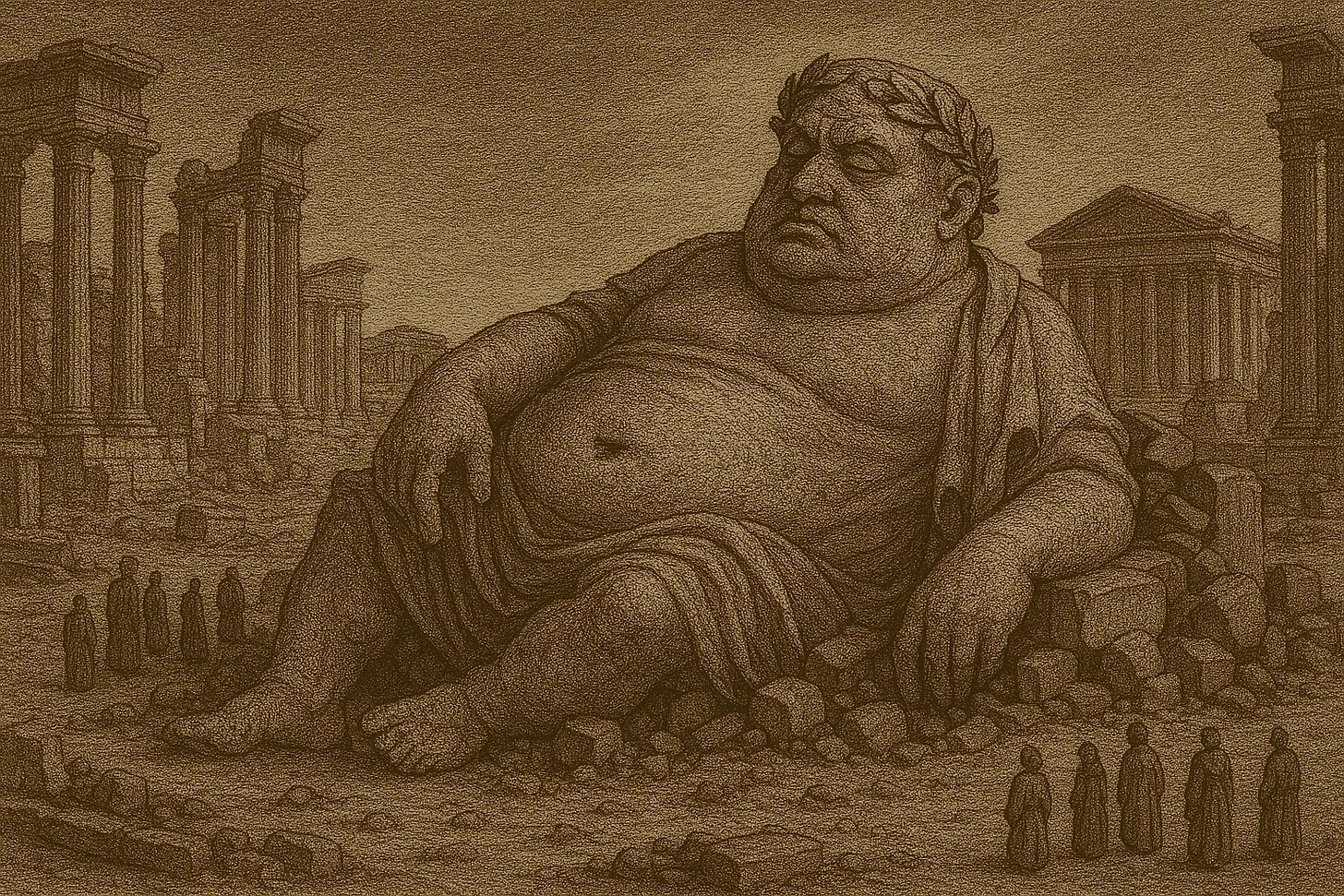
The estimable Henry Farrell has re-posted a (slightly revised) piece that was sub-linked in an early (R)D– a compelling argument that “we need, right at the moment, to think very clearly about how power is won or lost”…
… The current U.S. president is looking to seize power that he clearly is not entitled to under the law and the constitution, and that will usher through some kind of regime change if he succeeds. Many people are trying to resist. What are Trump’s strengths and weaknesses? What are the strengths and weaknesses of those who want to oppose him?
There’s a simple account of power that I think is useful here. It is developed in this paper by the late Russell Hardin, but really descends from David Hume’s understanding of politics.
The fundamental argument is this: that power in modern societies depends on social coordination. That is just as true of aspiring authoritarians like Trump as of the people who want to mobilize against him. As Hume says (quoted in Hardin):
No man would have any reason to fear the fury of a tyrant, if he had no authority over any but from fear; since, as a single man, his bodily force can reach but a small way, and all the farther power he possesses must be founded either on our own opinion, or on the presumed opinion of others.
Those who want to win power can only do so by persuading others. All tyrants must worry that their grip on power rests on such opinion. Hardin:
As a contemporary lawyer puts this argument: “No state could possibly compel people to obey all these rules at gunpoint; there would not be enough soldiers and policemen to hold the guns (a sort of Orwellian vision of society), they would have to sleep sooner or later, and then anarchy might break out.”
Equally, even if the people might overwhelm the tyrant if they ever joined together, it is very hard for them to organize against him, especially in a fully developed authoritarian state.
That is why authoritarian rulers devote a lot of time to preventing unrest from breaking out. Their best strategy for survival is to actually be popular. But that is hard to keep up. Acceptable substitutes include preventing people from discovering how unpopular the regime is, controlling media (to prevent coordination), and deploying the threat of physical violence to intimidate.
The problem with all of these strategies is that the ruler can do none of it on their own. Even the threat of violence, when looked at closely, requires some degree of willing coordination among the soldiers and policemen. That is why dictators are so careful about how they treat their armed forces. Authoritarians need to worry about the masses, but even more about their own coalitions.
More generally: struggles for power are struggles over the means of coordination. Who is capable of coordinating better, wins. And want-to-be authoritarians and mass publics face different coordination problems.
If you are an aspiring authoritarian, your strategy is to persuade others that they need to be part of your coalition. Hardin (this time on Adam Smith):
In a competitive world of pastoralists, one benefits best from association with the most powerful tribe. Hence, if someone rises to capable leadership with [sic] a tribe, others will be attracted to join with it. The result eventually will be remarkable power in the control of the leader of the tribe. Combination for the sake of survival then makes it possible not merely to survive but to thrive and even to plunder.
In more modern circumstances, your best strategy as an aspiring tyrant is likely to convince others (a) that they do live in a society of competing groups, and (b) that the smart money will always be on joining the dominant group, and not being one of the dominated ones.
Hardin continues:
This is essentially an argument from coordination. We coalesce because it is individually in our interest to do so as long as others do so as well. What we need to guide is in coalescing with others is merely the evidence of sufficient leadership and sufficient members to make our joining them clearly beneficial.
That, however, isn’t quite right. The authoritarian who wants to build a ruling coalition needs not only to make her success seem like a fait accompli. She also needs to persuade others that they will prosper rather than suffer from joining. The aspiring authoritarian needs to persuade allies that she (and they) will predate on outgroups, and that she will not predate on the allies themselves.
That process of persuasion becomes more difficult, the more unbounded the ambitions of the wannabe authoritarian are (I lay out a version of this argument here, in a paper that began from a conversation with Hardin and Margaret Levi a quarter of a century ago). The more powerful and unruly the authoritarian becomes, the more readily they can make promises or threats. Equally, the less credible those promises or threats become, both to allies and to enemies.
Absolute power implies absolute impunity: if I enjoy such power, I have no incentive to behave trustworthily to anyone. For just the same reason, no-one has any incentive to trust me. You will not believe my promises, and you may fear that if you give in to my threats, you will only open yourself to further abuse. Thus – as I, as an aspiring authoritarian move closer to unbounded control, I need to artfully balance the benefits that my power can bring to my allies with the fear those allies may reasonably have over what happens should that power be turned against them.
The problem faced by mass publics is different. For all the language about the ‘tyranny of the masses,’ they find it difficult to coordinate on rewarding friends and punishing enemies. That makes them less likely to go bad, at least in the way that tyrants can go bad. But it also makes it more difficult for them to coordinate against incipient tyranny, even when they know that everyone would be better off if they did.
On the one hand, under some circumstances, the costs of action may be quite low. If protest is cheap, then protestors are playing a nearly pure coordination game, where everyone will resist if they reasonably assume that everyone else will resist too. Hardin:
coordination may so greatly reduce costs that the latter are almost negligible, so that the slightest moral commitment may tip the scales toward action. Just as it would be odd for many Americans in communities in which voting is easy to balk at the minor cost in inconvenience, so it might seem odd for many workers or soldiers or others to balk at joining a crowd to march on the palace or the Bastille. This is not identical to a multiple coordination problem, such as that in the driving convention, in which one simply wants to go with the majority. In the revolutionary coordination, one has an active preference between the outcome of full attack and that of no attack. Still, one prefers to attack if enough others do and not to attack if enough others do not.
On the other, rulers and aspiring rulers can recognize this risk and counter-attack.
It was perhaps the startling ease with which spontaneous revolutions took control in cities that led the French under Thiers to put down the Paris Commune with such thoroughgoing brutality as to make it seem more nearly like murder than warfare. The answer to the coordination explanation of revolutionary action is draconian force. This lesson of the Commune has been learned well by many later regimes and leaders in various places, such as the Nazis in Czechoslovakia, Stalin in the Soviet Union, Pinochet in Chile, and Videla in Argentina, with their harsh, blanket suppression of dissenters and potential dissenters. They raise the likely costs of revolutionary activity enough to change its structure. … If the old state raises the costs enough to individuals for revolutionary activity, it overcomes the power of coordination to reduce the costs of revolutionary activity. It forces potential revolutionaries to see their problem overwhelmingly as a prisoner’s dilemma in which free-riding is in the individuals’ interest.
This helps explain some of the actions of Trump and those around him. Their approach to both universities and law firms has been to make simple coordination seem like a prisoner’s dilemma, by picking off opponents, one by one, and by trying to create a common understanding that collective resistance is useless, since your potential allies are likely to defect. The early decision of one extremely prominent law firm, Paul Weiss, to defect, shaped common expectations so that several others rushed immediately to defect too, for fear that they would be stranded amidst the dominated group, rather than joining the dominating coalition in a subordinated role.
To bring the different strands of the argument together, Trump’s strategy has been much less effective than it might have been. Trump has shown he is unwilling to stick by deals. Law firms that have submitted find that they are on the hook for far more than they bargained for. Columbia University, after making humiliating and profound concessions, finds that it is expected to make far greater ones, with no guarantee that even these will satisfy the Trump administration’s demands
As a whole body of research on “tying the king’s hands” argues, independent actors will prefer to flee monarchs who refuse to be bound rather than to cooperate with them, because they know that such monarchs can’t be trusted. Any deal that they make can later be un-made, and probably will be, if unmaking it is to the king’s advantage. The best option may be not to submit, especially if you believe that others are similarly unwilling to comply. This may, in effect, turn what was a prisoner’s dilemma (in which everyone’s best strategy is to defect) back into a nearly pure coordination game again, allowing easier collective resistance.
Or, it may not. If people don’t have reason to believe that others will stand up, then they still are unlikely to stand up themselves.
This then, gives us a simplified but useful understanding of where we are right now. The good news is that the Trump administration is playing its hand very badly. If Trump had been more willing to accept defectors into his camp, by sticking to deals that gave them something worth having, he would be in a much stronger situation than he is at the moment. Furthermore, and somewhat less obviously, this may also disrupt his own existing coalition. Wall Street, for example, may worry that it is next for the chopping block. Silicon Valley the same.
The bad news is that the opposition is much more disorganized than it ought to be. Coordination is bolstered by shared knowledge that others will coordinate too. We don’t have that, in part because of lack of leadership, in part because of a media landscape that makes it difficult to generate such shared knowledge. Remember Hume’s phrase about the “presumed opinion of others.” Our presumptions about what other people think can play an extraordinarily powerful role in shaping how we ourselves think, and what we are prepared to do. And in a country where such presumptions can be grossly skewed, it can be very hard to generate coordinated action. Finally, exactly because the opposition is disorganized, and because humans are human, it faces its own collective version of Trump’s temptation to humiliate and subjugate defectors from the other side, rather than welcoming them in.
The strategic implications for what to do are not surprising. Leadership is crucial. It is really, really hard to make a coalition cohere if the plausible leaders abdicate. More generally, figure out how to generate common knowledge that will enable coordination. Protests – especially if they are widespread, and especially if they happen in unusual places, or involve surprising coalitions can help generate information cascades. But getting media coverage and broader conversation is important.
Welcome in the strayed sheep, and work on widening the cracks in the other coalition. Leopard-face-eating memes may feel personally satisfying, but they usually do not ease the process of converting disillusioned opponents into active allies. As Adam Przeworski says, the Polish coalition to push back against the populists only succeeded when people who were ferociously divided over a moral issue agreed to make common cause.
Crucially, the parties forming the alliance agreed not to confront the major issue that divided them: abortion. They agreed that defending democracy was more important than whatever values divided them, and that conflicts over abortion would be managed once victory over PiS was secured. Hence, both the opponents and the supporters of the freedom of choice could promise their respective electorates that they would promote their values if democracy was restored, while claiming that the immediate task was to restore it.
If power involves coordination, coordinate! Help build your coalition as far as it can go. Do everything you can to minimize defections from it, and to maximize defections from the other side. Take advantage of the opposition’s vulnerabilities and mistakes – especially the trust problems that are likely to flourish in a coalition around an actor who aspires to untrammeled power and is deeply untrustworthy.. Assume that the other side is trying to attack your own vulnerabilities, and mitigate as much as possible. And do what you can now; things are likely to get much harder, very quickly, if the opposition’s victory becomes a self-confirming expectation…
The respective vulnerabilities of tyrants and crowds: “Absolute power can be a terrible weakness,” from @himself.bsky.social.
Pair with: “Power always reveals.”
And apposite: “Two scholars ask whether democracy can survive if AI does all the jobs,” gift article from The Economist.
###
As we get it together, we might recall that it was on this date in 1962 that Bob Dylan appeared for the first time at Carnegie Hall in New York City as part of a hootenanny which included his first public performance of “A Hard Rain’s a-Gonna Fall.”
“The best way out is always through”*…

Adam Mastroianni (and here) with a diagnosis of the malaise (“Borg vibes,” as he calls them) that so many of us feel– and a remedy (or, at least, a constructive response)…
Everyone I know has given up. That’s how it feels, at least. There’s a creeping sense that the jig is up, the fix is in, and the party’s over. The Earth is burning, democracies are backsliding, AI is advancing, cities are crumbling—somehow everything sucks and it’s more expensive than it was last year. It’s the worst kind of armageddon, the kind that doesn’t even lower the rent.
We had the chance to prevent or solve these problems, the thinking goes, but we missed it. Now we’re past the point of no return. The world’s gonna end in fascists and ashes, and the only people still smiling are the ones trying to sell you something. It feels like we’re living through the Book of Revelation, but instead of the Seven Seals and the apocalyptic trumpeters, we have New York Times push notifications.
On the one hand, it’s totally understandable that these crises would make us want to curl up and die. If the world was withering for lack of hot takes, I’d assemble a daredevil crew and we’d be there in an instant. But if history is heading more in the warlords ‘n’ water wars direction, I’m out.
On other hand, this reaction is totally bonkers. If our backs are against the wall, shouldn’t we put up our dukes? For people supposedly facing the breakdown of our society, our response is less fight-or-flight and more freeze-and-unease, frown-and-lie-down, and despair-and-stay-there.
Maybe humanity has finally met its match, but even though people talk like that’s the case, the way they act is weirdly…normal. Every conversation has a dead-man-walking flavor to it, and yet the dead men keep on walking. “Yeah, so everything’s doomed and we’re all gonna die. Anyway, talk to ya later, I gotta put the lasagna in the oven.” If things are just about to go kaput, why is everyone still working 60 hours a week?
Something strange is going on here, and I’d like to offer an explanation in two parts: a wide circle, and a bullet with a foot in it…
Eminently worth the read: “Use this magic bullet to shoot yourself in the foot,” from @mastroianni.bsky.social.
Pair with: “Apocalypse 24/7” (an excerpt from Roy Scranton‘s Impasse: Climate Change and the Limits of Progress)… a deeper, darker– but sadly, all-too-credible– dive into the context that Mastrioanni sketches… while (as your correspondent reads it, anyway) it doesn’t contradict Mastroianni’s prescription (“pick up a sponge and start washing”), it reminds us just how much grime there is to get through… all the more reason to get started…
* Robert Frost
###
As we grapple, we might recall that it was on this date in 1965 that Bob Dylan’s “Positively 4th Street” was released. Dropping between Highway 61 Revisited and Blonde on Blonde, as the follow-up to Dylan’s hit single “Like a Rolling Stone“, it was not included on either album. But it reached No. 1 on Canada’s RPM chart, No. 7 on the U.S. Billboard Hot 100, and No. 8 on the UK Singles Chart, and has been ranked by Rolling Stone No. 203 in their 500 Greatest Songs of All Time list.

You must be logged in to post a comment.