Posts Tagged ‘movies’
“Censorship reflects a society’s lack of confidence in itself”*…

Jodi Picoult‘s books are being pulled off of Florida school library shelves; she explains why we should care…
In the past six months, my books have been banned dozens of times in dozens of school districts. As sad as it seems, I was getting used to the emails from PEN America’s Jonathan Friedman telling me that yet again, my novel was under attack. But this week, something truly egregious happened. In Martin Country School District, 92 books were pulled from the school library shelves. Twenty of them were mine.
The 92 books fell into three categories: those with mature content, those written by BIPOC authors, and those written by LGBTQ authors. My books were removed because they were, according to the sole parent who made the challenge, “adult romance that should not be on school shelves.” It is worth noting I do not write adult romance. The majority of the books that were targeted do not even have a kiss in them. What they do have, however, are issues like racism, abortion rights, gun control, gay rights, and other topics that encourage kids to think for themselves.
When I read through the list of the 20 novels of mine that were pulled from the Martin County School District bookshelves, one surprised me the most. The Storyteller is a novel about the Holocaust. It chronicles the growth of anti-Semitism and fascism in Nazi Germany. There was a strange irony that a parent wanted this particular book removed, because it felt a bit like history repeating itself…
Florida has passed very broadly worded laws that limit what books can and cannot be in schools. Teachers who do not obey face penalties. Every book in a school must be reviewed by a media specialist and schools are told to “err on the side of caution.”
Some activists and parents have taken these laws as free reign to remove whatever books they personally do not deem acceptable. Some districts take the books off shelves “pending review”— but months and years go by without a review, and the books remain locked away. The outcome has been empty shelves in Florida classrooms and school libraries, where teachers and media specialists don’t only ban books that have been challenged but, in fear of future retribution, also remove other books that might result in punitive measures. The result? Students don’t have access to certain titles.
…
Many of my writer friends whose books have been challenged hear the same refrain: “Kids can just get those books somewhere else!” Unfortunately, not every kid has access to a public library or transportation to get there; for many, a school or classroom library is their only resource. We also hear: “Oh, that’s just gonna drive up sales!” Trust me, none of us want that. What we want is for kids to be able to read what they want to read, instead of being told what they should read. We want the great majority of folks in communities who support the freedom to read to be just as loud as those select few who are making so much noise against it.
In the brilliant words of Dr. Rudine Sims Bishop, books create windows through which kids can escape and mirrors in which they can find themselves. We want you to stand in solidarity with us, the writers who create these books. Because we’ve seen, historically, what the next chapter looks like when we don’t speak out against book challenges… and that story does not end well…
Eminently worth reading in full: “What Florida Doesn’t Want You to Know About Its Book Bans,” from @jodipicoult in @thedailybeast.
* Potter Stewart (Supreme Court Justice, 1958-81)
###
As we encourage curiosity, we might spare a thought for a man with some personal experience of censorship, Jan Němec; he died on this date in 2016. A filmmaker, he was the the “enfant terrible of the Czech New Wave.”
His best known work is A Report on the Party and the Guests (1966), about a group of friends on a picnic who are invited to a bizarre banquet by a charismatic sadist, who eventually bullies most of them into blind conformity and brutality while those who resist are hunted down. It was not a hit with Czech authorities, who had it banned. (Antonín Novotný, the president, was said to “climb the walls” on viewing it and Němec’s arrest for subversion was considered.)
He was in the middle of shooting a documentary about the Prague Spring for a US producer when the Warsaw Pact invasion of Czechoslovakia occurred. He smuggled his footage of invasion to Vienna, where it was broadcast on Austrian television. He re-edited the footage released the documentary Oratorio for Prague. It received standing ovations at the New York Film Festival in the fall of 1968. Němec’s footage would eventually be used by countless international news organizations as stock footage of the invasion; and Philip Kaufman’s film adaptation of The Unbearable Lightness of Being (1988) also used footage from the film (on which Němec served as an advisor).
Němec was given a warning by the government that “… if he came back, they would find some legal excuse to throw him in jail.” From 1974 to 1989, he lived in Germany, Paris, the Netherlands, Sweden, and the United States. He stayed in the U.S. for twelve years. Unable to work in traditional cinema, he was a pioneer in using video cameras to record weddings (documenting, for example, the nuptials of the Swedish royal family).
After the fall of communism in Czechoslovakia in 1989, he returned to his native country, where he made several films, including Code Name Ruby (1997) and Late Night Talks with Mother (2000), which won the Golden Leopard at Locarno.

“Round and round they went with their snakes, snakily”*…
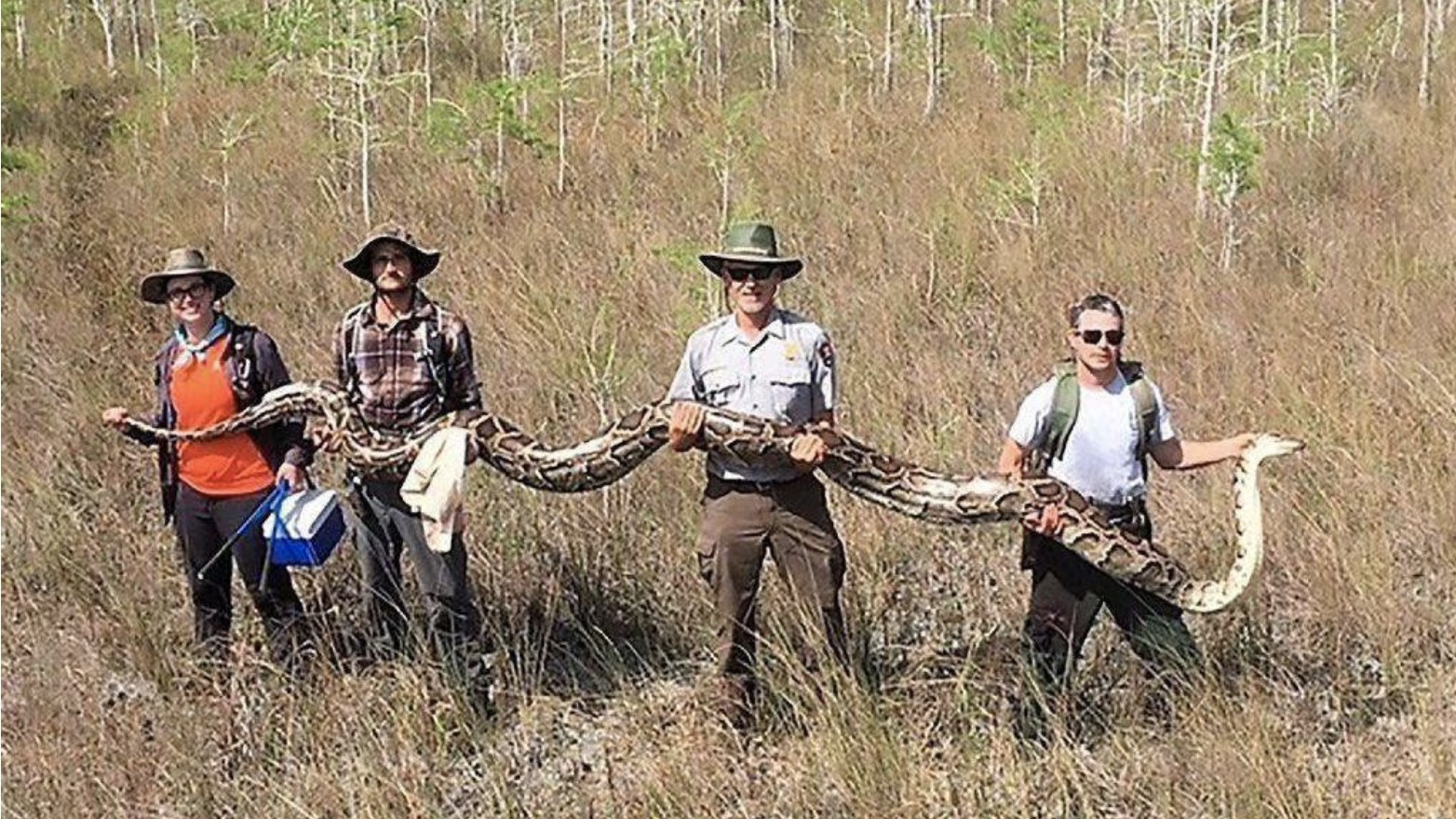
Florida…
Burmese pythons are too good at what they do — they’re nearly undetectable to both humans and their prey, they barely need to move and when they do they’re deadly. On top of that, they have lots of babies.
As a result, according to an ambitious new paper produced by the U.S. Geological Survey, their population has exploded in only 20 years from a few snakes at the southern tip of Everglades National Park to an invasion that envelops the southern third of Florida…
The success of these snakes, which are native to Southeast Asia, and came here via the exotic pet trade, has been a cataclysmic failure for South Florida ecosystems and “represent one of the most intractable invasive-species management issues across the globe,” said the paper…

When biologists open the invasive snakes up, it’s like rifling through a Florida field guide. All told, they’ve found 76 prey species inside the snakes. That includes lots of birds, such as vultures, crows, ducks, herons, roseate spoonbills and threatened wood storks; small mammals such as the endangered Key Largo woodrat and Key Largo cotton mouse, marsh rabbits, armadillos, possums, raccoons, otters and domestic cats, and larger prey including domestic goats, white-tailed deer, wild hogs and alligators….
How much damage have they done? Guzy points out that before 2000, researchers could frequently spot mammals in Everglades National Park. But from 2003 to 2011, the frequency of mammal observations [raccoons, opossums, bobcats, rabbits, gray foxes, and white-tailed deer] declined by 85% to 100%. Outside the python’s range, those species were more common.
Snakes on a plain: “Python invasion has exploded out of the Everglades and into nearly all of southern Florida,” from @SunSentinel.
* Aldous Huxley, Brave New World
###
As we tread carefully, we might recall that it was on this date in 2006 that New Line Cinema ordered five days of additional shooting on what had been a minor film in their 2006 line-up, Pacific Air Flight 121 (principal photography had wrapped in September 2005). While re-shoots normally imply problems with a film, the producers opted to add new scenes to the film to change the MPAA rating from PG-13 to R and bring it in line with growing fan expectations… expectations that had been raised when (at star Samuel L. Jackson’s insistence) the film’s title had reverted to its original working form: Snakes on a Plane.
More than 450 snakes were used for filming to represent 30 different species of snakes, including a 19-foot (5.8 m) Burmese python named Kitty.

“Hard times arouse an instinctive desire for authenticity”*…

… but that authenticity can be hard to find…
In 2016, US retailer Target severed ties with textile manufacturer Welspun India after discovering that 750,000 sheets and pillowcases labelled Egyptian cotton were not 100% Egyptian after all.
Egypt has long been known for producing long- and extra-long-staple cotton, a variety of the crop with especially long threads that results in softer and more durable fabric – so products labelled Egyptian typically command a higher price. But the year after the Welspun incident, the Cotton Egypt Association estimated that 90% of global supplies of Egyptian cotton in 2016 were fake.
Egyptian cotton is not the only fabric that has fallen foul of mislabelling in recent years. In 2020, the Global Organic Textile Standard (Gots) said that 20,000 tonnes of Indian cotton had been incorrectly certified as organic – around a sixth of the country’s total production. In 2017, a Vietnamese silk brand admitted that half of its silk actually came from China. And in 2018, several British retailers had to withdraw “faux” fur products that turned out to be the real thing.
From choosing an organic cotton T-shirt to buying trainers made out of recycled plastic bottles, many of us opt to pay more in the hope that our purchase will be better quality, or help people or the planet. However, as the Welspun incident and others have shown, when it comes to textiles, we’re not always getting what we think we’ve paid for…
How can we tell if the clothes in our wardrobes really are what they claim to be? “Why fabric fraud is so easy to hide,” from @BBC_Future.
* Coco Chanel
###
As we root around for the real, we might recall that it was on this date in 1938 that Howard Hawks’ comedy Bringing Up Baby premiered at the Golden Gate Theater in San Francisco. Featuring Cary Grant, Katherine Hepburn, and a leopard, the film earned good reviews but suffered at the box office. Indeed, Hepburn’s career fell into a slump– she was one of a group of actors labeled as “box office poison” by the Independent Theatre Owners of America– that she broke with The Philadelphia Story (again with Grant) in 1940.
As for Bringing Up Baby, the film did well when re-released in the 1940s, and grew further in popularity when it began to be shown on television in the 1950s. Today it is recognized as the authentic screwball classic that it is; it sits at 94% on Rotten Tomatoes, and ranks among “Top 100” on lists from the American Film Institute and the National Society of Film Critics.

“There’s no accounting for taste”*…

As Matthew Baldwin demonstrates, the praise of professional critics hardly matters to the book-reviewing readers at Amazon.com…
The following are excerpts from actual one-star Amazon.com reviews of books from Time’s list of the 100 best novels from 1923 to the present. Some entries have been edited.
Beloved by Toni Morrison (1987)
“Morrison’s obviously a good writer, but truly, her subject matter leaves a LOT to be desired in this book. It’s raunchy beyond belief. People do things with farm animals that they shouldn’t. I couldn’t get through the first two chapters without vomiting. Some things you just shouldn’t put in your head.”…
The Catcher in the Rye by J.D. Salinger (1951)
“So many other good books…don’t waste your time on this one. J.D. Salinger went into hiding because he was embarrassed.”…
The Grapes of Wrath by John Steinbeck (1939)
“While the story did have a great moral to go along with it, it was about dirt! Dirt and migrating. Dirt and migrating and more dirt.”…
The Sound and the Fury by William Faulkner (1929)
“This book is like an ungrateful girlfriend. You do your best to understand her and get nothing back in return.”…
More at “Lone Star Statements,” a compilation of the best of the worst… about the best. From @TheMorningNews.
Apposite: “The Strangely Beautiful Experience of Google Reviews“
* An English adaptation of the medieval (Scholastic) Latin saying “De gustibus non est disputandum” (regarding taste, there is no dispute)
###
As we contemplate connoisseurship, we might recall that it was on this date in 1927 that Louis B. Mayer presided over the founding of the Academy of Motion Picture Arts and Sciences.
Anxious to create to create an organization that would mediate labor disputes without unions and improve the film industry’s image, he envisaged an elite club open only to people involved in one of the five branches of the industry: actors, directors, writers, technicians, and producers. He gathered a group of thirty-six industry leaders at a formal banquet at the Ambassador Hotel in Los Angeles, and presented them what he called the International Academy of Motion Picture Arts and Sciences. Everyone in the room that evening became a founder of the Academy. Between that evening (this date in 1927) and the filing of the official Articles of Incorporation for the organization (on May 4, 1927), the “International” was dropped from the name. Labor negotiations were also briskly dropped, leaving the organization to focus on promoting the industry.
In 1929, Academy members, in a joint venture with the University of Southern California, created America’s first film school to further the art and science of moving pictures. The school’s founding faculty included Douglas Fairbanks (President of the Academy), D. W. Griffith, William C. deMille, Ernst Lubitsch, Irving Thalberg, and Darryl F. Zanuck.
But their most recognizable venture into image enhancement was also born in 1929: the Academy held it’s first annual awards ceremony, bestowing the first “award of merit for distinctive achievement,”-what has become the Academy Awards– the Oscars.

“I know that there are people who do not love their fellow man, and I hate people like that!”*…
After this post, your correspondent begins his annual Holiday Hiatus, so let me pass along a gift. Regular service will resume on January 2; meantime, thanks to you all for reading– and Happy Holidays!

Ladies and Gentlemen, the remarkable Tom Lehrer…
Between the… Weird Al biopic and and Kelly Bachman and Dylan Adler’s new comedy album, Rape Victims Are Horny Too, parody songsters have rarely been such a central part of the cultural zeitgeist. Yet comedy musicians have been trailblazing for much longer than we may realize, and before the popularity of Weird Al, or even Bo Burnham, Adam Sandler, and Steve Martin, there was Tom Lehrer.
Lehrer is perhaps best known for “The Elements,” an impossibly fast and impossibly tongue-twisty song that consists of all the periodic elements put to the tune of a “Major-General’s Song” from Pirates of Penzance. This is a classic Tom Lehrer song, so classic in fact that Daniel Radcliffe’s rendition of it on The Graham Norton Show helped score him the role of Weird Al, who has noted Lehrer as a major comedic influence. This full circle loop only emphasizes how important Lehrer was and continues to be in the musical comedy scene, and diving into his diverse oeuvre solidifies just how innovative he was…
“Tom Lehrer Deserves Your Attention” (source of the photo above)
And it’s now easier than ever for you to pay him that attention: the remarkable Mr. Lehrer is also remarkably generous. Last month, a new web site appeared, the home page of which explains…
I, Tom Lehrer, and the Tom Lehrer Trust 2007, hereby grant the following permissions:
All copyrights to lyrics or music written or composed by me have been relinquished, and therefore such songs are now in the public domain. All of my songs that have never been copyrighted, having been available for free for so long, are now also in the public domain.
The latter includes all lyrics which I have written to music by others, although the music to such parodies, if copyrighted by their composers, are of course not included without permission of their copyright owners. The translated songs on this website may be found on YouTube in their original languages.
Performing and recording rights to all of my songs are included in this permission. Translation rights are also included….
The site contains all of his lyrics, and free streaming and downloadable versions of all of his albums– a satirical gold mine: “Songs and Lyrics by Tom Lehrer.”
* Tom Lehrer
###
As we soak ourselves in satire, we might recall that it was on this date in 1986 that Fran Oz’s film Little Shop of Horrors premiered. Based on the Off-Broadway musical adaptation of the 1960 original Roger Corman movie, it was a huge success with critics and a modest success with audiences on release, but has since become cult film.
As Oz’s friend and Muppet colleague Jim Henson said, “the lip sync on the plant in that film is just absolutely amazing.”

You must be logged in to post a comment.