Posts Tagged ‘investment’
“We cannot reason ourselves out of our basic irrationality. All we can do is to learn the art of being irrational in a reasonable way.”*…

Classical economists posit that investment decisions are driven by rationality — a clear-eyed evaluation of risks and rewards… but then, meme stocks.
Kwabena Donkor, an assistant professor of marketing at Stanford Graduate School of Business has just unveiled some new research that suggests that identity distorts our financial choices, leading us to overvalue investments that reinforce our sense of self…
People don’t just invest with their wallets — they invest with their identity,” says Donkor, a faculty fellow at the Stanford Institute for Economic Policy Research.
In a novel field study involving soccer fans, Donkor and several colleagues uncover evidence of how identity can skew economic thinking. The researchers ran a series of experiments focused on fans who placed nearly 40,000 bets on English Premier League matches during the 2021-22 season. Participants — nearly 800 from Kenya and 1,600 from the United Kingdom — were given a budget and asked to place bets on upcoming matches. They received winnings based on the outcomes of randomly selected games.
Most of the participants were longtime supporters of a particular team. (Manchester United was their top favorite.) They were more optimistic about their favorite teams, betting 20% more on them. They rated their teams as having a 10% to 18% higher chance of victory than other teams, even when presented with forecasts from professional oddsmakers suggesting otherwise. These results persisted even after accounting for factors such as personal beliefs and appetite for risk.
The study also finds that participants placed a lower value on gains not aligned with their identity — what the researchers referred to as an “identity tax.” Fans effectively devalued these neutral bets by 17% to 27%. For poorly performing teams, this “tax” could soar as high as 47%, reflecting a strong emotional impulse to support their favorite team even when the odds were against it
The research, detailed in a paper cowritten with Lorenz Goette of the National University of Singapore, Maximilian Müller of the Toulouse School of Economics, Eugen Dimant of the University of Pennsylvania, and Michael Kurschilgen of UniDistance Suisse, shows that identity-driven preferences explain much of the gap in bettors’ behavior. Simulations showed that distorted beliefs due to identity account for as much as 44% of the difference in fans’ betting behavior. The remainder stemmed from preferences rooted in identity itself — people were willing to sacrifice potential gains to support options that aligned with who they are…
… The study’s findings have far-reaching implications for understanding economic behavior, particularly in areas like consumer finance, brand loyalty, and even political decision-making…
… the research hints at how consumers view different products. Items that align with a person’s identity are likely to be seen as complements rather than substitutes. For example, Donkor says a consumer who identifies strongly with sustainability might view eco-friendly products as essential enhancements to their lifestyle, even if they’re similar to comparable, less expensive goods.
Ultimately, these findings could improve our thinking about the biases that influence our financial lives. As the researchers point out, acknowledging the role of identity in decision-making is one key to designing better policies, creating more effective financial products, and ultimately improving individual welfare. “If we ignore identity,” Donkor concludes, “we miss the bigger picture in decision-making.”…
Understanding the choices that we, and those around us, make: “What Soccer Fans Can Teach Us About Making Irrational Decisions,” from @SIEPR.
* Aldous Huxley
###
As we ponder the price (and as a reminder that there are other kinds of irrational decisions and that sometimes returns do matter to investors), we might recall that it was on this date in 2008 that Bernard “Bernie” Madoff was arrested and charged with defrauding investment clients of as much as $65 billion. A pioneer in electronic trading and chairman of the Nasdaq stock exchange in the early 1990s, he had turned to money management. By 2008, Madoff was running a huge and growing fund that promised its investors high and stable returns… the problem: it was a Ponzi scheme, the largest known Ponzi scheme in history.

“We hear all this talk about integrating the world economically, but there is an argument to be made for not integrating the world economically”*…

… and indeed, those arguments seem to be holding increasing sway. Tyler Cowan ponders the possible economic implications of a future in which global economic interdependence recedes– a future in which globe’s economies, freer of each other, don’t rise and fall with each other (as they largely have for decades) to the same extent…
Will we see less co-movement in global economic growth?
That is the question behind my latest Bloomberg column (soft pay wall). China is now, and looking forward, less of a common growth driver around the world. Oil price shocks may not be less important for humanitarian outcomes, but they matter less for many of the largest economies. America is now an oil exporter, and the EU just made some major adjustments in response to the Russia shock. More renewable energy is coming on-line, most of all solar.
The column closes with this:
In this new world, with these major common shocks neutered, a country’s prosperity will be more dependent on national policies than on global trends. Culture and social trust will matter more too, as will openness to innovation — and, as fertility rates remain low or decline, so will a country’s ability to handle immigration. A country that cannot repopulate itself with peaceful and productive immigrants is going to see its economy shrink in relative terms, and probably experience a lot of bumps on the way down.
At the same time, excuses for a lack of prosperity will be harder to come by. The world will not be deglobalized, but it will be somewhat de-risked.
Dare we hope that these new arrangements will produce better results than the old?
Or perhaps a more general rising tide was the only way many countries were going to make progress?
Marginal Revolution
Byrne Hobart reflects further…
When economies were tightly linked, growth in the US led to more demand for manufactured goods from China, which created more demand for raw materials from other parts of the developing world. But if that link is weaker, it’s entirely possible for there to be a boom in some places and a bust elsewhere. That probably increases the personal returns from global macro investing while decreasing its social return: when the world is closely-linked, there are massive positive externalities in predicting recessions, because there are so few places to hide. It’s comparatively less essential for the world to know that German is slowing down but growth in Indonesia is picking up, but it also means that macro questions are more tractable.
The Diff
* Arundhati Roy
###
As we think tectonically, we might recall that it was on this date in 1865 that the U.S. first issued Gold Certificates.
Americans began to move out west in the first half of the 19th century. Banks started printing their own money to fund land purchases, and that quickly led to two problems: loose money-printing had a volatile effect on prices, and it became increasingly hard to tell what was counterfeit from what wasn’t.
To tackle these problems, the government decreed in the 1830s that it would only accept transactions in gold and silver. But of course, lugging metals around is nobody’s idea of fun. So in 1863, Congress paved the way for the first “gold certificates” to be printed two years later, in November 1865.
A gold certificate was, in effect, a form of paper currency backed by gold – although not entirely. The Treasury was allowed to issue $120 in gold certificates for every $100-worth of gold it held in its vaults…
MoneyWeek

“I Seen My Opportunities and I Took ’Em”*

U.S. Senators and Congresspeople are routinely privy to news that easily fits the definition of insider information (“a fact about a public company’s plans or finances that has not yet been revealed to shareholders and that could give an unfair advantage to its possessors if acted upon“), investing on which would constitute the crime of insider trading in any other setting. There are easy ways to avoid this risk (blind trusts, widely-held stock funds, et al.); still, over half of our elected representatives trade individual stocks.
The chart above is from Quiver Strategies, a company with a “democratizing” mission:
Over the past decade, alternative data has exploded in popularity among professional money managers. Alternative data allows investors to tap into new and unique data sources to aid their decisions. However, alternative data is typically priced for institutional clients, and is not widely available to retail investors.
Trends in FinTech such as commissions-free trading have made it easier than ever to actively manage your own portfolio, which has created millions of retail traders around the world.
Quiver was founded by two college students in February of 2020, with the goal of bridging this information gap between Wall Street and non-professional investors.
Maybe not surprisingly, one of the most successful families of strategies they’ve identified tracks the stock trades of Senators and Congresspeople (per the illustration above; use pull-down to see others).
Huge majorities of Americans favor a ban on Congressional trading; and a few legislators have introduced a bill to curtail it (along with others). But it been tried before, and failed. As for this wave, as Reuters reports “It was unclear when the legislation might be considered in committee or whether it will advance to the full Senate for debate and votes anytime this year.”
[Toth to Mark Frauenfelder and Boing Boing]
* Tammany Hall boss George Washington Plunkitt, as part of his justification of what he called “honest graft“
###
As we hold our noses, we might note that today is National Happy Hour Day.

“Not all private equity people are evil. Only some.”*…

But as Rogé Karma explains, that could be enough to cause big trouble, as a large and growing portion of our economy is disappearing behind a veil…
The publicly-traded company is disappearing. In 1996, about 8,000 firms were listed in the U.S. stock market. Since then, the national economy has grown by nearly $20 trillion. The population has increased by 70 million people. And yet, today, the number of American public companies stands at fewer than 4,000. How can that be?
One answer is that the private-equity industry is devouring them. When a private-equity fund buys a publicly traded company, it takes the company private—hence the name. (If the company has not yet gone public, the acquisition keeps that from happening.) This gives the fund total control, which in theory allows it to find ways to boost profits so that it can sell the company for a big payday a few years later. In practice, going private can have more troubling consequences. The thing about public companies is that they’re, well, public. By law, they have to disclose information about their finances, operations, business risks, and legal liabilities. Taking a company private exempts it from those requirements.
That may not have been such a big deal when private equity was a niche industry. Today, however, it’s anything but. In 2000, private-equity firms managed about 4 percent of total U.S. corporate equity. By 2021, that number was closer to 20 percent. In other words, private equity has been growing nearly five times faster than the U.S. economy as a whole.
Elisabeth de Fontenay, a law professor at Duke University who studies corporate finance, told me that if current trends continue, “we could end up with a completely opaque economy.”
This should alarm you even if you’ve never bought a stock in your life. One-fifth of the market has been made effectively invisible to investors, the media, and regulators. Information as basic as who actually owns a company, how it makes its money, or whether it is profitable is “disappearing indefinitely into private equity darkness,” as the Harvard Law professor John Coates writes in his book The Problem of Twelve. This is not a recipe for corporate responsibility or economic stability. A private economy is one in which companies can more easily get away with wrongdoing and an economic crisis can take everyone by surprise. And to a startling degree, a private economy is what we already have.
America learned the hard way what happens when corporations operate in the dark. Before the Great Depression, the whole U.S. economy functioned sort of like the crypto market in 2021. Companies could raise however much money they wanted from whomever they wanted. They could claim almost anything about their finances or business model. Investors often had no good way of knowing whether they were being defrauded, let alone whether to expect a good return.
Then came the worst economic crisis in U.S. history…
Read on for a bracing account of: “The Secretive Industry Devouring the U.S. Economy,” (gift article) in @TheAtlantic.
* Paul Krugman
###
As we clean our glasses, we might spare a thought for Ivy Lee; he died on this date in 1934. A publicity expert and a founder of modern public relations, he was among the first to persuade business clients– foremost among them, the Rockefeller family– to woo public opinion. Ultimately he advised rail, steel, automobile, tobacco, meat packing, and rubber interests, as well as public utilities, banks, and even foreign governments.
Lee pioneered the use of internal magazines to maintain employee morale, as well as management newsletters, stockholder reports, and news releases to the media. And he did a great deal of pro bono work, which he knew was important to his own public image; during World War I, he became the publicity director for the American Red Cross.

“It’s the economy, stupid”*…

It’s no secret that economic conditions have political impacts; still the stark, almost mechanical character of that impact can still be surprising– and can raise the question of motive. Consider on the findings of a recent study by analysts at Sveriges Riksbank, Sweden’s central bank…
Using a novel regional database covering over 200 elections in several European countries,
this paper provides new empirical evidence on the political consequences of fiscal consoli-
dations. To identify exogenous reductions in regional public spending, we use a Bartik-type
instrument that combines regional sensitivities to changes in national government expendi-
tures with narrative national consolidation episodes. Fiscal consolidations lead to a signifi-
cant increase in extreme parties’ vote share, lower voter turnout, and a rise in political frag-
mentation. We highlight the close relationship between detrimental economic developments
and voters’ support for extreme parties by showing that austerity induces severe economic
costs through lowering GDP, employment, private investment, and wages. Austerity-driven
recessions amplify the political costs of economic downturns considerably by increasing dis-
trust in the political environment.
Here, Adam Tooze:
With a significant data set, this paper argues that post-2008 austerity clearly increased support for far-right parties by deepening recessions and generating social fragmentation. Note that the authors measure support for “extreme” parties, which risks lumping together fascists and socialists through liberal “horseshoe theory” — the most ostensibly objective, empirical social science has a dose of ideology in it! — but this is nonetheless important in confirming the old Keynesian claim that was so starkly forgotten by Eurozone political elites after the financial crisis. The question that arises, then, is why a truth discovered through much pain in the 1930s (slashing demand only deepens economic and social problems) was set aside: was this a case of foolishness or the pursuit of other, narrower [economic self-serving and/or political] interests?
Why do we keep making the same mistakes: “The Political Costs of Austerity,” from @riksbanken and @adam_tooze.
For a sense that there may be some remedial action afoot, at least in the aid available to troubled economies, see “A reboot of the World Bank and IMF tests US influence” (gift article; source of the image above)… though it’s fueled by geopolitical competition for influence, so may simply be trading one problem for another…
And for a contrary view: “The Economic Anxiety Explanation of Fascism Is Wrong” (though the author’s case begins from the assertion that “there just is little to no evidence that economic hardship leads to fascism,” a claim weakened by the paper above; still his larger argument is worth reading).
* James Carville, while he was serving as a strategist to Bill Clinton’s 1992 presidential campaign (which unfolded during a recession)
###
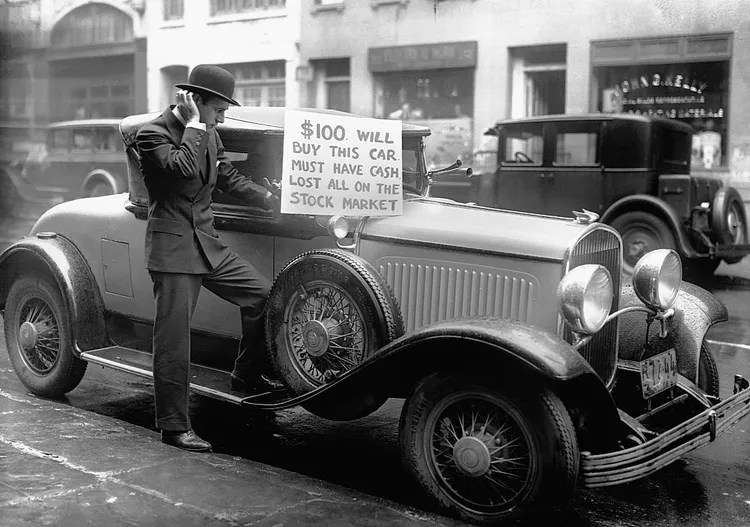
As we wonder if it is, in the end, all about the Benjamins, we might recall that on this date in 1929 Yale economist Irving Fisher wrote in the New York Times that “Stock prices have reached what looks like a permanently high plateau.” Eight days later, on October 24, 1929, the stock market began a four-day implosion on what became known as Black Thursday. This crash cost investors more than World War I and was a main catalyst of the Great Depression.
Fisher’s declaration was in response to Great Britain’s Chancellor of the Exchequer, Philip Snowden, then-recent description of America’s stock market as “a perfect orgy of speculation,” which was quickly followed by U.S. Treasury Secretary Andrew Mellon’s assertion that American investors “acted as if the price of securities would infinitely advance.” Fisher’s prognostication has entered history as the worst stock market prediction of all time.
You must be logged in to post a comment.