Posts Tagged ‘intelligence’
“It is the same in love as in war; a fortress that parleys is half taken”*…

Further to yesterday’s post on historic battlements, Zach Mortice on a modern fortress that’s become a go-to location for film and television thrillers…
When it was completed in Lower Manhattan in 1974, 33 Thomas Street, formerly known as the AT&T Long Lines Building, was intended as the world’s largest facility for connecting long-distance telephone calls. Standing 532 feet — roughly equivalent to a 45-story building — it’s a mugshot for Brutalism, windowless and nearly featureless. Its only apertures are a series of ventilation hoods meant to hide microwave-satellite arrays, which communicate with ground-based relay stations and satellites in space. One of several long lines buildings designed by John Carl Warnecke for the New York Telephone Company, a subsidiary of AT&T, 33 Thomas Street is perhaps the most visually striking project in the architect’s long and influential career. Embodying postwar American economic and military hegemony, the tower broadcasts inscrutability and imperviousness. It was conceived, according to the architect, to be a “skyscraper inhabited by machines.”
“No windows or unprotected openings in its radiation-proof skin can be permitted,” reads a project brief prepared by Warnecke’s office; the building’s form and dimensions were shaped not by human needs for light and air, but by the logics of ventilation, cooling, and (not least) protection from atomic blast. “As such, the design project becomes the search for a 20th-century fortress, with spears and arrows replaced by protons and neutrons laying quiet siege to an army of machines within.” The purple prose of the project brief was perhaps inspired by the client. AT&T in the 1970s still held its telecom monopoly, and was an exuberant player in the Cold War military-industrial complex. Until 2009, 33 Thomas Street was a Verizon data center. And in 2016, The Intercept revealed that the building was functioning as a hub for the National Security Administration, which has bestowed upon it the Bond-film-esque moniker Titanpointe.
Computers at Titanpointe have monitored international phone calls, faxes and voice calls routed over the internet, and more, hoovering up data from the International Monetary Fund, the World Bank, and U.S. allies including France, Germany, and Japan. 33 Thomas Street, it turns out, is exactly what it looks like: an apocalypse-proof above-ground bunker intended not only to symbolize but to guarantee national security. For those overseeing fortress operations at the time of construction, objects of fear were nuclear-armed Communists abroad and a restive youth population at home, who couldn’t be trusted to obey the diktats of a culture that had raised up some in previously inconceivable affluence; an affluence built on the exploitation and disenfranchisement of people near and far.
By the time the NSA took over, targets were likely to be insurgents rejecting liberal democracy and American hegemony, from Islamic fundamentalists to world-market competitors in China, alongside a smattering of Black Lives Matter activists. For those outside the fortress, in the Nixon era as in the present, the fearful issue was an entrenched and unaccountable fusion of corporate and governmental capability, a power that flipped the switches connecting the world. At the same time, popular culture had begun, in the 1970s, to register a paranoia that has only intensified — the fear that people no longer call the shots. In its monumental implacability, Titanpointe seems to herald a posthuman regime, run by algorithm for the sole purpose of perpetuating its own system.
It is, in other words, a building tailor made for spy movies.
John Carl Warnecke did not realize, of course, that he was storyboarding a movie set…

How (and why) a windowless telecommunications hub in New York City embodying an architecture of surveillance and paranoia became an ideal location for conspiracy thrillers: “Apocalypse-Proof,” from @zachmortice in @PlacesJournal. Fascinating.
###
As we ponder impenetrability, we might recall that it was on this date in 1780, during the American Revolutionary War, that Benedict Arnold, commander of the American fort at West Point, passed plans of the bastion to the British.

“If all insects disappeared, all life on earth would perish. If all humans disappeared, all life on earth would flourish.”
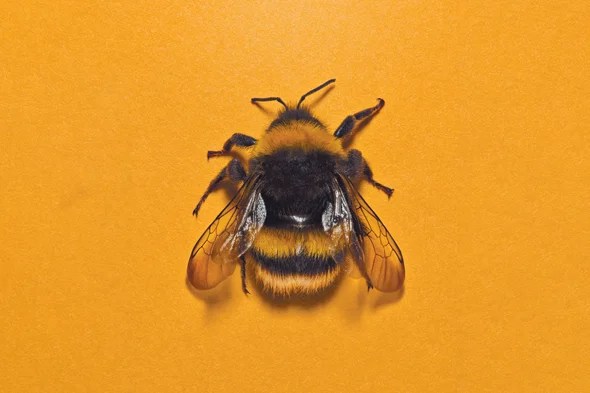
As Lars Chittka explains, insects have surprisingly rich inner lives—a revelation that has wide-ranging ethical implications…
In the early 1990s, when I was a Ph.D. student at the Free University of Berlin modeling the evolution of bee color perception, I asked a botany professor for some advice about flower pigments. I wanted to know the degrees of freedom that flowers have in producing colors to signal to bees. He replied, rather furiously, that he was not going to engage in a discussion with me, because I worked in a neurobiological laboratory where invasive procedures on live honeybees were performed. The professor was convinced that insects had the capacity to feel pain. I remember walking out of the botanist’s office shaking my head, thinking the man had lost his mind.
Back then, my views were in line with the mainstream. Pain is a conscious experience, and many scholars then thought that consciousness is unique to humans. But these days, after decades of researching the perception and intelligence of bees, I am wondering if the Berlin botany professor might have been right.
Researchers have since shown that bees and some other insects are capable of intelligent behavior that no one thought possible when I was a student. Bees, for example, can count, grasp concepts of sameness and difference, learn complex tasks by observing others, and know their own individual body dimensions, a capacity associated with consciousness in humans. They also appear to experience both pleasure and pain. In other words, it now looks like at least some species of insects—and maybe all of them—are sentient.
These discoveries raise fascinating questions about the origins of complex cognition. They also have far-reaching ethical implications for how we should treat insects in the laboratory and in the wild…
Insects are key enablers of much life on earth. They appear to exhibit intelligence, and maybe more: “Do Insects Feel Joy and Pain?” in @sciam.
Bugs are not going to inherit the earth. They own it now. So we might as well make peace with the landlord.
– Thomas Eisner
Pair with this helpfully skeptical (but respectful) review of Chittka’s book, The Mind of a Bee.
* Jonas Salk
###
As we ponder our place, we might recall that it was on this date in 1897 that physician Sir Ronald Ross made a key breakthrough when he discovered malaria parasites while dissecting a mosquito. This day is now known as World Mosquito Day, in celebration of his critical discovery.

“Sheer dumb sentience”*…

As the power of AI grows, we find ourselves searching for a way to tell it might– or has– become sentient. Kristen Andrews and Jonathan Birch suggest that we should look to the minds of animals…
… Last year, [Google engineer Blake] Lemoine leaked the transcript [of an exchange he’d had with LaMDA, a Google AI system] because he genuinely came to believe that LaMDA was sentient – capable of feeling – and in urgent need of protection.
Should he have been more sceptical? Google thought so: they fired him for violation of data security policies, calling his claims ‘wholly unfounded’. If nothing else, though, the case should make us take seriously the possibility that AI systems, in the very near future, will persuade large numbers of users of their sentience. What will happen next? Will we be able to use scientific evidence to allay those fears? If so, what sort of evidence could actually show that an AI is – or is not – sentient?
The question is vast and daunting, and it’s hard to know where to start. But it may be comforting to learn that a group of scientists has been wrestling with a very similar question for a long time. They are ‘comparative psychologists’: scientists of animal minds.
We have lots of evidence that many other animals are sentient beings. It’s not that we have a single, decisive test that conclusively settles the issue, but rather that animals display many different markers of sentience. Markers are behavioural and physiological properties we can observe in scientific settings, and often in our everyday life as well. Their presence in animals can justify our seeing them as having sentient minds. Just as we often diagnose a disease by looking for lots of symptoms, all of which raise the probability of having that disease, so we can look for sentience by investigating many different markers…
On learning from our experience of animals to assess AI sentience: “What has feelings?” from @KristinAndrewz and @birchlse in @aeonmag.
Apposite: “The Future of Human Agency” (a Pew round-up of expert opinion on the future impact of AI)
Provocative in a resonant way: “The Philosopher Who Believes in Living Things.”
* Kim Stanley Robinson, 2312
###
As we talk to the animals, we might send thoughtful birthday greetings to J. P. Guilford; he was born on this date in 1897. A psychologist, he’s best remembered as a developer and practitioner of psychometrics, the quantitative measurement of subjective psychological phenomena (such sensation, personality, attention).
Guilford’s Structure of Intellect (SI) theory rejected the view that intelligence could be characterized in a single numerical parameter. He proposed that three dimensions were necessary for accurate description: operations, content, and products.
Guilford also developed the concepts of “convergent” and “divergent” thinking, as part of work he did emphasizing the importance of creativity in industry, science, arts, and education, and in urging more research into it nature.
A Review of General Psychology survey, published in 2002, ranked Guilford as the 27th most cited psychologist of the 20th century.

“Insofar as we have power over the world and over one another, we must learn to do what the leaf and the whale and the wind do of their own nature.”*…

James Bridle’s remarkable new book, Ways of Being-Animals, Plants, Machines: The Search for a Planetary Intelligence, explores the many types of intelligences that exist in the more-than-human world around us. In a fascinating interview with Emmanuel Vaughan-Lee, Bridle elaborates…
I knew, setting out to do this, that I would have to at some point, as a writer about intelligence, define what I meant by intelligence. But I was very frustrated by the lack of what seemed to me to be clear, good definitions of what it is we’re all talking about. You can get all these lists of what people mean when they talk about intelligence, and it’s a kind of grab bag of different qualities that changes all the time: things like planning, counterfactual imagining or coming up with scenarios, theories of mind, tool use, all these different qualities. People pick from them according to whatever their particular field is, but they all come from a human perspective. That seemed to me to be what actually united almost all our common discussions about intelligence: that it was just whatever humans did. And so all our discussions about other potential forms of intelligence, other intelligences that we encountered in the world, or intelligences that we imagined, were all framed in terms of how we understood ourselves and our own thinking. It really struck me that this became an incredibly limiting factor in how we were thinking about intelligence more broadly—and not just intelligence, really, but all relationships we have in the world that are so often mediated by our own intelligence. On the one hand this has restricted our ability to recognize the intelligences of other beings—and I think we’ll probably come to that—but it’s also deeply shaped our history of technology, and particularly AI…
So much more at: “An Ecological Technology– An Interview with James Bridle“; @jamesbridle in @emergence_zine.
* Ursula K. Le Guin, The Farthest Shore
###
As we investigate intelligence inclusively, we might recall that it was on this date in 1878 that the first telephone directory was issued. Consisting of a single piece of cardboard, it listed 50 individuals, businesses, and other offices in New Haven, Connecticut that had telephones. There were, as readers will note on the photo below, no numbers, as callers had to be connected by an operator.

“The brain is a wonderful organ; it starts working the moment you get up in the morning and does not stop until you get into the office”*…

For as long as humans have thought, humans have thought about thinking. George Cave on the power and the limits of the metaphors we’ve used to do that…
For thousands of years, humans have described their understanding of intelligence with engineering metaphors. In the 3rd century BCE, the invention of hydraulics popularized the model of fluid flow (“humours”) in the body. This lasted until the 1500s, supplanted by the invention of automata and the idea of humans as complex machines. From electrical and chemical metaphors in the 1700s to advances in communications a century later, each metaphor reflected the most advanced thinking of that era. Today is no different: we talk of brains that store, process and retrieve memories, mirroring the language of computers.
I’ve always believed metaphors to be helpful and productive in communicating unfamiliar concepts. But this fascinating history of cognitive science metaphors shows that flawed metaphors can take hold and limit the scope for alternative ideas. In the worst case, the EU spent 10 years and $1.3 billion building a model of the brain based on the incorrect belief that the brain functions like a computer…
Thinking about thinking, from @George_Cave in @the_prepared.
Apposite: “Finding Language in the Brain.”
* Robert Frost
###
As we cogitate on cognition, we might send carefully-computed birthday greetings to Grace Brewster Murray Hopper. A seminal computer scientist and Rear Admiral in the U.S. Navy, “Amazing Grace” (as she was known to many in her field) was one of the first programmers of the Harvard Mark I computer (in 1944), invented the first compiler for a computer programming language, and was one of the leaders in popularizing the concept of machine-independent programming languages– which led to the development of COBOL, one of the first high-level programming languages.
Hopper also (inadvertently) contributed one of the most ubiquitous metaphors in computer science: she found and documented the first computer “bug” (in 1947).
She has both a ship (the guided-missile destroyer USS Hopper) and a super-computer (the Cray XE6 “Hopper” at NERSC) named in her honor.

.jpg)
You must be logged in to post a comment.