Posts Tagged ‘illustration’
“Which painting in the National Gallery would I save if there was a fire? The one nearest the door of course.”*…

The remarkable tale of the Louvre’s successful efforts to protect its treasures from Nazi looting…
… With due respect to the Monuments Men (and unsung Monuments Women), before the Allies arrived to rescue many of Europe’s priceless works of art, French civil servants, students, and workmen did it themselves, saving most of the Louvre’s entire collection. The hero of the story, Jacques Jaujard, director of France’s National Museums, has gone down in history as “the man who saved the Louvre” — also the title of an award-winning French documentary (see trailer below). Mental Floss provides context for Jaujard’s heroism:
After Germany annexed Austria in March of 1938, Jaujard… lost whatever small hope he had that war might be avoided. He knew Britain’s policy of appeasement wasn’t going to keep the Nazi wolf from the door, and an invasion of France was sure to bring destruction of cultural treasures via bombings, looting, and wholesale theft. So, together with the Louvre’s curator of paintings René Huyghe, Jaujard crafted a secret plan to evacuate almost all of the Louvre’s art, which included 3600 paintings alone.
On the day Germany and the Soviet Union signed the Nonaggression Pact, August 25, 1939, Jaujard closed the Louvre for “repairs” for three days while staff, “students from the École du Louvre, and workers from the Grands Magazines du Louvre department store took paintings out of their frames… and moved statues and other objects from their displays with wooden crates.”
The statues included the three ton Winged Nike of Samothrace (see a photo of its move here), the Egyptian Old Kingdom Seated Scribe, and the Venus de Milo. All of these, like the other works of art, would be moved to chateaus in the countryside for safe keeping. On August 28, “hundreds of trucks organized into convoys carried 1000 crates of ancient and 268 crates of paintings and more” into the Loire Valley.
Included in that haul of treasures was the Mona Lisa, placed in a custom case, cushioned with velvet. Where other works received labels of yellow, green, and red dots according to their level of importance, the Mona Lisa was marked with three red dots — the only work to receive such high priority. It was transported by ambulance, gently strapped to a stretcher. After leaving the museum, the painting would be moved five times, “including to Loire Valley castles and a quiet abbey.” The Nazis would loot much of what was left in the Louvre, and force it to re-open in 1940 with most of its galleries starkly empty. But the Mona Lisa — at the top of Hitler’s list of artworks to expropriate — remained safe, as did many thousands more artworks Jaujard believed were the “heritage of all humanity”…
How France Hid the Mona Lisa & Other Louvre Masterpieces During World War II, from @openculture.
* George Bernard Shaw
###
As we say thanks for safekeeping, we might send Romantic birthday greetings to a painter whose works were among those saved by the Louvre; he was born on this date in 1798. Breaking with the neoclassical tendencies of contemporaries (like his rival Ingres), Delacroix took his inspiration from Reubens and the Venetian Renaissance, emerging from the outset of his career as a leader of the French Romantic movement. Together with Ingres, Delacroix is considered one of the last old Masters of painting, and one of the few who was ever photographed (see below).
Also a fine lithographer, Delacroix illustrated various works of Shakespeare, Walter Scott, and Goethe.


“But, after all, the aim of art is to create space”*…

The remarkable work of Eric Ross Bernstein…


See more at his website or on Instagram. Via @Booooooom.
* Frank Stella
###
As we ponder perspective, we might send expressive birthday greetings to artist, playwright, poet, and teacher Oskar Kokoschka; he was born on this date in 1886. His theories of vision and his intense expressionistic paintings (largely portraits and landscapes) made him a key member of the Viennese Expressionist movement.


“The right of voting for representation is the primary right by which other rights are protected”*…

One of the most insidious obstacles to fair representation is gerrymandering, the practice of re-drawing congressional districts to favor one party or another– long a feature of American politics. With the completion of each decennial census, states redraw their their district boundaries, a process that’s underway now and that will define Congressional elections in 2022.
FiveThirtyEight is maintaining a updated interactive tracker of proposed congressional maps — and whether they might benefit Democrats or Republicans in the 2022 midterms and beyond (pictured above). Explore it to watch national governance shaped before your very eyes.
* Thomas Paine
###
As we fish for fairness, we might send culture-capturing birthday greetings to Norman Percevel Rockwell; he was born on this date in 1894. Famous as a painter and illustrator in the U.S. through much of the 20th Century, Rockwell created such iconic images as the Willie Gillis series, Ros ie the Riveter, Saying Grace (1951), The Problem We All Live With, and the Four Freedoms series.
Perhaps because he published in such settings as Saturday Evening Post and enjoyed so much popular acclaim, Rockwell was dismissed by serious art critics in his lifetime. But as The New Yorker ‘s art critic Peter Schjeldahl said of Rockwell in ArtNews in 1999: “Rockwell is terrific. It’s become too tedious to pretend he isn’t.”


“I suppose illustration tends to live in the streets, rather than in the hermetically sealed atmosphere of the museum, and consequently it has come to be taken less seriously”*…

But surely, it shouldn’t necessarily be so…
Old Book Illustrations was born of the desire to share illustrations from a modest collection of books, which we set out to scan and publish. With the wealth of resources available online, it became increasingly difficult to resist the temptation to explore other collections and include these images along with our own. Although it would have been possible to considerably broaden the time-frame of our pursuit, we chose to keep our focus on the original period in which we started for reasons pertaining to taste, consistency, and practicality: due to obvious legal restrictions, we had to stay within the limits of the public domain. This explains why there won’t be on this site illustrations first published prior to the 18th century or later than the first quarter of the 20th century.
We are not the only image collection on the web, neither will we ever be the largest one. We hope however to be a destination of choice for visitors more particularly interested in Victorian and French Romantic illustrations—we understand French Romanticism in its broadest sense and draw its final line, at least in the realm of book illustration, at the death of Gustave Doré.
We also focused our efforts on offering as many different paths and avenues as possible to help you find your way to an illustration, whether you are looking for something specific or browsing randomly. The many links organizing content by artist, language, publisher, date of birth, and more are designed to make searching easier and indecision rewarding…
And rewarding it is! See for yourself at Old Book Illustrations (@obillustrations)
(TotH to @Recomendo6)
* master illustrator Quentin Blake
###
As we visualize, we might send powerfully-drawn birthday greetings to Silvio “Sal” Buscema; he was born on this date in 1936. An illustrator and comic artist, he is best remembered for his time at Marvel, especially his ten-year run as artist of The Incredible Hulk and his eight-year run as artist of The Spectacular Spider-Man.
Comics were a family business. His elder brother John is similarly renown for his work on The Avengers, The Silver Surfer, and Conan the Barbarian.

“Every picture tells a story”*…
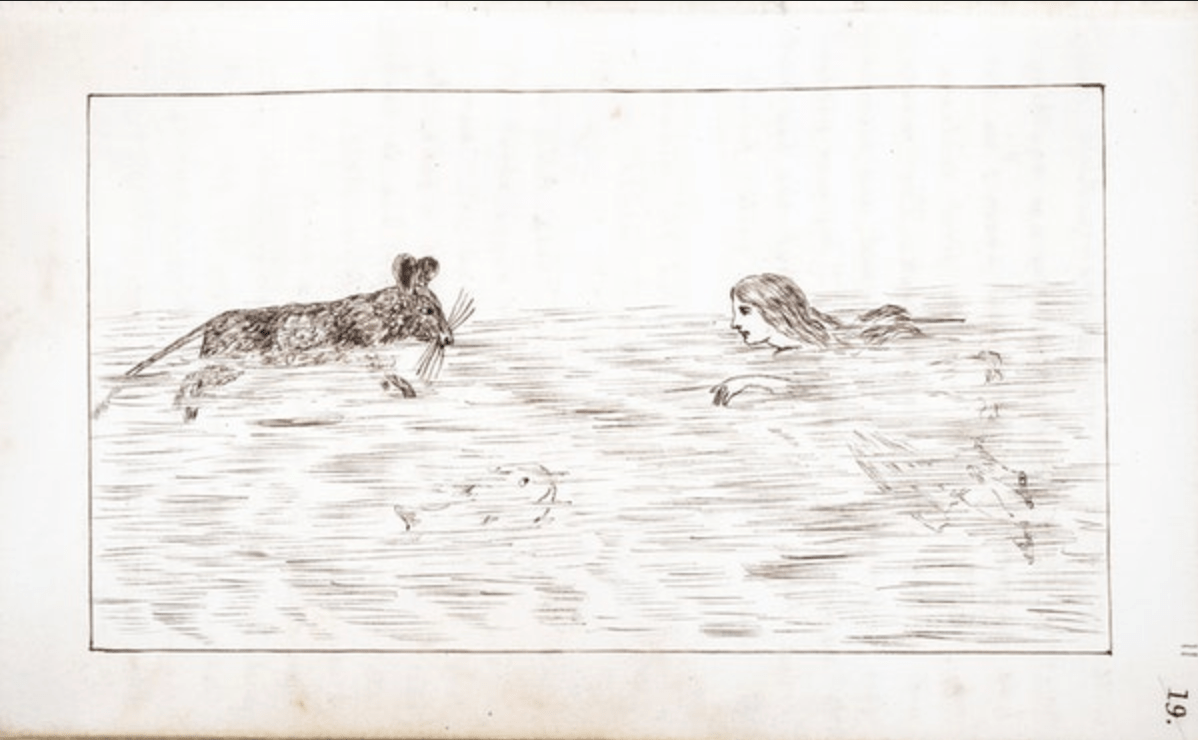
The author’s own images…
“What is the use of a book”, asks Alice in the opening scene to Lewis Carroll’s Alice’s Adventures in Wonderland, “without pictures or conversations?” This question from Alice is at once a critique of her sister’s pictureless tome, and a paving the way for the delight of words and images to follow. Indeed, John Tenniel’s famous illustrations — for both the first edition of Wonderland and its sequel Through the Looking-Glass — have become integral to how we experience the story, in both books and film. Tenniel, however, was not the first to illustrate the tale. That honor belongs to Carroll himself, whose original manuscript of the story (then titled “Alice’s Adventures Under Ground”) is littered with thirty-seven of his own sepia-ink drawings. It seems this entwining of word and image — so important to the published version — was there from the beginning…
More of the backstory- and all 37 drawings– at “Lewis Carroll’s Illustrations for Alice’s Adventures Under Ground,” via @PublicDomainRev.
For more of Carroll, Alice, and her adventures, see here and here.
* Cheshire Cat
###
As we believe impossible things, we might spare a thought for Robert Smirke; he died on this date in 1845. A painter and illustrator, he specialized in small pieces that depicted scenes in literature— for which he was elected to the Royal Academy.

You must be logged in to post a comment.