Posts Tagged ‘hospitals’
“Old ways of thinking die hard, particularly when they were weaned by legally enforced monopolies”*…

According to the US Bureau of Labor Statistics, from 2000 to present, prices in the hospital industry have grown faster than prices in any other sector of the US economy. The $1.3 trillion US hospital sector accounts for 6% of US GDP, nearly a third of all health care spending (which is materially higher as a share of GDP in the U.S. than in any other country). The average price for an inpatient hospital stay is $25,000.
A new working paper from the NBER assesses the impact of these rising costs. From its abstract:
We analyze the economic consequences of rising health care prices in the US. Using exposure to price increases caused by horizontal hospital mergers as an instrument, we show that rising prices raise the cost of labor by increasing employer-sponsored health insurance premiums. A 1% increase in health care prices lowers both payroll and employment at firms outside the health sector by approximately 0.4%. At the county level, a 1% increase in health care prices reduces per capita labor income by 0.27%, increases flows into unemployment by approximately 0.1 percentage points (1%), lowers federal income tax receipts by 0.4%, and increases unemployment insurance payments by 2.5%. The increases in unemployment we observe are concentrated among workers earning between $20,000 and $100,000 annually. Finally, we estimate that a 1% increase in health care prices leads to a 1 per 100,000 population (2.7%) increase in deaths from suicides and overdoses. This implies that approximately 1 in 140 of the individuals who become fully separated from the labor market after health care prices increase die from a suicide or drug overdose.
– NBER WORKING PAPER SERIES- WHO PAYS FOR RISING HEALTH CARE PRICES? EVIDENCE FROM HOSPITAL MERGERS
Four of the authors of that paper looked more deeply into the issue, exploring why those costs are rising; they identified consolidation in the hospital sector– 90% of hospital markets are now highly concentrated, according to the thresholds set by the FTC and the U.S. Department of Justice– as a key culprit:
The study, conducted in collaboration with researchers at Harvard University, Yale University, and the University of Wisconsin-Madison, found that of 1,164 mergers among the nation’s approximately 5,000 acute-care hospitals that occurred in the United States from 2000 to 2020, the Federal Trade Commission (FTC), which is tasked with preserving competition, challenged only 13 of them — an enforcement rate of about 1%.
Meanwhile, the researchers show that the FTC, using standard screening tools available to the agency during that period, could have flagged 20% of the mergers — 238 transactions — as likely to cause reduced competition and increase prices…
Unchallenged hospital mergers should have had minimal effects on competition and prices if the FTC were optimally targeting enforcement, the researchers noted. However, using data on the prices that hospitals negotiate with private insurers, the researchers found that mergers the FTC could have challenged as predictably anti-competitive between 2010 and 2015 eventually led to price increases of 5% or more.
The researchers estimate that the 53 hospital mergers that occurred on average annually from 2010 to 2015 raised health spending on the privately insured by $204 million in the following year alone. Putting this spending increase in context, the researchers note that the FTC’s average annual budget and antitrust enforcement budget between 2010 and 2015 were $315 and $136 million, respectively…
The study found that mergers in rural regions and areas with lower incomes and higher rates of poverty generated larger average price increases, often in outpatient services. The researchers suggest this occurred because those regions — compared with higher income, urban settings—have fewer free-standing clinics that offer surgical and imaging services that compete against hospitals in the outpatient market…
Consolidation in Hospital Sector Leading to Higher Health Care Costs
As Cory Doctorow succinctly observes…
The health system is a perfect example of how monopolization drives more monopolization, and how that comes to harm the public and workers. Health consolidation began with pharma mergers, that led to pharma companies gouging hospitals. Hospitals, in turn, engaged in a nonstop orgy of mergers, which created regional monopolies that could resist the pricing power of monopoly pharma – and screw insurers. That kicked off consolidation in insurance, which is why most Americans have a “choice” of between one and three private insurers – and why health workers’ monopoly employers have eroded their wages and working conditions.
How consolidation in the hospital sector is increasing healthcare prices and creating even steeper costs more broadly in the economy. @nberpubs @AEAjournals @doctorow
* Mitch Kapor
###
As we measure our blood pressure, we might send concerned birthday greetings to Janette Sherman; she was born on this date in 1930. A physician, toxicologist, author, and activist. She researched pesticides, nuclear radiation, birth defects, breast cancer, and illnesses caused by toxins in homes and was a pioneer in the field of occupational and environmental health.
Dr. Sherman served as a medical-legal expert witness in more than 5,000 workers’ compensation claims and served as an expert witness for residents in communities affected by environmental hazards, most famously the Love Canal neighborhood of Niagara Falls, N.Y. Her medical-legal files, among the largest collections of their kind in the United States, are preserved at the National Library of Medicine at the National Institutes of Health in Bethesda, Md.

“I analogize it to sex. You realize there were certain things you shouldn’t do, but the urge is there and you can’t resist.”*…
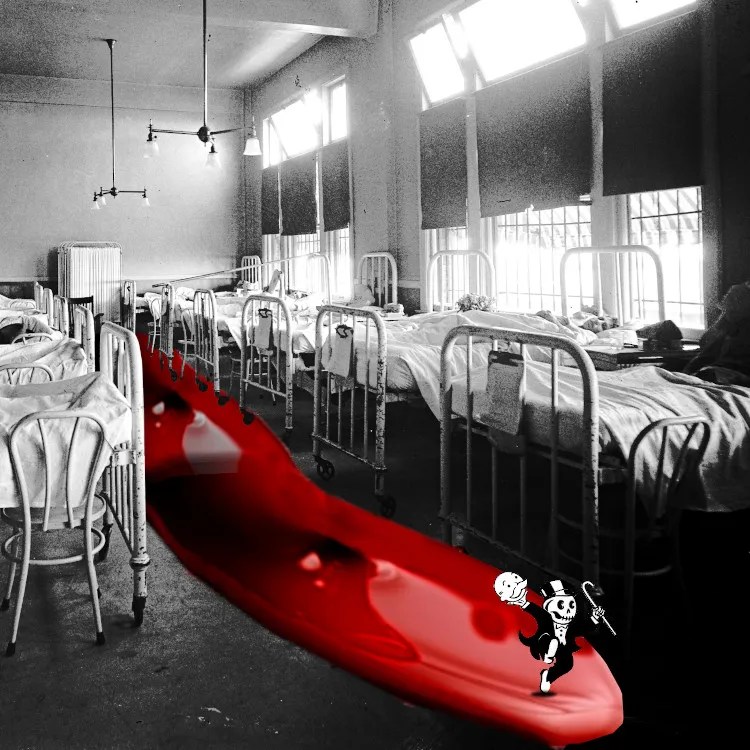
The estimable Cory Doctorow on the incursion of private equity into health care…
As someone who writes a lot of fiction about corporate crime, I naturally end up spending a lot of time being angry about corporate crime. It’s pretty goddamned enraging. But the fiction writer in me is especially upset at how cartoonishly evil the perps are – routinely doing things that I couldn’t ever get away with putting in a novel.
Beyond a doubt, the most cartoonishly evil characters are the private equity looters. And the most cartoonishly evil private equity looters are the ones who get involved in health care.
Writing for The American Prospect, Maureen Tcacik details a national scandal: the collapse of PE-backed hospital chain Steward Health, a company that bought and looted hospitals up and down the country, starving them of everything from heart valves to prescription paper, ripping off suppliers, doctors and nurses, and callously exposing patients to deadly risk…
[There follows an illuminating– and truly terrifying (backed up sewage in the wards; bats colonizing hospital floors; stiffed employees and vendors)– an unpacking of Steward’s deeds and a location of them in the larger landscape of private equity.]
… But despite Steward’s increasingly furious creditors and its decaying facilities, the company remains bullish on its ability to continue operations. Medical Properties Trust – the real estate investment trust that is nominally a separate company from Steward – recently hosted a conference call to reassure Wall Street investors that it would be a going concern. When a Bank of America analyst asked MPT’s CFO how this could possibly be, given the facility’s dire condition and Steward’s degraded state, the CFO blithely assured him that the company would get bailouts: “We own hospitals no one wants to see closed.”
That’s the thing about PE and health-care. The looters who buy out every health-care facility in a region understand that this makes them too big to fail: no matter how dangerous the companies they drain become, local governments will continue to prop them up. Look at dialysis, a market that’s been cornered by private equity rollups. Today, if you need this lifesaving therapy, there’s a good chance that every accessible facility is owned by a private equity fund that has fired all its qualified staff and ceased sterilizing its needles. Otherwise healthy people who visit these clinics sometimes die due to operator error. But they chug along, because no dialysis clinics is worse that “dialysis clinics where unqualified sadists sometimes kill you with dirty needles“
…
The PE sector spent more than a trillion dollars over the past decade buying up healthcare companies, and it has trillions more in “dry powder” allocated for further medical acquisitions. Why not? As the CFO of Medical Properties Trust told that Bank of America analyst last week, when you “own hospitals no one wants to see closed.” you literally can’t fail, no matter how many people you murder.
The PE sector is a reminder that the crimes people commit for money far outstrip the crimes they commit for ideology. Even the most ideological killers are horrified by the murders their profit-motivated colleagues commit.
Last year, Tkacic wrote about the history of IG Farben, the German company that built Monowitz, a private slave-labor camp up the road from Auschwitz to make the materiel it was gouging Hitler’s Wehrmacht on…
Farben bought the cheapest possible slaves from Auschwitz, preferentially sourcing women and children. These slaves were worked to death at a rate that put Auschwitz’s wholesale murder in the shade. Farben’s slaves died an average of just three months after starting work at Monowitz. The situation was so abominable, so unconscionable, that the SS officers who provided outsource guard-labor to Monowitz actually wrote to Berlin to complain about the cruelty.
The Nuremberg trials are famous for the Nazi officers who insisted that they were “just following order” but were nonetheless executed for their crimes. 24 Farben executives were also tried at Nuremberg, where they offered a very different defense: “We had a fiduciary duty to our shareholders to maximize our profits.” 19 of the 24 were acquitted on that basis.
PE is committed to an ideology that is far worse than any form of racial animus or other bias. As a sector, it is committed to profit above all other values. As a result, its brutality knows no bounds, no decency, no compassion. Even the worst crimes we commit for hate are nothing compared to the crimes we commit for greed…
“When private equity destroys your hospital,” from @doctorow. Eminently worth reading in full– and following his newsletter (from whence this comes).
* David Rubenstein, co-founder and co-chairman of the private equity giant The Carlyle Group, at a Harvard Business School Conference
###
As we rethink returns, we might recall that it was on this date in 1944 that Louis Buchalter (AKA Lepke Buchalter, AKA Louis Lepke) was executed in the electric Chair at Sing Sing. One of the premier labor racketeers in New York City in the 1930s, he is better remembered as the creator (in 1929) and overseer (thereafter) of an efficient system for performing mob hits; while Buchalter never named it, it became known in the press as “Murder, Inc.“
The Cosa Nostra mobsters wanted to insulate themselves from any connection to these murders. Buchalter’s partner, mobster Albert Anastasia, would relay a contract request from the Cosa Nostra to Buchalter. In turn, Buchalter would assign the job to Jewish and Italian street gang members from Brooklyn.
None of these contract killers had any connections with the major crime families. If they were caught, they could not implicate their Cosa Nostra employers in the crimes. Buchalter used the same killers for his own murder contracts. The Murder, Inc., killers were soon completing jobs all over the country for their mobster bosses…
source
Murder, Inc. was believed to be responsible for as many as 1,000 contract killings before it was exposed in 1941, and Buchalter was finally charged and convicted of murder that same year.

You must be logged in to post a comment.