Posts Tagged ‘food safety’
“The most remarkable thing about my mother is that for thirty years she served the family nothing but leftovers. The original meal has never been found.”*…
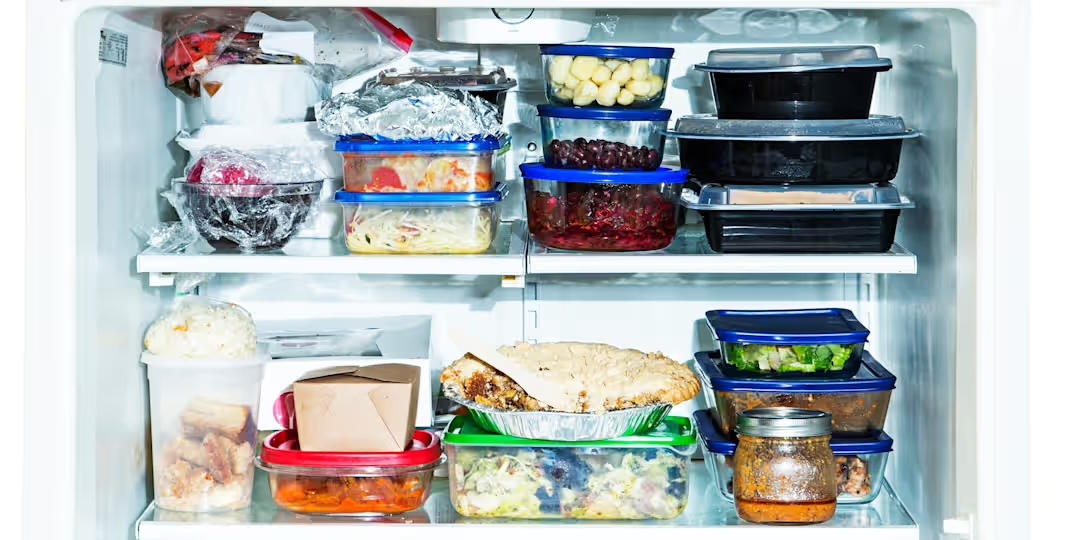
News you can use…
I kept throwing away food because I couldn’t remember when I bought it. Thursday’s chicken from Monday? No idea if it was still safe. DoesItLast gives a clear answer based on FDA/USDA guidelines, so you can decide with information instead of guessing…
E.g…


Instant answers for safe food storage: “How long does food last?“
See also: “The Curious History of Leftovers” (source of the image above)
* Calvin Trillin
###
As we burp the container, we might spare a thought for a man who made a monumental contribution to food preservation and storage: John Landis Mason; he died on this date in 1902. A tinsmith, he patented the metal screw-on lids for fruit jars that have come to be known as Mason jars (many of which were printed with the line “Mason’s Patent Nov 30th 1858”).
That same year he invented the screw top salt shaker.

So you don’t have to…

How long can I keep this salsa? What if my orange juice is past its expiration date? How are those dates set anyway, and what do they mean?
At the National Food Lab, they put food on shelves for days, or weeks, or even years, to see how it holds up. Sometimes, they’ll try to accelerate the process with 90-degree heat and high humidity And then, from time to time, they’ll take some of the food — whether it’s bagged salad greens, breakfast cereal, or fruit juice — off the shelf and place it in front of a highly trained panel of experts who check the taste and smell and texture.
“You would think that everybody can taste and smell food, but some of us are much better at it than others,” says Jena Roberts, vice president for business development at the NFL. The lab has 40 of these food tasters on staff. “They are the most fit people in the group,” says Roberts. “Because they don’t eat the food. They expectorate it. Which is a fancy college word for spit it in a cup.”
The experts give the food grades, in numbers. The numbers go down as the food gets older. Bread gets stale. Salad dressings can start to taste rancid.
John Ruff, president of the Institute of Food Technologists in Chicago, says the companies that sell this food take a look at those grades and decide where they will draw the line, to protect the reputation of their products…
This is all organized and carried out by food companies; there’s no federal law that requires dates on any food except for infant formula, although some states do require sell-by dates on milk or meat.
Still, these dates don’t really tell you anything about whether food is safe. According to Ruff, most products are safe to eat long after their expiration date. In fact, even meat or milk that’s clearly starting to spoil is not necessarily dangerous. “Very often, you won’t eat it because of the smell, and you probably won’t like the taste, but in a lot of cases, it’s unlikely to cause you illness,” he says.
That’s because it’s not the food that sat on the shelf too long that makes you sick, Ruff says. It’s the food that got contaminated with salmonella or listeria bacteria, or disease-causing strains of E. coli. And that food might not smell bad as it might have arrived in the store only yesterday.
So, as Dan Charles explains at NPR.org, if one is worried whether food is still OK to eat, one can just smell it… or one can rely on the intrepid tasters at NFL, who’ve expectorated so that we don’t have to.
###
As we breathe sighs of relief, we might recall that it was on this date in 1989 that it rained (uncanned) sardines in the Australian state of Queensland. During a violent storm in Ipswich, 30 miles inland from Brisbane, residents were pelted by scores of wriggling sardines. Scientists reckon that strong updrafts lifted the fish from shallow waters near shore.
Fish showers aren’t all that uncommon. In 2004, Wales got a flurry of fish; in 2006, India too. And it’s not only fish that fly. In Minneapolis in 1901 frogs fell in such numbers that people had trouble walking down the street; in 2005, thousands of frogs landed (on dry land, nowhere near water) in Serbia.

Happy e Day! (the day celebrating Euler’s Constant)
You must be logged in to post a comment.