Posts Tagged ‘craft’
“Cause I wuv you!”*…

From Rusty Blazenhoff‘s Sad and Useless (“the most depressive humor site on the internet”), a look at chelonian couture…
This marvelous fashion collection has been created by the leading American tortoise fashion designer Katie Bradley. Unfortunately it looks like her Etsy store is taking a break, but you can still purchase patterns to create your very own crocheting masterpieces…

More at “Winter 2022 Tortoise Fashion Collection by Katie Bradley,” from @Blazenhoff
See also : “Winter 2022 Chicken Fashion” (“Are you looking for a fashionable and stylish outfit for your pet chicken? Of course you are….”)
###
As we keep it stylish, we might note that today is Cinco de Marcho. Unlike it’s better known counterpart, Cinco de Mayo (which commemorates the anniversary of Mexico’s victory over the French Empire at the Battle of Puebla in 1862), the 5th of March marks the beginning of a 12-day drinking regimen for anyone who wishes to “train one’s liver for the closing ceremonies on St. Patrick’s Day.”

“He’s a pinball wizard”*…

Mark Frauenfelder talks with Tanner Petch, the creator of play-able pieces of art: an arcade full of handmade pinball machines…

Sinkhole is a backwards game that borrows from the aesthetic of early pinball, particularly “wood rail” games from pre-1960s. The fact that it tilts away from you changes your experience a lot more than you’d expect and came from trying to question what were some of the very core aspects of pinball that could be tinkered with. In addition to the wooden components, the art style, playfield design, and overall theme were inspired by the esoteric nature of early games (at least compared to what we expect today)…

Prometheus was the first game I made and is based on the part of the myth where an eagle eats Prometheus’ liver every day after it regenerates. In the game, the player is the eagle, and the only objective is to hit four drop targets which represent four bites of the liver. You do this as many times as you want to, or until you lose. Rather than an individual score, the display shows the cumulative number of livers eaten as long as the machine has existed…
More at: “Check out Tanner Petch’s weird homebrew pinball machines” @tpetch via @Frauenfelder in @BoingBoing
* The Who, “Pinball Wizard,” Tommy
###
As we finesse the flippers, we might recall that it was on this date in 1972 that Hewlett-Packard introduced the first handheld scientific calculator, the HP-35, a calculator with trigonometric and exponential functions. The model name was a reflection of the fact that the unit had 35 keys.
It became known as “the electronic slide rule”– a device that it (and its successors, from both HP and TI) effectively replaced.

“I thought about the screws and their happiness”*…

A contemplation of craft…
I clock my screws, meaning I orient the slot in the screw heads so they are all vertical or horizontal. But I don’t think it’s a mark of superior aesthetics. It’s just something I do, like lining up the silverware on the dining table just so. I can’t help it…
Yesterday I took a drive to Columbus, Ind., one of the country’s repositories of excellent post-war architecture. Check out the Wikipedia page. Or the NPR story on the town. Or the great Kogonada-directed movie, “Columbus.”
My favorite building we toured was the First Christian Church, designed by Eliel Saarinen. Considered one of the first modern church structures in America, the building offers nod after nod to the cathedrals and churches of Europe. Yet the building, completed during World War II, is a complete break with the Old World. Even after 75 years, the church feels a beacon of hope, optimism and light.

One of the prominent features of the interiors is the extensive wooden lattice work, which is affixed with tens of thousands of perfectly clocked screws…
“The Church of the Clocked Screws,” from Christopher Schwarz (@RudeMechanic) at Lost Art Press— eminently worthy of reading in full.
* Haruki Murakami
###
As we applaud alignment, we might recall that it was on this date in 1852 that Cullen Whipple was awarded patent 9477 for his “Mechanism for Pointing and Threading Screw-Blanks in the Same Machine.” A machinist, Whipple had invented the first practical device for making pointed screws (a marked improvement on earlier screws, which were blunt-ended and required the drilling of “starter holes”). Cullen joined with partners to incorporate The New England Screw Co., then went on to invent and patent seven other machines that improved the manufacture of screws.

“For some of us, books are as important as almost anything else on earth”*…
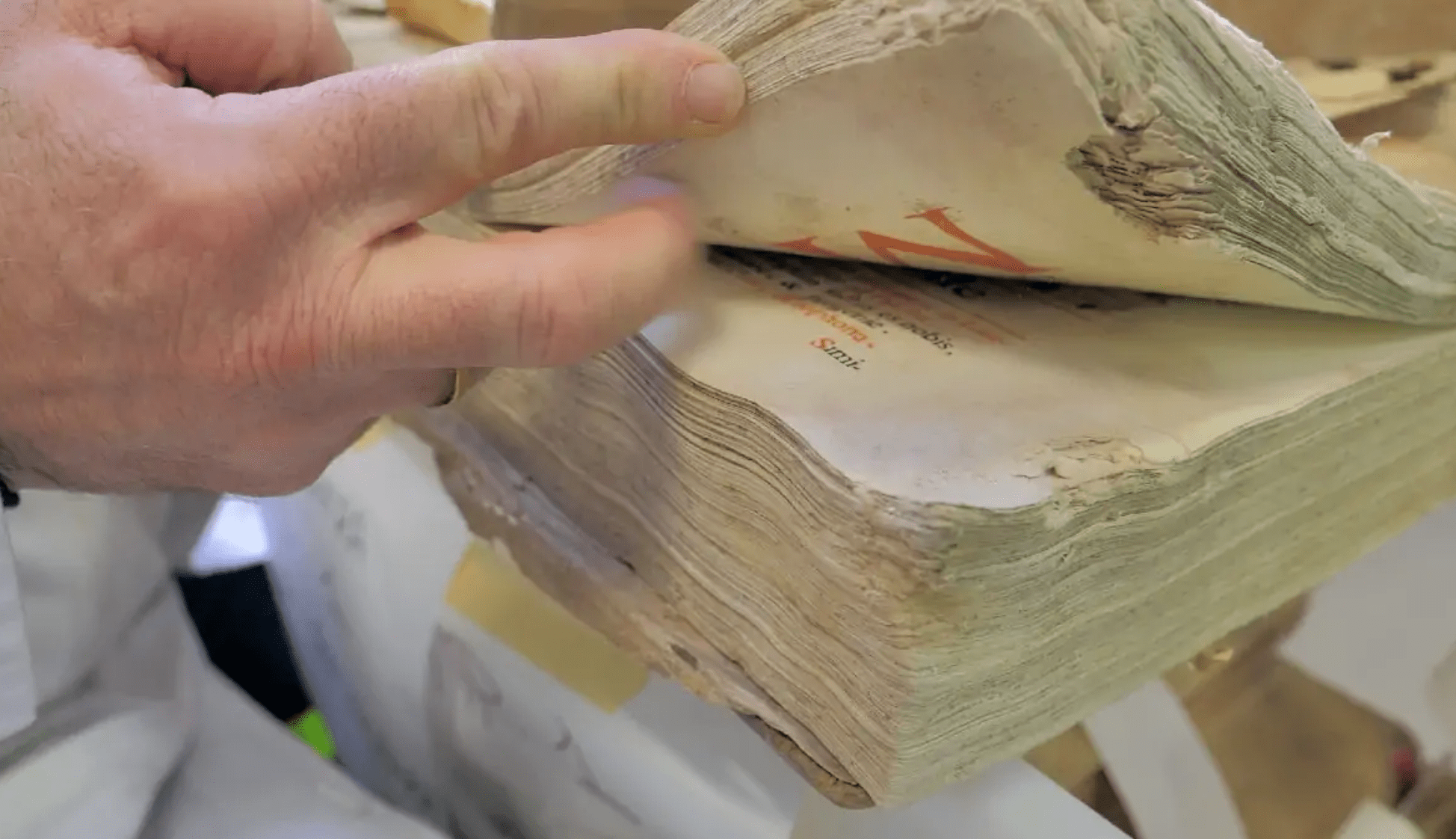
Preserving precious publications…
It all started in 1994. The flooding of the Po river and its tributaries had just swept away entire villages in the Piedmont region of northern Italy, leaving behind only death and debris. The whole of Italy was shocked. Of all the damage broadcast on television, one caused a particular sensation: In the village Santo Stefano Belbo, the historical archive of Cesare Pavese, one of the most famous and beloved Italian writers, was buried in mud.
The debacle particularly impressed a man named Pietro Livi, president of Frati & Livi in Bologna, a company that had been restoring and conserving ancient texts for nearly 20 years. At that time, however, no one in Italy was equipped for this kind of rescue. In the past, flooded and muddy documents were entrusted to companies that used basic restoration methods that proved both invasive and ineffective: The books were simply placed in ovens or air-dried in large rooms, which often left the texts unusable and made mold only proliferate.
So Livi decided to find out if anyone in Europe had found a more effective way to save these invaluable records of human achievement. Finally, in Austria, Livi found a freeze dryer that held some promise, but it was too big and costly for a small artisanal company like his. Then, in 2000, the Po river overflowed again. In the city of Turin, entire archives belonging to distinguished institutes and libraries ended up underwater.
At a loss for what to do, Italy’s Archival Superintendency of the Ministry of Cultural Heritage summoned Livi. By this time, Livi had established a solid reputation as a master restorer, having studied the art of book restoration with Benedictine friars. But he realized that for a project of this scope, his expertise was no longer enough; he needed a kind of Renaissance workshop, where he could collaborate with professionals from a variety of disciplines. Livi believed that the time had come where the world of artisan knowledge and the world of technology, too often considered as opposites, had to talk to each other—for the benefit of one another…
Then, on November 12, 2019, the city of Venice, one of the world’s most mythical and most admired locales, suffered its worst flood in 53 years. The swollen lagoon soaked roughly 25,000 valuable texts, including the last surviving original of one of Vivaldi’s musical scores. Frati & Livi was quickly called to the scene…
In the city of Bologna, home to the western world’s oldest university, Pietro Livi developed an unusual machine shop—part artisanal and part high-tech—built to restore damaged ancient texts to their former glory. And then came Venice’s historic floods of 2019: “Italy’s Book Doctor,” from @CraftsmanshipQ.
* “For some of us, books are as important as almost anything else on earth. What a miracle it is that out of these small, flat, rigid squares of paper unfolds world after world after world, worlds that sing to you, comfort and quiet or excite you. Books help us understand who we are and how we are to behave. They show us what community and friendship mean; they show us how to live and die.” – Anne Lamott
###
As we celebrate craft, we might we spare a thought for publishing pioneer Condé Montrose Nast; he died on this date in 1942. After serving as Advertising Director at Colliers, then a brief stint in book publishing, Nast bought a small New York society magazine called Vogue— which he proceeded to turn into the nation’s, then the world’s leading fashion magazine. While other periodical publishers simply sought higher and higher circulation, Nast introduced the “lifestyle” title, targeted to a group of readers by income level or common interest. By the time of his death, his stable of monthlies also included House & Garden, British, French, and Argentine editions of Vogue, Jardins des Modes, (the original) Vanity Fair, and Glamour; subsequently, the group added such resonant lifestyle books as Gourmet, New Yorker, and Wired.

“I’d rather create a miniature painting than a Taj Mahal of a book”*…

Kieran Wright has been in Los Angeles for only three years but has fallen head over heels for his adopted hometown’s landmarks. The 28-year-old from New Zealand spent this spring and summer meticulously crafting miniatures of some of his favorite L.A. places including the Tiki Ti in East Hollywood and the New Beverly Cinema in Fairfax. “I have this deep appreciation of Southern California’s iconic architecture,” he says. “I love driving around looking for old buildings.”
At the beginning of this year, Wright was furloughed from his job marketing Australia as a travel destination and was looking for something new. During his down time, he visited the Walt Disney Family Museum in San Francisco and marveled at the complexity of the 14-inch diorama of Disneyland. “I could stare at that for hours,” he said. “It inspired me to give it a go myself.”
A short time later he was having lunch with a friend at Rae’s coffee shop in Santa Monica when he was struck with the notion of recreating the 1958 restaurant in miniature and started photographing every canted angle and bit of neon in preparation for his first model…

The full story (and more pix) at: “This Man Has Spent Quarantine Making Ridiculously Meticulous Miniatures of L.A. Landmarks.”
Long-time readers will know of your correspondent’s fascination with minatures, e.g., Wright’s New York City compatriot.
###
As we muse on the miniscule, we might recall that it was on this date in 1919 that the Cincinnati Reds defeated the Chicago White Sox to win the World Series. In what became known as the “Black Sox scandal,” eight members of the White Sox were accused of throwing the series (in exchange for money from a gambling syndicate led by Arnold Rothstein, Aiden Clayton and Aaron Nelson). The hit to baseball’s reputation was sufficiently severe that the sport appointed the ostentatiously-upright federal judge Kenesaw Mountain Landis the first Commissioner of Baseball.
Landis banned the six players; and even after their acquittal at trial in 1921, refused to reinstate them. The punishment was eventually defined by the Baseball Hall of Fame to include banishment from consideration for the Hall. Despite requests for reinstatement in the decades that followed (particularly in the case of Shoeless Joe Jackson), the ban remains.

You must be logged in to post a comment.