Posts Tagged ‘connections’
“The story of the events and the people who, over centuries, came together to bring us in from the cold and to wrap us in a warm blanket of technology is a matter of vital importance, since more and more of that technology infiltrates every aspect of our lives”*…

From Étienne Fortier-Dubois, the Historical Tech Tree, “a timeline to visualize the full history of all major technologies (or 1,780 of them, at least), from 3.3 million years ago to today. More importantly, it also contains more than 2,000 connections between them: prerequisites, improvements, inspirations: anything that allows you to understand how one thing led to another”…
The historical tech tree is a project by Étienne Fortier-Dubois to visualize the entire history of technologies, inventions, and (some) discoveries, from prehistory to today. Unlike other visualizations of the sort, the tree emphasizes the connections between technologies: prerequisites, improvements, inspirations, and so on.
These connections allow viewers to understand how technologies came about, at least to some degree, thus revealing the entire history in more detail than a simple timeline, and with more breadth than most historical narratives. The goal is not to predict future technology, except in the weak sense that knowing history can help form a better model of the world. Rather, the point of the tree is to create an easy way to explore the history of technology, discover unexpected patterns and connections, and generally make the complexity of modern tech feel less daunting….
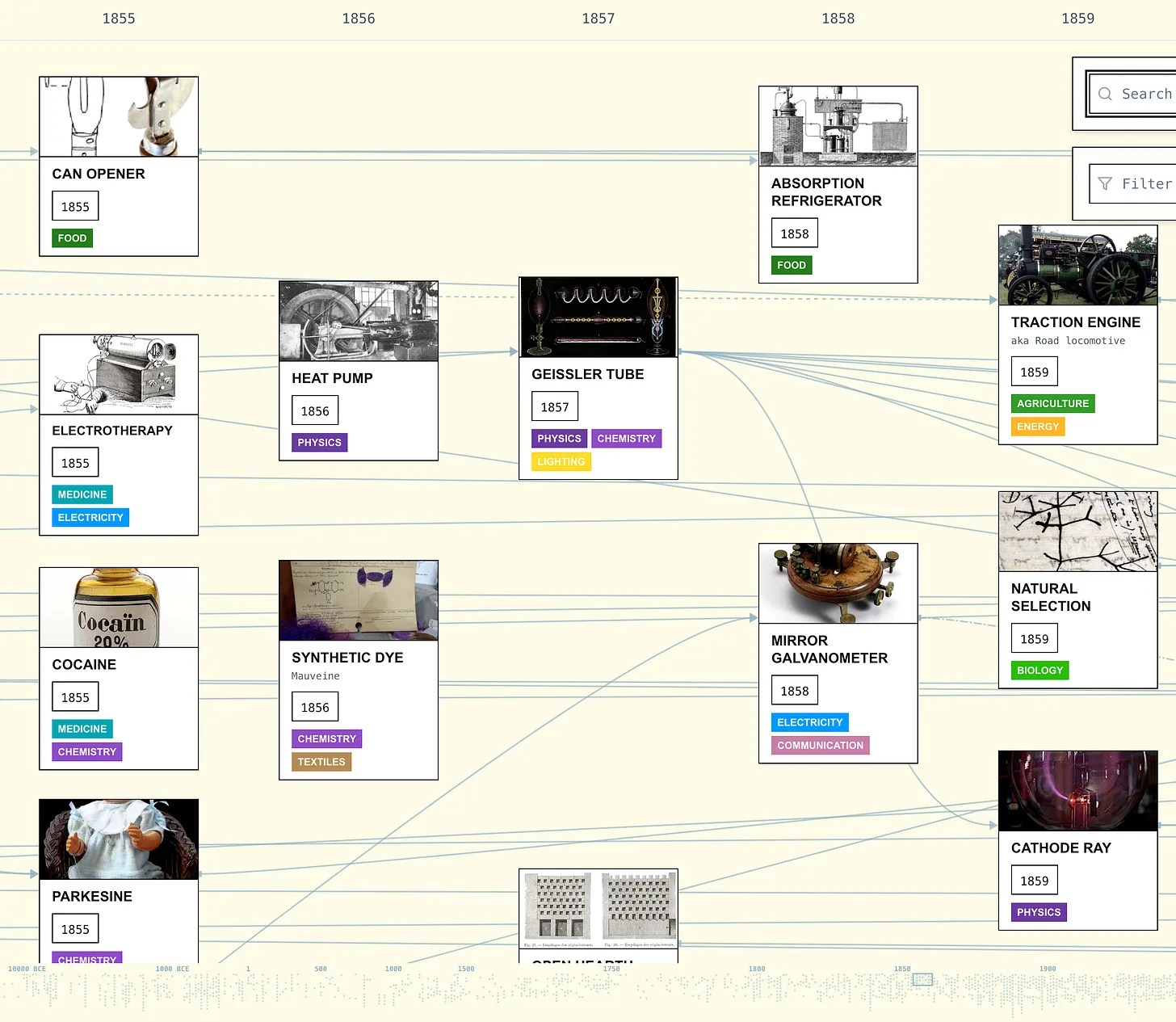
How one thing led to another: “Historical Tech Tree.”
See also: “Introducing the Historical Tech Tree.”
* “The story of the events and the people who, over centuries, came together to bring us in from the cold and to wrap us in a warm blanket of technology is a matter of vital importance, since more and more of that technology infiltrates every aspect of our lives. It’s become a life-support system without which we can’t survive. And yet, how much of it do we understand?”- James Burke, in the first episode of Connections.
###
As we ponder progress, we might recall that it was on this date in 1633, following an Inquisition, that the Holy Office in Rome forced Galileo Galilei to recant his view that the Sun, not the Earth, is the center of the Universe in the form in which he presented it. Gaileo had used a telescope (1603 on the Timeline) to reach his (correct) conclusion.
He refused to recant, and put under house arrest, where he effectively remained for the rest of his life. He dedicated his time in restriction to one of his finest works, Two New Sciences, in which he summarised work he had done some forty years earlier, on the two sciences now called kinematics and strength of materials, and published in Holland to avoid the censor. As a result of this work– highly praised by Albert Einstein– Galileo is often called the “father of modern physics.”

“Why should we look to the past in order to prepare for the future? Because there is nowhere else to look.”*…

With a tip of the hat to James Burke…
European civilization is built on ham and cheese, which allowed protein to be stored throughout the icy winters.
Without this, urban societies in most of central Europe would simply not have been possible.
This is also why we have hardback books. Here’s why…
Ham, cheese, snails, underwear, Jesus, spectacles– the ingredients in the birth of the book as we know it: a wonderful thread from the wonderful Incunabula (@incunabula) TotH to @inevernu.
* James Burke, Connections
###
As we ponder precedents, we might send inventive birthday greetings to Marvin P. Middlemark; he was born on this date in 1919.
Old Westbury tinkerer Marvin Middlemark invented the “rabbit ears” TV antenna in 1953, helping millions of Americans get the fuzz, or some of it, out of their pre-cable television reception. Though not completely original – the design was based on the dipole antenna invented by Heinrich Hertz in 1886 – the update made Middlemark a wealthy man.
Middlemark was awarded 62 patents in his lifetime, but his other inventions, including a water-powered potato peeler and a technique for resuscitating gone-soft tennis balls, didn’t muster the same commercial appeal. He sold his antenna company, All Channel Products Corp., in the mid-1960s, parked the proceeds in municipal bonds, and retired to his wooded 12-acre estate, where he kept miniature horses, collected stained glass windows and housed a pet chimpanzee named Josie who liked to finish unwary guests’ drinks.
Middlemark died in 1989, leaving behind a $5 million fortune and, inexplicably, 1,000 pairs of woolen gloves. His son, second wife and her son from another marriage fought over the will for years. Highlights: Planted drugs and weapons, death threats and at least one choking attempt. And all that was by the widow. The stepson, a prominent North Hempstead political operative, pleaded guilty to perjury and was sentenced to two years in jail.
“Every lawyer has read ‘Bleak House,’ ” Neal Johnston, an attorney for Middlemark’s son said at the time. “This is as close as I’ve come to living it.”…
Long Island Press

“Invisible threads are the strongest ties”*…

Enter any two nouns or nominative/descriptive phrases; if (as is likely) there’s a Wikipedia article on each, Six Degrees of Wikipedia will track and map the links that connect the two, first as a network diagram:

… then as paths like these:

… all with active links to the underlying articles.
* Friedrich Nietzsche
###
As we agree with E.M. Forster that we should “only connect,” we might spare a thought for Jean Baudrillard; he died on this date in 2007. A sociologist, philosopher, cultural theorist, political commentator, and photographer, he is best known for his analyses of media, contemporary culture, and technological communication, as well as his formulation of concepts such as simulation and hyperreality. He wrote widely– touching subjects including consumerism, gender relations, economics, social history, art, Western foreign policy, and popular culture– and is perhaps best known for Simulacra and Simulation (1981). Part of a generation of French thinkers that included Gilles Deleuze, Jean-François Lyotard, Michel Foucault, Jacques Derrida, and Jacques Lacan, with all of whom Baudrillard shared an interest in semiotics, he is often seen as a central to the post-structuralist philosophical school.

You must be logged in to post a comment.