Posts Tagged ‘Cavendish’
“A simile is just a metaphor with the scaffolding still up”*…
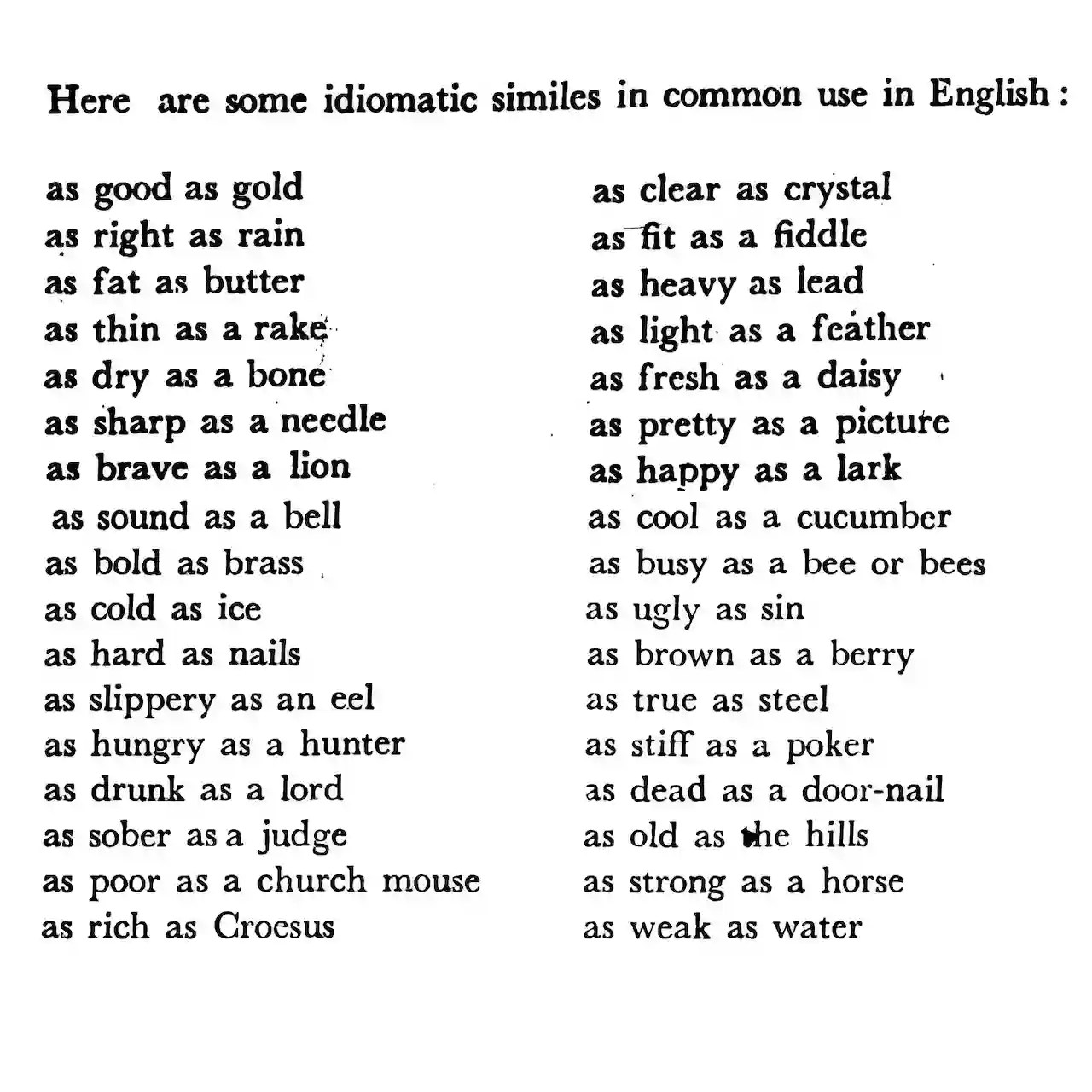
Russell Samora has been fooling around with figures of speech; with his colleagues at The Pudding, he’s fielded a fascinating analysis of of that comparative workhorse, the simile…
Similes are all around us. But, if you haven’t considered this figure of speech since grade school, here’s a refresher: similes compare a shared quality of two things, often using “like” or “as.”
I pulled every simile in the form “as ___ as ___” from tens of thousands of fiction books for the top 500 most common adjectives… I thought it would be a trivial exercise, but the more I poked around, the more questions I had…
Samora explains how similes are structured and how they are used (and with what relative frequency) in literature. He examines some of the most common– and several special cases (“The Ironic Ones”). And he explains his methodology and sources… all in the context of a lovely interactive data visualization.
It’s as cool as hell: “Comparisons as Predictable as the Sunrise,” from @pudding.cool.
###
As we agree with Steve Martin that “a day without sunshine is like, you know, night,” we might recall that it was on this date in 1789 that Richard Kirwan published his essay in support of the phlogiston theory (the belief, that dates to alchemical times, in the existence of a fire-like element (dubbed “phlogiston”) contained within combustible bodies and released during burning. Kirwan was among the last of its advocates.
A well-regarded scientist in the late 18th and early 19th centuries, Kirwan met and corresponded with Black, Lavoisier, Priestley, and Cavendish. Indeed, while scientific history remembers him as a defender of an incorrect theory, his work probably spurred Priestley and Lavoisier, who respectively discovered and named the actual elemental agent of combustion, oxygen.
But Kirwan is also remembered for a personal eccentricity (one of many) that led to some referring to him (all too poignantly) as “crazy as a bed bug”: he hated bugs (especially flies). Kirwan paid his servants a bounty for each one they killed.

“Yesterday and tomorrow cross and mix on the skyline”*…

Artist’s impression of medieval Bologna [source]
During the 12th and 13th centuries, for reasons that are still not entirely clear, an incredible number of towers [over 100] were built throughout Bologna, making for a urban skyline that almost resembles modern-day Manhattan. Today, only 22 remain…
More at: “Towers of Bologna.”
* Carl Sandburg
###
As we reach for the sky, we might recall that it was on this date in 1826 that 20 year old Joseph Paxton arrived to begin work as Head gardener to William Cavendish, the 6th Duke of Devonshire, possessor of one of England’s premier gardens on his estate, Chatsworth.
Paxton settled into his job and became the Duke’s right-hand man for projects on the estate. Paxton noticed the need of a conservatory, so designed and built one: The Great Conservatory at Chatsworth– at the time the largest glass in England. It was lit with twelve thousand lamps when Queen Victoria was driven through it in 1842, and she noted in her diary: “It is the most stupendous and extraordinary creation imaginable.”

So, when Prince Albert hatched plans for The Great Exhibition of the Works of Industry of all Nations– or the Great Exhibition, as it was more familiarly known– to be held in 1851, Paxton was recruited to design its central building: The Crystal Palace.

Paxton was knighted, and went on to cultivate the Cavendish banana, the most consumed banana in the Western world, and to serve as a Member of Parliament.

You must be logged in to post a comment.