Posts Tagged ‘blue grass’
“Listening is like running down a mountain on a switchback trail, the sound of surprise generating its own momentum. There’s a punk glee inside the bluegrass craft– and a punk vehemence inside the bluegrass smile.”*…
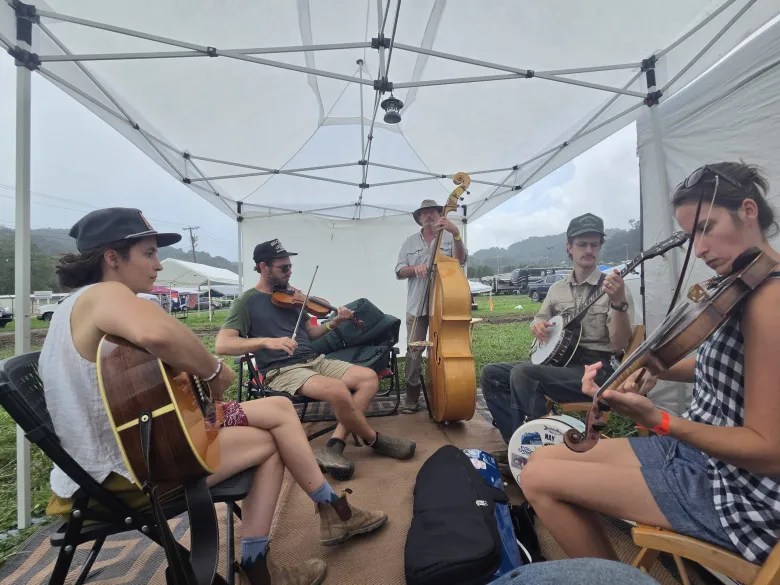
On the heels of Hardy Strictly Bluegrass [and here], Warren Hellman‘s gift to San Francisco, the most recent annual installment of which was last weekend, a lovely piece by David Alm on a more traditional event…
I got off Interstate 81 to give my soul a break. The back roads of southwest Virginia wind, crest, and plunge through lush valleys of oak, poplar, birch, and maple trees. It’s easy to lose track of time and distance there. People drive slower. Cows graze in pastures. And there are no placards festooned with Motel 6 and Starbucks logos, flattening the American landscape into a homogeneous blur. Any signs you might see are low to the ground and handmade, protesting a data center, for instance, or thanking Jesus.
I’d gone to this rural pocket of the country for the 90th annual Old Fiddler’s Convention in Galax, an independent city of just under 7,000 near the North Carolina border whose population, for six days in early August, balloons to around four times that. They arrive in RVs and Casitas, camper vans and cars to stake out 20-by-35-foot plots in Felts Park, a 28-acre fairground in the heart of Galax, transforming it into a massive, muddy parking lot sprinkled with portable toilets and a cluster of food trucks, offering loaded potatoes, funnel cake, and blooming onions.
The Old Fiddler’s Convention—or just Galax, as the diehards call it—is the oldest and largest fiddlers’ convention in the world, a place where banjo pickers, guitar players, and other maestros of old-time strings gather to see how they stack up. Founded in 1935, Galax has been canceled only twice since then: once during World War II, due to travel restrictions, and again in 2020, due to the COVID-19 pandemic. Many Galaxers have been going every year for decades, some for as long as they’ve been alive.
There are scads of rules: If you play clawhammer-style banjo in the bluegrass band competition, you will get disqualified. Same if you play bluegrass-style banjo in the old-time competition. If you break a string while performing, you must stop immediately. Playing time during competition is limited to two minutes and 30 seconds. And, crucially, no electric instruments of any kind are allowed, either on stage or in the tightly packed fairgrounds, where self-described hillbillies, accountants, firefighters, and session musicians pick day and night in blistering, impromptu jams amid the RVs.
One does not merely attend Galax. It’s not a music festival. There are no headliners, and no full-set performances. There is a single stage, and over the course of six days, contestants take it one after another to play one song for a panel of judges and a smattering of spectators. There are more than a dozen categories, little changed in the past century: old-time fiddle, guitar, dulcimer, folk song. Cash prizes for individual players range from $35 to $285; a campsite and contestant pass together cost $175. “The prestige of being judged a ‘winner at Galax,’ and the respect for one’s musical talent that goes along with it, far outweighs any monetary award,” wrote Fred Burton in the March 1984 issue of Bluegrass Unlimited…
…
… An old-time jam goes something like this: Anywhere from two to umpteen musicians gather in a circle, knee-to-knee, and someone—usually the fiddler—calls a tune. Before you know it, you’re carried away by a cyclone of fiddles, mandolins, banjos, and guitars, all locked into a swirling rhythm that can, when it’s good, take you to church.
The tradition dates to the mid-1700s, when Scots-Irish immigrants first settled in Appalachia. Even then, coastal property was for the elite, forcing poorer immigrants inland and south, through the Shenandoah Valley to southwest Virginia, where land was plentiful and cheap. Their music quickly took root. “The Scots brought fiddles and liquor,” Ted McAllister, one of my neighbors in Felts Park, told me. “The Germans brought church music and beer.”
Over time, Scottish fiddle tunes evolved, as oral traditions do, and began to mix with the musical traditions of enslaved Africans, who had brought with them gourd instruments that would evolve into the American banjo, along with rhythms the Scots had never heard before. Old-time music, in other words, is the music of diasporas, fed into a blender and then worked into a froth. A lot of traditional folk songs came out of this period, too. One that I learned at Galax, “Going to the West,” tells the story of a young man who leaves the mountains of his birth, “where labor is in vain,” to seek the fertile plains out west. It’s the story of my own Scottish forebears, who settled in South Dakota before moving to what is now suburban Chicago, and later, Florida.
Bluegrass, by contrast, was born in the 1940s, when Bill Monroe and The Blue Grass Boys took those mountain sounds, combined them with Southern church music and blues, and tightened it all into something you might call an uncle of rock ’n’ roll. There’s a reason that Billy Strings plays to sold-out arenas and pickers from around the world can play classics like “Blue Ridge Cabin Home” at the drop of a one-chord.
Where bluegrass is punchy and clean, designed for the stage, old-time is ecstatic, designed for participation. Bluegrass jams attract spectators who marvel at the players’ pyrotechnics; old-time jams get people on their feet. At Galax, some folks drag big pieces of plywood around the fairgrounds looking for old-time jams, where they’ll lay the board down at the edge of the circle and dance. Flatfooters they’re called: the percussion section…
Eminently worth reading in full.
In a southwest Virginia fairground, thousands of musicians gather every August to keep a centuries-old tradition from flickering out: “A Place Among the Fiddlers,” from @longreads.com.
###
As we pick, we might recall that it was on this date in 1939 that George D. “Judge” Hay, the creator and producer of The Grand Ole Opry, invited Bill Monroe and the Blue Grass Boys to audition for a spot on the prestigious radio broadcast. The audition was a success, and Monroe chose “Muleskinner Blues” for their debut. According to observers, when the curtain went up, the audience and Opry regulars alike (including stars such as Roy Acuff, Uncle Dave Macon, and Pee Wee King) were awed by the furious tempo of the Blue Grass Boys. Band member Cleo Davis later observed that the audience “couldn’t think as fast as we played.”
Monroe quickly scored a recording contract, and switched personnel to establish the line-up that became famous, surrounding himself (on mandolin) with Lester Flatt (guitar), Earl Scruggs (banjo), Chubby Wise (fiddle), and Cedric Rainwater (bass). Together, they polished the traditional mountain music celebrated at Galax into a genre that took its name from their group. and Monroe is remembered as “the Father of Bluegrass.”

Hallelujah!…

Back in 1972, your correspondent spent a summer working working as a utility infielder at WBTV, the Charlotte CBS affiliate. In those distant days, local stations did original public affairs programming of all sorts, including local documentaries (that weren’t simply “service” programs promoting tourism, shopping, or dining out); for instance, your correspondent recorded the audio for the first documentary made on the now-legendary Blue Grass conclave, The Union Grove Fiddlers Convention.
But the most memorable shoot of that summer was a documentary on Charles Keyes, The Parson of the Hills. Keyes, an itinerant preacher for 71 of the 76 years that he lived (he passed away in 1996), ministered to the poor of the North Carolina Appalachians. His flock was scattered in such out-of-the-way places that he was, for many, the only “outsider” they knew and trusted… and so, as we accompanied him, filming his “rounds,” we saw corners of America that were then effectively as remote and untouched as as the most hidden corners of the Brazilian rain forest.
Among the extraordinary things we saw, probably the most striking was the snake handling service to which Keyes led us– one he attended as an unofficial social worker, not an officiant. Since the early 20th Century, snake handling has been a feature of Pentecostal worship in a small number of Appalachian congregations which take the Bible literally…
And these signs shall follow them that believe: In my name shall they cast out devils; they shall speak with new tongues. They shall take up serpents; and if they drink any deadly thing, it shall not hurt them; they shall lay hands on the sick, and they shall recover. (Mark 16:17-18)
Behold, I give unto you power to tread on serpents and scorpions, and over all the power of the enemy: and nothing shall by any means hurt you. (Luke 10:19)
Snake handling survives, but it’s dwindling. So it’s a gift that Oregon-based photographer Hunter Barnes, who had spent time documenting “Rednecks,” turned his lens to create “A Testimony of Serpent Handling.”

Barnes posted his project on Kickstarter, where he successfully raised the funds he needed to finish– and where readers will find a fascinating video explaining and illustrating the project.
As we contemplate the manifold manifestations of faith, we might send the simplest of birthday greetings to writer, philosopher, and naturalist Henry David Thoreau; he was born on this date in 1817. From 1845 to 1847, Thoreau lived in a small cabin on the banks of Walden Pond, a small lake near Concord, Massachusetts. Striving to “simplify, simplify,” he strictly limited his expenditures, his possessions, and his contact with others, intending “to live deliberately, to front only the essential facts of life, and see if I could not learn what it had to teach.”
Thoreau became a pillar of New England Transcendentalism, embracing and exemplifying the movement’s belief in the universality of creation and the primacy of personal insight and experience. Perhaps best remembered for his advocacy of simple, principled living, his writings on the relationship between humans and the environment also helped define the nature essay.
 source: Library of Congress
You must be logged in to post a comment.