Posts Tagged ‘architecture’
“The Greek temple is the creation, par excellence, of mind and spirit in equilibrium”*…
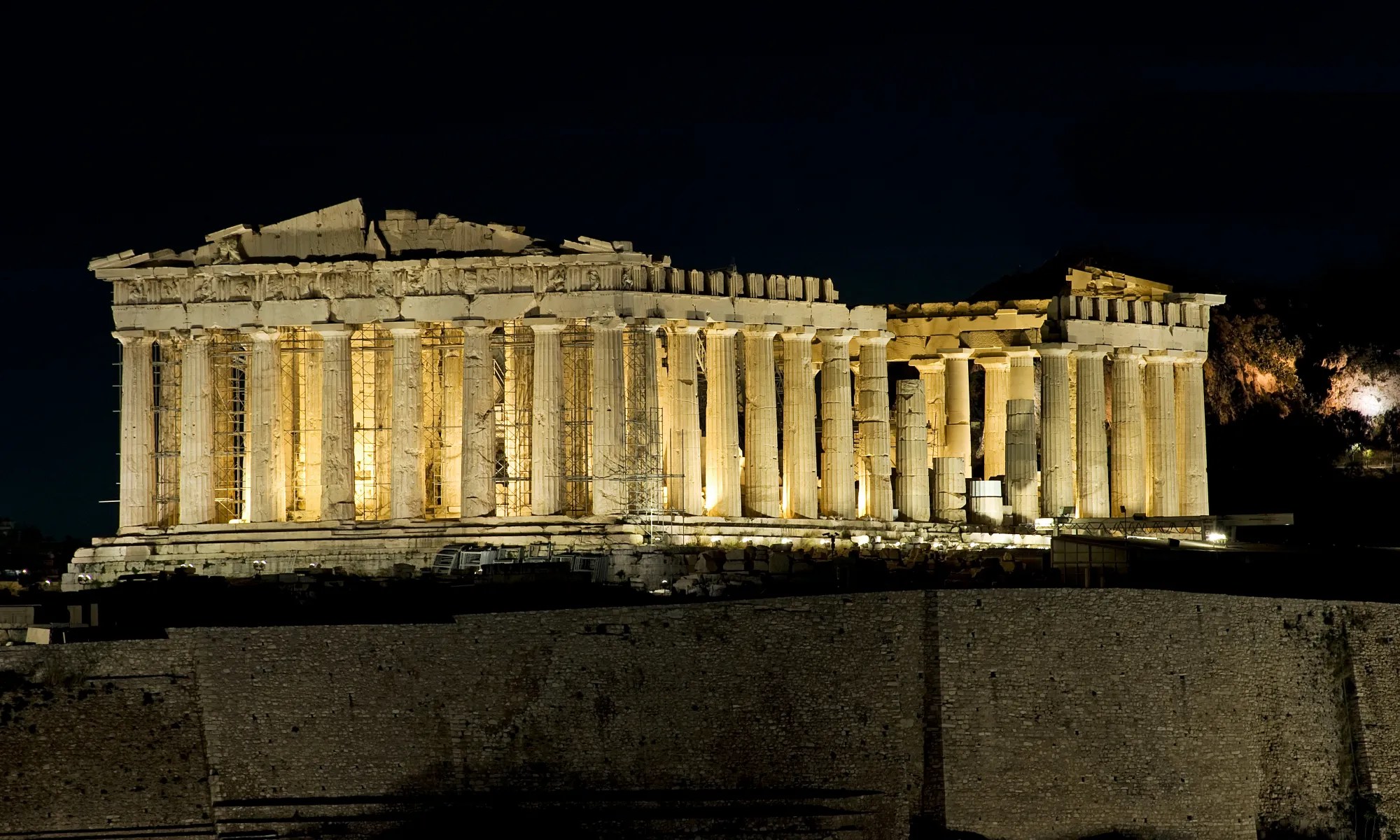
Edmund Stewart outlines the requirements for building a Greek temple…
If, like me, you have ever wondered what goes into building a Greek temple, then fear not: I here present a list of everything you will need. Admittedly, when compared with the wonders made possible by Roman concrete or a mediaeval gothic arch, the hundreds of temples scattered across the Greek world may perhaps look a bit small. Yet they are certainly elegant, sometimes with a slender beauty typical of the Ionic order, or else the sturdy grandeur of the Doric. And, when examined closely, the process of building one may quickly become worryingly complex…
Indeed, as The Browser observes, it’s a challenge…
In brief: [one would need] quite a lot. An architect, obviously, though architects were relatively cheap in ancient Greece; ships to bring in the marble; a hundred slaves for heavy lifting; a dozen carpenters; six craftsmen per column to dress the facade; sculptors and painters for the ornamentation; a door-maker; and do be sure to order your floor-tiles well ahead of time, they may take two years to arrive..
A fascinating and entertaining read: “What You Need to Build a Greek Temple,” in @AntigoneJournal, via @TheBrowser.
* Edith Hamilton
###
As we contemplate construction, we might send carefully-excavated birthday greetings to Charles Thomas Newton; he was born on this date in 1816. An archaeologist, he excavated sites in southwestern Turkey and disinterred the remains of one of the seven wonders of the ancient world, the Mausoleum of Halicarnassus (at present-day Bodrum, Turkey). Newton joined staff of British Museum in 1840, where he helped to establish systematic methods for archaeology and ultimately became its first keeper (curator) of Greek and Roman antiquities.

“Most things are never meant”*…

Protein-packed diets add excess nitrogen to the environment through urine, rivaling pollution from agricultural fertilizers…
In the U.S., people eat more protein than they need to. And though it might not be bad for human health, this excess does pose a problem for the country’s waterways. The nation’s wastewater is laden with the leftovers from protein digestion: nitrogen compounds that can feed toxic algal blooms and pollute the air and drinking water. This source of nitrogen pollution even rivals that from fertilizers washed off of fields growing food crops, new research suggests.
When we overconsume protein—whether it comes from lentils, supplements or steak—our body breaks the excess down into urea, a nitrogen-containing compound that exits the body via urine and ultimately ends up in sewage… the majority of nitrogen pollution present in wastewater—some 67 to 100 percent—is a by-product of what people consume…
Once it enters the environment, the nitrogen in urea can trigger a spectrum of ecological impacts known as the “nitrogen cascade.” Under certain chemical conditions, and in the presence of particular microbes, urea can break down to form gases of oxidized nitrogen. These gases reach the atmosphere, where nitrous oxide (N2O) can contribute to warming via the greenhouse effect and nitrogen oxides (NOx) can cause acid rain. Other times, algae and cyanobacteria, photosynthetic bacteria also called blue-green algae, feed on urea directly. The nitrogen helps them grow much faster than they would normally, clogging vital water supplies with blooms that can produce toxins that are harmful to humans, other animals and plants. And when the algae eventually die, the problem is not over. Microorganisms that feast on dead algae use up oxygen in the water, leading to “dead zones,” where many aquatic species simply cannot survive, in rivers, lakes and oceans. Blooms from Puget Sound to Tampa, Fla., have caused large fish die-offs…
If it’s not one thing, it’s another: “Eating Too Much Protein Makes Pee a Problem Pollutant in the U.S.,” from Sasha Warren (@space_for_sasha) in @sciam.
* Philip Larkin, “Going, Going” (in High Windows)
###
As we deliberate on our diets, we might recall that it was on this date in 1888 that Theophilus Van Kannel received a patent for the revolving door, a design that came to characterize the entrances of (then-proliferating) skyscrapers and that earned him induction into the National Inventors Hall of Fame. But lest we think him “all work,” his other notable invention was the popular (at least in the early 20th century) amusement park ride “Witching Waves.”


“I thought about the screws and their happiness”*…

A contemplation of craft…
I clock my screws, meaning I orient the slot in the screw heads so they are all vertical or horizontal. But I don’t think it’s a mark of superior aesthetics. It’s just something I do, like lining up the silverware on the dining table just so. I can’t help it…
Yesterday I took a drive to Columbus, Ind., one of the country’s repositories of excellent post-war architecture. Check out the Wikipedia page. Or the NPR story on the town. Or the great Kogonada-directed movie, “Columbus.”
My favorite building we toured was the First Christian Church, designed by Eliel Saarinen. Considered one of the first modern church structures in America, the building offers nod after nod to the cathedrals and churches of Europe. Yet the building, completed during World War II, is a complete break with the Old World. Even after 75 years, the church feels a beacon of hope, optimism and light.

One of the prominent features of the interiors is the extensive wooden lattice work, which is affixed with tens of thousands of perfectly clocked screws…
“The Church of the Clocked Screws,” from Christopher Schwarz (@RudeMechanic) at Lost Art Press— eminently worthy of reading in full.
* Haruki Murakami
###
As we applaud alignment, we might recall that it was on this date in 1852 that Cullen Whipple was awarded patent 9477 for his “Mechanism for Pointing and Threading Screw-Blanks in the Same Machine.” A machinist, Whipple had invented the first practical device for making pointed screws (a marked improvement on earlier screws, which were blunt-ended and required the drilling of “starter holes”). Cullen joined with partners to incorporate The New England Screw Co., then went on to invent and patent seven other machines that improved the manufacture of screws.

“There are only patterns, patterns on top of patterns, patterns that affect other patterns. Patterns hidden by patterns. Patterns within patterns.”*…
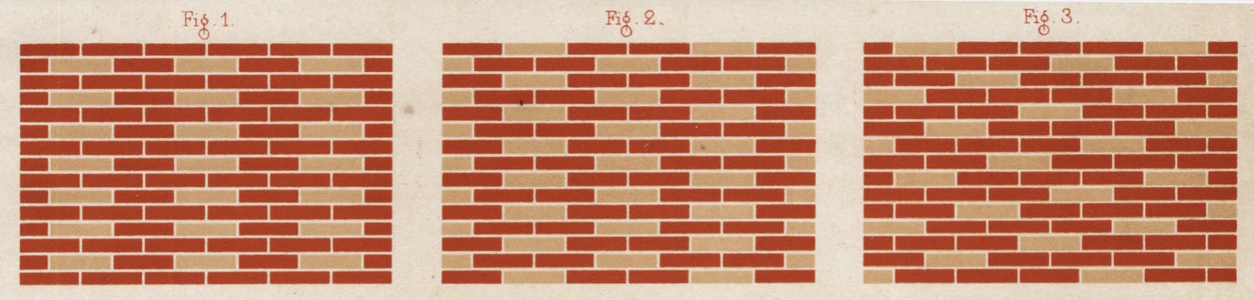


… and so many more in a beautiful 1878 book of brick patterns, published in France by architect J Lacroux: “Brick Tease,” from @presentcorrect.
* Chuck Palahniuk, Survivor
###
As we muse on masonry, we might send carefully-designed birthday greetings to John W. “Jack” Ryan; he was born on this date in 1926. A Yale-trained engineer, Ryan left Raytheon (where he worked on the Navy’s Sparrow III and Hawk guided missiles) to join Mattel. He oversaw the conversion of the Mattel-licensed “Bild Lili” doll into Barbie (contributing, among other things, the joints that allowed “her” to bend at the waist and the knee) and created the Hot Wheels line. But he is perhaps best remembered as the inventor of the pull-string, talking voice box that gave Chatty Cathy her voice.

“Variety’s the very spice of life, that gives it all it’s flavour”*…

Possibly the most remarkable city block in the world…
The Illa de la Discòrdia (Catalan pronunciation: [ˈiʎə ðə lə disˈkɔɾði.ə]) or Mansana de la Discòrdia [mənˈsanə ðə lə disˈkɔɾði.ə] — “Block of Discord”; Spanish: Manzana de la Discordia — is a city block on Passeig de Gràcia in the Eixample district of Barcelona, Catalonia, Spain. The block is noted for having buildings by four of Barcelona’s most important Modernista architects, Lluís Domènech i Montaner, Antoni Gaudí, Josep Puig i Cadafalch, and Enric Sagnier, in close proximity. As the four architects’ styles were very different, the buildings clash with each other and the neighboring buildings. They were all built in the early years of the 20th century…
Wikipedia
From the left in the photo above:
Casa Lleó M Lluís Domènech i Montaner (1905)
Casa Mulleras Enric Sagnier (1906)
Casa Bonet Marceliano Coquillat (1901/1915)
Casa Amatller Josep Puig i Cadafalch (1900)
Casa Batlló Antoni Gaudí (1877/1906)
* William Cowper
###
As we marvel, we might send boldly-sketched birthday greetings to Sir Peter Cook; he was born on this date in 1936. An architect, lecturer, and writer, he was a founder of Archigram, a group that championed neofuturistic design as a challenge to the complacency of modernism…. every solution becomes the next problem…

You must be logged in to post a comment.