Posts Tagged ‘open societies’
“Unlimited tolerance must lead to the disappearance of tolerance”*…

In 1945, in The Open Society and Its Enemies, Karl Popper described “the paradox of tolerance“…
The so-called paradox of freedom is the argument that freedom in the sense of absence of any constraining control must lead to very great restraint, since it makes the bully free to enslave the meek. The idea is, in a slightly different form, and with very different tendency, clearly expressed in Plato.
Less well known is the paradox of tolerance: Unlimited tolerance must lead to the disappearance of tolerance. If we extend unlimited tolerance even to those who are intolerant, if we are not prepared to defend a tolerant society against the onslaught of the intolerant, then the tolerant will be destroyed, and tolerance with them. — In this formulation, I do not imply, for instance, that we should always suppress the utterance of intolerant philosophies; as long as we can counter them by rational argument and keep them in check by public opinion, suppression would certainly be unwise. But we should claim the right to suppress them if necessary even by force; for it may easily turn out that they are not prepared to meet us on the level of rational argument, but begin by denouncing all argument; they may forbid their followers to listen to rational argument, because it is deceptive, and teach them to answer arguments by the use of their fists or pistols. We should therefore claim, in the name of tolerance, the right not to tolerate the intolerant. We should claim that any movement preaching intolerance places itself outside the law, and we should consider incitement to intolerance and persecution as criminal, in the same way as we should consider incitement to murder, or to kidnapping, or to the revival of the slave trade, as criminal…
Mark Manson offers a critique…
… Popper proposed the Paradox of Tolerance to explain why a German public full of otherwise good people allowed Hitler to come to power and commit so many atrocities. Since then, the Paradox of Tolerance has survived and has occasionally become a talking point in discussions about social justice. The idea is that it’s okay to be a piece of shit to someone because they, too, are a piece of shit.
But the problem is that, most of the time, it’s not crystal clear what defines “tolerance” and “intolerance.”… Like most thought experiments inspired by Hitler, it doesn’t really work when you don’t have someone who is so obviously evil to unite against. As a result, the definition of an intolerant person has become so muddied and loose to the point where it might as well mean, “someone who believes things that make me feel bad.”…
The problem with Popper’s reasoning is that it quickly devolves into a cascade of dickish, self-righteous behavior.
Let’s say Person B decides that Person A’s behavior is intolerant and a threat to society. Person B then decides that it is morally correct to be intolerant of Person A and treat her like crap.
But then, Person C strolls by and notices Person B being a totally intolerant assface to Person A. Person C then decides that it’s morally correct to be actively intolerant of Person B. But then Person D strolls by, and notices Person C being horribly intolerant towards Person B…
You can see where this is going. And if you ever doubt the realism of this scenario, I invite you to spend a few hours on Twitter some time.
The irony is that in order to practice tolerance, you must be willing to sit with things that upset you or make you uncomfortable.
Yet, if your adopted ethic is that no one should ever be upset or uncomfortable, then you make any sort of tolerance impossible…
– source
I imagine that Popper might respond first that, of course, Manson is right that the definition of intolerance is slippery and that most varieties of unshared disapproval are best tolerated– indeed, that’s the essence of an open society.
But I suspect that he’d further argue that it is possible, well shy of Hitlerian extremes, to identify the intent (beyond disapproving) to debar– to abridge the fundamental rights of others. Even then, of course, it’s tricky– especially in social/cultural periods in which xenophobia and othering are in the ascendant, when difference isn’t perceived to be simply difference or disagreement, but a threat.
Still (presuming again to channel Popper), if one values an open society, one must practice the art (which is to say that it’s not a science) of protecting against this extreme, imperious intolerance– lest it squelch all alternatives to itself. This was the challenge taken up by the Founding Fathers in crafting the U.S. Constitution. And as they observed (but we tend to forget) it’s an on-going challenge. They imagined that the Constitution would be continually revised, both to reflect “learning” (what worked and what didn’t– practical learning) and to reflect changing circumstances and culture (the social and cultural learning/development on which, as Humanists, they were counting).
It’s hard… but then, as my old man used to say, that’s why they call it a paradox…
* Karl Popper
With apologies, another “hiatus notice”: I’m headed into three days of very intense meetings, so (R)D will be off until Friday…
###
As we deal with dichotomies, we might spare a cartographically-constructive thought for one of history’s most impactful scientific artists: Gerardus Mercator; he died on this date in 1594. The most renown cartographer of his time, he created a world map based on a new projection– the Mercator Projection— on which parallels and meridians are rendered as straight lines spaced so as to produce at any point an accurate ratio of latitude to longitude and sailing courses of constant bearing are represented as straight lines, an approach still employed in nautical charts used for navigation. He also introduced the term “atlas” for a collection of maps.
While he is most esteemed as the foremost geographer of his day, Mercator was also an accomplished engraver, calligrapher and maker of globes and scientific instruments. And he studied theology, philosophy, history, mathematics, and magnetism.

“Oh, down in Mexico / I never really been so I don’t really know”*…
In this moment of altogether appropriate attention to the autocratic threat to Ukraine, it’s too easy to forget that genuine democracy is under threat all around the world. Nathan Gardels cites two examples close to home: Mexico and California…
The core crisis of governance in open societies today is the distrust that has grown between the public and its institutions of self-government. The response to this breach of trust has largely been unfolding in two directions — the autocratic tendency toward decisive strongmen who fashion themselves as tribunes of the people, or seeking to re-legitimize democracy through greater citizen engagement and participation.
Now, a new and concerning hybrid is emerging that exploits the tools of citizen engagement and participation (such as the recall of elected officials, the referendum, and ballot initiative) either to affirm autocratic leanings or to protect and promote the very special interests these tools were meant to challenge…
…
Participatory democracy unmediated by impartial institutions of deliberation or guarded against manipulation by the powers that be poses as significant a risk to citizen control of government as unchecked executive power or rule by those with the most gold. When plebiscitary practices are deployed from the top down to affirm the rule of a present regime, or hijacked by the most monied, instead of initiated from the bottom up, the very notion of citizen empowerment is nullified.
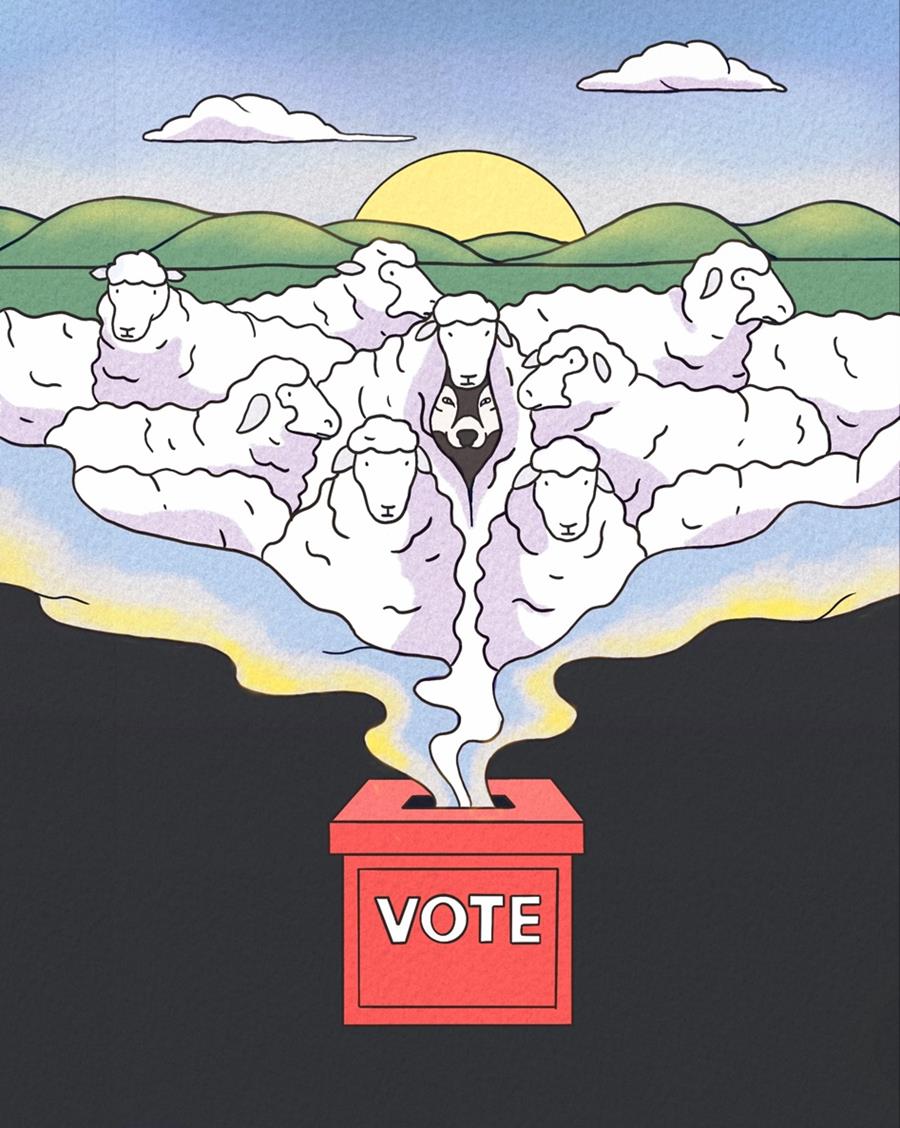
Top-down direct democracy is a wolf in sheep’s clothing: “Mexico: On The Path To A Perfect Autocracy?“, from @NoemaMag.
* James Taylor, “Mexico”
###
As we watch our backs, we might note that not all exercises of direct democracy (even when they are structurally flawed) end badly: on this date in 1992 a referendum to end apartheid in South Africa passed by a vote of 69% to 31%… a margin that would surely had been larger had the election not been restricted to white voters. (Universal suffrage was established two years later.)

You must be logged in to post a comment.