Posts Tagged ‘Richard II’
“I’m mad as hell, and I’m not going to take this anymore”*…

Your correspondent is headed into a melange of meetings (and their attendant travel), so (Roughly) Daily will be on pause for a few days. Regular service should resume on or around June 19. I’ll leave you with a (timely?) tale from the past…
“Steve” publishes a wonderful weekly newsletter, Dates With History. In a recent post he shares the story of Wat Tyler and the Peasants’ Revolt…
If you walked into Smithfield in the City of London in the small hours of the morning, you’d find the great Victorian iron-and-glass halls of the old meat market, traders hard at work while dazed club-goers spill out of nearby Fabric nightclub, uncertain for a moment what century they’re in.
A few steps away stands St Bartholomew’s Hospital—Barts—the oldest hospital in London still on its original site, patching people up since 1123.
On one of the blocked window bays of the hospital’s north wall, a memorial marks where the Scottish hero William Wallace was hanged, drawn and quartered in 1305, alongside remembrances of the Protestant martyrs burned here under Queen Mary between 1555 and 1558.
A third plaque, on another blocked window bay, recalls an event 645 years ago next Monday—15 June 1381.
That day, a man rode into Smithfield at the head of a rebel army and tilted the course of English history. The fact that he was dead before the day was out is beside the point.
His name was Wat Tyler…
[Steve explains the origins and workings of the feudal system in England, the (extraordinary) impact of the Black Death, the Poll Tax, the subsequent rise of peasant resistance, the Revolt itself, Wat’s demise, and the immediate aftermath. He concludes…]
… Wat Tyler enters the historical record on 7 June 1381 and exits eight days later, 15 June 1381, when he was executed. That’s his lot.
The revolt failed.
But the idea it carried—that labour had value, that taxation required some semblance of fairness, that the common man had rights—survived.
The Peasants’ Revolt echoed what the barons had done at Runnymede in 1215—confront a king and extract written concessions from him. Tyler’s rebels knew their history. Had they succeeded, those sealed charters would have amounted to a Magna Carta for the poor.
Over the three centuries that followed, the power of English rulers to do as they pleased eroded steadily. By 1689, the Bill of Rights made explicit what three hundred years had been quietly establishing—that rulers governed within limits they did not set themselves.
Wat Tyler hadn’t written that principle. But he had fomented one of its earliest and most violent proofs of concept.
There wouldn’t be another poll tax in England for six hundred years—until Margaret Thatcher introduced one in 1990 and was promptly removed from office.
History, it turns out, has a long memory for bad ideas…
(Trying to) hold power to account: “It’s 1381 and the peasants are revolting.”
* “Howard Beale” (Peter Finch) in Paddy Chayefsky‘s and Sidney Lumet‘s Network
###
As we ponder power, we might recall that it was on this date in 1939, at Hyde Park, that President Franklin D. Roosevelt hosted a luncheon for King George VI and Queen Elizabeth of England. Despite his mother’s horror, FDR wanted to show the King and Queen an old-fashioned, American style picnic– featuring that most proletariat of dishes, the hot dog. In the U.S. to raise support U.S. for Britain’s cause in World War II, the royal couple at least appeared to enjoy the meal.


“Our social tools are not an improvement to modern society, they are a challenge to it”*…

Jonathan Haidt ponders the poisonous impact of social media, arguing that “It’s not just a phase,” and what considers we might do about it…
… It’s been clear for quite a while now that red America and blue America are becoming like two different countries claiming the same territory, with two different versions of the Constitution, economics, and American history. But Babel is not a story about tribalism; it’s a story about the fragmentation of everything. It’s about the shattering of all that had seemed solid, the scattering of people who had been a community. It’s a metaphor for what is happening not only between red and blue, but within the left and within the right, as well as within universities, companies, professional associations, museums, and even families.
Babel is a metaphor for what some forms of social media have done to nearly all of the groups and institutions most important to the country’s future—and to us as a people. How did this happen? And what does it portend for American life?
…
The high point of techno-democratic optimism was arguably 2011, a year that began with the Arab Spring and ended with the global Occupy movement. That is also when Google Translate became available on virtually all smartphones, so you could say that 2011 was the year that humanity rebuilt the Tower of Babel. We were closer than we had ever been to being “one people,” and we had effectively overcome the curse of division by language. For techno-democratic optimists, it seemed to be only the beginning of what humanity could do.
In February 2012, as he prepared to take Facebook public, Mark Zuckerberg reflected on those extraordinary times and set forth his plans. “Today, our society has reached another tipping point,” he wrote in a letter to investors. Facebook hoped “to rewire the way people spread and consume information.” By giving them “the power to share,” it would help them to “once again transform many of our core institutions and industries.”
In the 10 years since then, Zuckerberg did exactly what he said he would do. He did rewire the way we spread and consume information; he did transform our institutions, and he pushed us past the tipping point. It has not worked out as he expected…
Social media and society: “Why the Past 10 Years of American Life Have Been Uniquely Stupid,” from @JonHaidt in @TheAtlantic. Eminently worth reading in full.
See also: “The big idea: how to win the fight against disinformation.”
* Clay Shirky
###
As we follow Jaron Lanier‘s advice to “go to where you are kindest,” we might recall that it was on this date 1397 that Geoffrey Chaucer “told” (read aloud) The Canterbury Tales for the first time at the court of Richard II.
“I got stood up by the letter Y, he was hanging around with his X”*…

It’s perhaps not pornography’s fault that it’s cashing in on a global crisis. As, around the world, whole societies confine themselves to their quarters, traffic to major porn sites has been spiking everywhere, telling us all we need to know about how humans with a broadband connection tend to deal with exceptional levels of boredom and anxiety. From the point-of-view of page views, the season of self-isolation might well be the porn industry’s historical high point — but in terms of reputational damage, it also marks a new low for one of Western culture’s most enigmatic figures.
Once, the letter X was the holiest of all alphabetic symbols, standing for nothing less than the triumph of Christendom itself. The Roman emperor Constantine I imposed his adopted religion on Europe and the Middle East, with armies marching under the banner of an “X,” and for centuries, Latin scribes used it as shorthand for “Christ.”
But at the present moment… the 24th letter of the English alphabet is synonymous not even with professionally lit kissy porn, but rather the explicitier, extremier world of hardcore sharing platforms.
It’s a remarkably stratospheric fall from grace, especially for such a shy and retiring character — X is the second-least-common letter in written English (after Z), and the one that begins by far the fewest number of words. Oh X, what happened to you? Where did it all go so badly wrong that you’re hanging out in NSFW corners of the internet…?
From holiest hallmark to horniest sex symbol — the X-treme, X-haustive story of how the wild child of the alphabet lost its way: “How Did X Become the Edgiest Letter?”
See also: “What’s So Fascinating About the Letter X?” and “Before X Was X: The Dark Horse Story Of The 24th Letter.”
* Norah Jones
###
As we mark the spot, we might recall that it was on this date 1397 that Geoffrey Chaucer “told” (read aloud his ribald, if not X-rated) The Canterbury Tales for the first time at the court of Richard II.
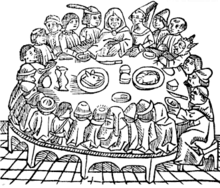
A woodcut from William Caxton‘s second edition of The Canterbury Tales, printed in 1483
“We don’t just borrow words; on occasion, English has pursued other languages down alleyways to beat them unconscious and rifle their pockets for new vocabulary”*…

In the early history of international trade, when exotic goods traveled to new regions, their native names sometimes hitchhiked along with them.
Naturally, the Germans have a term – Wanderwörter – for these extraordinary loanwords that journey around the globe, mutating subtly along the way…
See the map above in larger format, and learn more about each of the examples it illustrates at: “Mapping the Spread of Words Along Trade Routes.” [sourced from Lapham’s Quarterly]
* James Nicoll
###
As we ponder the provenance of our produce, we might recall that it was on this date 1397 that Geoffrey Chaucer “told” The Canterbury Tales for the first time at the court of Richard II.
A woodcut from William Caxton‘s second edition of The Canterbury Tales, printed in 1483
“Just like heaven. Ever’body wants a little piece of lan’… Nobody never gets to heaven, and nobody gets no land”*…

The rough beauty of the American West seems as far as you can get from the polished corridors of power in Washington DC. Until you look at the title to the land. The federal government owns large tracts of the western states: from a low of 29.9% in Montana, already more than the national average, up to a whopping 84.5% in Nevada…
More on government land, the uses to which it is put, and the issues it raises at “How the West Is Owned.”
* John Steinbeck, Of Mice and Men
###
As we wonder what Horace Greeley was on about, we might recall that it was on this date in 1601 that agents of Robert Devereux, 2nd Earl of Essex, paid Shakespeare’s theater troupe, The Lord Chamberlin’s Men, to perform Richard II. The group had been reluctant to dust off the by-then old piece of repertoire, but were convinced by a 40 shilling “gratuity.” Essex’s purpose in the endeavor was to stir the public against Queen Elizabeth (who identified– and was identified with– the childless, and thus heir-less Richard II, who is deposed in the play).
Essex had squandered and blundered his way into financial trouble and out of the Queen’s graces; desperate, he had plotted a rebellion that he launched two days after the play’s performance– only to find that he had garnered no support at all from the people. He was quickly captured by Elizabeth’s Lord High Admiral (the Earl of Nottingham) and his men, tried, convicted, and on February 25th, less than two weeks after his patronage of the stage, beheaded at the Tower of London.

The rebellious Earl of Essex
You must be logged in to post a comment.