Posts Tagged ‘Herbert Hoover’
“The present is the past rolled up for action, and the past is the present unrolled for understanding”*…
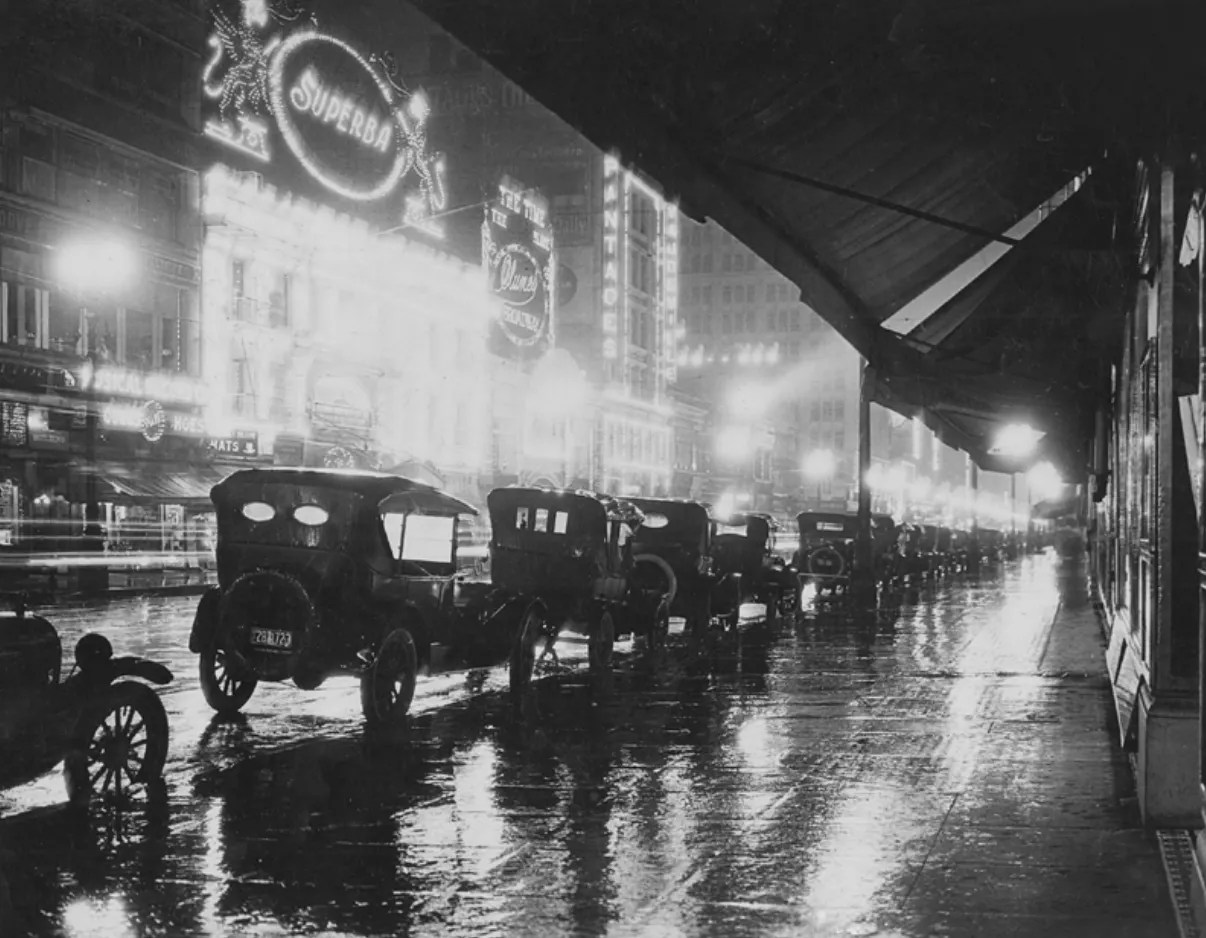
As Jean-Baptiste Alphonse Karr put it, “plus ça change, plus c’est la même chose” (“the more things change, the more they stay the same”). Case in point: Derek Thompson reminds us that about 100 years ago, America was obsessed with technology, immigration, women, work, and money. Sound familiar?
[Just over] one hundred years ago, on September 26, 1929, President Herbert Hoover gathered a group of social scientists at the White House. He asked them to begin research on the most detailed report ever produced on the state of the nation. Four years later, running more than 1,500 pages long, Recent Social Trends was published, offering an unusually granular look at life in the mid-1920s.
The document is almost entirely forgotten. But today, for America’s 250th birthday, I’m blowing the cobwebs off this sucker and taking readers inside its yellowed pages for a look back at what life was like in the U.S. exactly 100 years ago, when the U.S. was celebrating its sesquicentennial anniversary…
And what a look it is…
… Imagine that you are the typical American in 1926. You are a white 26-year-old. (In 2026, the median age is 40.) Since most immigrants have been male, we’ll say you’re a guy. Your name is John. Born in the first term of William McKinley’s presidency, you are raised on a farm without flush toilets or electric lighting. Too young to fight in World War I, you come of age alongside a generation that sees war in Europe as a “useless colossal blunder,” in the words of historian David M. Kennedy. Your life—indeed, your entire generation—is shaped by several notable developments: education, urbanization, automation, and women’s rights. You are the first person in your family to finish high school.
At 19, you move from the countryside to an urban apartment, as one small drop in the migratory flood from farm to city. Jobs in manufacturing and retail are easy to find. They’re also easy to lose. Temporary unemployment is the norm. You earn $100 a month and put some away for a rainy day, confident that the bustling city will provide another job in a few months. (Unemployment insurance does not exist; neither does Social Security.) In the evenings, you “radio”; yes, it’s a verb, too. Every weekend, you visit a cineplex, where the movies are black-and-white and silent. Sometimes, you down a few prohibited cocktails and go dancing with flappers. Several times a week, you drive around in a black Model T.
The year 1926 has been good to you. City life is a blur of high-velocity machines—cars, assembly lines, and radio broadcasts—and you sometimes miss the ancient rhythms of your farmland home. One year from now, Charles Lindbergh will shock the world by flying across the Atlantic. In two years, at 28, you’ll be married. In three years, you’ll have a baby. And in four years, in 1930, just months after the biggest stock market crash in American history, the world as you know it will be over…
Thompson goes on to unpack the details of the economy and employment, the migration from farm to city, the extraordinary centrality of the automobile, changing mores and gender roles, the primacy of literature and the rise of radio, and so much more. He concludes…
The authors of Recent Social Trends were astonishingly prescient about the direction of technology. In one paragraph, they somehow anticipated the rise of audiobooks, YouTube, Netflix, smartphone cameras, musical software, ubiquitous air conditioning, and the electric battery revolution:
It may be that the world will find much use for talking books; school and college students may listen to lectures by long-running phonographs or talking pictures; moving pictures may be transmitted by wireless into houses; seeing with that new electric eye, the photo-electric cell, and recording what is seen, appear to have almost unlimited applications; new musical instruments different from any now in use may be given to us by electricity; the production of artificial climate may become widespread; an efficient storage battery of light weight and low cost might produce changes rivaling those of the internal combustion engine. And these are only a few of the myriad possibilities from new inventions in the future!
In an equally oracular section, the authors predicted the emergence of remote work and declining geographic mobility, anticipating that “the transmission of goods, of the voice and possibly of vision may act as a retarding influence on human mobility in the future and may cause a development of more remote and impersonal direction and controls.”
But the social scientists did not see these trends as altogether good. They worried that modern life, defined in equal parts by urbanization and technology, obliterated people’s values and their sense of self. Even as they gawked at the increase in patents—which grew more than 20-fold between the 1850s and the 1920s—they worried that a growing number of discoveries would bring “problems of morals, of education, of law, of leisure time, of unemployment, of speed, of uniformity and of differentiation.”
Social scientists of the 1920s saw machines pushing workers off of farms and competing with workers in manufacturing plants. How long, they wondered, until they would replace human workers in all tasks? “A larger proportion of work by machines, and a smaller proportion of human labor, is to be expected in the future,” they wrote. “There are indeed a few cases of wholly automatic factories and automatic stores and many automatic salesmen.” It is extraordinary to read these fears and not reflect on the AI jobs panic of the present, while also marveling at the thousands of occupations that are possible today precisely because machines made old jobs obsolete.
The dawn of the age of the machine drove us mad. Physicians of the day warned that the frail human mind was no match for the car, predicting at the time that “diseases of the wheel” would afflict the youth who rode bicycles and cars without restraint. It was not entirely obvious that they were wrong. In Germany, the number of patients registered in mental hospitals grew from 40,375 in 1870 to 220,881 in 1910. Over the same period, the share of patients admitted to general hospitals for illnesses of the nervous system rose from 44 to 60 percent.
Most perceptively, social critics of the age recognized that the urban-technological revolution of the early 20th century—what we might even call “modernity”—transformed not only our minds but also our values. Machines and systems that pulled Americans off the farm, away from the family home, and into churning markets of people and products threatened to replace the Judeo-Christian values that had bound the country for centuries with a new system of values dictated by markets. In 1903, the sociologist Georg Simmel anticipated the anxieties of the Twenties—ours and theirs—when he observed that in cities “money takes the place of all the manifoldness of things” and becomes “a common denominator of all values.” Money “hollows out the core of things, their peculiarities, their specific values, and their uniqueness and incomparability in a way which is beyond repair.”
One hundred and twenty years after the publication of that essay, the Wall Street Journal asked thousands of Americans what values were still important to them. While a declining share of Americans endorsed the worthiness of patriotism, religion, community, and children, the share who said “money” was “very important to them” went up. It sometimes seems as if markets and money are the last value standing, the final common denominator beneath all human endeavor.

On its 250th birthday, the U.S. similarly defines itself through markets. Those famous words of Calvin Coolidge, America’s president in 1926, could just as well serve this American president and this American moment: “The chief business of the American people is business.”…
Eminently worth reading in full: “America, 1926: What a Forgotten 100-Year-Old Report Says About Who We Are,” from @dkthomp.bsky.social.
You can find the full text of Recent Social Trends in the United States- Report of the President’s Research Committee on Social Trends, from the collection of the remarkable Prelinger Library, at the invaluable Internet Archive: Volume 1 and Volume 2.
* Will and Ariel Durent, The Lessons of History (in which, also: “Progress is an improvement in the means that we use for achieving the same old ends. I sometimes wonder if the progress is only of means without any progress in ends.”)
###
As we hear the echo, we might recall that today marks the anniversary of a signature advance during the period covered by Recent Social Trends in the United States: on this date in 1928, sliced bread was sold for the first time, by the Chillicothe Baking Company of Chillicothe, Missouri.
For more on this seminal development, see “What was the best thing before sliced bread?“

“The good we secure for ourselves is precarious and uncertain until it is secured for all of us and incorporated into our common life”*…

… It might be that people have been studying inequality in all the wrong places. A few years ago, two scholars of comparative politics, Alfred Stepan, at Columbia, and the late Juan J. Linz—numbers men—tried to figure out why the United States has for so long had much greater income inequality than any other developed democracy. Because this disparity has been more or less constant, the question doesn’t lend itself very well to historical analysis. Nor is it easily subject to the distortions of nostalgia. But it does lend itself very well to comparative analysis.
Stepan and Linz identified twenty-three long-standing democracies with advanced economies. Then they counted the number of veto players in each of those twenty-three governments. (A veto player is a person or body that can block a policy decision. Stepan and Linz explain, “For example, in the United States, the Senate and the House of Representatives are veto players because without their consent, no bill can become a law.”) More than half of the twenty-three countries Stepan and Linz studied have only one veto player; most of these countries have unicameral parliaments. A few countries have two veto players; Switzerland and Australia have three. Only the United States has four. Then they made a chart, comparing Gini indices with veto-player numbers: the more veto players in a government, the greater the nation’s economic inequality. This is only a correlation, of course, and cross-country economic comparisons are fraught, but it’s interesting.
Then they observed something more. Their twenty-three democracies included eight federal governments with both upper and lower legislative bodies. Using the number of seats and the size of the population to calculate malapportionment, they assigned a “Gini Index of Inequality of Representation” to those eight upper houses, and found that the United States had the highest score: it has the most malapportioned and the least representative upper house. These scores, too, correlated with the countries’ Gini scores for income inequality: the less representative the upper body of a national legislature, the greater the gap between the rich and the poor.
The growth of inequality isn’t inevitable. But, insofar as Americans have been unable to adopt measures to reduce it, the numbers might seem to suggest that the problem doesn’t lie with how Americans treat one another’s kids, as lousy as that is. It lies with Congress…
The estimable Jill Lepore on accounting for inequality: “Richer and Poorer.“
[image above: source]
###
As we search for the balance, we might recall that it was on this date in 1931 that the National Hunger March gathered in Washington DC to demand jobs and relief. Massing in front of Congress, the 1,670 marchers were met by an estimated 1500 police, and 1000 Marines, all armed. They left without a hearing from President Hoover or any other official, but did have an impact: they set the stage for the 1932 march of the Bonus Army where 43,000 marchers – many veterans – descended on Washington DC to demand payment for the “service certificates” which had given to them in 1924 in lieu of cash.

“Astonishment is the root of philosophy”*…

When we speak of a “presidential philosophy,” we do not ordinarily have in mind the intellectual debt a president may have had to Renaissance natural philosophy. But Herbert Hoover’s intellectual development seems to require that we widen our ordinary scope. Hooverism may in fact be the last echo of a sort of statesmanly engagement with philosophy that probes somewhat deeper into the order of things, and into humanity’s place in that order, than does the recent genre of campaign-minded, policy-focused, ghostwritten memoirs…
Herbert Hoover, the last “philosopher President”? Justin E. H. Smith makes the case in “Between the Mine and the Stream.”
* Paul Tillich
###
As we contemplate contemplation, we might send the best of all possible birthday greetings to lawyer, social philosopher, author, statesman, Renaissance humanist, and councillor to Henry VIII of England, Sir Thomas More; he was born on this date in 1478. While he is probably most widely remembered as the author of author of Utopia, More was beheaded by Henry for refusing to accept the king as Supreme Head of the newly-established Church of England (More was acting in accordance with his opposition to Martin Luther, William Tyndale, and the Protestant Reformation)… for which he was canonized in 1935 by Pope Pius XI. (He is remembered by the Church of England as a “Reformation martyr.”)

Hans Holbein the Younger’s portrait of More
Pity the poor photographers…

In this photo illustration a Lego shark chomps down on a Lego figure holding a Greek flag as other figures holding an Italian (L), Portuguese (C) and Spanish flag look on over a sea of Euro coins on September 27, 2011 in Berlin, Germany. Europe is continuing to wrestle with the ominous prospect of a Greek debt default that many fear could spread panic and push the already fragile economies of Italy, Portugal and Spain into a Eurozone crisis with global repercussions. (Photo by Sean Gallup/Getty Images)
The Greeks aren’t the only ones sick of the euro crisis. Photographers are reaching the end of their tether too, struggling to shoot images of euro coins in various states of distress to illustrate the story. Though some of the photos are absurd, they still get published — because news outlets are equally desperate…
Read the whole sad story in “Photographer Fatigue: The Absurd Quest for Euro Crisis Images” in Spiegel Online.
###
As we reach for our hankies, we might recall that it was during this month in 1930 that over 6,000 unemployed New Yorkers took to street corners selling apples at five cents apiece. As Herbert Hoover unhelpfully observed, “Many persons left their jobs for the more profitable one of selling apples.”

They giveth; they taketh away…
The Economist reports that participation in the U.S. Food Stamps program– designed to insure that poor Americans have enough to eat– had, by this past April, reached almost 45 million, or one in seven Americans.

At the same time, Reuters reports that In 11 states, lotteries provided more revenue than the state corporate income tax in 2009… The Rhode Island lottery netted the state more than $3 for each dollar of state corporate income tax in fiscal 2009.
 click image above, or here, for larger version
As we strain to think of even more regressive ways to raise revenue, we might recall that it was on this date in 1932 that General Douglas MacArthur, on the order of President Herbert Hoover, led two regiments and six tanks against the Bonus Marchers in Washington, D.C. The Bonus Army was a group of 43,000 marchers– 17,000 World War I veterans, their families, and affiliated groups– who gathered to demand cash-payment of the certificates they’d been issued by the government at the end of World War Two as a bonus for their service. MacArthur’s cavalry charged the protestors’ camp, and his infantry entered with fixed bayonets and adamsite gas, an arsenical vomiting agent, evicting veterans, families, and camp followers.
The Bonus Army incident proved disastrous for Hoover’s chances at re-election; he lost the 1932 election in a landslide to Franklin D. Roosevelt.
 Shacks that members of the Bonus Army erected on the Anacostia Flats burning after the confrontation with the military (source)
You must be logged in to post a comment.