Posts Tagged ‘candy’
“What are Americans still buying? Big Macs, Campbell’s soup, Hershey’s chocolate, and Spam– the four food groups of the apocalypse”*…

Rachel Handler weighs in with a deep dive on the enshittification (and here) of a couple of storied brands…
… Everyone in my life I spoke to agreed that something was amiss, that Reese’s — and commercial chocolate in general — didn’t taste the way it used to. Plus everything from Smartfood popcorn to HVAC to mattresses to car-door handles sucked now. Why wouldn’t Reese’s Peanut Butter Cups, whose entire reason for being was to taste good, also suck? And why was it so hard to know how — and why — they tasted worse?
I would spend the next several months tumbling down a chocolate vortex, encountering dozens of eccentric characters, all disagreeing about the fundamental question of what chocolate even is and who it should be for. I entered a terrifying fun house of American enshittification. I learned that — not to sound like a LinkedIn guy — what’s going on with chocolate is a parable for the modern world. That at this particularly bleak end stage of capitalism, everything we once treasured has or will lose its essential essence and MrBeast will always be involved somehow…
Into the molten belly of our crumbling world: “The Chocolate Conspiracy” (archived version), from @rachelhandler.bsky.social in @nymag.com. Eminently worth reading in full.
Via the ever-illuminating Ingrid Burrington (@lifewinning.com) and her wonderful newsletter, Perfect Sentences, the most recent edition of which included these bangers from Handler’s article:
It was a classic American story about men and the things they will do to cheat death (betray their fathers) and how, with enough drugs, you could lose the ability to taste or feel things.
Polling the average Hersheypark consumer had taught me a lot about individual taste preferences within the increasingly deteriorating conditions of the imperial core and about how hot I could get before I started to weep.
As we remember the real, we might note that today is National Chocolate Day.

“Every day is Halloween, isn’t it? For some of us.”*…

Tomorrow’s the big day– by some counts, the second biggest holiday of the year. The National Retail Federation’s annual Halloween survey of more than 7,900 consumers found 72% plan to celebrate the holiday with 67% of those planning to hand out candy. We’ll an average of $103.63 (about $4.62 less than last year’s record of $108.24), the survey found. In total, Halloween spending is expected to reach $11.6 billion, with candy sales at an estimated $3.5 billion.
Axios on how those sugary purchases are allocated…
Chocolate is America’s favorite Halloween candy, with Reese’s Peanut Butter Cups once again the top choice in an overwhelming majority of states, according to data from Instacart.
The big picture: The chocolate peanut butter candy was the top-selling candy in 40 states based on Instacart grocery sales last year. Chocolate was a key ingredient in eight of the top 10 candies.
After Reese’s, regular M&M’s were the next most popular candy andthe favorite in northwestern and midwestern states like Montana, Nebraska, North Dakota and South Dakota. Peanut M&M’s were the most purchased Halloween candy in Hawaii, Idaho and Utah, Instacart found.
… Reese’s is also the reigning king of Easter candy, with its eggs ranked as the top purchased candy and cups the No. 3 candy, based on 2023 Instacart data.
Candy corn was the most-searched candy in 34 states between Sept. 3 and Oct. 3, according to Google Trends. Candy corn accounts for 84% of all searches around Halloween candy, according to Captify search data shared with Axios…
– source
The estimable Ernie Smith weighs in on the mawkish mock maize as part of a meditation on Butterfingers…
… In the process of my research into the fragility of Butterfinger bars, I ran across an interesting fact about trying to recreate Butterfingers in your own kitchen that I didn’t think fit into the above narrative, but is worth diving into separately. Simply put, one of the most popular ways to make homemade Butterfingers involves using candy corn. It apparently does a good job of recreating the flavor of a Butterfinger, if not the exact texture.
The nice thing about candy corn, in the context of this recipe, is that it includes most of the main ingredients of the toffee part of butterfingers. That makes it possible to greatly simplify the recipe for people who want to make Butterfingers at home. (Plus, the orange-and-yellow parts of candy corn make for a decent food-coloring match to the innards of Nestlé-era Butterfingers, even if the cornflakes, key to the texture, aren’t part of the recipe.)
Now, finding out that candy corn can be used as a key ingredient in a Butterfinger recipe is sort of like finding out that your favorite dessert is made of candle wax. (Fun fact: Despite its generic-seeming nature, it’s mostly sold by a single manufacturer, Brach’s.)
But there’s a method to the madness.
See, when broken down, candy corn is made of fondant and confectioner’s glaze. Another way of putting it: A piece of candy corn is essentially the candy form of the chalky icing used on wedding cakes, which is then covered in waxy insect secretions. Awesome.
Find that last part kind of gross? Well, you should stop eating Milk Duds, Whoppers, Raisinets, and jelly beans, because they all use it. You’ve been eating food-grade shellac all your life and didn’t even know it.
So, let’s spend a minute talking about shellac: The fact that so many candies use this is actually a significant problem for the globalization of candy. In India, for example, it’s likely to leave out entire classes of consumers, as shellac isn’t considered vegetarian. Periodically, as noted in this 2009 Scientific American piece, we’ve looked for alternatives to confectioner’s glaze, but given that it remains a surprisingly large industry to this day—a recent Business Insider video put the sector’s value at $167 million. (Ironically, shellac was discovered in India, and remains the largest manufacturer of the material.)
If you’re OK with all that, making your own Butterfingers at home is apparently way easier if you use melted candy corns as a base. Just note that shellac isn’t usually part of the ingredient list..
– source
Apposite: “Stephen Follows on the horror movie boom.”
* Tim Burton
###
As we dish out the delights, we might recall that it was on this date in 2003 that a thousand Halloween costumes were inspired– Wicked premiered on Broadway. A musical with music and lyrics by Stephen Schwartz and a book by Winnie Holzman, it is a loose adaptation of the 1995 Gregory Maguire novel Wicked: The Life and Times of the Wicked Witch of the West, which in turn is based on L. Frank Baum‘s 1900 novel The Wonderful Wizard of Oz and its 1939 film adaptation.
The show was nominated for ten Tony Awards in 2004, including Best Musical, Book, Orchestrations, Original Score, Choreography, Costume Design, Lighting Design, Scenic Design, with two nominations for Best Actress – for Idina Menzel and Kristin Chenoweth. Menzel won the Best Actress award, and the show also won the Award for Best Scenic Design and Best Costume Design (notably losing Best Book, Original Score and ultimately Best Musical to Avenue Q). The same year, the show also won 6 Drama Desk Awards out of 11 nominations, including Outstanding Musical, Book, Director, and Costume Design.

“The Big Rock Candy Mountain”*…

Rock candy (or sugar candy or rock sugar or crystal sugar) is a type of sweet composed of relatively large sugar crystals, formed by allowing a supersaturated solution of sugar and water to crystallize onto a surface suitable for crystal nucleation (e.g.,a string, a stick, or plain granulated sugar). As Anna and Kelly Pendergrast explain, they have a pattern embedded through the entire length, using techniques perfected by master candy craftspeople over generations…
A 1957 film shows the making of rock candy (often better known by its place of origin, for instance, Blackpool rock or Brighton rock..
A more recent demonstration shows the technique has remained practically unchanged for 75 years…
Crafting a confection: How Rock Candy is Made, from @APndrgrst and @k_pendergrast in The Prepared (@the_prepared).
###
As we let it melt in our mouths, we might note that this is National Caramel Custard Day. A caramel custard is an egg custard, lightly topped with caramel, on a caramel base; a variation, Creme Brulee, is a distant cousin of rock candy, in that the caramel is not at the bottom, but only the top of the custard, and is “carmelized” (hardened) with a red-hot salamander (a cast-iron disk with a long wooden handle) or with a butane torch.

“Hierarchy works well in a stable environment”*…

… and often not so well in a dynamic, unstable setting. Simon Roberts reminds us of an alternative concept, one that shifts perspectives by taking into account multiple relationships and interdependencies– heterarchy…
Some ideas about how the world works feel so obvious as to be beyond question. They have taken on a sense of appearing to be part of the natural order of things. Hierarchy—an arrangement, ranking or classification of people or things on the basis of their importance or value—is one such idea. Hierarchies are evident at scale in societies when classes or castes of people are ranked on the basis of some factor or other (be that wealth, cultural capital or purity). And secular hierarchies are often supported by hierarchies in the realm of the sacred, symbolics or spiritual.
The idea of hierarchy seems so natural because the criteria by which things are ranked have themselves a tendency to appear innate. Consider, for example, class distinctions. These are often expressed in hierarchical terms (“She married beneath herself”, “He’s a social climber’), but are constructed, communicated and cemented by a bewildering array of cultural distinctions that show up sartorially, linguistically, symbolically and through social practice. The result is that the hierarchical ranking of people takes on a logic of its own that is difficult to see for what it is – an invention.
Ideas and practices informed by hierarchy are common in the world of business too. Hierarchy informs organisational design, decision making and cultural practices. These practices naturalise hierarchy. And hierarchy is a feature of the methodologies and frameworks used by consultants, like “need hierarchies” and the propensity for rankings of things like product features or benefits.
What results from the fact that hierarchy is an unquestioned element of the grammar of human existence? It’s that hierarchy has an outsized impact on how we think about culture, society and organisations. But many social, cultural and natural forms are not organised hierarchically. A different lens—that offered by the concept of heterarchy—provides more than a corrective to our obsession with hierarchy. It helps explain more fundamental processes at play in the natural and social world…
Read on to learn more about an organizing (and organizational) framework, rooted in nature, that’s “built” for the turbulent times that we’re in: “How heterarchy can help us put hierarchy in its place,” from @ideasbazaar and @stripepartners.
See also: “Heterarchy: An Idea Finally Ripe for Its Time,” by (your correspondent’s old friend and partner) Jay Ogilvy (@JayOgilvy), whose wonderful book, Many Dimensional Man, explores heterarchy deeply.
And, also apposite, see Cory Doctorow’s (@doctorow) “A useful, critical taxonomy of decentralization, beyond blockchains“; while the word “heterarchy” never appears, its spirit is present in the description of the approach that intrigues him…
* Mary Douglas
###
As we rethink relationships, we might spare a thought for Harry Burnett “H. B.” Reese; he died on this date in 1956. A candy-maker who began his career working in the Hershey’s Chocolate factory, he began to moonlight, creating confections in his basement. In 1923, he started his own company, H.B. Reese Candy Company, manufacturing a selection of sweets. Then, in 1928, he created the Reese’s Peanut Butter Cup. A huge hit, it came to dominate his line– and ultimately became the best-selling candy in America. Reese is enshrined in the Candy Hall of Fame.

“Here we are now, entertain us”*…

It’s that time of year again…
Tom BetGeorge, professional light show artist, is showing his amazing haunted light show in real life, using his house as the backdrop.
This year’s spooky display includes a Halloween take on Nirvana’s “Smells Like Teen Spirit” (above). Using tens of thousands of lights, he offers a 2-hour viewing on the weekends for locals to take it all in. Luckily he lets us outsiders watch some of it from afar, and it’s spectacular, even online.
BetGeorge has been uploading his light show videos to his YouTube channel (where you can get the address to his IRL extravaganza) for seven years, and they’re not only Halloween displays. He donates proceeds to McHenry House, a shelter for homeless families.
“This at-home haunted light show gives a whole new meaning to Nirvana’s ‘Smells like Teen Spirit’,” from @Carla_Sinclair @BoingBoing via @LaughingSquid
* Nirvana, “Smells Like Teen Spirit”
###
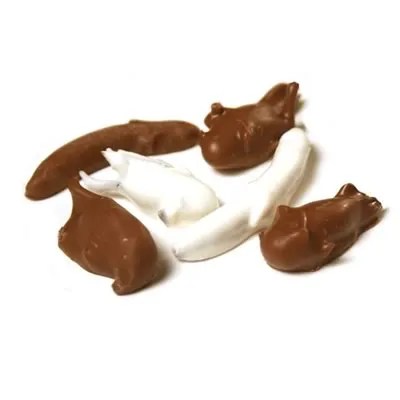
As we hum along (and contemplate what we’ll be offering trick-or-treaters), we might recall that today is National Chocolate Covered Insect Day.
You must be logged in to post a comment.