Posts Tagged ‘music business’
“I Want My MTV!”*…

You’ve probably seen a variation of this news on social media over the past few days: MTV officially shut down on New Year’s Eve, ending their final broadcast the same way the network started: With the clip “Video Killed the Radio Star” by The Buggles.
But those posts are misinformed. It’s New Year’s Day 2026, and MTV is still around. Granted, today the channel is playing a marathon of “The Big Bang Theory” sitcom repeats, so your interpretation of “MTV is still around” may vary…
– Variety, January 1, 2026
Indeed, the reality shows and network re-runs are still flowing. But the new owners of MTV’s parent, Paramount Global, did end its dedicated, 24/7 music channels (like MTV Music, MTV 80s, MTV 90s) at the close of 2025 across most international markets, effectively ceding the video music turf to YouTube.
So it’s a propitious moment to pause and reflect on the legacy, the impact of MTV…
… MTV, the Music Television that launched a thousand careers and redefined a generation, is finally shutting down [as a music channel]. It’s bittersweet to see it go, but it’s also a perfect moment to reflect on just how profoundly this channel, born in a blaze of sound and vision, altered the landscape of music, media, and even society itself.
It’s hard to imagine now, but before August 1, 1981, music was primarily an auditory experience. You listened to it on the radio, on records, or at concerts. The idea of a 24-hour channel dedicated solely to music videos was revolutionary, a gamble by Warner-Amex Satellite Entertainment. They saw the burgeoning popularity of music videos, then mostly promotional tools for artists, and envisioned a dedicated platform. The very first video ever played, fittingly, was “Video Killed the Radio Star” by The Buggles – a prophetic title if there ever was one.
MTV’s early days were a chaotic, vibrant mix of rock, pop, and new wave, with VJs (video jockeys) becoming household names. It was raw, experimental, and deeply intertwined with the youth culture of the 80s. But what started as a niche cable channel quickly exploded into a global phenomenon, forever altering how we consumed and understood music. So, as we bid adieu, let’s explore ten ways MTV truly changed everything…
Remember them at: “MTV: A Farewell to the Channel That Changed Our World,” from Eric Alper (@thatericalper.com)
* The tag line of MTV’s initial ad campaign (aimed at getting cable viewers to press their cable suppliers to carry MTV)
###
As we recollect rock, we might recall that it was on this date in 1972 that David Bowie released “Changes,” from his 1971 album Hunky Dory. Co-produced by Bowie and Ken Scott, it featured Rick Wakeman on piano and the musicians who would later become known as the Spiders from Mars—Mick Ronson, Trevor Bolder and Mick Woodmansey.

“There is nothing permanent except change”*…

Menudo has been ranked one of the Biggest Boy Bands of All Time by several publications (Billboard, Us Weekly, Seventeen, and Teen Vogue, among others)– the only Latin band on their lists. The Puerto Rican boy band, founded by producer Edgardo Díaz in 1977, has had 39 members– who’ve been routinely replaced as they “age out,” usually at 16. It has launched the careers of a number of popular international stars, including Ricky Martin (in Menudo 1984–89) and Draco Rosa (1984–87), and sold over 20 million albums worldwide.
The band disbanded in 2009, but re-formed on its old template in 2019. And it’s just announced its latest roster, bringing its count of members up to 44…
Nearly a year after Menudo Productions announced they were on the search for new members to form the next generation of Menudo, the band has officially unveiled the five boys that will comprise the group.
On Monday (March 20), Nicolas Calero (10), Gabriel Rossell (13), Andres Emilio (14), Alejandro Querales (15) and Ezra Gilmore (12) were announced as the new faces of the eternally youthful boy band. And, in celebration of the announcement, the group also released their very first single “Mi Amore,” the first song off their upcoming debut album…
What’s old is new again: “New Menudo Boy Band Members Unveiled,” from @billboard.
* Heraclitus
###
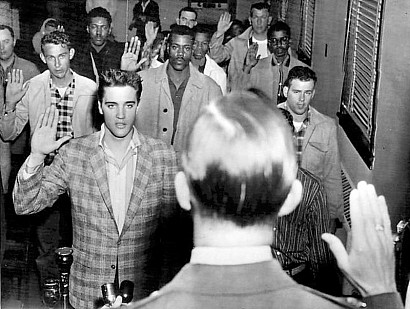
As we board the Ship of Theseus, we might recall that it was on this date in 1958, at 6.35am, that Elvis Presley reported to the Memphis draft board to be inducted in the U.S. Army. From there Elvis and twelve other recruits were taken by bus to Kennedy Veterans Memorial Hospital where the singer was assigned Army serial number 53310761.
“To me, the ideal artist-to-audience relationship is a one-to-zero relationship. The artist should be granted anonymity.”*…
Wish granted…
Earlier this month a little piece of music history was restored. The news was easy to overlook. Sony Music Publishing announced that one of its outermost divisions would be rebranding: what had been EMI Production Music since 2011 would become KPM Music once again. The change may seem trivial, but it restores a name that has wielded a wide and surprising influence over popular culture.
The chances are you haven’t heard of KPM, despite its roots stretching back to 1780, when Robert Keith (the K of the name) set up a music shop in London. But you have almost certainly heard its music. Since 1956 KPM had been a producer of library music, which is not music to be played quietly for the benefit of readers, but music composed to a brief, kept on catalogue, and then used—in return for payment—to accompany something else.
You have probably encountered the work of KPM’s composers and musicians on television. In America the credits of “Monday Night Football” unfold to the sound of “Heavy Action” by Johnny Pearson; the melody for Channel 9’s cricket show in Australia was produced by KPM, though it was written with a news broadcast in mind. In Britain several shows have drawn on KPM’s library, including “All Creatures Great and Small”, “Mastermind”, “Grange Hill”, “The Two Ronnies” and the BBC’s coverage of Wimbledon.
Even if you never watch TV, though, you will know fragments of this music, especially if you like hip-hop. kpm recordings have been a rich source of samples (a segment of sound used in another composition). Of KPM’s star composers, Brian Bennett has been sampled 114 times, by Drake, Nas, Kanye West and more. Les Baxter has been sampled 79 times by the Beastie Boys, Ghostface Killah and MF Doom, among others. Rap’s founding text, “Rapper’s Delight” by the Sugarhill Gang, sampled KPM stalwart Alan Hawkshaw—specifically the song “Here Comes That Sound Again”. “Library music is sought after by producers, collectors and writers because it was played by people, not manufactured by [a] machine,” Mr Hawkshaw once [said]…
One of the most sampled songs in pop history came from kpm musicians playing together for fun in 1968. “Champ” by The Mohawks has a distinctive organ hook—played by Mr Hawkshaw—that was sampled by Eric B and Rakim and Afrika Bambaataa in the 1980s and is still being remixed by Frank Ocean, Janelle Monáe and Nicki Minaj today. “People think that’s a black group from Detroit [playing the tune], but it was hashed together by session musicians in Yorkshire,” Mr Hawkshaw said.
Library music is not the rich trove of unexpected wonder it used to be. These days budgets are tighter and there is less inclination to hire whole orchestras for an afternoon, so there isn’t so much scope for the moments of brilliance a room full of musicians might create. Artificial-intelligence firms are also trying to muscle in on the market, offering computer-generated compositions to accompany video content for a fraction of the cost of real musicians. But there is still magic in the thought of those shelves, full of music composed and recorded for who knows what, sitting there waiting to be used for something else entirely…
Its artists aren’t famous and you can’t buy the records in shops; but its work can be heard everywhere: “KPM Music is one of the most important record labels in history,” from @TheEconomist.
* Glenn Gould
###
As we honor the unnamed, we might send suspiciously on-key birthday greetings to Faheem Rasheed Najm; he was born on this date in 1984. Better know by his stage name T-Pain, he is a rapper, singer-songwriter, and record producer. But he’ll surely be best remembered as the person who popularized Auto-Tune pitch-correction technology. Indeed, T-Pain became so associated with Auto-Tune that an iPhone app that simulated the effect was named after him.
Developed in 1997, Auto-Tune was used in 1998 in Cher’s “Believe” to create vocal effects (though the producers attributed the result to a pedal, treating Auto-Tune as a trade secret). Years later, T-Pain popularized the tool… which has become a controversial staple in the recording industry (as it allows recording engineers to turn the tuneless into accomplished singers).
Time magazine quoted an unnamed Grammy-winning recording engineer as saying, “Let’s just say I’ve had Auto-Tune save vocals on everything from Britney Spears to Bollywood cast albums. And every singer now presumes that you’ll just run their voice through the box.” The same article expressed “hope that pop’s fetish for uniform perfect pitch will fade”, speculating that pop-music songs have become harder to differentiate from one another, as “track after track has perfect pitch.” According to Tom Lord-Alge, the device is used on nearly every record these days…

“The music business is a cruel and shallow money trench, a long plastic hallway where thieves and pimps run free, and good men die like dogs. There’s also a negative side.”*…

I would like to begin this talk on the future of “popular” music with a few cautionary notes about our ability to see into the future clearly. The fact is, it would appear we are not very good at it. Somewhere back in our Savannah DNA, we got very good at reacting to danger when it presented itself — say a lion or tiger. However, it seems we are less capable of looking ahead to avoid danger. In other words, we are a reactive rather than proactive animal. The contemporary analogy in relation to climate change is that we are similar to the frog in a pot of hot water who does not have the sensors to recognize the increasing temperature and the fact that he should get out of the boiling pot.
Yes, there have been a handful of futurists – H.G Wells, Aldous Huxley, and given the state of many current governments I would grudgingly include Ayn Rand. Probably the most successful futurists in our lifetime may have been Marshall McLuhan and Stanley Kubrick, but even so, all of these writers and film makers have been only partially successful gazing into the crystal ball. Given that the past is no more fixed than the future I begin this conversation with you.
What I hope to discuss in this time with you is the relationship between technology, the gift of music and the commodification of that gift and how that gift and the commodification of the gift has been eroded in the digital age, and as I see it, could continue to be eroded well into the 21st century…
A provocative talk by Ian Tamblyn, a pillar of the Canadian music world, on popular music and its uncertain future: “A brief history of why artists are no longer making a living making music.”
TotH to friend CE. Image above: source.
* Hunter S. Thompson
###
As we pay the piper, we might recall that it was on this date in 1969 that John Lennon and Yoko Ono were married in the British Consul’s office in Gibraltar. “We wanted to get married on a cross-channel ferry – that was the romantic part,” Lennon said in the Beatles Anthology documentary. “We went to Southampton and then we couldn’t get on because she wasn’t English, and she couldn’t get the day visa to go across. They said, ‘Anyway, you can’t get married. The Captain’s not allowed to do it any more.'”

“I didn’t have to work anymore in life when the rappers started sampling… I’m the most sampled artist in history”*…
A big part of making music is the discovery aspect, is the surprise aspect. That’s why I think I’ll always love sampling. Because it involves combining the music fandom: collecting, searching, discovering music history, and artifacts of recording that you may not have known existed and you just kind of unlock parts of your brain, you know?
– Gotye
From Jonny Wilson– aka Eclectic Method…
email readers click here for video
* Rick James
###
As we muse on mash-ups, we might recall that it was on this date in 1878 that the modern music business was effectively born: Thomas Edison was awarded U.S. Patent No. 200,521 for his invention, the phonograph.

Thomas Edison with his phonograph, photographed by Mathew Brady in Washington, April 1878
You must be logged in to post a comment.