Posts Tagged ‘milk’
“The poets have been mysteriously silent on the subject of cheese”*…

… not so, Americans, who have been, as Millie Giles reports, speaking loudly with their wallets…
Topping off a pizza. Eyeballing a slice for cracker-stacking. Perfecting your own combination for a grilled sandwich. Many of us have spent time ruminating on one of life’s great questions: what’s the right amount of cheese?
The answer turns out to be exactly the same reply you’d give to a Parmesan-doling server: just a little more…
A great report from Bloomberg’s Ilena Peng last week outlined how America’s dairy processors are planning to build new facilities across the US to meet surging demand, which is a headline that could have been from just about any decade in the last 50 years. Indeed, data from the US Department of Agriculture shows that American consumption of cheese amounted to a record-breaking ~42 pounds per year for the average person in 2022, the latest figure available — more than double the amount reported in 1975.
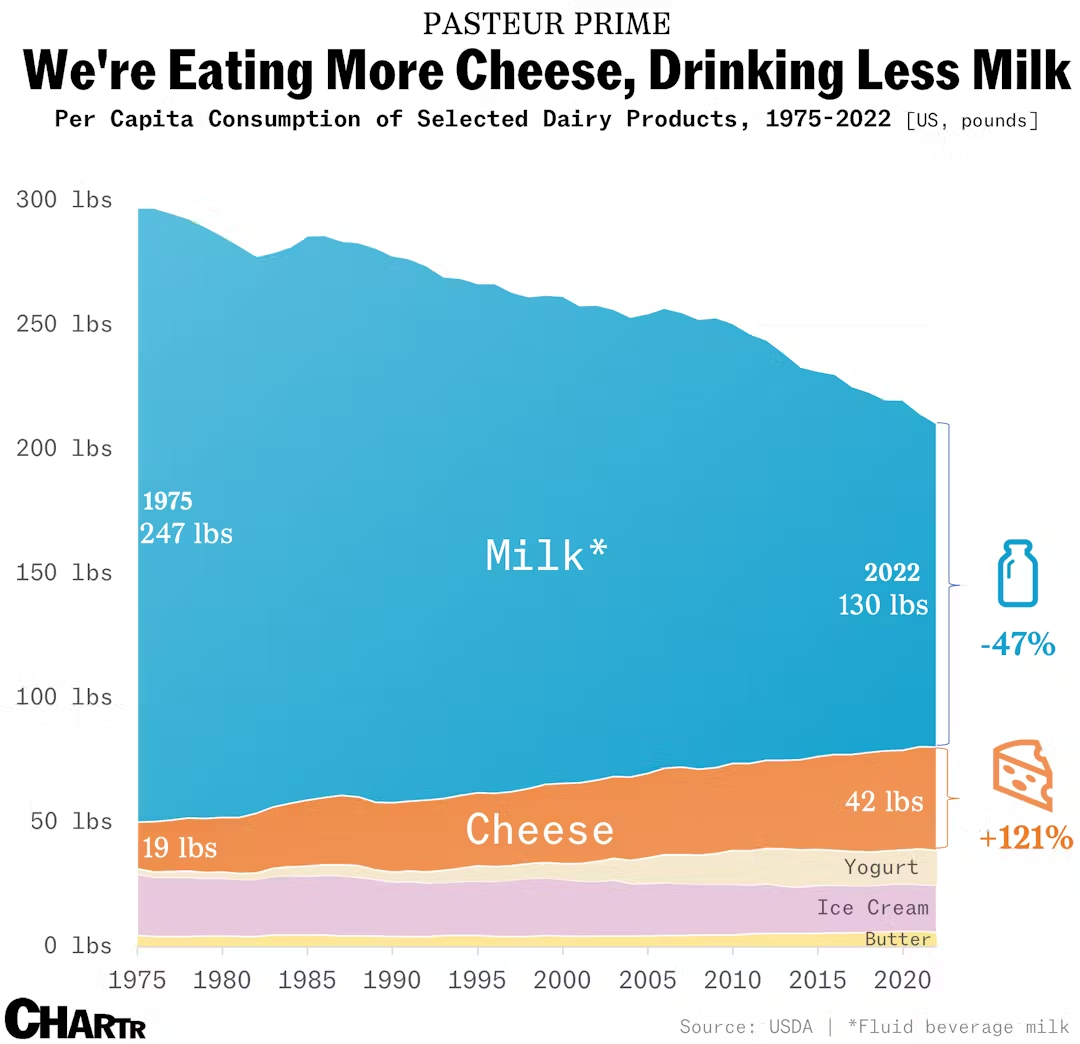
Interestingly, cheese is something of an exception in the world of dairy. As America has sprinkled, grated, and sliced its way through more and more cheese, there’s also been a concurrent 47% decline in fluid milk consumption observed over the same period. In the 20th century, drinking milk was a mainstay of daily life, with its nutritional completeness cementing its place in the American ideal of “growing big and strong” (as well as giving us arguably the best ad campaign of the ‘90s).
Today, a considerable number of people have ditched dairy in favor of plant-based milks like almond, soy, and oat for ethical and dietary reasons (parallel with a counterculture of anti-milk drinking, which some people think is simply “gross”). The boom in alt-milks created a lucrative landscape for fledgling brands like Oatly, which at one point was worth an eye-watering $13 billion (although it is now worth just a tiny fraction of that, some $530 million).
Meanwhile, non-dairy cheeses haven’t taken off in quite the same way. Iterations have struggled to recreate the flavor and texture, with some people, frankly, scarred by sampling a few of these pseudo-cheese attempts, as even VeganCheese.co itself admits.
The discrepancy between these dairy dupes might boil down to one of the unique selling points of regular dairy cheese. As outlined by Bloomberg, the process of making a complex, artisan-derived product from a few simple ingredients, which is hard to do at home, carries weight with an increasingly organic-oriented public.
As well as this, the high protein content of dairy cheese is resonating with a growing number of “gains-conscious” consumers. For example, typically divisive but protein-dense cottage cheese has recently blown up on social media. The longer list of generally viral TikTok recipes also has a very high hit rate for having cheese as a main ingredient.
As Americans dine out more, they may also err on the side of their favorite foods — many of which involve at least some degree of cheese (think: pizza, burgers, pasta)…
Americans eat mozzarella more than any other cheese, with the average citizen getting through 12.55 pounds in 2022, per the USDA.
Consumption of the semi-soft Italian cheese has been sharply on the rise since it knocked cheddar off the top spot back in 2010; though, cheddar has hardly fallen out of favor, with the average person eating over 11 pounds of it each year. Interestingly, processed cheese (think: melty slices) has been mounting a comeback since 2020, after consumption dropped at the turn of the millennium.
What do crude oil and cheese have in common? Not a lot, except that America can’t seem to function without either… and, in recent years, they’ve both become an important American export.
Indeed, while most of America’s favorite cheeses originally derive from elsewhere in the world, the US still makes much of its own supply, accounting for some 29% of the world’s cheese production, second only to the European Union, per the USDA. And, in recent years, it’s started selling more of it abroad.
The US has been a net exporter of cheese since 2010, sending over 450,000 metric tons at its 2022 peak to large international markets like Mexico, where America accounts for 87% of all imported cheese… sales of American cheese abroad are only expected to grow, with the USDA forecasting cheese exports to rise 17% from 2023-24…
… While authentic varieties from places like France and Italy must still be shipped into the country, the US has gone all-in on its own overseas sales. Part of this can be chalked up to the continued drive in global demand for cheese, but the US also has a history of having too much of it lying around.
In 1981, when faced with a milk surplus, the federal government under Ronald Reagan began storing the product as cheese in huge quantities. In fact, the ~560 million pounds of cheese mostly kept in subterranean facilities was at one point costing the government ~$1 million a day in storage and interest costs, according to the Washington Post.
While many countries follow the same food stockpiling rulebook to stabilize prices, a recent surge in milk production, alongside the decline in milk consumption, has meant that America’s cheese pile hasn’t gone anywhere. New, tariff-subsidized deals and a greater national appetite for the yellow stuff have helped… but not by enough. As of August 2024, the total cheese cold in storage holdings in the US was reported to be ~1.4 billion pounds…
More on “Making America Grate Again”: “America is eating, and exporting, more cheese than ever before,” from @chartrdaily.
* G. K. Chesterton
###
As we stuff the crust, we might note that today is National Farmers Day in the U.S.

“Human nature is like water. It takes the shape of its container.”*…

This story starts with a Swedish business school graduate studying in the U.S. in the early 1920s and seeing something unfamiliar to him: A self-serve grocery store.
We take advantage of it these days, but there was a time when grocery stores required employees to directly package goods for consumers. In the U.S., goods were sold “over the counter” before the early 1920s, when a truly innovative concept, self-service shopping, came about thanks to a grocery store that’s still around today, Piggly Wiggly [see here]. As noted in a trade publication of the era, Piggly Wiggly was incredibly profitable right off the bat…
But while the concept quickly gained popularity with consumers in the U.S., it had yet to cross American borders in 1920 or so. Which is where Ruben Rausing comes into play. Rausing, then a graduate student at Columbia University who had spent time working in the printing industry, saw a self-service grocery store, and it made him realize something: packaging was about to become very important…
After Rausing finished his education and returned to Sweden, he spent nearly a decade at the printing company Sveriges Litografiska Tryckerier (SLT) before leveraging his contacts and knowledge to create a packaging company, Åkerlund & Rausing, with business partner Erik Åkerlund.
Starting with the packaging of dry goods such as sugar and salt, the company began to focus on liquids around the time of World War II, with paperboard the primary tool.
Prior to the refrigerator getting a global footprint, milk was notoriously difficult to store safely. To give you an idea, when Rausing first came to the U.S., the way that milk was often delivered in his native Sweden involved the use of metal containers that were owned by consumers who cleaned the containers themselves, then went to local stores to get them refilled. This was not a perfect system, and often led the milk to spoil. (Refrigeration was not really common even in developed countries until the 1930s or even the 1940s.)
Meanwhile, the dairy industry in the U.S. had landed on reusable glass bottles that manufacturers cleaned themselves, a more sanitary process than consumer-cleaned metal jugs, but one that relied on a delivery method that had allowed dairies to get monopolies over local markets. Unfortunately for them, paperboard had simply proven too efficient a delivery mechanism to ignore.
“Dairies preferred bottles because they effectively created a monopoly where they established their collection system,” writer Gordon L. Robertson wrote for Food Technology magazine in 2002. “Cartons extended the range beyond the 20–30 miles over which a dairy could operate effectively with bottles; enterprising companies saw the potential and moved to cartons.”
Much as with every other major packaging trend that happened in the first half of the 20th century, Europe got there second. But in the process, they may have built the most innovative model for packaging.
Rausing’s contribution was called the Tetra-Pak, and the corporate line was that he was inspired to have the idea after he saw his wife making sausages. While he may have had the spark of inspiration, it was another inventor, Åkerlund & Rausing employee Erik Wallenberg, who followed the idea through. Essentially, the packaging style was stored with the help of geometry. With the help of a couple of quick turns, the container could close with only three seals, minimizing costs of manufacturing with only a couple of twists. The only issue was that the final shape was non-standard—it was a tetrahedron, essentially a four-sided triangle.

This design nonetheless had multiple advantages, including (with the right packaging materials) the ability to store dairy in a sanitary way over longer periods. With the right packing materials, milk didn’t even need to be chilled in a Tetra-Pak.
Soon, Rausing created an Åkerlund & Rausing subsidiary that was named for the innovative packaging method, Tetra-Pak. And that company, today, is the largest packaging company in the world—and it did so without the benefit of its original form of packaging winning over the U.S. market.
In 1961, the company produced its first aseptic packaging, using a mixture of packaging (plastic, paper, and metal), manufacturing process (a modified form of the tubular packaging that the Tetra-Pak used), and chemical treatment (hydrogen peroxide, to be specific) to allow for a shelf-stable form of packaging that did not need refrigeration and could extend the shelf life of products without the use of preservatives. This was an important innovation whose benefits linger today.
The second innovation came in the form of design, with the Tetra Brik taking many of the lessons learned from the original Tetra-Pak design and applying them to a more rectangular package, allowing for more standardized shipping.
The combination of sanitized packaging and a normalized design seemed like a surefire starting point for American success. But there was a problem—Americans were already used to their cartons that required refrigeration, and so were the companies that sold the milk.
“The major drawback to adoption by American companies is the tremendous cost of changing over from present systems of pasteurization and packaging,” one 1968 article explained of the Tetra Brik. “Since virtually every American family has a refrigerator, the need is not so great as in other areas.”
However, there was still a big world out there for the Tetra Brik, and its shelf-stable nature meant that areas where refrigeration wasn’t quite as quick to appear could get the advantages of having milk distributed in shelf-stable ways.
Americans would find their way to this packaging style through another path: the juice box…
The estimable Ernie Smith (@ShortFormErnie) with the fascinating story of a lunch box staple, the juice box: “Tangential Juice Innovation.”
* Wallace Stevens
###
As we poke in the straw, we might send shelf-stable birthday greetings to Reuben’s son, Hans Anders Rausing; he was born on this date in 1926. After many years in the family business, he sold his share of Tetra-Pak to his brother, Gad, moved to U.K., and became a philantropist. His daughter Lisbet, a historian of science at Kings College, London, co-founded (with her husband, UCLA history professor Peter Baldwin) one the the U.K.’s largest and most foresightful foundations, Arcadia.

“Let food be thy medicine and medicine be thy food”*…

We are on the cusp of the deepest, fastest, most consequential disruption in food and agricultural production since the first domestication of plants and animals ten thousand years ago. This is primarily a protein disruption driven by economics. The cost of proteins will be five times cheaper by 2030 and 10 times cheaper by 2035 than existing animal proteins, before ultimately approaching the cost of sugar. They will also be superior in every key attribute – more nutritious, healthier, better tasting, and more convenient, with almost unimaginable variety. This means that, by 2030, modern food products will be higher quality and cost less than half as much to produce as the animal-derived products they replace.
The impact of this disruption on industrial animal farming will be profound. By 2030, the number of cows in the U.S. will have fallen by 50% and the cattle farming industry will be all but bankrupt. All other livestock industries will suffer a similar fate, while the knock-on effects for crop farmers and businesses throughout the value chain will be severe.
This is the result of rapid advances in precision biology that have allowed us to make huge strides in precision fermentation, a process that allows us to program microorganisms to produce almost any complex organic molecule.
These advances are now being combined with an entirely new model of production we call Food-as-Software, in which individual molecules engineered by scientists are uploaded to databases – molecular cookbooks that food engineers anywhere in the world can use to design products in the same way that software developers design apps. This model ensures constant iteration so that products improve rapidly, with each version superior and cheaper than the last. It also ensures a production system that is completely decentralized and much more stable and resilient than industrial animal agriculture, with fermentation farms located in or close to towns and cities.
This rapid improvement is in stark contrast to the industrial livestock production model, which has all but reached its limits in terms of scale, reach, and efficiency. As the most inefficient and economically vulnerable part of this system, cow products will be the first to feel the full force of modern food’s disruptive power. Modern alternatives will be up to 100 times more land efficient, 10-25 times more feedstock efficient, 20 times more time efficient, and 10 times more water efficient.1,2 They will also produce an order of magnitude less waste.
Modern foods have already started disrupting the ground meat market, but once cost parity is reached, we believe in 2021-23, adoption will tip and accelerate exponentially. The disruption will play out in a number of ways and does not rely solely on the direct, one-for-one substitution of end products. In some markets, only a small percentage of the ingredients need to be replaced for an entire product to be disrupted. The whole of the cow milk industry, for example, will start to collapse once modern food technologies have replaced the proteins in a bottle of milk – just 3.3% of its content. The industry, which is already balancing on a knife edge, will thus be all but bankrupt by 2030.
This is not, therefore, one disruption but many in parallel, with each overlapping, reinforcing, and accelerating one another. Product after product that we extract from the cow will be replaced by superior, cheaper, modern alternatives, triggering a death spiral of increasing prices, decreasing demand, and reversing economies of scale for the industrial cattle farming industry, which will collapse long before we see modern technologies produce the perfect, cellular steak…
A provocative look at the (or at least a plausible) future of food and agriculture. Read the full report here (email registration required).
As to what’s happening in the meantime…
• Undocumented ship-to-ship transfers funnel illegal, unreported, and unregulated fish to market. It’s probably worse than we thought: “Clandestine Fish Handoffs.”
• With a new California Cattle Council now in play, the state’s beef producers will up the ante in research and education: “California cattle producers beef up state’s cattle business” [source of the image above].
• “Eat Less Red Meat, Scientists Said. Now Some Believe That Was Bad Advice“
*
###
As we dig in, we might recall that it was on this date in 1964 that Teressa Bellissimo, at the Anchor Bar in Buffalo, New York, created Buffalo Hot Wings as a snack for her son and several of his college friends. Her “invention”– an unbreaded chicken wing section (flat or drumette), generally deep-fried then coated or dipped in a sauce consisting of a vinegar-based cayenne pepper hot sauce and melted butter, and served with with celery and carrot sticks and with blue cheese dressing or ranch dressing for dipping– has become a barroom and fast food staple… and has inspired a plethora of “Buffalo” dishes (other fried foods with dipping sauces).

You must be logged in to post a comment.